
Home | Category: Physical Oceanography
UNDERNEATH THE OCEAN FLOOR

subterranean freshwater that can affect the ocean
Under the ocean floor is a layer of oceanic crust, primarily made of basalt and gabbro, which sits above the Earth's mantle. It's a dynamic layer where new crust is continuously formed at mid-ocean ridges and older crust is destroyed. Below the oceanic crust is the mantle, which is composed of peridotite.
The mantle is Earth's thickest layer, a mostly solid silicate rock layer between the crust and the core that makes up about 84% of the planet's volume. While its rocks are predominantly solid, they behave as a viscous fluid over long geological timescales, allowing tectonic plates to move on its surface. The mantle is a site of intense heat and pressure and its movement creates convection currents that drive plate tectonics, leading to the formation of new crust, mountain ranges, and earthquakes
In certain areas, particularly around hydrothermal vents, there are cavities in the solidified lava. Scientists have discovered that larger animals like tubeworms and snails can live in these underground spaces, not just microbes as was previously thought. These animals rely on chemosynthetic bacteria for energy.
Related Articles:
PHYSICAL FEATURES OF THE OCEAN FLOOR: TRENCHES, VENTS, MOUNTAINS ioa.factsanddetails.com ;
SEAMOUNTS AND VOLCANOES IN THE OCEAN ioa.factsanddetails.com ;
OCEANS: THEIR HISTORY, WATER, LAYERS AND DEPTH ioa.factsanddetails.com
SEAS AND OCEANS: DEFINITIONS, FEATURES AND THE MAIN ONES ioa.factsanddetails.com
PHYSICS OF THE OCEAN: PRESSURE, SOUND AND LIGHT ioa.factsanddetails.com ;
DEVICES, TECHNOLOGY AND MEASUREMENTS USED IN OCEANOGRAPHY ioa.factsanddetails.com
RECOMMENDED BOOKS:
“Descriptive Physical Oceanography” by Lynne Talley (2017) Amazon.com
“Mapping the Deep: The Extraordinary Story of Ocean Science” by Robert Kunzig Amazon.com
“Essentials of Oceanography” by Alam Trujillo and Harold Thurman Amazon.com
“The Blue Machine: How the Ocean Works” by Helen Czerski, explains how the ocean influences our world and how it functions. Amazon.com
“How the Ocean Works: An Introduction to Oceanography” by Mark Denny (2008) Amazon.com
“The Science of the Ocean: The Secrets of the Seas Revealed” by DK (2020) Amazon.com
“The Unnatural History of the Sea” by Callum Roberts (Island Press (2009) Amazon.com
“Ocean: The World's Last Wilderness Revealed” by Robert Dinwiddie , Philip Eales, et al. (2008) Amazon.com
“An Introduction to the World's Oceans” by Keith A. Sverdrup (1984) Amazon.com
“Blue Hope: Exploring and Caring for Earth's Magnificent Ocean” by Sylvia Earle (2014) Amazon.com
“National Geographic Ocean: A Global Odyssey” by Sylvia Earle (2021) Amazon.com
Drilling into the Ocean Floor
Suzanne Oconnell of Wesleyan University wrote: It’s stunning but true that we know more about the surface of the moon than about the Earth’s ocean floor. Much of what we do know has come from scientific ocean drilling — the systematic collection of core samples from the deep seabed. This revolutionary process when the drilling vessel Glomar Challenger sailed into the Gulf of Mexico in August 1968 on the first expedition of the Deep Sea Drilling Project. [Source: Suzanne Oconnell, Professor of Earth & Environmental Sciences, Wesleyan University, The Conversation, September 26, 2018]
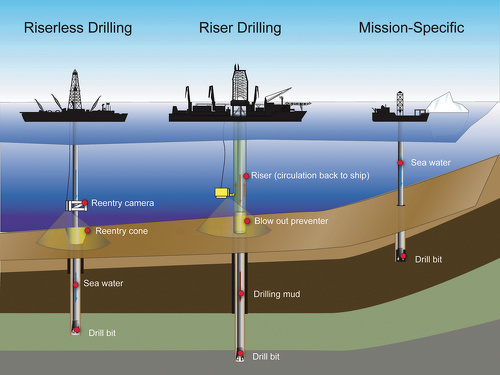
Types of drilling vessels utilized for scientific ocean drilling, iodp.org)
I have participated in expeditions to locations including the far North Atlantic and Antarctica’s Weddell Sea. In my lab, my students and I work with core samples from these expeditions. Each of these cores, which are cylinders 31 feet (9.5 meters) long and 3 inches (7.5 centimeters) wide, is like a book whose information is waiting to be translated into words. Holding a newly opened core, filled with rocks and sediment from the Earth’s ocean floor, is like opening a rare treasure chest that records the passage of time in Earth’s history.
Over a half-century, scientific ocean drilling has proved the theory of plate tectonics, created the field of paleoceanography and redefined how we view life on Earth by revealing an enormous variety and volume of life in the deep marine biosphere. When scientific ocean drilling began in 1968, the theory of plate tectonics was a subject of active debate. One key idea was that new ocean crust was created at ridges in the seafloor, where oceanic plates moved away from each other and magma from earth’s interior welled up between them. According to this theory, crust should be new material at the crest of ocean ridges, and its age should increase with distance from the crest.
The only way to prove this was by analyzing sediment and rock cores. In the winter of 1968-1969, the Glomar Challenger drilled seven sites in the South Atlantic Ocean to the east and west of the Mid-Atlantic ridge. Both the igneous rocks of the ocean floor and overlying sediments aged in perfect agreement with the predictions, confirming that ocean crust was forming at the ridges and plate tectonics was correct.
The ocean record of Earth’s history is more continuous than geologic formations on land, where erosion and redeposition by wind, water and ice can disrupt the record. In most ocean locations sediment is laid down particle by particle, microfossil by microfossil, and remains in place, eventually succumbing to pressure and turning into rock. Plankton microfossils can be smaller than the width of a human hair but like larger plant and animal fossils, scientists can use these delicate structures of calcium and silicon to reconstruct past environments.
Thanks to scientific ocean drilling, we know that after an asteroid strike killed all non-avian dinosaurs 66 million years ago, new life colonized the crater rim within years, and within 30,000 years a full ecosystem was thriving. A few deep ocean organisms lived right through the meteorite impact. Ocean drilling has also shown that ten million years later, a massive discharge of carbon — probably from extensive volcanic activity and methane released from melting methane hydrates — caused an abrupt, intense warming event, or hyperthermal, called the Paleocene-Eocene Thermal Maximum (PETM). During this episode, even the Arctic reached over 73 degrees Fahrenheit. The resulting acidification of the ocean from the release of carbon into the atmosphere and ocean caused massive dissolution and change in the deep ocean ecosystem. Scientific ocean drilling has also shown that there are roughly as many cells in marine sediment as in the ocean or in soil. Expeditions have found life in sediments at depths over 8000 feet; in seabed deposits that are 86 million years old; and at temperatures above 140 degrees Fahrenheit.
Technology That Makes Ocean Floor Drilling Possible
Suzanne Oconnell of Wesleyan University wrote: Two key innovations made it possible for research ships to take core samples from precise locations in the deep oceans. The first, known as dynamic positioning, enables a 471-foot ship to stay fixed in place while drilling and recovering cores, one on top of the next, often in over 12,000 feet of water. [Source: Suzanne Oconnell, Professor of Earth & Environmental Sciences, Wesleyan University, The Conversation, September 26, 2018] Anchoring isn’t feasible at these depths. Instead, technicians drop a torpedo-shaped instrument called a transponder over the side. A device called a transducer, mounted on the ship’s hull, sends an acoustic signal to the transponder, which replies. Computers on board calculate the distance and angle of this communication. Thrusters on the ship’s hull maneuver the vessel to stay in exactly the same location, countering the forces of currents, wind and waves.
Another challenge arises when drill bits have to be replaced mid-operation. The ocean’s crust is composed of igneous rock that wears bits down long before the desired depth is reached. When this happens, the drill crew brings the entire drill pipe to the surface, mounts a new drill bit and returns to the same hole. This requires guiding the pipe into a funnel shaped re-entry cone, less than 15 feet wide, placed in the bottom of the ocean at the mouth of the drilling hole. The re-entry cone is welded together around the drill pipe, then lowered down the pipe to guide reinsertion before changing drill bits. The process, which was first accomplished in 1970, is like lowering a long strand of spaghetti into a quarter-inch-wide funnel at the deep end of an Olympic swimming pool.
This research is expensive, and technologically and intellectually intense. Today scientists from 23 nations are proposing and conducting research through the International Ocean Discovery Program, which uses scientific ocean drilling to recover data from seafloor sediments and rocks and to monitor environments under the ocean floor.
Scientists Reach the Mantle Drilling Deep Into the Mid Atlantic Ridge?
In 2024, scientists drilled the deepest mantle-related core ever recovered, extracting 1,268 meters of serpentinized peridotite from the seafloor near the Atlantis Massif and the Lost City hydrothermal field on the Mid-Atlantic Ridge. The International Ocean Discovery Program’s 2023 expedition aboard the JOIDES Resolution far exceeded its original 200-meter goal, recovering unusually intact sections—some up to 5 meters long—and yielding more than 70 percent of the entire 1.2-kilometer (0.7-mile) core. [Source: Darren Orf, Popular Mechanics, October 10, 2025; Stephanie Pappas, Live Science, August 9, 2024]
The core consists mainly of altered mantle rocks such as harzburgite and gabbro, formed by partial melting and later transformed through reactions with seawater. Although drilling did not reach pristine mantle below the Moho, the sample provides an unprecedented record of upper-mantle composition, melt pathways, and the geological foundations of the Lost City—an environment rich in hydrogen and methane that supports unique microbial life and offers clues to how life may have originated on Earth.
Throughout the expedition, microbiologists collected fresh samples from each recovered section in search of deep, heat-tolerant microbes and to better understand the limits of life in such environments. Early results suggest mantle melts migrate obliquely rather than vertically, offering new insights into mantle dynamics.
Freshwater Aquifer Beneath the Atlantic Ocean
Scientists have drilled into a vast, little-explored freshwater reservoir beneath the Atlantic Ocean off the northeastern United States—an aquifer that could have major implications for global water security. [Source: Laura Paddison, CNN, September 17, 2025]
Freshwater beneath the ocean has been known since the 1960s, but only in 2019 did researchers map a huge system stretching from Massachusetts to New Jersey. In 2025, an international team (Expedition 501) has drilled directly into it, retrieving water 1,000–1,300 feet below the seafloor. The samples show salinity low enough to meet drinking-water guidelines, and are being tested to determine their age, microbial content, and safety.
A crucial question is whether the aquifer is replenishing or is an ancient, nonrenewable resource. The water might be as young as 200 years or as old as 20,000 years. Early results suggest it likely formed when sea levels were far lower and the continental shelf was exposed, allowing rain or glacial meltwater to seep underground.
If the reservoir is extensive and partly renewable, it could supply major coastal cities for centuries. Offshore freshwater aquifers are believed to exist globally—in Indonesia, Australia, South Africa, and elsewhere—raising hopes they could help ease future shortages as coastal populations grow and onshore aquifers decline.
But serious challenges remain: pumping water from offshore will be costly and energy-intensive; ownership and management questions are unresolved; and extraction risks mixing the fresh water with surrounding seawater or disrupting onshore aquifers.
Researchers say offshore aquifers won’t replace the need to protect land-based freshwater, but they could become a valuable alternative. With further testing and new technology, tapping them might be feasible within about a decade—and lessons from this U.S. “postage stamp” may apply worldwide.
Image Sources: Wikimedia Commons; YouTube, NOAA
Text Sources: National Oceanic and Atmospheric Administration (NOAA) noaa.gov; “Introduction to Physical Oceanography” by Robert Stewart , Texas A&M University, 2008 uv.es/hegigui/Kasper ; Wikipedia, National Geographic, Live Science, BBC, Smithsonian, New York Times, Washington Post, Los Angeles Times, The New Yorker, Reuters, Associated Press, Lonely Planet Guides and various books and other publications.
Last Updated December 2025