
Home | Category: Oceans and Sea Life
WORLD'S OLDEST LIFE FORMS
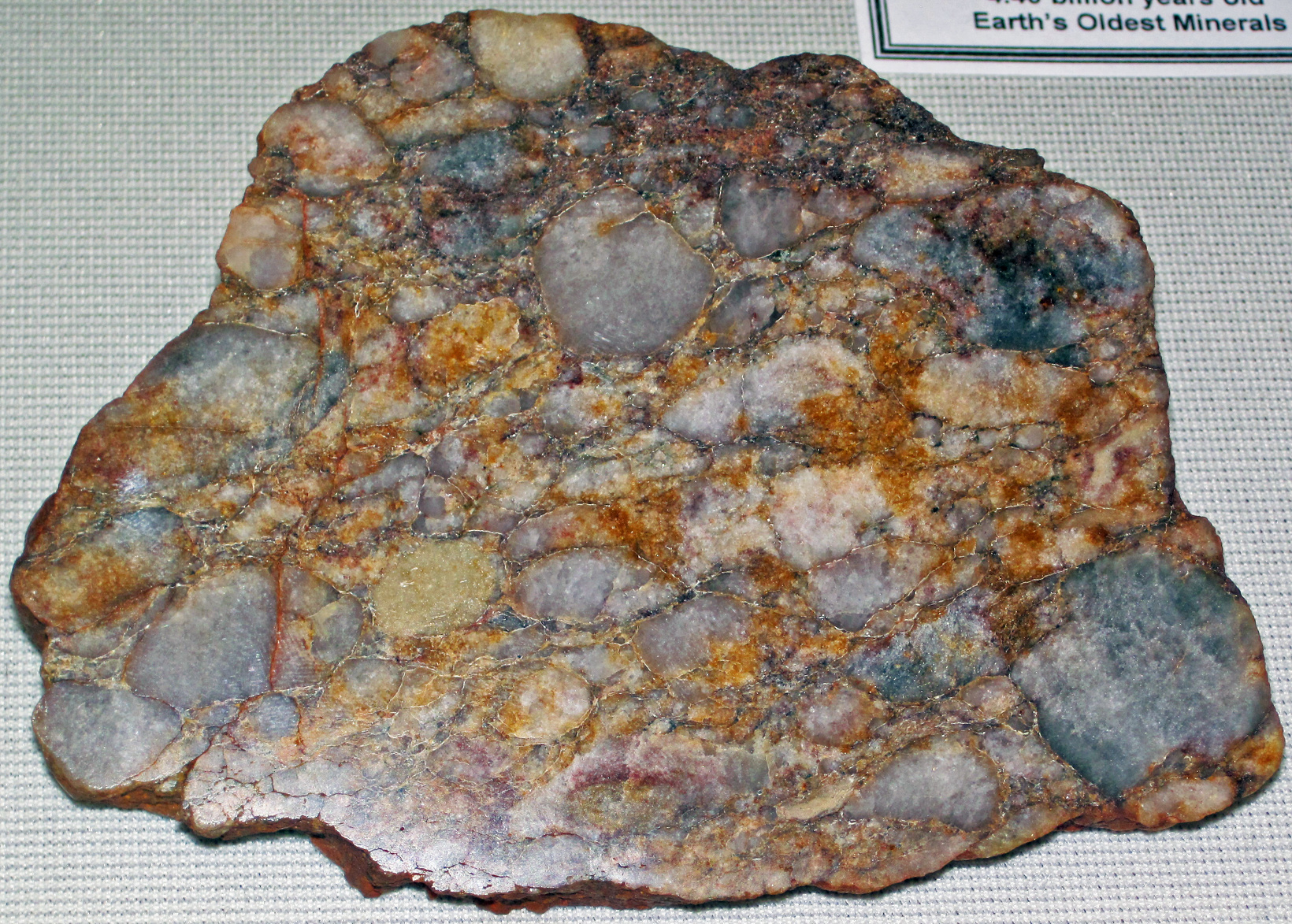
Quartz-pebble metaconglomerate (Jack Hills Quartzite), the rock type that contains Earth's oldest dated mineral grains (detrital zircon)
The earliest known life forms on Earth may be as old as 4.1 billion years based on biologically fractionated graphite inside a single zircon grain in the Jack Hills range of Australia. This is not long after the formation of the oceans 4.5 billion years ago and the formation of the Earth 4.6 billion years ago. The earliest evidence of life found in stratigraphic (layered) rock, not just a single mineral grain, is 3.7 billion years old, from metasedimentary rocks containing graphite from the Isua Supracrustal Belt in Greenland. [Source Wikipedia]
The earliest direct known life on Earth are stromatolite fossils found in 3.48-billion-year-old geyserite unearthed in the Dresser Formation of the Pilbara Craton of Western Australia (See Stromatolites). Microfossils of various sorts of microorganisms have been found in 3.4-billion-year-old rocks, including 3.465-billion-year-old Apex chert rocks from the Pilbara craton region, and in 3.42-million-year-old hydrothermal vent precipitates from Barberton, South Africa.
In March 2006, a team from Tokyo Institute of Technology reported in the science journal Nature that it had found evidence of the earliest known life — methane trapped in rock created 3.5 billion years ago, 700 million years old than any similar findings. , The rock was found in a 3.5-billion-year-old stratum in the Pilhara region of western Australia. The methane contained carbon 12 — a kind of carbon associated with life. It was likely created by bacteria that lived in hot water near the bottom of the sea.
Much, much later in the geologic record, beginning around 1.73 billion years ago, preserved molecular compounds of biologic origin are indicative of aerobic life.
RELATED ARTICLES:
WORLD'S OLDEST COMPLEX LIFE FORMS AND EARLY STEPS IN THE DEVELOPMENT OF LIFE ioa.factsanddetails.com
WORLD'S EARLIEST ANIMALS: CANDIDATES, CRITERIA, DEBATE ioa.factsanddetails.com
CAMBRIAN EXPLOSION: PRECURSORS, WEIRD CREATURES, THEORIES ioa.factsanddetails.com
DINOSAUR-ERA AND PRE-DINOSAUR-ERA SEA CREATURES ioa.factsanddetails.com
OCEAN PREDATORS, FISH FEEDING AND THE MARINE FOOD CHAIN ioa.factsanddetails.com
OCEAN LIFE: SPECIES, BIODIVERSITY, OLDEST AND MOST NUMEROUS ioa.factsanddetails.com
RECOMMENDED BOOKS:
“Stromatolites: Ancient, Beautiful, and Earth-Altering” by R. J. Leis, Bruce L. Stinchcomb, Terry McKee (Illustrator) Amazon.com
“Cradle of Life: The Discovery of Earth's Earliest Fossils” by J. William Schopf Amazon.com
“Life on a Young Planet: The First Three Billion Years of Evolution on Earth” (Princeton Science Library) by Andrew H. Knoll Amazon.com
“The Stairway to Life: An Origin-of-Life Reality Check” by Laura Tan Amazon.com
“The Mystery of Life’s Origin” by Charles B. Thaxton et al. Amazon.com
“When Life Nearly Died: The Greatest Mass Extinction of All Time” by Michael J. Benton, Julian Elfer, et al. Amazon.com
“The Cambrian Explosion: The Construction of Animal Biodiversity” by Douglas Erwin and James Valentine Amazon.com
“Cambrian Ocean World: Ancient Sea Life of North America (Life of the Past)”
by John Foster Amazon.com
“The Story of Earth: The First 4.5 Billion Years, from Stardust to Living Planet” by Robert M. Hazen Amazon.com
“Ocean Life in the Time of Dinosaurs” by Nathalie Bardet, Alexandra Houssaye, Stéphane Jouve Amazon.com
“Encyclopedia Prehistorica: Sharks and Other Sea Monsters” by Robert Sabuda and Matthew Reinhart Amazon.com
“Ancient Sea Reptiles: Plesiosaurs, Ichthyosaurs, Mosasaurs” by Darren Naish Amazon.com
Stromatolites
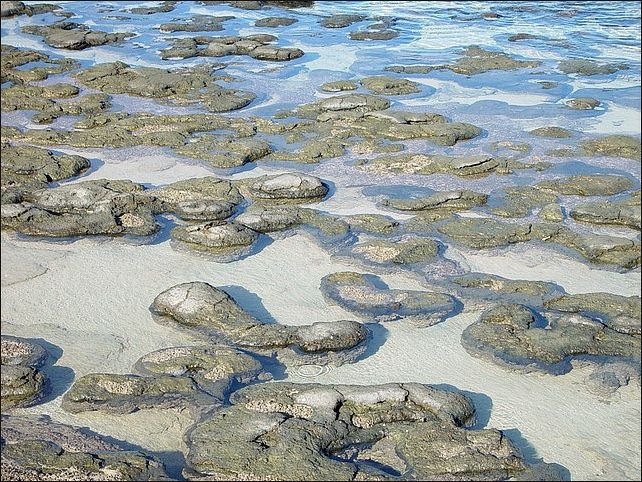
Hamelin pool stromatolites
Stromatolites are layered rock formations created by colonies of microscopic algae-like bacteria. Under some conditions, as sediment forms in shallow water, bacteria grows over them and binds with particles in the sediment. Over time the sediments attach to the sticky surfaces of bacteria and minerals dissolved in the waters turn into solid layers that bond with and build upon other similar layers until they become mounds. These mounds formed the world's first reefs and were the Earth's first life forms. [Source: BBC]
Unlike many modern reefs that are made by corals, the builders of the first reef-like structures were cyanobacteria — microbes that grow in slimy sheets, forming layered mounds described above. When fossilized, the layered microbial structures are known as stromatolites. Some date as far back as 3.5 billion years ago, providing some of the earliest convincing traces of any kind of life on Earth. [Source: Maya Wei-Haas, National Geographic Science News, July 29, 2021]
In a more technical definition, stromatolites, or stromatoliths are layered sedimentary formations that are created mainly by photosynthetic microorganisms such as cyanobacteria, sulfate-reducing bacteria, and Pseudomonadota (formerly proteobacteria). These microorganisms produce adhesive compounds that cement sand and other rocky materials to form mineral "microbial mats". In turn, these mats build up layer by layer, growing gradually over time. A stromatolite may grow to a meter or more. Although they are rare today, fossilized stromatolites provide records of ancient life on Earth. [Source: Wikipedia]
See Separate Article: STROMATOLITES — WORLD'S OLDEST LIFE FORMS — WHAT AND WHERE THEY ARE ioa.factsanddetails.com
3.4-Billion-Year-Old Hydrothermal Life in South Africa
Fossilized cell remnants in 3.4 billion-year-old bedrock are from primitive microbes. Ashley Braun wrote in Natural History magazine: Where and how life on Earth first began remains a hotly debated area of science. Hydrothermal environments beneath the ocean are a top contender for early life, given their favorable mix of conditions, including chemistry, energy availability, and temperature. Now, an international team of researchers led by geobiologist Barbara Cavalazzi at the University of Bologna, Italy, has discovered evidence of fossilized microbes dating to roughly 3.42 billion years ago in a hydrothermal system just under the seafloor. [Source: Ashley Braun, Natural History magazine, October 2021]

Outcrop photographs showing the few reported occurrences of Palaeoarchaean stromatolites from South Africa; A) Domical stromatolite from the 3.4 billion-year-old Kromberg Formation, Barberton greenstone belt; B) Laterally linked domical and laminated stromatolites from the 3.26 3.4 billion-year-old Mendon Formation, Barberton greenstone belt. C) and D) Decimetric domical stromatolites from the 3.4 billion-year-old Witkop Formation, Nondweni greenstone belt, from researchgate
The suspected microfossils, in some cases measuring only tens of micrometers thick, were found in an outcrop of South Africa’s Barberton Greenstone Belt, an area known for its wellpreserved microbial fossils and ancient sedimentary rocks. The research team analyzed the microfossils across a range of scales, using microscopy, spectrometry, and X-ray imaging to illuminate their form and chemical composition.
The suspected microfossils are believed to be from stromatolites and something similar. Filamentous in shape, these prehistoric microbes appear to have formed two thin layers, with some arranged in clusters similar to a biofilm. Researchers uncovered them among the branches of a subseafloor hydrothermal vein that billions of years ago would have been filled with a rich mixture of fluids. Here, a few meters under the ocean floor, cool, low-oxygen seawater met volcanically warmed hydrothermal fluids, producing moderate temperatures and an abundance of nutrients essential to life.
These microfossils contain carbon, hydrogen, and nitrogen, as well as trace levels of sulfur and nickel. The presence of certain nickel compounds in a hydrothermal environment suggests that the putative microbes likely produced or used methane in their metabolism, as modern microbes do in similar anoxic environments today. Other features of the filaments also support the idea that they were once alive: a carbonaceous outer layer acted as a sheath around a distinct core—reminiscent of a cell wall or membrane surrounding cell cytoplasm. From the collective evidence, the researchers conclude that these microfossils represent the oldest methanecycling archaea microbes found in a subsurface environment.
According to Cavalazzi, these findings “are expanding the concept of habitability. Similar environments, and so forms of fossil life, could also possibly be detected on early Mars when the conditions for life were similar to those on early Earth.” And that could have implications in the search for life elsewhere in the Solar System, such as the watery moons of Jupiter and Saturn. (Science Advances)
Evidence of 3.3 Billion Year Old Microbial Life Detected in Rocks
Scientists have discovered some of Earth's oldest signs of life using a new machine-learning method that identifies chemical “fingerprints” of living organisms in ancient rocks. The technique distinguishes biological from non-biological organic molecules with over 90 percent accuracy. Using this method, researchers found evidence of microbial life in 3.3-billion-year-old South African rocks. [Source: Will Dunham, Reuters, November 19, 2025]
"The remarkable finding is that we can tease out whispers of ancient life from highly degraded molecules," said Robert Hazen, a mineralogist and astrobiologist at the Carnegie Institution for Science in Washington and co-lead author of the study published this week in the journal Proceedings of the National Academy of Sciences, opens new tab. "This is a paradigm shift in the way we look for ancient life."
The approach analyzes thousands of tiny molecular fragments left behind after all original biomolecules (like sugars or fats) have degraded. Machine learning detects subtle patterns invisible to the human eye. It extends the age at which chemical signs of life can be detected—from 1.6 billion to 3.3 billion years and can distinguish different types of life, such as photosynthetic microbes.
What is Necessary for Life to Form
The exact requirements for life’s origin are still debated, but most scientists agree on a set of fundamental conditions that make life possible and In simple terms, life needs:
1. A Source of Chemical Building Blocks: Life requires basic molecules such as: carbon, hydrogen, oxygen, nitrogen, phosphorus and sulfur. These atoms form amino acids, nucleotides, lipids, and sugars—the building blocks of cells. [Source: Chatgpt]
2. Liquid Water (or another stable solvent): Water allows molecules to move, react, and assemble into larger structures. It is critical for: chemical reactions, nutrient transport and maintaining stable environments. Other solvents (like liquid methane) are sometimes proposed, but water is the most widely supported.
3. An Energy Source: Life needs energy to drive chemical reactions. Possible sources include: sunlight (photosynthesis), geothermal heat, chemical gradients near hydrothermal vents or lightning or ultraviolet radiation (for early Earth chemistry)
4. A Mechanism for Self-Replication: Life must be able to copy itself. Early Earth may have used: RNA-like molecules capable of storing information and self-replicating, autocatalytic chemical networks and simple membranes that allowed chemical cycles to grow and divide. This is one of the biggest unresolved questions.
5. A Way to Maintain Boundaries (Compartmentalization): Life needs a protected micro-environment where reactions can occur. Simple membranes made of lipids can form spontaneously and trap molecules, creating “protocells.”
6. A Stable Environment: Life needs conditions that allow reactions to proceed: moderate temperatures, stable liquid water, protection from destructive radiation and availability of nutrients. How these pieces first came together on early Earth is still being explored, with leading hypotheses including hydrothermal vents, tidal pools, and RNA-world scenarios.
Theories on the Origin of Life
Lightning Sparked Life: In 1952, the famous Miller-Urey experiment demonstrated that electric sparks could generate amino acids and sugars from an atmosphere rich in water, methane, ammonia, and hydrogen. This suggested that lightning might have triggered the creation of life’s building blocks. Later research revealed that early Earth’s atmosphere was likely hydrogen-poor. However, volcanic clouds might have supplied methane, ammonia, and hydrogen—and been filled with lightning—making this theory still plausible.[Sources: Scott Dutfield and Charles Q. Choi, Live Science, February 14, 2022]
Molecules Formed on Clay: Scottish chemist A.G. Cairns-Smith proposed in 1985 that life’s first molecules might have formed on clay surfaces. As clay crystals grow, they can trap and organize molecules into patterns—much like genes store information today. Cairns-Smith suggested that mineral crystals originally arranged organic molecules, before organic chemistry “took over.” Although not widely accepted, his “clay hypothesis” remains an intriguing idea in origin-of-life studies.
Life Began at Deep-Sea Vents: The hydrothermal vent theory proposes that life started at submarine vents on the ocean floor. These vents release superheated, mineral-rich fluids containing carbon and hydrogen. Their rocky walls could have concentrated molecules and catalyzed key chemical reactions. Even today, vent ecosystems thrive without sunlight, relying on chemical and thermal energy. In 2019, researchers at University College London successfully created protocells—nonliving cell-like structures—under conditions similar to those at hydrothermal vents, lending new support to this theory.
Life Began on Ice: Some scientists believe life began under ice-covered oceans more than 3 billion years ago. According to Jeffrey Bada of the University of California, key organic compounds are more stable at low temperatures. When frozen, amino acids and other molecules concentrate, making chemical reactions more likely. Ice could also have shielded fragile molecules from ultraviolet light and cosmic impacts, giving them time to evolve into more complex forms.
RNA World: Modern DNA requires proteins to form—and proteins need DNA—so how did either appear first? The answer might be RNA, which can both store genetic information and act like an enzyme. This “RNA World” hypothesis suggests RNA came first, eventually giving rise to DNA and proteins, which are more efficient. RNA still plays many crucial roles in cells today, but how it originally formed remains unsolved.
Simple Beginnings: Some researchers argue that life started not from complex molecules like RNA but from smaller molecules interacting in metabolic cycles within primitive membranes. Over time, these systems may have evolved into more efficient, self-replicating chemical networks—a “metabolism-first” model of life’s origin.
Life Came from Space: Another possibility is panspermia—that life arrived on Earth from elsewhere in the cosmos. Meteorites from Mars have been found on Earth, and some scientists speculate they may have carried microbes. Others suggest life may have traveled here on comets from distant star systems. Even if true, this would simply shift the question: how did life begin there?
Where Did Energy That Sparked the First Life Come from?
Leading theories suggest that the first energy used by life was either from the sun or from
Scientists disagree on exactly where life first emerged on Earth, but all candidates share two essentials: water and an energy source. Around 3.7 billion years ago, sugars and other modern biological fuels didn’t yet exist, so early life required alternative energy inputs. [Source: JoAnna Wendel, Live Science, February 12, 2023; Google AI]
One possibility is that UV radiation in shallow volcanic pools created reactive molecules that could assemble into life’s building blocks — though the same radiation would also destroy them. For this reason, many researchers favor a deep-sea hydrothermal vent origin. At vents, hot alkaline fluids rich in hydrogen mixed with cooler, acidic seawater loaded with dissolved CO , producing powerful chemical gradients. These conditions could generate reactive molecules that evolve into amino acids, nucleotides, and other precursors of life.
Another hypothesis holds that asteroids delivered simple sugars, amino acids, and reactive radicals protected inside icy layers. When these materials struck Earth and mixed with ocean water, geothermal heat could have driven further prebiotic chemistry. Because almost no rock survives from the Hadean eon, it’s impossible to identify a single energy source with certainty. UV radiation, hydrothermal chemistry, geothermal heat, lightning, and asteroid-delivered compounds may all have contributed to the energetic environment that allowed life to arise.
Did Life Originate in Shallow, Volcanic, Carbonate-Rich Lakes?
A study of Last Chance Lake in British Columbia, coauthored by David Catling, a University of Washington professor of geosciences, published in the journal Nature on January 9, 1924 strengthens the idea that life may have originated not in the ocean, but in shallow, volcanic, carbonate-rich lakes on early Earth. The lake, only a foot deep and perched on volcanic rock, contains the highest phosphate concentrations ever recorded in a natural body of water—over 1,000 times typical ocean or lake levels. [Source: Ayurella Horn-Muller, CNN, February 17, 2024]
Phosphate is essential for life’s key molecules (DNA, RNA, ATP). Researchers found that interactions among volcanic minerals, carbonate-rich water, and an arid climate created exceptionally high phosphate through the formation of dolomite, which traps and concentrates phosphorus. These conditions resemble what might have existed about 4 billion years ago, making the lake a strong modern analog for “cradles of life.”
Such soda lakes have long been linked to theories of life’s origins, including Darwin’s “warm little pond” idea. Lab experiments that synthesize early biomolecules require precisely the kind of extreme phosphate levels naturally found at Last Chance Lake, supporting the plausibility of this scenario.
The study does not claim the lake contains all the necessary ingredients for life—some key chemicals, like cyanide, are missing today—but it demonstrates that early Earth could easily have hosted lakes capable of producing critical building blocks.These findings also shape the search for extraterrestrial life: if life began on land in soda-lake environments, then planets with similar volcanic rock chemistry—such as Mars—may be promising places to look.
Did Life Originate in Mud Volcano Mud
A study published in November 2025 in the journal Communications Earth & Environment reported the discovery of lipid biomarkers in highly alkaline serpentinite mud from mud volcanoes near the Mariana Trench. These biomarkers—fats from microbial cell membranes—indicate that methane- and sulfate-metabolizing microbes are actively surviving in this extreme environment. [Source: Darren Orf, Popular Mechanics, November 17, 2025]
The serpentinite mud, formed when water reacts with deep igneous rock, reaches a bleach-like pH of 12 and contains very few nutrients, making it one of the most hostile known habitats. Because DNA is hard to detect at such low cell densities, researchers instead identified lipids in 5.4-foot core samples to confirm the presence of living microbial communities. Their analyses show that these microbes persist beneath the seafloor and form part of the deep biosphere, which may account for up to 15 percent of Earth’s biomass.
The findings strengthen the idea that early life could have originated in similar ancient mud-volcano settings. As senior author Florence Schubotz notes, life’s ability to endure such extreme pH and nutrient scarcity offers a valuable glimpse into conditions that may have fostered primordial life on Earth.
Image Sources: Wikimedia Commons, NOAA
Text Sources: National Oceanic and Atmospheric Administration (NOAA) noaa.gov; Wikipedia, National Geographic, Live Science, BBC, Smithsonian, New York Times, Washington Post, Los Angeles Times, The New Yorker, Reuters, Associated Press, Lonely Planet Guides and various books and other publications.
Last Updated November 2025