
SPIDERS IN AUSTRALIA

Brown Huntsman spider
Australia is home to an estimated 12,000–20,000 spider species, with over 4,100 named, including common examples like the huntsman, redback, funnel-web, white-tailed, wolf, jumping, and orb-weaving spiders. Many are harmless, while others, such as the Sydney Funnel-web, are medically significant, and mouse spiders and white-tails can cause bites with symptoms like pain and swelling.
Huntsman spiders are large, fast-moving spiders known for their impressive size, they are not dangerous to humans but hunt insects in homes. Wolf spiders are a common family of spiders found in Australia. Garden wolf spider are commonly seen. Jumping spiders are known for their keen eyesight and ability to jump. They are common across Australia. Orb-weaving Spiders create large, circular webs. Golden orb weavers are a well-known species.
Daddy long legs spider look sort of like the spiders with the same name in North America but look a little different. They are very common house spiders.Trapdoor spiders look sort of like tarantulas. Both live in burrows in the ground: Trapdoor spiders create hidden burrows in the ground with a kind of “door” — hence their name. The female of on Australian spider lays her eggs, and when her young matures she slowly liquifies into an "edible goo" that her offspring can feed on.
RELATED ARTICLES:
MOST VENOMOUS SPIDERS: SPECIES, BITES, VENOM factsanddetails.com
SPIDERS AND HUMANS: FEAR, MISINFORMATION factsanddetails.com ;
SPIDERS: HISTORY, CHARACTERISTCS, SILK, WEBS factsanddetails.com ;
TARANTULAS: CHARACTERISTICS, VENOM, TOXIC HAIRS, EATING. HUNTING factsanddetails.com ;
SCORPIONS, MATING HABITS, CANNIBALISM, VENOM AND HUMAN VICTIMS factsanddetails.com ;
Interesting Spiders in Australia
Net-Casting Spiders (Deinopis ravidus) are considered among the most innovative spiders. According to Live Science: Rather than building a silken web and passively waiting for prey to become entangled, these spiders take a proactive approach, using a net of silk to trap their food. These spiders typically use their nets to capture ants, beetles and even other spiders during the night, according to the Australian Museum. To help them see in the dark, the unusual arachnids have two large eyes, Live Science previously reported, earning them the nickname "ogre-faced spider." Before the sun rises, net-casters will consume their nightly catch, including the net to recycle the silk.
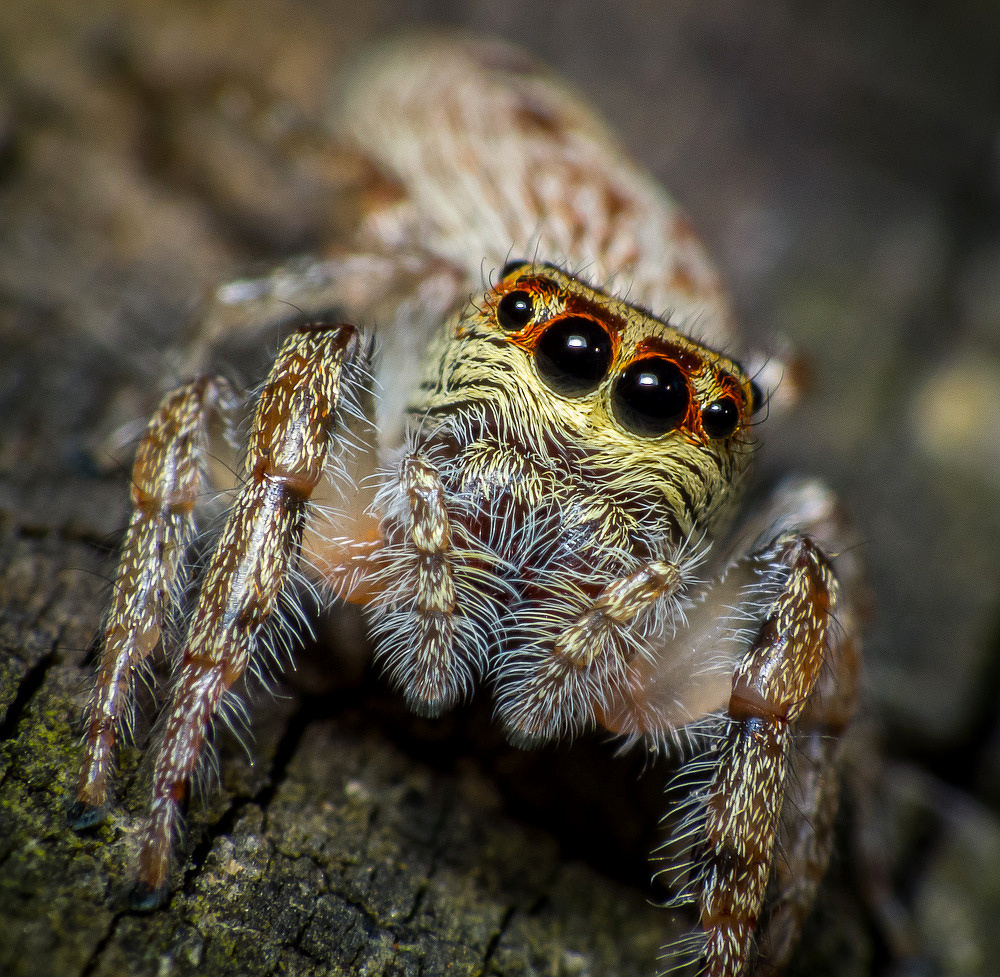
jumping spider in Brisbane
Peacock Spiders (Maratus volans) Peacock spiders are found in the south of Australia and are well known for their elaborate courtship dance, Live Science reported. Males wave around their third pair of legs and reveal their vibrant abdomen to attract a female. The spiders are tiny, measuring around an eighth of an inch (a few millimeters) long. [Source: Scott Dutfield, How It Works magazine, May 19, 2021]
Wrap-Around Spiders from the Dolophones genus are named for their incredible ability to flatten their bodies and wrap around tree limbs. Their flattened body and unique camouflage pattern of oval discs help them blend seamlessly into the bark of trees.
Jewel (Christmas) Spiders are a type of orb-weaver (Austracantha minax) easily recognized by the six spiny projections on their abdomen. Their distinctively spiny appearance and the fact that they can be found in large aggregations with overlapping webs.
Social House Spiders form large, tangled webs and exhibit cooperative hunting behavior, with multiple spiders working together to take down larger prey.
Venomous Spiders in Australia
By one estimate around 6,000 people are bitten by bu venomous spiders in Australia every year. A few become seriously ill and have to be given an antivenom. Over the century a few infants and small childreb have died. Sydney funnel-web spiders and redback spiders are Australia's most dangerous, lethal and well-known venomous species. But there are others, including mouse spiders, white-tailed spiders, and Australian tarantulas, though they pose less of a threat to humans. Anti-venom and medical treatment are readily available for bites, making fatalities rare despite the potent nature of their venom, which can attack the nervous system and cause severe pain.
Mouse Spider (Missulena species) are found throughout Australia. Their venom is potentially dangerous, and similar to that of funnel-web spiders. Mouse Spiders are found in various habitats. White-tailed Spider (Lampona cylindrata) are found in various parts of Australia. Their bites are generally painful but unlikely to be lethal. These spiders prey on other spiders and their bites can cause pain and swelling. Various genera of these large, hairy spiders, including Australian Tarantulas, are found across Australia; their bites are typically painful but not lethal.
Black house spiders are also known as the black window spider. They are very common in houses. Their bite is venomous but are not considered dangerous.Brown widow spider (Latrodectus geometricus) are an introduced species primarily found in urban areas. Brown widows possess a venom family to that of redback spiders.
According to the New York Times: Australia is home to more dangerous spiders than almost every other country, and yet spider news in Australian publications is consistently accurate, rarely charged with emotion. On the other hand, Britain was the source of the greatest amount of spider misinformation, despite having very few dangerously venomous spider species. [Source: Oliver Whang, New York Times, August 26, 2022]
Funnel Web Spiders — the World’s Deadliest Spiders
Funnel-web spiders are recognized as the deadliest spiders in the world. Native to Australia, their venom contains 40 different toxic proteins, according to Mount Sinai School of Medicine. These spiders have been responsible for several human deaths in the Sydney area, but no deaths have been reported from funnel-web spiders in Australia since 1980. [Source: Olivia Munson, USA TODAY, February 26, 2023]
Michelle Starr wrote in ScienceAlert: Almost every Australian is taught, from a very young age, to be cautious around the funnel-web spider. These large, black, aggressive arachnids can be found along the eastern coast of the continent, making their homes in web-lined burrows, to pounce on the small critters on which they feast. They also, through some quirk of evolution, secrete a venom more deadly to humans than any other spider. There are dozens of funnel-web species in Australia, but the most venomous of the bunch is the Sydney funnel-web (Atrax robustus). The bites of six of funnel-web spider species have caused severe injuries to victims. The bites of northern tree-dwelling funnel-web spiders (Hadronyche formidabilis) are also potentially deadly, [Source: Michelle Starr, ScienceAlert, January 18, 2025]
Funnel-web spiders in Australia, sometimes called atracids, belong to the Atracidae family of mygalomorph spiders (which includes trap-door spiders and tarantulas). Atracidae consists of three genera: Atrax, Hadronyche, and Illawarra, comprising 35 species. Spiders in the atrax genus have been described as being "very large, very poisonous, very aggressive." They can lunge at prey or in self defense. The bite can be very painful. Symptoms include muscle spasms (twitches) profuse sweating, high blood pressure, fluid in lungs, coma." Death when it has occurred has been caused by asphyxiation. Funnel-web spiders can be 10 centimeters (four inches long). Their fangs can penetrate leather boot. It took 20 years to developed an anti-venom.
See Separate Article: FUNNEL WEB SPIDERS — THE WORLD’S DEADLIEST SPIDERS — CHARACTERISTICS, BEHAVIOR AND REPRODUCTION ioa.factsanddetails.com
Australian Redback Spiders
Australian redback spiders (Latrodectus hasselti) are regarded by some reckonings as the world’s fifth most venomous spider. They are black with a red stripe on their back, and are less than five centimeters (two inches) in length and have a one centimeter (half inch) body. They produce venom equivalent to a bad bee sting that in some cases makes people sick for a couple of days. [Source: Kevin Sullivan and Mary Jordan, the Washington Post]
According to the Australian Museum about 2,000 people are bitten by redback spiders each year. No one has died from a redback bite in Australia since an antivenom was developed in 1956. Redbacks are very common and few people have ever been seriously hurt by them. They are often found in wood piles and garden sheds. A popular schoolyard goes" "There was a redback on my toilet seat when I was there last night. I didn't see it in the dark, but boy I felts its bite.”
Redback spiders are members of the global spider genus Latrodectus, the widow spiders, which also include black widow spiders. Female redback spiders live for two to three years while males only live for about six to seven months. The male’s lifespan is cut short by sexual cannibalism during mating, male-male competition, and size differential between males and females (often leading to females killing the much smaller males).[Source: Aaron Bindman, Animal Diversity Web (ADW) |=|]
Redback spiders are aposematic, meaning that their red markings warn predators that they are venomous. Few species prey on redbacks other than daddy longlegs, white-tailed spiders and parasitoid wasps. The primary ecosystem role of redback spiders is as an insect predator. They have adapted well to human-altered environments.
See Separate Article: REDBACK SPIDERS: CHARACTERISTICS, BEHAVIOR, VENOM, BITES, REPRODUCTION ioa.factsanddetails.com
Trapdoor Spiders
Trapdoor spiders are a diverse group of shy, burrowing spiders found across Australia, especially in eastern and southern regions. Though often mistaken for the highly dangerous funnel-web spider, trapdoor spiders are not considered a major threat to humans. According to the Australia Museum most but not all trapdoor spiders are misleadingly named, as not all species make a door for their burrows. For those species that do, these highly camouflaged entrances are almost undetectable, unless the door is open.
Trapdoor spiders are medium to large, brown or black, and have a thick, hairy coat. Somewhat resembling tarantulas, they have a dusty or earthy appearance, with some males displaying distinct "boxing glove" shaped palps used for mating. Females are generally larger than males. Trapdoors have shorter, blunt spinnerets (the silk-spinning organ) compared to the longer spinnerets of funnel-webs.Male trapdoors have a mating spur on their first pair of legs, while male funnel-webs have a large spur on the second pair. Funnel-webs have a shinier, less hairy appearance.
Trapdoor spiders are named for their ability to construct burrows with camouflaged lids or "trapdoors" made of soil, silk, and plant material. However, many species, like the Sydney brown trapdoor, create open burrows without a door. The burrow entrance is often rimmed with silk. Females typically live their entire lives within or near their burrow, which can be up to 40 centimeters deep. They are very long-lived, with some species surviving for up to 20 years. One lived to the age of 43. Mature males, however, leave their burrows to wander in search of a mate, especially during humid weather.
Trapdoor spiders are ambush predators. They wait at the entrance of their silk-lined burrow and leap out at high speed to capture passing insects, beetles, and other arthropods before retreating back into the burrow.
Eleven-Million-Year-Old Trapdoor Spider Fossil
In September 2023, Scientists in Australia announced that they have unearthed the fossil of a new genus of trapdoor spider that lived 11 to 16 million years old. On top the fossil is the second largest spider fossil in the world, approximately five times larger than currently existing trapdoor spiders. [Source: Stacey Ritzen, Men's Journal, September 27, 2023] at 4:01
The new species is named Megamonodontium mccluskyi after Australian National University associate professor and geospatial scientist Dr. Simon McClusky, who found the specimen. It was discovered at McGraths Flat in New South Wales. The fossil site is known for its iron-rich rock called goethite, which rarely produces exceptional fossils. However, in this instance, the spider was so well preserved that researchers were able to make out minute details in the body of the spider.
Stacey Ritzen wrote in Men's Journal: While Monodontium, the genus of brushed trapdoor spiders, tends to be on the smaller side, the new species is much larger. Its body measures just under an inch and would probably fit comfortably into the palm of your hand with its legs spread. The fact that a spider of that size is so well preserved makes the find that much more impressive. But more importantly, it shows how the species once lived in Australia's mesic rainforest habitats before the continent turned arid and dry, according to Palaeontologist Dr. Matthew McCurry of the Australian Museum, which currently houses the specimen.
"Only four spider fossils have ever been found throughout the whole continent, which has made it difficult for scientists to understand their evolutionary history," McCurry said in a statement. "That is why this discovery is so significant, it reveals new information about the extinction of spiders and fills a gap in our understanding of the past. The closest living relative of this fossil now lives in wet forests in Singapore through to Papua New Guinea," he added. This suggests that the group once occupied similar environments in mainland Australia but have subsequently gone extinct as Australia became more arid."
Queensland Museum Arachnologist Dr. Robert Raven, supervising author of a study about the fossil published in the Zoological Journal of Linnean Society, explained another reason why it's rare to see the species preserved in a fossil. "Not only is it the largest fossilized spider to be found in Australia but it is the first fossil of the family Barychelidae [brushed trapdoor spiders] that has been found worldwide," Raven said. "There are around 300 species of brush-footed trapdoor spiders alive today, but they don’t seem to become fossils very often. This could be because they spend so much time inside burrows and so aren’t in the right environment to be fossilized."
New Species of Giant Trapdoor Spider Discovered in Queensland
In March 2023, researchers at the Queensland Museum announced the discovery of a new species of giant trapdoor spider in woodlands area of central Queensland. Scientists named the spider Euoplos dignitas, meaning “dignity or greatness”, that’s intended to highlight the “impressive size and nature of the spider,” museum officials said. Male Euoplos dignitas spiders have bright red coloring, long spindly legs and shiny body. Females have a more muted red coloring and a compact body shape. Genetic and biological research on the new species was published in the Journal of Arachnology on March 15, 2023.[Source: Aspen Pflughoeft, Miami Herald, March 22, 2023]
The Euoplos dignitas spider has “really cryptic trapdoors in these woodland habitats on the ground,” Michael Rix, co-author of the study, told the Australian Broadcasting Corporation. “Most people wouldn’t even realise that they’re there.” Photos shared on Facebook by Threatened Treasures show the animal’s circular, almost pipe-like burrow with a “door” made of silk and soil. The spider uses venom on its prey but is not harmful for humans, Rix told The Guardian. “The bite might be physically painful because of their size, but they’re not dangerous,” he said.
The Miami Herald reported: The female spiders spend most of their lives in their underground burrows, Rix told The Guardian. The male spiders move from mate to mate and burrow to burrow every five to seven years. “The males of this species are what we sort of call a really honey-red color — they’re really quite stunning,” Rix told the Australian Broadcasting Corporation.
So far, the Euoplos dignitas has only been found in a few areas of central Queensland, the museum said. Researchers found the species in Eidsvold and Monto, a pair of cities about 700 miles north of Sydney. Land clearing operations in central Queensland have negatively affected the spider’s habitat, the museum said. The study authors described the species as likely endangered. Scientists do not know the population size or distribution range of these spiders, The Guardian reported.
Large Webs Cover Victoria after Floods as Spiders Attempt to Reach Higher Ground
Millions of spiders blanketed the countryside with webs after Victoria’s floods in June 2021 in an effort to reach higher ground. Matilda Boseley wrote in The Guardian: Residents in eastern Victoria have been taken aback after waking up to vast, alien-like sheets of spider webs laying across paddocks and roadsides. The East Gippsland town of Traralgon was one of the hardest-hit areas by recent flooding and wild weather. While its neighbour Sale avoided the brunt of the damage, flooded roads and paddocks disrupted the local spider populations, which are now seeking higher ground on road signs, trees and any tall grass they can find. “It’s just incredible, when they blow in the winds they look like waves,” said Jena Beatson, who saw the spiders on her first trip into Sale from Longford after the roads were cut off by flood waters. “It does look creepy the way it covers all the signs and everything. You can’t really see it in the photos but there are spiders all over. It’s like thousands and thousands of spiders.” [Source: Matilda Boseley, The Guardian, June 15, 2021]
Actually, according to Dr Ken Walker, a senior curator of entomology at the Melbourne Museum, it is millions. “It’s a semi-regular occurrence in Victoria in wintertime when we get most of our rain. Spiders can make a wide range of different silks and one of the silks they use for this behavior — ballooning — it’s a very, very thin little silk that they use … to fly away with the breeze. They could fly 100 kilometers,” he said. “What’s happened is there’s been a massive flooding event pretty quickly … so they’re using the ballooning not to escape for hundreds of kilometers but to almost throw up a lasso on top of the vegetation. It hooks on to the tops of the vegetation because it’s lighter than air, and then they quickly climb up.”
When a huge number of spiders all do this at once, they end up hooking on to each other and can blanket the countryside. This phenomenon, sometimes called the gossamer effect, is caused by “vagrant hunter” spider species, which live on the ground and do not build a web. They also do not create webs after ballooning away from a flood. In fact, Walker said, each spider only threw up a single thread, meaning every tiny line of silk represented a different animal.
Photos of the spiders online have been accompanied by dozens of comments declaring that “the spider plague has descended too”, but Walker said these webs do not actually indicate any increase in numbers. “It’s purely a result of the flooding event … What it shows you is the enormous amount, literally millions, of spiders that are there on the ground all the time. We just normally don’t see them because they’re under vegetation, on the leaves, under bark and things like that,” he said. The spiders ballooning near Sale includes the red and black Ambicodamus species, and although their bites are not dangerous to humans, they can cause minor local irritation. Walker said people should not be worried though, as none of the highly venomous species would make up part of the net. “It’s not dangerous at all. Most of these spiders, their fangs are probably too short to penetrate the human skin.”
Locals from all around Sale had been coming out to look at the spiders, Beatson said. “It’s actually not a great drive at the moment, because everybody’s stopping and pulling over the side of the road to take photos,” she laughed. But these blankets of silk will not last long. “These threads are so thin, usually as soon as the first breeze comes along, they get quickly broken up and dispersed,” Walker said, encouraging those in the area to enjoy them while they lasted. “[Across Victoria] we only really see it about once a year … It’s a beautiful event and it’s something that’s quite rare.”
Image Sources: Wikimedia Commons
Text Sources: Animal Diversity Web animaldiversity.org , National Geographic, Live Science, Natural History magazine, Australian Museum, David Attenborough books, Australia Geographic, New York Times, Washington Post, Los Angeles Times, Smithsonian magazine, Discover magazine, The Conversation, The New Yorker, Time, BBC, CNN, Reuters, Associated Press, AFP, Lonely Planet Guides, Wikipedia, The Guardian, Top Secret Animal Attack Files website and various books and other publications.
Last updated August 2025