
FUNNEL-WEB SPIDERS
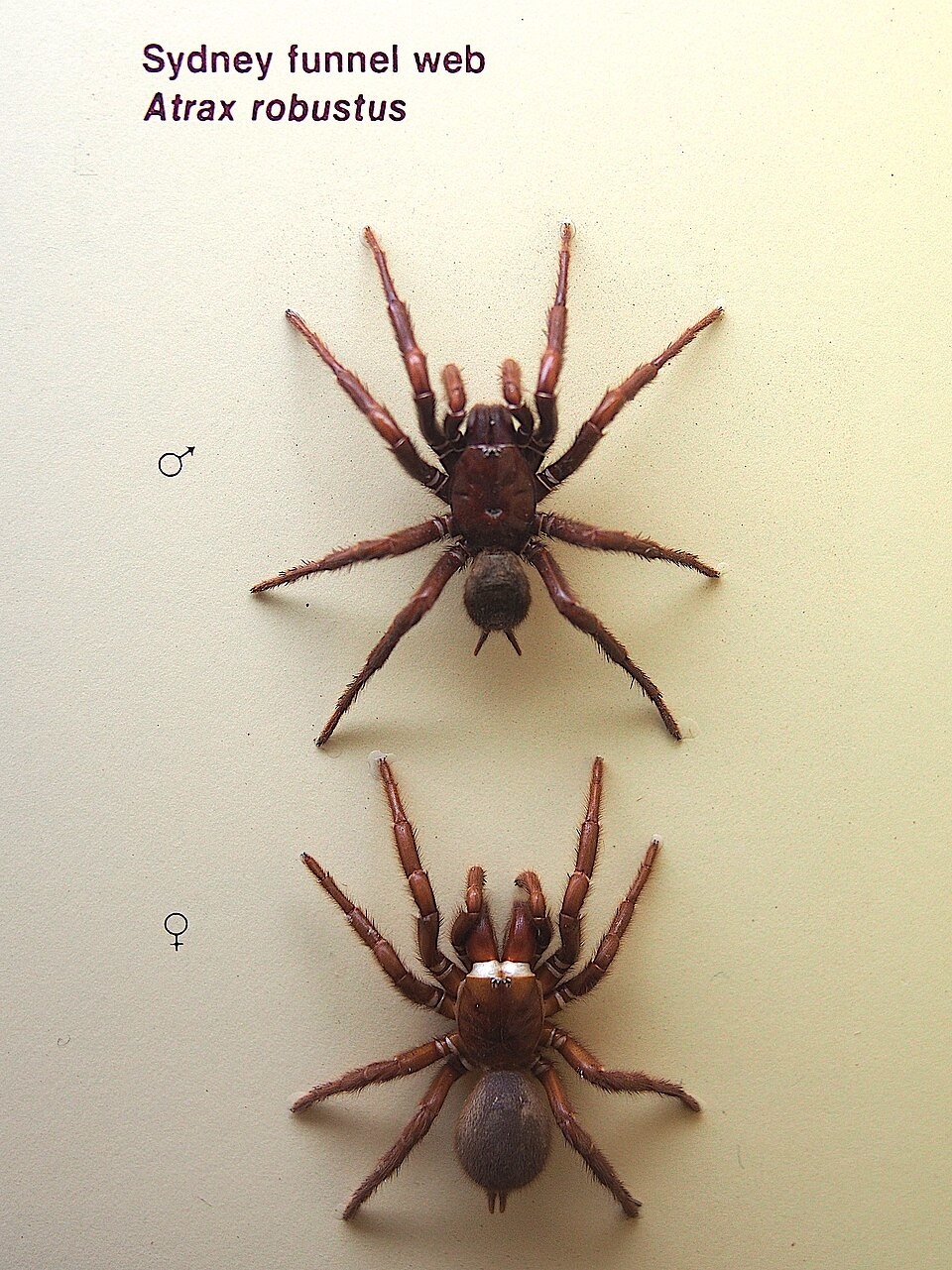
Sydney funnel-web spider display at the Australian Museum: female (top); male (bottom)
Funnel-web spiders are recognized as the deadliest spiders in the world. Native to Australia, their venom contains 40 different toxic proteins, according to Mount Sinai School of Medicine. These spiders have been responsible for several human deaths in the Sydney area, but no deaths have been reported from funnel-web spiders in Australia since 1980. [Source: Olivia Munson, USA TODAY, February 26, 2023]
Michelle Starr wrote in ScienceAlert: Almost every Australian is taught, from a very young age, to be cautious around the funnel-web spider. These large, black, aggressive arachnids can be found along the eastern coast of the continent, making their homes in web-lined burrows, to pounce on the small critters on which they feast. They also, through some quirk of evolution, secrete a venom more deadly to humans than any other spider. There are dozens of funnel-web species in Australia, but the most venomous of the bunch is the Sydney funnel-web (Atrax robustus). The bites of six of funnel-web spider species have caused severe injuries to victims. The bites of northern tree-dwelling funnel-web spiders (Hadronyche formidabilis) are also potentially deadly, [Source: Michelle Starr, ScienceAlert, January 18, 2025]
Funnel-web spiders in Australia, sometimes called atracids, belong to the Atracidae family of mygalomorph spiders (which includes trap-door spiders and tarantulas). Atracidae consists of three genera: Atrax, Hadronyche, and Illawarra, comprising 35 species. Spiders in the atrax genus have been described as being "very large, very poisonous, very aggressive." They can lunge at prey or in self defense. The bite can be very painful. Symptoms include muscle spasms (twitches) profuse sweating, high blood pressure, fluid in lungs, coma." Death when it has occurred has been caused by asphyxiation. Funnel-web spiders can be 10 centimeters (four inches long). Their fangs can penetrate leather boot. It took 20 years to developed an anti-venom.
According to the BBC the funnel-web spider is also one of the most aggressive and deadliest creatures on Earth. It is incredibly defensive, and because of this can bite several times in a single attack. The bite itself is very painful, and symptoms can arise quickly. If a bite is left untreated it can lead to serious illness and even death. Children are especially susceptible to bites and must be taken to hospital as soon as possible if bitten. [Source: James Cutmore, BBC, November 2, 2024]
Funnel-web spiders are named after the funnel shape of their webs. There are many species of funnel spiders. They make their funnel-shaped webs outside their ground burrows. These are designed to trap insects long enough for the spiders to rush out of their holes and inject therm with venom. There funnel-web spiders in North America, but they not of the atrax genus. Funnel-web numbers in Australia appear to be on in decline. Although humans may not like them, they play important ecological roles in the environments they inhabit. [Source: Steven Hill, Field & Stream, October 25, 2023]
RELATED ARTICLES:
MOST VENOMOUS SPIDERS: SPECIES, BITES, VENOM factsanddetails.com
REDBACK SPIDERS: CHARACTERISTICS, BEHAVIOR, VENOM, BITES, REPRODUCTION ioa.factsanddetails.com
INTERESTING SPIDERS IN AUSTRALIA: TRAPDOORS, PEACOCKS AND VENOMOUS ONES ioa.factsanddetails.com
SPIDERS AND HUMANS: FEAR, MISINFORMATION factsanddetails.com ;
SPIDERS: HISTORY, CHARACTERISTCS, SILK, WEBS factsanddetails.com ;
TARANTULAS: CHARACTERISTICS, VENOM, TOXIC HAIRS, EATING. HUNTING factsanddetails.com ;
SCORPIONS, MATING HABITS, CANNIBALISM, VENOM AND HUMAN VICTIMS factsanddetails.com ;
Sydney Funnel-Web Spiders
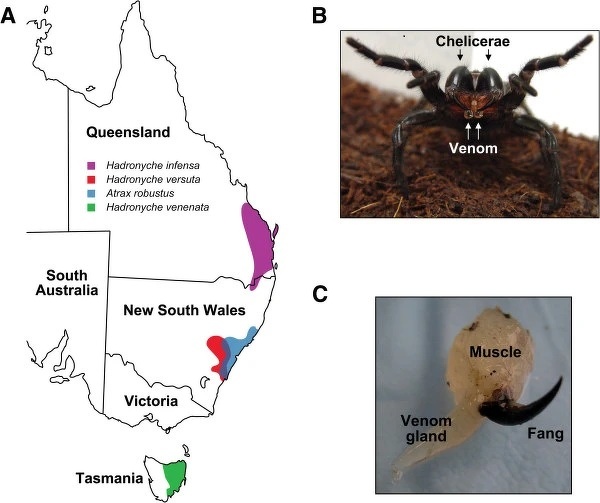
distribution of the five species of Australian funnel-web spider in eastern Australia, with the Sydney funnel-web spider in blue; (B) Female funnel-web spider (Hadronyche infensa) from Fraser Island, Queensland; In response to provocation, the spider has adopted a typical aggressive/defensive posture, with front legs and pedipalps raised and the fangs in an elevated position ready to strike; Note the drop of venom on each of the fang tips; (C) A single H; versuta venom gland that has been dissected from the surrounding muscle tissue; The venom gland in these and other mygalomorph spiders is located directly below the dorsal surface of the chelicerae;
Sydney funnel-web spiders (Atrax robustus) are a species funnel-web spider and venomous mygalomorph spider native to eastern Australia, usually found within a 100-kilometer (62-mile) radius of Sydney. Their bite is capable of causing serious illness or death in humans if left untreated.
Sydney funnel-web spiders do not hesitate to attack. They have fangs that can easily penetrate a human fingernail. Venom of Sydney funnel-web spiders has different affects on different animals; humans are highly affected by the venom. Those found around Sydney are said to be particularly venomous. "One bite," some Aussies say, "and you're dead as a mutton chop."
Sydney funnel-web spiders are ground-dwelling spiders found mainly in New South Wales. They tend to live in lush gullies beneath rocks and fallen timber. They also live in moist soil beneath houses, crevices in garden rockeries and compost heaps. Their white silk webs are 20 to 60 centimeters long and go into ground that has stable, high humidity and low temperatures. The entrance is either Y-shaped or T-shaped and is woven into a funnel. [Source: Jason Fathallah, Animal Diversity Web (ADW) |=|]
Sydney funnel-web spiders feed on beetles, cockroaches, insect larvae, native land snails, millipedes and occasionally frogs and other small vertebrates. All food is taken at the edge of their 'funnel-webs.' The webs are made entirely of dry silk. Insects often times land on the web; once they land, the trapped insects have trouble moving on the slippery web. Sydney funnel-web spiders have no trouble moving and repeatedly bite the trapped insect and takes it back into the funnel for feeding.
Silk made by Sydney funnel-web spiders is used as crosshairs in optical instruments. The Australian Reptile Park has over 1000 funnel-web spiders where the venom is milked for antivenom and research. On the International Union for Conservation of Nature (IUCN) Red List they are listed as No special status. In CITES (Convention on International Trade in Endangered Species of Wild) they have no special status. [Source: Jason Fathallah, Animal Diversity Web (ADW) |=|]
Sydney Funnel-Web Spider Characteristics
Sydney funnel-web spiders have body length ranging from one to five centimeters (0.4 to 2 inches). Their size is much bigger if you include their legs. Both sexes are glossy and darkly colored, ranging from blue-black, to black, to shades of brown or dark-plum colored. The carapace covering the cephalothorax (head and thorax, most the spider) is almost hairless and appears smooth and glossy. There are fine, velvety hairs covering the abdomen.[Source: Wikipedia, Jason Fathallah, Animal Diversity Web (ADW) |=|]
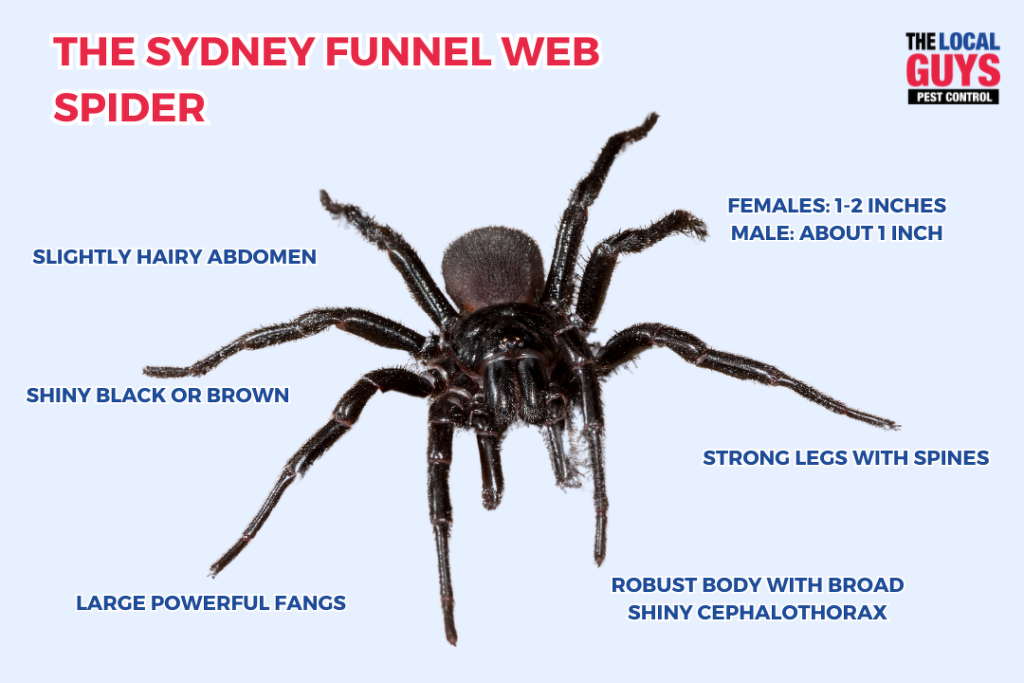
Sydney funnel-web spiders have large fangs and venom sacs. Males average about to 2.5 centimeters (one inch) long while females grow to 3.5 centimeters (1.4 inches) long. Funnel-web spiders have shiny, solidly built limbs, a row of teeth along the fang groove and another row on their paired claws. They are (ectothermic (“cold blooded”, use heat from the environment and adapt their behavior to regulate body temperature). Males are smaller and slimmer than females but have longer legs. They also have a shorter lifespan. Another characteristic is finger-like spinnerets at the end of their abdomen.
Males is the family Atracidae have a large mating spur projecting from the middle of their second pair of legs. Male Sydney funnel-web spiders can recognized by the modified terminal segment of the palp (mouth parts). Like other Mygalomorphae — an infraorder of spiders that includes the tropical tarantulas — these spiders have fangs that point straight down the body and do not point towards each other. They have relatively large venom glands that lie entirely within their mouth parts. Their fangs are large and powerful, capable of penetrating fingernails and leather.
In 2024, a Sydney funnel-web spider at the Australian Reptile Park set a record for the specie. It measured 7.9 centimeters (3.1 inches) from foot to foot, surpassing the park's previous record-holder from 2018.
Sydney Funnel-Web Spider Actually Three Different Species
In January 2025, in a study published in BMC Ecology and Evolution. scientists announced that the Sydney funnel-web spider was actually three different species — a discovery that is good news because it will allow scientists to better understand the venom each species produces.. Michelle Starr wrote in ScienceAlert: The group of spiders formerly known as A. robustus had posed something of a puzzle to scientists for some time. Although they were all lumped together, there seemed to be some regional variation in what they looked like, with particularly large specimens found to the north of Sydney in the Newcastle region, including the largest male attributed to the species ever seen, an absolute unit nicknamed Big Boy. [Source: Michelle Starr, ScienceAlert, January 18, 2025]
Led by arachnologist Stephanie Loria of the Leibniz Institute for the Analysis of Biodiversity Change in Germany, a team of researchers decided to get to the bottom of this diversity. Was it simply adaptations to different habitats, or indicative of deeper diversity within the species? Performing genetic analysis of the spiders, they found that what we had previously called A. robustus included two other species — and, in turn, they were able to characterize the habitat range of each.
The habitat of A. robustus itself is focused around the Sydney area, as far north as the Central Coast, south to the Georges River, and west to the Baulkam Hills area, with scattered, isolated sightings only slightly further to the west and south. Further to the south and west dwells the Southern Sydney funnel-web (Atrax montanus), a species originally described in 1914 and later folded into A. robustus. Turns out it was indeed a different spider all along. Finally, to the north dwells an entirely newly discovered species, the Newcastle funnel-web (Atrax christenseni). And these are the chonkers: Big Boy, it transpires, was a Newcastle funnel-web, and some of the other large funnel-web spiders from the region, such as the recently recovered spider named Hemsworth, were misattributed too.
Sydney Funnel-Web Spider Behavior, Burrows and Reproduction
Sydney funnel-web spiders are solitary animals except when mating. Females tend to stay in the same location except when forced out by flooding. Males tend to roam around in search of a mate after reaching sexual maturity. Males locate females by sensing the female's pheremones. [Source: Jason Fathallah, Animal Diversity Web (ADW) |=|]
Australian funnel-web spiders make their burrows in moist, cool, sheltered habitats – under rocks, in and under rotting logs, and some in rough-barked trees (occasionally meters above ground). They are commonly found in suburban rockeries and shrubberies, rarely in lawns or other open terrain. A burrow characteristically has irregular silk trip-lines radiating from the entrance.Unlike some related trapdoor spiders, they do not build lids to their burrows. [Source: Wikipedia
Long-lived female funnel-web spend most of the time in their silk-lined tubular burrow retreats. When potential prey, which includes insects, lizards or frogs, walks across the trip-lines, they rush out, subduing their prey by injecting their venom. Males tend to wander during the warmer months of the year. This makes encounters with male specimens more likely as they sometimes wander into backyards or houses, or fall into swimming pools. The spiders can survive such immersion for up to twenty-four hours, trapping air bubbles on hairs around their abdomen.
Sydney funnel-web spiders are mainly active at night, as typical day-time conditions would dehydrate them. During the day, they seek cover in cool, moist hideaways. After heavy rain, spider activity is increased as their burrows may be flooded. When threatened or provoked, funnel-web spiders display aggressive behaviour, rearing up on their hind legs and displaying their fangs. When biting, the funnel-web spider maintains a tight grip on its victim, often biting repeatedly.
Male reproductive organs consists of testes and a tube that connects the testes to a small opening. Sperm is discharged onto a small silk mat that the spiders weave. Sperm is then discharged into the female's genital opening where it is either used or stored by the female. Reproduction usually occurs towards the end of summer or early fall. Males reach sexual maturity at about four years of age and the females take just a little bit longer. Females lay from 90 to 120 yellow-green eggs. |=|]
Sydney Funnel-Web Spider Venom and Bite
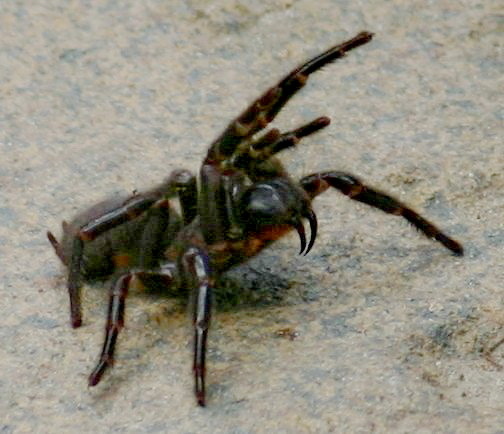
Female Sydney funnel-web spider in an aggressive posture
"The Sydney funnel-web spider can kill a toddler in about five minutes and a 5-year-old in about two hours," Rick Vetter, a retired research associate with the Department of Entomology at University of California, told Live Science. Although no one has died from these spiders since the advent of antivenom in the 1980s, it is difficult to imagine a toddler receiving treatment soon enough to recover from a funnel-web bite. [Source: Joshua A. Krisch, Live Science, May 16, 2023]
For some reason the venom of Sydney funnel-web spiders is only dangerous to the small creatures upon which it preys, and primates, including humans. Only male Sydney funnel-web spiders have venom that can kill an adult. There has been no reported case of severe envenoming by female Sydney funnel-web spiders. Their venom is less potent than that of males. The Australian Museum claims that the antivenom to treat funnel-web spider bites has been given to about 100 patients since 1980.
The lethal dose of venom from a Sydney funnel-web spider in humans is not known. The lethal dose of venom from male Sydney funnel-web spiders for the crab-eating macaque (Macaca fascicularis) is 0.2 mg/kg. The average venom yield for a male is 0.81 mg. Delta atracotoxin — is an ion channel inhibitor — is the active compound in the venom that is highly toxic for humans and other primates. However, it does not affect the nervous system of other mammals.
Sydney funnel-web spiders typically delivers a full envenomation when they bites, often striking repeatedly. In the case of severe envenomation, the time to onset of symptoms, according to one study, averages 28 minutes. The same study revealed that children are at particular risk of severe Sydney funnel-web spider envenoming, with 42 percent of all cases of severe envenoming being children.
Sydney Funnel-Web Spider Bite Symptoms and Treatment
The bite of a Sydney funnel-web is initially very painful. There are clear fang marks separated by several millimetres. The size of fangs is responsible for the initial pain. In some cases the spider remains attached until dislodged by shaking or flicking it off. Physical symptoms can include intense nausea, vomiting, copious secretion of saliva, muscular twitching and breathing difficulty, disorientation and confusion, leading to unconsciousness. [Source: Wikipedia]

From vitalfirstaid
A Sydney funnel-web bite is regarded as a medical emergency requiring immediate hospital treatment. Guidelines recommend two vials of antivenom, or four if symptoms of envenomation are severe. Patients are assessed every 15 minutes, with further vials recommended if symptoms do not resolve. The most vials that have been used to treat a bite is twelve, for a 10-year-old boy who was bitten in February 2017 by a male Sydney funnel-web that was hiding in a shoe.[27]
The antivenom was developed by a team headed by Struan Sutherland at the Commonwealth Serum Laboratories in Melbourne. In September 2012 stocks of antivenom were running low, and people were asked to catch the spiders so that they could be milked for their venom. One dose of antivenom requires around 70 milkings from a Sydney funnel-web spider. The Australian Reptile Park receives Sydney funnel-web spiders as part of its milking program.
Deaths from Sydney Funnel-Web Spiders
Although Sydney funnel-web spider venom is the deadliest in the world, no one in Australia has died of a funnel-web bite since the introduction of an antivenom in 1981, despite the 30 to 40 recorded funnel-web bites every year. This is because the antivenom is an excellently effective treatment. Otherwise, funnel-web spiders venoms is a complex peptide mixtures that can vary from species to species, or even from occasion to occasion. [Source: Michelle Starr, ScienceAlert, January 18, 2025]
Thirteen deaths were attributed to Sydney funnel-web spiders between 1927 and the early 1980s. There is at least one recorded case of a small child dying within 15 minutes of a bite from a funnel-web.
In February 1927, in the first reported death, a young boy died after being bitten on the hand after playing with a big black spider on the laundry steps of his home in the Sydney suburb of Thornleigh. He fell gravely ill and perished later that evening. Public interest in the spiders surged, and the police brought the dead spider to the Australian Museum, where Anthony Musgrave identified the creature as Euctimena tibialis. He examined a series of male and female spiders collected around Sydney and concluded based on anatomical similarities that Euctimena tibialis was the male Atrax robustus.
Huge Amount of Antivenom Saves Boy Bitten by Funnel-Web Spider
In February 2017, a 10-year-old required — Matthew Mitchell — received what is believed to be the largest dose of antivenom ever administered in Australia — 12 vials in total — after experiencing numerous convulsions after being bitten by a funnel-web spider. [Source: Sunita Patel-Carstairs, Sky News, February 24, 2017]
Sky News reported: The youngster from Berkeley Vale in New South Wales was helping his father clear out a shed at their home when he was bitten on a finger by a funnel-web spider which was inside one of his shoes. "It sort of clawed on to me and all the legs and everything crawled around my finger and I couldn't get it off," he told Australia's Daily Telegraph.
His family rushed him to hospital where he was given the antivenom — an unheard-of amount, according to the Australian Reptile Park, which runs a antivenom milking programme. "I've never heard of it, it's incredible," the park's general manager Tim Faulkner told the Australian Associated Press on Friday. "To walk out of hospital a day later with no effects is a testament to the antivenom."
Image Sources: Wikimedia Commons
Text Sources: Animal Diversity Web animaldiversity.org , National Geographic, Live Science, Natural History magazine, Australian Museum, David Attenborough books, Australia Geographic, New York Times, Washington Post, Los Angeles Times, Smithsonian magazine, Discover magazine, The Conversation, The New Yorker, Time, BBC, CNN, Reuters, Associated Press, AFP, Lonely Planet Guides, Wikipedia, The Guardian, Top Secret Animal Attack Files website and various books and other publications.
Last updated August 2025