
Home | Category: Animals / Nature, Environment, Animals
REDBACK SPIDERS
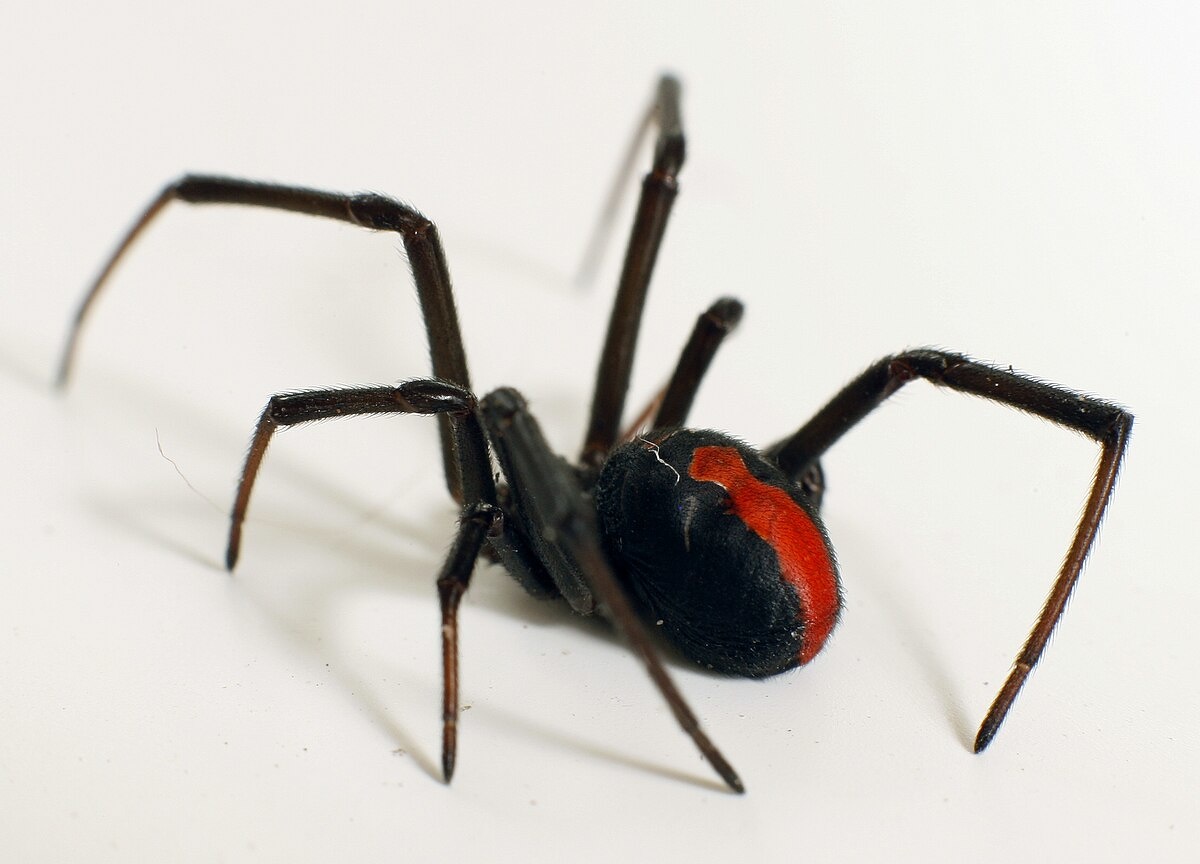
female redback spider
Australian redback spiders (Latrodectus hasselti) are regarded by some reckonings as the world’s fifth most venomous spider. They are black with a red stripe on their back, and are less than five centimeters (two inches) in length and have a one centimeter (half inch) body. They produce venom equivalent to a bad bee sting that in some cases makes people sick for a couple of days. [Source: Kevin Sullivan and Mary Jordan, the Washington Post]
According to the Australian Museum about 2,000 people are bitten by redback spiders each year. No one has died from a redback bite in Australia since an antivenom was developed in 1956. Redbacks are very common and few people have ever been seriously hurt by them. They are often found in wood piles and garden sheds. A popular schoolyard goes" "There was a redback on my toilet seat when I was there last night. I didn't see it in the dark, but boy I felts its bite.”
Redback spiders are members of the global spider genus Latrodectus, the widow spiders, which also include black widow spiders. Female redback spiders live for two to three years while males only live for about six to seven months. The male’s lifespan is cut short by sexual cannibalism during mating, male-male competition, and size differential between males and females (often leading to females killing the much smaller males).[Source: Aaron Bindman, Animal Diversity Web (ADW) |=|]
Redback spiders are aposematic, meaning that their red markings warn predators that they are venomous. Few species prey on redbacks other than daddy longlegs, white-tailed spiders and parasitoid wasps. The primary ecosystem role of redback spiders is as an insect predator. They have adapted well to human-altered environments. Redback spiders do not currently have any special conservation status. On the International Union for Conservation of Nature (IUCN) Red List they are listed as Not Evaluated.
RELATED ARTICLES:
MOST VENOMOUS SPIDERS: SPECIES, BITES, VENOM factsanddetails.com
FUNNEL WEB SPIDERS — THE WORLD’S DEADLIEST SPIDERS — CHARACTERISTICS, BEHAVIOR AND REPRODUCTION ioa.factsanddetails.com
INTERESTING SPIDERS IN AUSTRALIA: TRAPDOORS, PEACOCKS AND VENOMOUS ONES ioa.factsanddetails.com
SPIDERS AND HUMANS: FEAR, MISINFORMATION factsanddetails.com ;
SPIDERS: HISTORY, CHARACTERISTCS, SILK, WEBS factsanddetails.com ;
TARANTULAS: CHARACTERISTICS, VENOM, TOXIC HAIRS, EATING. HUNTING factsanddetails.com ;
SCORPIONS, MATING HABITS, CANNIBALISM, VENOM AND HUMAN VICTIMS factsanddetails.com ;
Redback Spider Habitat and Where They Are Found
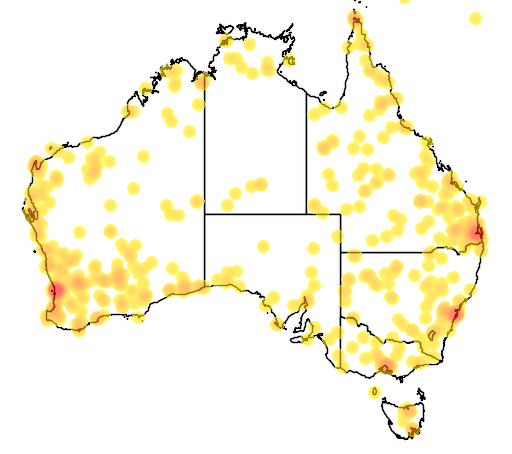
range of redback spiders Australia based on records of redback spider specimens reported to the Atlas of Living Australia as of September 2013
Redback spiders occur in most areas of Australia. They are also found on the North and South islands of New Zealand, having been introduced there via grape imports from Australia. Sighting of the spiders have been reported in places in Southeast Asia, and India. They have been in south central Japan since the 1990s. [Source: Aaron Bindman, Animal Diversity Web (ADW) |=|]
Redback spiders have adapted to a number of habitats in temperate and tropical environments: deserts, grasslands, shrub forests, dry sclerophyll (hard leaf) forests, rain forests and urban and suburban areas. They are commonly found in places with humans. Various human structures and objects — sheds, outhouses, garages, stacks of bricks, wood piles, basements, attics, and nooks and crannies of buildings — provide them ideal shelter. They prefer dry habitats like savannas, chaparral and desert areas and are generally not found at higher elevations.
Colonies and individuals of Redback spiders have been found spotted in England, Belgium, the United Arab Emirates and Iran. It was at one time believed thats redbacks may have been introduced to Australia, because when they were first formally described in 1870, they appeared to be concentrated around sea ports. However, an earlier informal description (1850) from the Adelaide Hills is now known, and names in Australian Aboriginal languages also show that it was present well before European settlement.
The presence of redback spider populations in Japan and other places show that these spiders are capable of surviving without food for long periods of time, as they likely traveled the long distances in cargo carried by ships with little to no food available. Juveniles may survive up to 160 days and adults 300 days without food. At later stages of starvation they are sluggish and incapable of finding food for themselves, however Redbacks are noted to recover immediately after one meal. The ability to hang on in Japan, shows that redbacks are also capable of surviving at very low temperatures (to -3 degrees C).
Redback Spider Characteristics
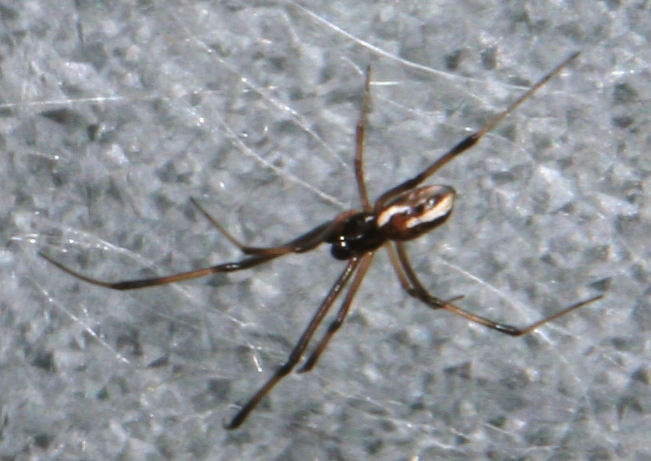
Male redback spider
Redback spiders have a head and body length of three millimeters to one centimeters (0.12 to 0.39 inches). Sexual Dimorphism (differences between males and females) is present: Females are larger than males. Sexes are colored or patterned differently with the female being more colorful. Adult females are easily recognized by her spherical black body with a prominent red stripe on the upper side of the abdomen and an hourglass-shaped red or orange streak on the underside. Females usually have a body length of about one centimeters (0.4 inches), while the male is much smaller, being only three to four millimeters (0.12–0.16 inches) long. [Source: Wikipedia, Aaron Bindman, Animal Diversity Web (ADW) |=|]
Redback spiders and North American black widow spiders belong to the same genus, Latrodectus. The main difference is their appearance: redbacks have a red stripe on their back. Both species have red hourglass on their underside Female redbacks are the ones with with a bright red stripe on their back, along with their characteristic hourglass mark on its abdomen. Female black widows are generally larger and have shiny black body and the distinct red or orange hourglass marking on the underside of their abdomen. Both spiders have venomous bites that require immediate medical attention, though redback venom is often considered more potent. [Source: Google AI]
The body of female redbacks is about the size pea. Males are are significantly smaller. Both sexes have slender legs, with the first pair being longer than the rest, and a pair of venom glands, one attached to each of their chelicerae (mouth parts) with very small fangs. The round abdomen of adult females is deep black (occasionally brownish). The longitudinal stripe on the upper surface is usually red but sometimes orange. Males are light brown in color, with white markings on the upper side of the abdomen and a pale hourglass marking on the underside. Redback spiderlings are grey with dark spots, and become darker with each moult. Juvenile females have additional white markings on the abdomen. The bright scarlet red colors may be a warning to potential predators that the spiders are venomous.
Redback Spider Food and Eating Behavior
Redback spiders are carnivores (eat meat or animal parts) and primarily insectivores (eat insects). Animal foods include birds, mammals, reptiles, insects, non-insect arthropods such as spiders, They store and cache food and mainly prey on small insects caught within their webs such as ants. They sometimes catch larger animals in their webs — such as mice, small birds, snakes, small lizards, king crickets, Cromwell chafer beetles, and trapdoor spiders — and eat them. Redback spiders also steal stored prey caught in the webs of other spiders. All redbacks have a potentially venomous bite, however only females have been known to envenomate prey. [Source: Aaron Bindman, Animal Diversity Web (ADW) |=|]
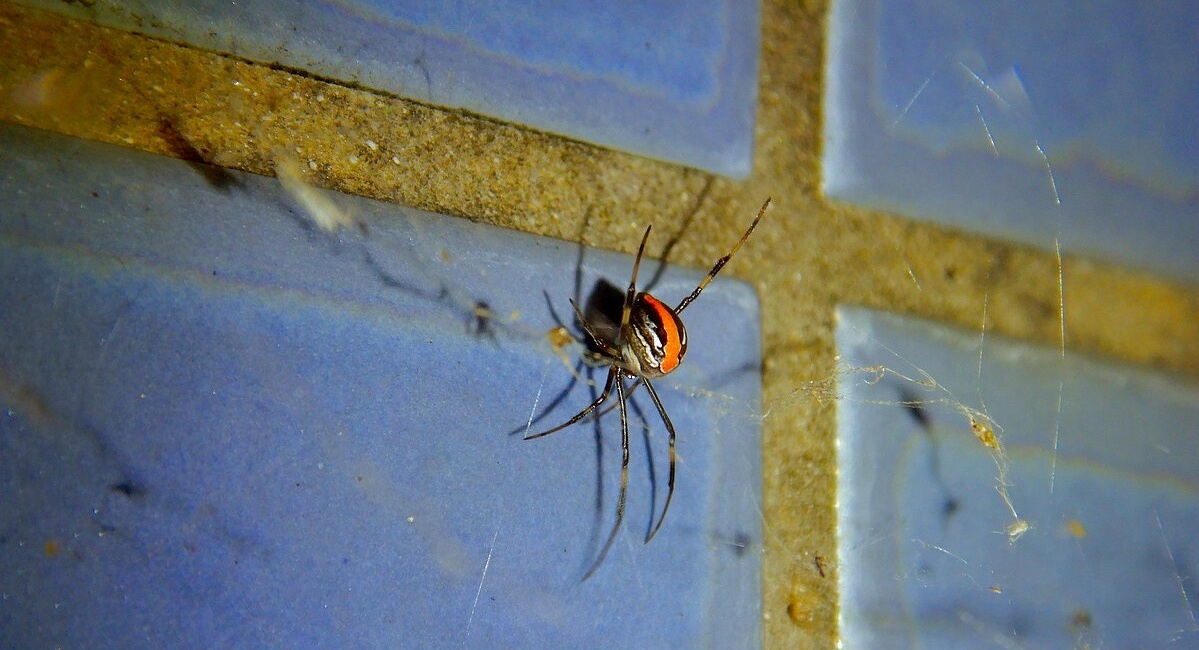
redback spider on the wall of a toilet in a park
Redback spiders have a unique way of catch their prey in a. At night, females construct a complex, haphazard-looking web system reaching in all directions, including towards the ground. They set traps for prey by bringing a strand of their silk web down and sticking it to the ground surface. Next, they climb up that line, adding an additional silk line on top of the original to strengthen it. They then pull the line taut and a single trap is complete. They do this multiple times creating a number of traps and wait for prey to run or fly into a line and get stuck.
Redbacks kill their prey by injecting a complex venom through their two fangs when they bite, before wrapping the prey in silk and sucking out the liquefied insides. Often, they first squirt their victims with what resembles 'superglue' from their spinnerets, immobilising the prey by sticking the victim's limbs and appendages to their own body. Redback spiders then truss the victim with silk. Once prey is restrained, it is bitten repeatedly on the head, body and leg segments and is then hauled back to the redback spider's retreat. Sometimes a potentially dangerous victim can be left to struggle for hours until it is exhausted enough to approach safely.Male spiders and spiderlings often live on the periphery of the female spiders' web and steal leftovers. [Source: Wikipedia]
Redback Spider Behavior
Redback spiders are shy, nocturnal (active at night), motile (move around as opposed to being stationary), sedentary (remain in the same area) and solitary. They rarely interact with members of their own species, except when mating, and stay out of sight during the day, preferring to hide in dry interior environments, such as sheds, where there is shelter and plenty of prey. If outside, they live under rocks, logs, or low growing plants. Redback spiders prefer to stay within a very small home range. [Source: Aaron Bindman, Animal Diversity Web (ADW) |=|]|
Like most spiders, female redbacks spin webs made with a strong silk (males are not able to make webs). Their webs are a disorganized funnel shape. The spiders are stationary most of the time, perched in the very rear of the funnel. The web is constructed in such a way that they are able to feel the vibrations made by prey running into their traps. Redback spiders in Japan hibernate during the cold winter months. This is behavior has not been observed in Australia. Hibernation is the state that some animals enter during winter in which normal physiological processes are significantly reduced, thus lowering the animal's energy requirements.
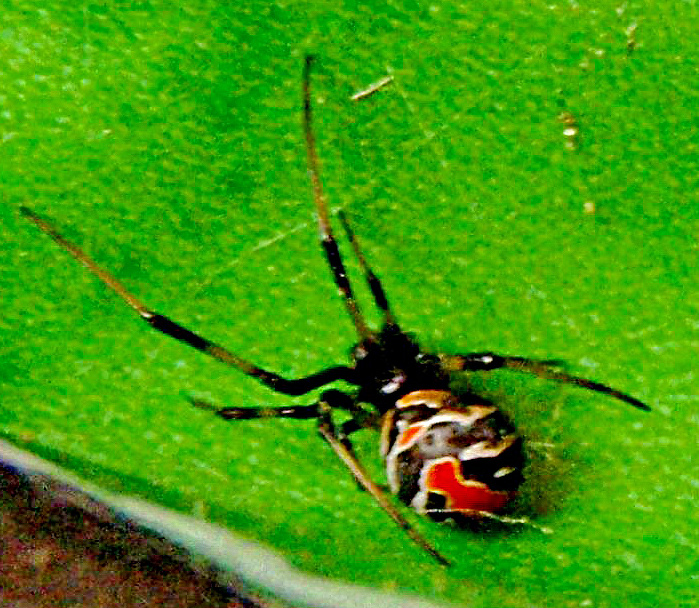
juvenile female redback spider
Redback spiders sense and communicate with vision, touch and chemicals usually detected by smelling. They also employ pheromones (chemicals released into air or water that are detected by and responded to by other animals of the same species) and vibrations. Webs are constructed so that spiders are able to sense vibrations — using their hair-like setae — made by animals moving into the web's strands. Unmated female redbacks deposit a chemical pheromone on their webs to attract males. During courtship, male redbacks must make their presence known using tactile cues to avoid being consumed. As with most spiders, redbacks have simple eyes that are capable of sensing movement.
In the summer of 2005, scientists warned that Australia's hot, humid and wet weather was driving redback spiders indoors. Reuters reported: Normally found in outdoor sheds, gardens and under roofs, the cantankerous creepy-crawlies are seeking shelter indoors in tropical Queensland and New South Wales, two of Australia's biggest states. "There has been rain and winds which push falling leaves into the roof gutters, destroying their web. This leaves them no other option but to come down into the house," said Queensland Museum arachnologist Robert Raven. [Source: Reuters, February 11, 2005]
Redback Spider Mating, Reproduction and Sexual Cannibalism
Redback spiders are polyandrous, with females mating with several males during one mating season. They employ sperm-storing (producing young from sperm that has been stored, allowing it be used for fertilization at some time after mating) and use delayed fertilization in which there is a period of time between copulation and actual use of sperm to fertilize eggs; due to sperm storage and/or delayed ovulation. Redback spiders engage in year-round breeding and capable of breeding once every one to three weeks. They most commonly breed during summer months). The gestation period ranges from 17 to 43 days, with the average being 28.7 days. The average number of eggs and offspring is 2,500. On average females reach sexual or reproductive maturity at age 120 days and males so at 90 days.[Source: Aaron Bindman, Animal Diversity Web (ADW) |=|]
Redback spiders mating behavior includes sexual cannibalism. Aaron Bindman wrote in Animal Diversity Web: Smaller males attempt to mate multiple times with a single, much larger, female. When they approach a female, a male will insert one pedipalp into one of the female's sperm-storage organs. During this action it will twist its body 180 degrees, placing its abdomen directly near the female's fangs (a "copulatory somersault"). Early in this first sperm transfer, the female begins to masticate her partner; most males (69.6-83.3 percent), are able to break free of this first restraint. After additional courtship behaviors by males, the mating behavior described is repeated, with the male's second pedipalp inserted into the female's other sperm-storage organ. Following 65 percent of these second insertions, the female will completely consume the male.
Some male redbacks have adapted a unique behavior called "mid-dorsal abdominal constriction" in order to increase survival after the first attempt of female cannibalism. This involves manually shrinking their abdomens and, in so doing, shifting essential organs anteriorly, lengthening survival time of males so they may inseminate the female’s second sperm-storage organ. Those who succeed at this behavior increase chances of paternity. |=|
Due to cannibalistic behaviors by females, a majority of male redbacks only mate with one female. During the mating period, several males are typically found on a female's web, leading males to compete with one another, often fatally, for access to females. Redbacks have a lengthy courtship period of around three hours; however, males may rush these activities if another male is detected approaching. If they attempt to shorten courtship too much, females typically cannibalize males before copulation is completed. During copulation, the apical sclerite of the male redback spider's copulatory organ may break off and act as a plug in the female's sperm-storage organs, blocking insemination by other males and helping increase chances of paternity for the first mate. Cannibalized males who exhibit this behavior potentially more than double their likelihood of paternity compared to males not consumed. After consumption of a male, females are much less receptive to further mates. Because 80 percent of males never find a mate, it is important to invest everything into their one mating experience. Redback spider males who survive copulation are likely sterile for the rest of their lives. |=|
Redback Spider Offspring and Development
Parental care by redback spiders is provided by females. Males are usually dead by the time young are born. After mating, sperm is stored by females in the spermathecae, organs of the female reproductive tract, and can be used up to two years later to fertilise several clutches of eggs. Females lay multiple batches of eggs, from different supplies of sperm, with a period of at least one to three weeks between each batch. Batches are made up of about 10 egg sacs, each of which contains approximately 250 eggs, which are laid and suspended in the web. [Source: Aaron Bindman, Animal Diversity Web (ADW) |=|]
Each clutch of 250 eggs is housed in a round white silken egg sac which are white when the sacs are laid but turn brown over time. The length of time before hatching is related to temperature, with young emerging, according to some studies and observations, after 17-24 days at 30°C (86̊ F) and after 26-43 days at 25°C (77̊F). Below 25°C, development is typically arrested.
Females lay large numbers of eggs and suspend them in bundles from their webs, possibly as a form of protection. When hatched, spiderlings quickly disperse from their mother's territory. Sometime spiderlings disperse from their place of birth by catching air currents while attached to long silk threads, with their landing places typically determining their nesting areas.
Young redback spiders follow a similar developmental sequence to other spider species. A week and a half after females lay their egg sacs, the first molt occurs inside individual eggs. The first instar (stage between molts) follows, during which spiderlings hatch and disperse within 14 days, usually via wind currents. Young spiders look like small adults. Members of this species reach maturity and adult size after four instars/5 molts (males) or six instars/7 molts (females).
Redback Spider Bites
Redback spiders have historically been responsible for more envenomations requiring antivenom than any other creature in Australia. However, by 2017 the spider was blamed for only 250 envenomations requiring antivenom annually. Estimates of the number of people thought to be bitten by redback spiders each year across Australia range from 2,000 to 10,000. A 2004 review reported 46 percent of bites occurring on distal extremities of the limbs, 25 percent on proximal areas of limbs (upper arms and thighs), 21 percent on the trunk, and 7 percent on the head or neck. In some cases the same spider bites a victim multiple times. Historically, victims were often bitten on the genitalia. The occurance of this phenomenon disappeared as outhouses were replaced by indoor toilets.[Source: Wikipedia]
Most bites appear to be by females. Males are believed to be as capable of delivering painful, venomous bites as females, although bites are rarely reported. When disturbed, larger females redback spiders often bite and envenomate intruders. Bites typically occur during the summer season and in the late afternoon when temperatures are highest and the spiders are most active. The venom is produced in the cephalothorax and is delivered via the animal's fangs. Redback spiders can control the amount of venom that they inject and "dry" bites are not unheard of. [Source: Aaron Bindman, Animal Diversity Web (ADW) |=|]
Approximately 80 percent of bites cause little to no effect. Of the remaining 20 percent, most feel pain spreading out from the bite spot for only about 24 hours. More serious cases include pain lasting longer than 24 hours, bumps and swollen lymph nodes followed by sweating, a rapid heart beat, possible vomiting, headache, and insomnia. Unlike most other envenomation syndromes, the effects of bites from this species may persist for several days, weeks, or months.
Fatalities from redback bites are rare and none have occurred since 1956, when an antivenom was created. Most bites from this species can be treated with household remedies (ice packs and pain relievers). Bites that show more severe symptoms may require antivenom to be administered intramuscularly, sometimes in multiple injections. Recently, Australian doctors have chosen to only give the antivenom when absolutely necessary because they fear possible negative side effects. Other doctors are not convinced of its effectiveness in general. |=|
Redback Spider Venom
Redback spider venom is neurotoxic and can causes symptoms like intense pain, sweating, muscle cramps, and nausea. There is an antivenom available in Australia. Black widow venom is also neurotoxic and can cause severe pain, muscle cramps, sweating, nausea, and difficulty breathing. The main toxic component of redback venom, α-latrotoxin, affects humans differently depending on the amount injected.
Redback venom is produced by holocrine glands in the spider's chelicerae (mouth parts). Venom accumulates in the lumen of the glands and passes through paired ducts into the spider's two hollow fangs. The venom of the redback spider is thought to be similar to that of the other Latrodectus spiders. It contains a complex mixture of cellular constituents, enzymes and a number of high-molecular-weight toxins, including insect toxins and a vertebrate neurotoxin called alpha-latrotoxin, which causes intense pain in humans.
In vertebrates, alpha-latrotoxin destabilizes cell membranes and causes the degranulation of nerve terminals, resulting in excessive release of neurotransmitters, namely acetylcholine, norepinephrine and GABA. Excess neurotransmitter activity causes many of envenomation symptoms but exactly how this occurs is not well understood. Acetylcholine release accounts for neuromuscular manifestations, and norepinephrine release accounts for the cardiovascular manifestations.
Female redbacks have an average of around 0.08–0.10 mg of venom, and experiments indicate that the median lethal dose (LD50) for mice at room temperature is 10–20% of this quantity (0.27–0.91 mg/kg based on the mass of the mice used), but that it is considerably deadlier for mice kept at lower or higher temperatures. Pure alpha-latrotoxin has an LD50 in mice of 20–40 μg/kg. The specific variant of the vertebrate toxin found in the redback was cloned and sequenced in 2012, and was found to be a sequence of 1180 amino acids, with a strong similarity to the equivalent molecule in other Latrodectus mactans spiders. There is some evidence there is a higher incidence of sweating, and local and radiating pain with the redbacks, while black widow envenomation results in more back and abdominal pain. Abdominal rigidity is a feature common with bites from the west coast button spider (Latrodectus indistinctus) of South Africa.
Redback Spiders in Japan
In 1995, poisonous Australian redback spiders were found in the Takaisho district of southern Osaka and in Yokkaichi, a western port city in Mie prefecture. The black spiders, with a red stripe on their back, are less than five centimeters (two inches) in length and and have a one centimeter (half inch) body. They produce venom equivalent to a bad bee sting that in some cases makes people sick for a couple of days. No one has died from a redback bite in Australia since the antitoxin was developed in 1956. [Source: Kevin Sullivan and Mary Jordan, the Washington Post]
In spite of assurances by Australians who consider the spider shy and non-threatening, the Japanese freaked out. Men in toxic-waste suit, armed with vacuums, fumigators tweezers, nets and chopsticks, searched swear and drain pipes for spiders. Schoolyards and parks were fumigated and shipments of antitoxin were airlifted from Australia. The stock of Fumakilla, Japan’s largest insecticide maker, jumped 16 percent in one day. Headlines in newspapers screamed, "Archipelago Panic!" and "Redbacks Spin Web of Wear in Osaka."
About 800 spiders were found in the drain of a public pool in Sakai in Osaka and another 100 were found 60 miles away in Yokkaichi. It is believed the spiders arrived in Japan from Australia in a cargo of fruit or vegetables in the early 1990s. In August 2005, redback widow spiders were found in the Kanto area in Takasaki in Gunma Prefecture.
Australians were highly amused by the Japan reaction. Redbacks are very common and few people have ever been seriously hurt by them. A popular schoolyard goes" "There was a redback on my toilet seat when I was there last night. I didn't see it in the dark, but boy I felt its bite.” One Australian journalist told the Washington Post, "It's impossible to live in Australia and not see them. They're fairly timid spiders...But Japan is in a panic. The whole thing is hilarious."
Image Sources: Wikimedia Commons
Text Sources: Animal Diversity Web animaldiversity.org , National Geographic, Live Science, Natural History magazine, Australian Museum, David Attenborough books, Australia Geographic, New York Times, Washington Post, Los Angeles Times, Smithsonian magazine, Discover magazine, The Conversation, The New Yorker, Time, BBC, CNN, Reuters, Associated Press, AFP, Lonely Planet Guides, Wikipedia, The Guardian, Top Secret Animal Attack Files website and various books and other publications.
Last updated August 2025