
KING OF SAXONY BIRDS-OF-PARADISE
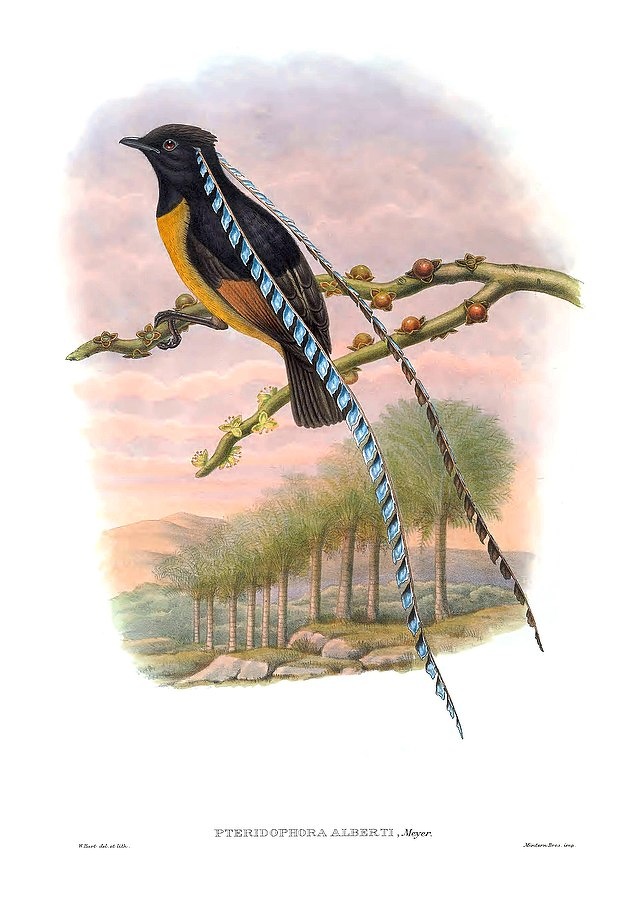
King of Saxony bird-of-paradise
King of Saxony birds-of-paradise (Pteridophora alberti) are the only birds-of-paradise and the only member of genus Pteridophora. Endemic to montane forests in New Guinea, they reside in the western and central two-thirds of the central mountain ranges, from Weyland Range to Kratke Range and Mount Giluwe in Papua New Guinea. The mainly eat fruits, berries, insects and other arthropods. [Source: Wikipedia]
These birds were first described by Adolf Bernard Meyer of the Dresden Museum in the December 1894 bulletin of the British Ornithologist's Club. Both the common name "King of Saxony" and the scientific specific name "alberti" honored the then king of Saxony, Albert of Saxony, whose wife had her name attached to the Queen Carola's parotia. King of Saxony birds-of-paradise are is sometimes referred to as "Kiss-a-ba" or "Leme" by the natives of Papua New Guinea and Western New Guinea — names derived from the sounds of the male's loud call. The Wola people of New Guinea imitate the courtship displays of King of Saxony bird-of-paradise in their ritualistic dances; the Wola also use the occipital plumes in traditional headresses.
King-of-Saxony birds-of-paradise are found mostly in rain forests in the mountains of New Guinea from 1500 to 2850 meters (4921 to 9350 feet),usually between 1,800 and 2,500 meters. They don’t require pristine forest; they do well in lightly disturbed sections of rain forest and forest edges as well. There are two main ranges of King-of-Saxony birds-of-paradise in New Guinea, which run in a generally south-east line from the Weyland and Snow Mountains eastward to the Bismarck and Kratke Ranges. The larger of the two ranges of King of Saxony bird-of-paradise is located more to the north, and covers much of the Weyland Mountains. The smaller, more circular range sits to the south-east. [Source: Katherine Grzesiak, Animal Diversity Web (ADW) |=|]
Males have long been hunted for their valuable long plumes used by locals and in the past Europeans for adornment. These striking occipital plumes sported by males, which were used in ladies’ hats in the late 1800s into the 1930s, when hunting of all birds-of-paradise was banned by both the United Kingdom and the Netherlands. Despite this King of Saxony birds-of-paradise are still fairly common in parts of their range, much of which is difficult fir humans to reach. They are classified as a species of of least concern on the International Union for Conservation of Nature (IUCN) Red List of Threatened Species. In CITES (Convention on International Trade in Endangered Species of Wild) they are in Appendix II, which lists species not necessarily threatened with extinction now but that may become so unless trade is closely controlled. /=\
RELATED ARTICLES:
BIRDS-OF-PARADISE ioa.factsanddetails.com
ALFRED RUSSEL WALLACE ON BIRDS OF PARADISE factsanddetails.com
PARADISAEA BIRDS-OF-PARADISE: LESSER, RED, BLUE, EMPEROR'S, GOLDIE'S AND RAGGIANA SPECIES ioa.factsanddetails.com
GREATER BIRD-OF-PARADISE: CHARACTERISTICS, BEHAVIOR AND REPRODUCTION factsanddetails.com
SICKLE-TAILS (CICINNURUS): MAGNIFICENT, WILSON'S AND KING’S BIRDS-OF-PARADISE factsanddetails.com
ASTRAPIA BIRDS-OF-PARADISE: CHARACTERISTICS, BEHAVIOR AND REPRODUCTION ioa.factsanddetails.com
PAROTIA BIRDS-OF-PARADISE: CHARACTERISTICS, BEHAVIOR, DANCES ioa.factsanddetails.com
LOPHORINA (SUPERB BIRD-OF-PARADISE): CHARACTERISTICS, SPECIES AND WILD COURTSHIP DANCES factsanddetails.com
RIFLEBIRDS (PTILORIS): CHARACTERISTICS, BEHAVIOR, SPECIES, REPRODUCTION ioa.factsanddetails.com
SICKLEBILL BIRDS-OF-PARADISE: CHARACTERISTICS, BEHAVIOR, SPECIES ioa.factsanddetails.com
BIRDS-OF-PARADISE AND HUMANS ioa.factsanddetails.com
BIRDS: THEIR HISTORY, CHARACTERISTICS, COLORS factsanddetails.com
King of Saxony Bird-of-Paradise Characteristics and Diet
King of Saxony birds-of-paradise are relatively small. They range in weight from 68 to 95 grams (2.40 to 3.35 ounces) and have an average length of 22 centimeters (8.66 inches), excluding their tail feathers. Sexual Dimorphism (differences between males and females) is present: Males are larger than females. Males weigh 80 to 95 grams. Females weigh 68 to 88 grams. Sexes are colored or patterned differently with the male being more colorful. Ornamentation is different. [Source: Katherine Grzesiak, Animal Diversity Web (ADW) |=|]
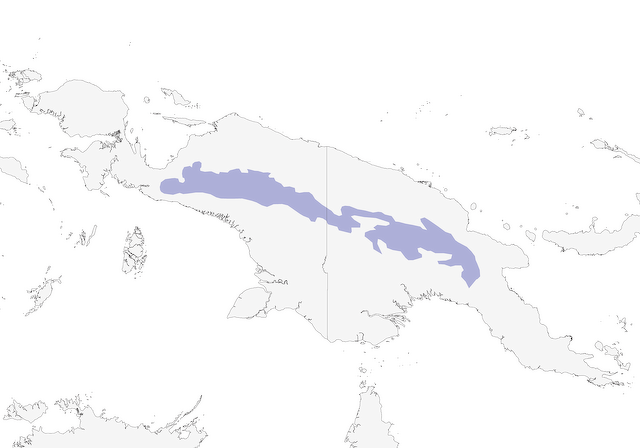
range of King of Saxony birds-of-paradise
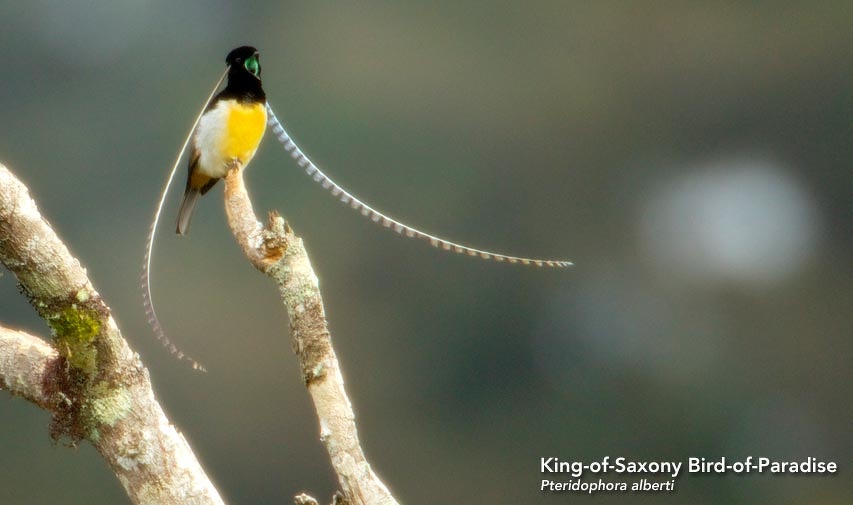
Males are black and yellow with dark brown irises, brownish-grey legs, a black bill with a bright aqua-green gape, and two remarkably long scalloped, enamel-blue brow-plumes — up to 50 centimeters — that can be independently erected at the bird's will. According to Animal Diversity Web: The head, chest and top of the body are black, with scale-like iridescent feathers on the chest, the underbody is buff-yellow. The wings have large ochre patches formed from the bases and leading edges of the primary feathers. The legs are grey-brown, the bill is black with a bright aqua-green gape. A feather shaft twice as long as the bird’s body sporting 40 to 50 flag-like structures are rooted behind each eye. These flags are bright blue on top, and red-brown underneath. The unadorned female is greyish brown with barred underparts. Their off-white underbodies are patterned with darker chevrons. There are also immature males that sport female-style plumage.
The male's ornamental head plumes are so unusual that, when the first specimen was brought to Europe, they was thought to be fakes. King of Saxony bird-of-paradise skulls have small depressions behind the occipital cavity to allow for the musculature necessary to control the occipital plumes. Moulted head-plumes in good condition are sought by male Archbold's bowerbirds for use as decorations, and in turn collected from the courtship bowers by humans.
King-of-Saxony birds-of-paradise are mainly frugivores (eat fruit). Approximately 80 percent of their diet consists of fruit; they tend to favor green fruits, especially false figs above most other fruits. They are also known to eat insects. Adult males forage mainly in the upper canopy, but females and males with female-plumage have been spotted in all levels of forest growth.King-of-Saxony birds-of-paradise may be made up of three subspecies: Pteridophora a. alberti, P. a. burgersi, and P. a. hallstromi. The differences between these subspecies are mostly matters of subtle changes in coloration. However, these subspecies descriptions are not universally accepted.
King of Saxony Bird-of-Paradise Behavior and Communication
King-of-Saxony birds-of-paradise fly and are arboreal (live mainly in trees), diurnal (active mainly during the daytime), motile (move around as opposed to being stationary), sedentary (remain in the same area) and territorial (defend an area within the home range). [Source: Katherine Grzesiak, Animal Diversity Web (ADW) |=|]
King-of-Saxony birds-of-paradise are mainly solitary birds excapt during the mating season. Males are likely territorial yet are known to group closer together than usual during displays, though the closeness of a true lek is not reached.
King-of-Saxony birds-of-paradise communicate with vision and sound and sense using vision, touch, sound and chemicals usually detected with smell. They communicate mostly using vocalizations, body posturing and movements. According to Animal Diversity Web: The male’s song has been described as a radio-static hiss, which increases in tempo and lessens in volume simultaneously. Songs last four to five seconds, and are repeated at one-minute intervals. Immature males give calls described as noisy descending churrs. Males courting females perform elaborate movements with their occipital plumes during their songs, as well as changing posture to better attract the female’s attention. Females convey interest or disinterest during displays using body posture as well.
King of Saxony Bird-of-Paradise Mating, Reproduction and Offspring
King-of-Saxony birds-of-paradise are polygynous (males have more than one female as a mate at one time). They engage in seasonal breeding once yearly— from April through November. The average number of eggs per season is one. It is not known if more than one clutch is attempted per season. The average time to hatching is 22 days. The mating system is considered an "exploded lek" because males perform mating displays in their own spot in a place where many males attempt to court females. When approaching the female for copulation, the male wags his head from side to side while hopping up the vine. After copulation, the female leaves, and the male returns to his perch to attract another female. [Source: Katherine Grzesiak, Animal Diversity Web (ADW) |=|]
Female King of Saxony bird-of-paradise care for chicks exclusively. Other than copulating, males have no involvement in the raising of young. Females build their own nests, and care for chicks by themselves, including providing food. Young are altricial, meaning they are relatively underdeveloped at birth. Nestling and fledging periods are unknown. However, most species in the birds of paradise family fledge within 20 to 30 days of hatching. Age of sexual maturity is also unknown for this species, but sexual maturity usually takes one to two years for most birds of paradise.
The courtship display of male King-of-Saxony birds-of-paradise begin near dawn or in late afternoon, when the male attracts a female by singing a hissing rattle while sitting on a bare branch in the canopy. He accompanies his song with movements of his occipital plumes while his mantle cape and breast shield are held erect. The male usually turns repeatedly on his perch. When a female arrives, he flies down to vines in the understory, usually two or more meters from the forest floor. There, he perches below the female on a vine, bounces, and gives a hissing call, which is often accompanied by manipulations of the occipital plumes, erection of the mantle cape and breast shield, and, if the female appears disinterested, wing shivers.
King of Saxony Birds-of-Paradise Courtship Behavior
Adult male King of Saxony birds-of-Paradise are territorial, guarding their territory from perches placed in the tops of tall trees. From these perches they sing to compete with males in neighbouring territories. While singing, the male moves his occipital plumes about. In 1996 David Attenborough filmed the first ever footage of their mating ritual of the bird. [Source: Wikipedia]
King of Saxony Bird-of-paradise mating and courtship behavior combines vocalizations, physical movements, and enhancement and displays of their bold and beautiful plumage. Their occipital feathers — or “head wires” — serve no purpose other than to be eye-catching ornaments. These feathers can be twice as long as male’s body and have evolved as the result of female selection, in which females select males based upon indirect genetic benefits which increase offspring fitness. Their displays are most common between July and February, but can occur any time of the year.
Male King of Saxony birds-of-paradise begin their song-and-dance courtship displays perched on a branch in the forest canopy in exploded leks and sing to attract females. In an "exploded lek" males spread out over a large area to perform their displays to attract females. They are separated from each other by significant distances but still within earshot of each other. In traditional leks males are closely grouped together in a visible display area. The term "explode" is used because they are scattered over a large area. Females flit about checking out the different displays, shopping around for a suitable mate.
The songs sung by the males have been described as being like "radio-static hisses," and last from four to five seconds, and have been chosen for over time through trial and error based on their success in attracting females. Songs are repeated at one minute intervals until a female arrives. The the male King of Saxony starts dancing usually in a way that utilizes their unique occipital plumes, flaring them up and down to arouse the interest of the attending female.
If the female’s interest is piqued, males bounce their mantle cape and breast shield feathers up and down. If the female is still attracted she invites the male to the understory of the forest where the courtship continues. Here, the male perches on a vine, connected to, but below the female and proceeds to rhythmically bounce up and down, which in turn, causes her vine to vibrate. If she is still enticed, the male hop up next to her, erecting his mantle cape and breast shield and wagging his head from side to side to get his head wires to swirl about the female.
Image Sources: Wikimedia Commons
Text Sources: Animal Diversity Web animaldiversity.org ; National Geographic, Live Science, Natural History magazine, David Attenborough books, New York Times, Washington Post, Los Angeles Times, Smithsonian magazine, Discover magazine, The New Yorker, Time, BBC, CNN, Reuters, Associated Press, AFP, Lonely Planet Guides, Wikipedia, The Guardian, Top Secret Animal Attack Files website and various books and other publications.
Last updated June 2025