
Home | Category: Oceans and Sea Life / Physical Oceanography / Surfing
ROGUE WAVES
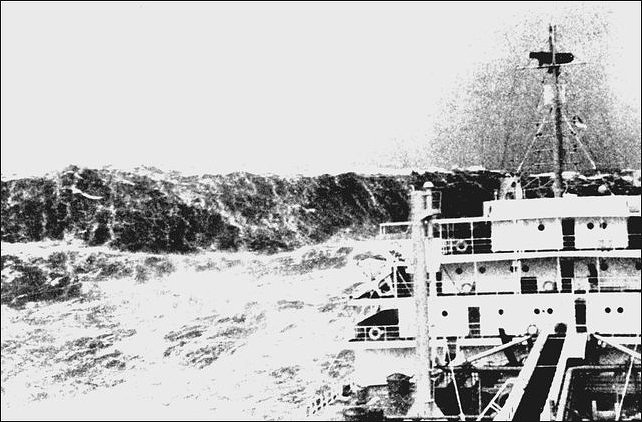
Rogue wave in the Bay of Biscayne in 1940
Massive waves, called freak waves, killer waves or rogues, develop in the open sea and are a serious danger to even the largest ships. Between 1984 and 2004 more than 200 super carriers were lost at sea, reportedly due to massive waves. These waves can reach heights of over a 30 meters 100 (feet) and generate a force equal to 100 tons a square meter. They are a threat to cargo ships and ocean liners. Such waves can also be a threat to coastal communities and beachgoers if they make it all the way to shore.
Rogue, freak, monster or killer waves have been part of marine folklore for centuries and were thought to be myths or exaggerations. They have only been accepted as real by scientists over the past few decades. The Draupner wave, a single giant wave measured on New Year's Day 1995 on an oil platform the North Sea, finally confirmed the existence of rogues. This wave had reached a height of 25.6 meters (84 feet). Careful analysis of two European Space Agency satellite images of the world’s oceans over a three week period in 2001 scientists spotted ten waves that were over 25 meters (82 feet) in height, indicating that not only do they exist but occur with more frequency than people had thought.
Rogues, called 'extreme storm waves' by scientists, are those waves which are greater than twice the size of the highest surrounding waves, are very unpredictable, and often come unexpectedly from directions other than prevailing wind and waves. They are often described by witnesses as "walls of water". They are often steep-sided with unusually deep troughs.[Source: NOAA]
Scientists say: “These waves are at least twice as tall as the surrounding waves. They’re unpredictable. They can come from unexpected directions, often against prevailing winds and swells. You need a whole cocktail of factors to come together – wind, swell, current. It’s a chaotic, nonlinear wave interaction, where one wave will suddenly gather energy from others and explode in size.” [Source: Dashel Pierson, Surfer Magazine, June 27, 2025]
I. Nikolkina and I. Didenkulova wrote: The New Era of rogue wave science started with the 25.6 meters “New Year wave” recorded in the North Sea at the Statoil-operated “Draupner” platform on 1 January 1995. This wave of an enormous crest height (18.5 meters) luckily did not cause substantial damage, but attracted attention of the public and insurance agencies to this problem. After this ground-breaking record numerous high-cost accidents of oilplatforms and ships have been linked to the rogue wave occurrence. It is believed by now that rogue waves have been a major cause of more than 200 accidents” between 1990 and 2010 including the loss of supertankers and container ships exceeding 200 meters in length.[Source: I. Nikolkina and I. Didenkulova, University of the French West Indies and Guiana, Guadeloupe, Tallinn University of Technology,Tallinn, Estonia, Natural Hazards Earth System Science, November 2011]
Related Articles:
LARGE AND DANGEROUS WAVES: SNEAKER WAVES, METEOTSUNAMIS AND THE BIGGEST WAVES EVER ioa.factsanddetails.com
OCEANS: THEIR HISTORY, WATER, LAYERS AND DEPTH ioa.factsanddetails.com
PHYSICAL FEATURES OF THE OCEAN FLOOR: TRENCHES, VENTS, MOUNTAINS ioa.factsanddetails.com
ISLANDS: TYPES, HOW THEY FORM, FEATURES AND NATIONS ioa.factsanddetails.com
OCEAN CURRENTS ioa.factsanddetails.com
SURVIVORS AT SEA: ADRIFT FOR MONTHS, ALONE IN A RAFT AND 480 METERS UNDERWATER ioa.factsanddetails.com
RECOMMENDED BOOKS:
“The Wave: In Pursuit of the Rogues, Freaks, and Giants of the Ocean” by Susan Casey (2010) Amazon.com
“Waves and Beaches: The Powerful Dynamics of Sea and Coast” by Willard Bascom 2021) Amazon.com
“Waves in Oceanic and Coastal Waters” by Leo H. Holthuijsen (2007) Amazon.com
“Waves, Tides and Shallow-Water Processes” Open University(1989) Amazon.com
“Tides: The Science and Spirit of the Ocean” by Jonathan White Amazon.com
“Surf Science” by Tony Butt (2004) Amazon.com
“The Beach Book: Science of the Shore” by Carl H Hobbs (2012) Amazon.com
“Descriptive Physical Oceanography” by Lynne Talley (2017) Amazon.com
“Essentials of Oceanography” by Alam Trujillo and Harold Thurman Amazon.com
“The Blue Machine: How the Ocean Works” by Helen Czerski, explains how the ocean influences our world and how it functions. Amazon.com
“How the Ocean Works: An Introduction to Oceanography” by Mark Denny (2008) Amazon.com
“The Science of the Ocean: The Secrets of the Seas Revealed” by DK (2020) Amazon.com
“Atmospheric and Oceanic Fluid Dynamics: Fundamentals and Large-Scale Circulation” by Geoffrey K. Vallis (2006) Amazon.com
“The Unnatural History of the Sea” by Callum Roberts (Island Press (2009) Amazon.com
“Ocean: The World's Last Wilderness Revealed” by Robert Dinwiddie , Philip Eales, et al. (2008) Amazon.com
“Blue Hope: Exploring and Caring for Earth's Magnificent Ocean” by Sylvia Earle (2014) Amazon.com
“National Geographic Ocean: A Global Odyssey” by Sylvia Earle (2021) Amazon.com
Causes of Rogue Waves
What exactly causes rogue waves is still a mystery, but scientists have ideas. Elizabeth Rayne of SYFY wrote: When storm winds that are already blowing mercilessly form waves in a current against the direction in which those waves would normally go, this drastically shortens wave frequency, meaning smaller waves are forced together into one Godzilla of a rogue wave. These can go on for a while before they finally collapse.” [Source: Elizabeth Rayne, SYFY, March 9, 2022]
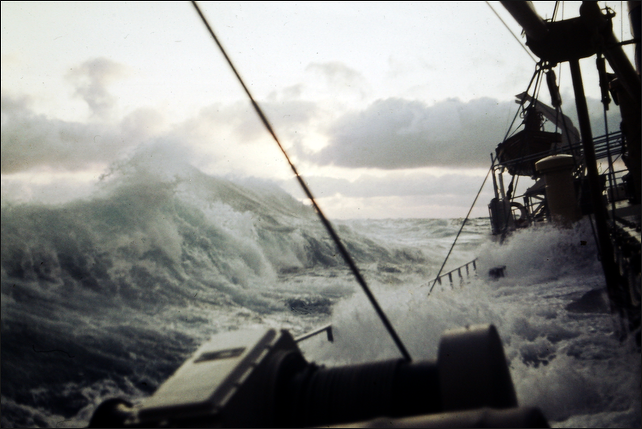
Big waves in the North Atlantic
Rouge waves usually occur in deep water, usually far out at sea. Since these waves are uncommon, measurements and analysis of this phenomenon is extremely rare. Exactly how and when rogue waves form is still under investigation, but there are several known causes: [Source: NOAA]
Freak waves have been reported in mid Pacific and mid Atlantic generated by large storms. Off South Africa they occur with some regularity where the fast flowing Agulhas Current runs head on into waves generated by winds blowing in the opposite direction. Off of Norway they have been reported where waves are focused on one spot in a shallow sea bottom. Many are believed to be caused when several waves combine, forming a super massive wave, or an already large wave steals energy from other waves.
Constructive interference. Extreme waves often form because swells, while traveling across the ocean, do so at different speeds and directions. As these swells pass through one another, their crests, troughs, and lengths sometimes coincide and reinforce each other. This process can form unusually large, towering waves that quickly disappear. If the swells are travelling in the same direction, these mountainous waves may last for several minutes before subsiding.
Focusing of wave energy. When waves formed by a storm develop in a water current against the normal wave direction, an interaction can take place which results in a shortening of the wave frequency. This can cause the waves to dynamically join together, forming very big 'rogue' waves. The currents where these are sometimes seen are the Gulf Stream and Agulhas current. Extreme waves developed in this fashion tend to be longer lived.
I. Nikolkina and I. Didenkulova wrote: The mechanism of rogue wave generation and propagation is recognized to differ in different zones of the World Ocean. In deep water the nonlinear self-modulation is commonly believed to be the most probable cause of rogue wave generation while in shallower water the effects of dispersion, basin geometry and bathymetry, and (both linear and nonlinear) wave-coast. Another important factor is the number of waves in the rogue event or wave grouping. Sometimes the rogue event is manifested by two or three (so-called “three sisters”) consecutive waves of extreme height We extracted available information on the number of observed abnormal waves for each rogue accident for rogue wave statistics in 2006–2010. In most of cases (83 percent) only one wave was observed. This conclusion remains the same for all kinds of rogue waves, even though the probability of single-wave events is slightly smaller for waves in deep water (78 percent) and is slightly larger for waves at the coast (87 percent). Still, it is remarkable that the occurrence of multiple extreme waves (two, three, four, and several) is regularly mentioned in the observations of rogue events. More often two or three waves are observed.
[Source: I. Nikolkina and I. Didenkulova, University of the French West Indies and Guiana, Guadeloupe, Tallinn University of Technology, Tallinn, Estonia, Natural Hazards Earth System Science, November 2011]
Many believe there is a link between big waves and climate change. Lancaster wrote in the Washington Post, “A warming atmosphere means warmer seas, which mean larger and more violent storms, which means bigger and more destructive waves — with potentially dire consequences for shipping and coastal erosion. As one climate scientist cheerfully tells her: "We're gonna get smacked. No doubt." [Source: John Lancaster, Washington Post, October 10, 2010]
Rogue Waves Between 1860 and 1950
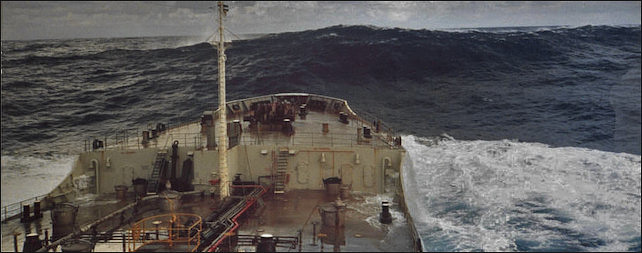
Rogue wave coming
In March 1861, a wave estimated to bee 66 meters (210 feet) high struck the lighthouse on Eagle Island, off the west coast of Ireland. The large wave smashed 23 panes at the top of the lighthouse, washing some of the lamps down the stairs and damaging beyond repair the reflectors with broken glass. In order to damage the uppermost portion of the lighthouse, water would have had to surmount a seaside cliff measuring 40 meters (133 feet) and a further 26 meters (87 feet) of lighthouse structure. [Source: Wikipedia]
In November 1865, the wooden cutter Aenid was in the Tasman Sea near Long Reef off New South Wales, Australia, when her helmsman sighted three huge waves approaching from the starboard side. Before he could turn the cutter to face them, they swamped Aenid and wrecked the ship. Two of the crew died. Four others on board survived. The wreck later was found washed up on Long Reef with part of its side smashed in.
In December 1900, three lighthouse keepers mysteriously disappeared from the Flannan Isles Lighthouse in the Outer Hebrides of Scotland during a storm. Although there were no surviving witnesses, a rogue wave that hit the west side of the island has been hypothesized to be responsible.
In October 1903, the British passenger liner RMS Etruria was only four hours out of New York City when, at 2:30 p.m., a rogue wave struck the ship. The wave was reported to be at least 15 meters (50 feet) high and struck the ship on the port side. The wave carried away part of the forebridge and smashed the guardrail stanchions. There were a number of first-class passengers sitting in deck chairs close to the bridge and they caught the full force of the water. One passenger was fatally injured and several other passengers were hurt.
In July 1909, the Blue Anchor Line luxury steamer SS Waratah, a 16,000-ton Australian ship disappeared without trace south of Durban, South Africa, with 211 passengers and crew aboard. No survivors or wreckage were found. The most plausible explanation for what happened was that the ship got hammered by a monster wave that caused it to either capsize or flooded her cargo holds, sinking her almost instantly.
In January 1910, a wave struck the liner RMS Lusitania during a storm in the Atlantic Ocean west of Ireland, smashing the windows in her bridge and pilot house 23 meters (75 feet) above the waterline, pushing the bridge back 5.1 centimeters (2 inches), and permanently depressing the bridge and forecastle deck by several centimeters. Water reached the top of the wheelhouse, 80 feet (24 meters) above her deck.
In December 1914, Captain Fred Harrington, the lighthouse keeper at Trinidad Head, California, saw a wave at the level of the lantern: 53 meters (175 feet) above sea level. In November 1915, the British battleship HMS Albemarle was truck by two large waves struck in rapid succession that severely damaged the ship in a storm in the Pentland Firth, a strait north of Scotland. Water rose as high as the bottom of the lower foretop, filling it with water. The forebridge was smashed. Much of it was found in pieces on the upper deck — wrecking the chart house, shifting the roof of the conning tower, and flooding the forward main gun turret, mess decks, and flats. Five of the ship’s crew died, and 17 others suffered serious injuries.
At midnight on 5–6 May 1916 the British polar explorer Ernest Shackleton was at the tiller of the small sailboat James Caird in the Southern Ocean during a storm when he thought he saw the bad weather clearing in the west, astern. He then realized that what he thought was a line of white clouds above a clear dark sky was actually the crest of a single enormous wave that struck and nearly swamped the boat. Shackleton reported that the wave was larger than any he had ever seen before in his 26 years of seafaring.
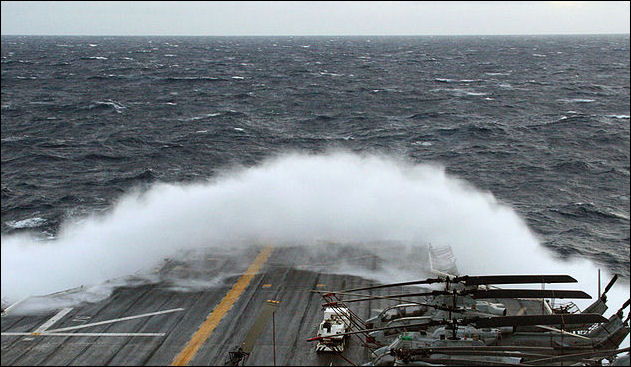
waves create sea spray over U.S. Navy ship
In August 1916, the United States Navy armored cruiser USS Memphis was wrecked in Santo Domingo harbor in the Dominican Republic when it was struck in rapid succession by three waves of up to 21 meters (70 feet) in height, causing 40 men to be killed and 204 to be injured. The waves also damaged and nearly capsized the U.S. Navy gunboat USS Castine, which also was in the harbor. Once thought to be a tsunami, the waves have more recently been recategorized as exceptionally large, wind-driven freak waves generated by passing hurricanes.
In August 1924, the British ocean liner Homeric arrived in New York City late after steaming through a hurricane off the United States East Coast in which a 80-foot (24 meters) rogue wave struck her, injuring seven people, smashing numerous windows and portholes, carrying away one of the lifeboats, and snapping chairs and other fittings from their fastenings. In February 1926 in the North Atlantic a massive wave hit the British passenger liner RMS Olympic, smashing four of the bridge's nine glass windows and doing some other damage. In 1934 in the North Atlantic an enormous wave smashed over the bridge of the British passenger liner RMS Majestic, injuring the first officer and the White Star Line's final commodore. In December 1942 while operating as a troopship and carrying 11,339 United States Army troops and crew, the British passenger liner RMS Queen Mary was broadsided during a gale by a 28 meters (92-foot) wave 608 nautical miles (700 mi; 1,126 kilometers) from Scotland. The Queen Mary nearly capsized. It listed briefly about 52 degrees before slowly righting itself.
Reports of rogue waves come mainly from mass media sources. Only in the last few decades has there been an effort to assess them scientifically.
Rogue Waves Between 1950 and 1999
In February 1963, the French Navy light cruiser Jeanne d'Arc encountered a rogue wave while serving as the training ship of the French Naval Academy. In 1966, the Italian liner Michelangelo was on its way to New York City when a giant wave tore a hole in its superstructure, smashed heavy glass 24 meters (80 feet) above the waterline, and killed a crewman and two passengers. The Wilstar, a Norwegian tanker, suffered structural damage from a rogue wave in 1974. [Source: Wikipedia]
In November 1975, SS Edmund Fitzgerald was a lake freighter that sank suddenly during a gale storm on Lake Superior, on the Canada–United States border. The ship went down without a distress signal in Canadian waters about 28 kilometers (17 miles) from the entrance to Whitefish Bay. The wreck was influenced in 160-meter (530-feet) deep water. All 29 members of the crew were killed. In October 1977, the tanker MS Stolt Surf encountered a rogue wave on a voyage across the Pacific from Singapore to Portland, Oregon. the engineer took photos of the wave, which was higher than the 22-meter (72-foot) bridge deck..

Big Waves at Kaena Point, Oahu, Hawaii in 2016
In December 1978, the MS Munchen, a six-year-old, 37,134-ton barge carrier, sunk suddenly in the mid-Atlantic with the loss its entire 27-member crews, presumably from a freak wave. A garbled mayday message was sent from from the mid-Atlantic at 3:00am. Rescuers found only "a few bits of wreckage." This included an unlaunched lifeboat, normally stowed 20 meters (66 feet) above the water line, which had one of its attachment pins "twisted as though hit by an extreme force." The Maritime Court concluded that "bad weather had caused an unusual event." It is thought that a large wave knocked out the ship's controls (the bridge was sited forward), causing the ship to shift side-on to heavy seas, which eventually overwhelmed it.
In February 1982, the Ocean Ranger, a semi-submersible mobile offshore drilling unit, sank with its entire crew lost in storm off of of Newfoundland that produced wave of 17 meters (55 feet) to 20 meters (65 feet). A wave higher than 28 meters (92 feet) flooded the platform's ballast control room. In 1985, the Fastnet Lighthouse off the south coast of Ireland was struck by a 47-meter-high (154-foot-high) wave.
In October 1991, in an incident that was the subject of the 200 film “The Perfect Storm”, with George Clooney, the fishing boat Andrea Gail was lost with its entire crew presumed dead off the coast of Nova Scotia. The boat got caught in the 1991 Perfect Storm while returning to Gloucester, Massachusetts, after fishing on the Grand Banks of Newfoundland. Near where the boat was last reported, waves were running at 18 to 21 meters (60 to 70 feet), and a series of buoys reported a rogue wave with a height of 30.7 meters (100.7 feet), the highest ever recorded in the area. It is assumed that whatever happened to Andrea Gail occurred very quickly. Debris and flotsam from the boat washed up on Sable Island. None of the bodies of six crewmen were ever found.
In September 1995, the ocean liner Queen Elizabeth 2 (QE2) was smashed by a 28 meter (95 foot) wave generated by Hurricane Luis in the North Atlantic. The master of the ship said it "came out of the darkness" and "looked like the White Cliffs of Dover." Newspaper reports at the time described the ocean liner as attempting to "surf" the nearly vertical wave in order not to be sunk.
Deep Ocean Rogue Waves Since 2000
In February 2000, a British oceanographic research vessel, the RRS Discovery, cruising in the Rockall Trough west of Scotland, encountered the largest waves ever recorded by scientific instruments in the open ocean. John Lancaster wrote in the Washington Post: Instruments on board measured the "significant wave height" — an average of the largest 33 percent of the waves — at 61 feet, (some spiked as high as 100 feet). The episode added to growing evidence about the prevalence of rogue waves. [Source:John Lancaster, Washington Post, October 10, 2010]
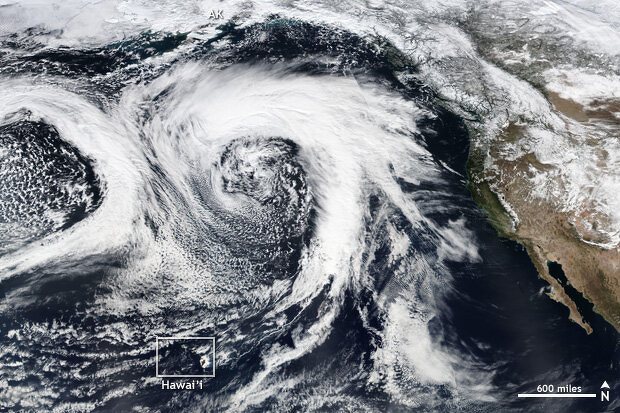
Storm in 2016 that caused big waves in Hawaii
In March 2001, two tourist liners — the “Bremen” and “Caledonia Star” — both had their bridge windows smashed in by 30 meter (100 foot) waves in the South Atlantic. All power and instrumentation was lost on both ships. Naval Research Laboratory ocean-floor pressure sensors detected a freak wave caused by Hurricane Ivan in the Gulf of Mexico in 2004. The wave was around 27.7 meters (91 feet) high from peak to trough, and around 200 meters (660 feet) long.
Video footage of a rogue wave appears in an episode of “Deadliest Catch from Season 2", Episode 4 "Finish Line". It is one of the few video recordings of a rogue wave. While sailing through rough seas during a night time storm, a "freak wave", believed to be around 18 meters (60 feet) high, violently struck the fishing vessel's starboard side. The wave crippled the vessel and causing it to tip onto its side at a 30-degree angle. The boat manages to right itself; some of the crew suffer minor injuries. [Source: Wikipedia]
In June 2005, two participants in a fishing competition were hit by pair of rogue waves which capsized their 10-meter (34-foot boat) 38 miles off Merritt Island, Bahamas. The men were rescued by Coast Guard 30 hours later, after an extended search. One of them said: "One second everything is going great. The next second we're upside down in the Atlantic Ocean, 30 miles out ... We weren't going fast, but the speed of the wave — the back wave pushed us into the front one... The sea had essentially dropped out ... It was just like we were just tumbling straight down and picking up speed at a wave that was triple the size of what we were just dealing with".
Between 2006 and 2010 , nine ship collisions with rogue waves in deep waters were reported. These events caused 6 fatalities and 27 injuries. The maximum wave height during deep water accidents reached 21 meters in November 2006 when the 440-ft merchant containership “Westwood Pomona” was hit by a wave that caused one injury, smashed windows on the bridge and damaged electronics, forcing vessel to seek temporary shelter in Coos Bay, Oregon.[Source: I. Nikolkina and I. Didenkulova, University of the French West Indies and Guiana, Guadeloupe, Tallinn University of Technology, Tallinn, Estonia, Natural Hazards Earth System Science, November 2011]
In December 2006 the ship “Picton Castle” was struck by rogue wave 760 kilometers from Cape Cod, in the Atlantic Ocean. The impact caused one fatality. In February 2007, Holland America's cruise ship MS Prinsendam was hit by two 12-meter (39 feet) tall rogue waves near Cape Horn. There were around 40 injuries, with some requiring hospitalization. In April 2007, The 17.5 meters ketch “Cowrie Dancer” was hit twice by waves up to 12 meters at a distance of 750 nautical miles south-east of the South African coast. Three West Australian men who were aboard were seriously injured. In May 2007, the submarine “HMAS Farncomb” encountered a rogue wave during the deployment in Southeast Asia waters. The event resulted in five injuries.
In March 2010, the largest number of human losses (two deaths and 14 injuries) was is associated with the accident of the cruise ship “Louis Majesty” that occurred 24 miles off the coast of Cabo de San Sebastian near the Spanish town of Palagrugell, in the Mediterranean Sea. The cruise ship was hit by three so-called “three sisters” giant waves. In December 2011, the super tanker “Aegean Angel” was hit by a big wave northeast of Bermuda in the Atlantic Ocean that resulted in two fatalities and ship damage.
Near Shore Rogue Waves Since 2000
A total of 30 shallow-water rogue wave events were reported in 2006–2010. Fourteen of them led to the vessel damage and seven of them to loss of life . I. Nikolkina and I. Didenkulova wrote: These events are associated with an extremely high number of human fatalities (79 persons) and injuries (90 persons). The largest number of fatalities supposedly caused by rogue waves is reported for the Indonesian region: in August 2010 the ship carrying 60 people (only 21 rescued) capsized and sank minutes before arriving in Lembata, Tenggara. Another large loss of lives (11 fatalities) occurred in this area when a fishing boat “Jaya Baru” was engulfed by 6 meters waves on 24 May 2007 The largest wave was reported on 11 November 2006 when the 42 000-tonne oil tanker “FR8 Venture” was hit by a 100 feet (about 30 meters) wave while passing through the Pentland Firth off the coast of northeast Scotland. Two crewmen were killed and one seriously injured during the accident. [Source: I. Nikolkina and I. Didenkulova, University of the French West Indies and Guiana, Guadeloupe, Tallinn University of Technology,Tallinn, Estonia, Natural Hazards Earth System Science, November 2011]
In November 2000, the 17-meter (56-foot) long research vessel R/V Ballena, with three crew members, was hit by a 6.1-meter (20 foot rogue wave and capsized near Point Conception off Santa Barbara, California. Two United States Geological Survey (USGS) crew members were trapped briefly inside the capsized ship, but they were able to find their way to the bridge doors and escaped but were unable to use the life raft. Two members of the crew donned the two available life jackets and all three attempted to swim to a pocket beach on Point Arguello. After the captain made it to shore he swam back out to assist the other two crew members. One USGS crew member was treated for facial lacerations and a slight concussion. The Ballena broke apart in the waves against the rocky shore and was totally destroyed. [Source: Wikipedia]
In April 2005, a rogue wave estimated at 18.3 meters (60 feet) in the Gulf Stream off of the coast of Georgia was caught in a photograph by a passenger on the the Norwegian Dawn cruise ship. At the time, surface winds were light at 15 knots. The wave was moving away from the ship after crashing into it moments before this photo. The wave caused injuries and damaged to the ship.
Three waves struck in succession, One passenger said: "The sea had actually calmed down when the 21-meter (69 feet) wave seemed to come out of thin air… Our captain, who has 20 years on the job, said he never saw anything like it." Media reported: "The water exerted enough force to shear off the welds for the aluminum rail supports on the [ninth and tenth level] balconies of two cabins, allowing the teak balcony rails to break loose and crash into the cabin windows. The broken glass filling the drains compounded the water damage by allowing a large amount of water to enter the two cabins and damage the carpets in 61 other cabins. The ship's operating at reduced speed when the waves hit probably limited the damage."
In April 2008, half a nautical mile off Kleinbaai, near Gansbaai, South Africa — freak wave hit tourists diving to see sharks. The shark diving boat capsized. Three tourists died, two were seriously injured and a number treated for shock. Multiple other shark boats witnessed the wave.
In June 2006, a terrible freak accident occurred. Three students and a teacher were killed during an educational trip to Costa Rica. The students had been spending the afternoon on the beach when an unexpected wave came in and pulled them under the water. The students described it as a perfect afternoon for swimming until the unexpected wave came. In May 2008 eight people died after a five- meter-high wave swept tourists and fishing people away along Kunsan, South Korea (Yoo et al., 2010). In February 2010 a rogue wave “wiped out” spectators at Mavericks surfing competition in California. At least 13 spectators received significant injuries, including broken legs and hands, when the crowd was knocked off the wall by two unexpected six-meter waves. [Source: I. Nikolkina and I. Didenkulova, University of the French West Indies and Guiana, Guadeloupe, Tallinn University of Technology, Tallinn, Estonia, Natural Hazards Earth System Science, November 2011]
During 2006–2010, 39 such events were reported, which caused 46 fatalities and 79 injuries. It is also interesting to note that 14 of 39 coastal rogue accidents (36 percent) occurred at gently sloping beaches and 25 (64 percent) at high rocks or cliffs or sea walls.. It has also been suggested that these types of waves may be responsible for the loss of several low-flying aircraft, namely United States Coast Guard helicopters on search and rescue missions maybe also some drug smugglers.
In September 2019, in the Cabot Strait off Channel-Port aux Basques, Newfoundland, during Hurricane Dorian, several rogue waves were detected by an off-shore buoy. Five of these rogue waves reached heights of 20 meters (66 feet) with the largest of the waves reaching 30 meters (100 feet).
In December 2022, an American woman was killed and four other passengers injured when a massive rouge wave struck the Viking Polaris cruise ship while it was sailing toward the port of Ushuaia in southern Argentina on an Antarctic cruise. [Source: The Guardian, December 3, 2022]
Six-Story Rogue Wave Off Vancouver — the Most Extreme Wave Ever Recorded?
In the winter of 2022, off the coast of Uclulet, British Columbia, Canada, sensors recorded a 18-meter (58-foot) wave — as high as a six -story building. Researchers Johannes Gemmrich and Leah Cicon, who co-authored a study published in Scientific Reports, describe the wave as something that could only happen once in a millennium. Detected with a sensor buoy, the wave was recorded at 57.7 feet (17.6 meters) tall, while other swells around the same time were only 19.6 feet (6 meters) tall, making it three times higher. [Source: Elizabeth Rayne, SYFY, March 9, 2022]
CTV News reported. "Only a few rogue waves in high sea states have been observed directly, and nothing of this magnitude," University of Victoria scientist Johannes Gemmrich, who co-led the research with Leah Cicon, said. "The probability of such an event occurring is once in 1,300 years...Proportionally, the Ucluelet wave is likely the most extreme rogue wave ever recorded," [Source: Brie Stimson, Fox News, February 11, 2022]
“Rogue waves are also sometimes called "freak" or "killer" waves and can be extremely dangerous because of their "unpredictability" and "sheer power," MarineLabs CEO Scott Beatty said. “The first rogue wave ever recorded was off the coast of Norway in 1995. Known as the "Draupner wave," it was about 83.9 feet tall while other waves surrounding it were closer to 39 feet tall. He said, "The potential of predicting rogue waves remains an open question, but our data is helping to better understand when, where and how rogue waves form, and the risks that they pose." "Capturing this once-in-a-millennium wave, right in our backyard, is a thrilling indicator of the power of coastal intelligence to transform marine safety," Beatty told CTV.
Massive Rogue Wave Batters Cruise Ship in North Sea
In December 2023, a rogue wave stunned passengers on a North Sea cruise, towering over and tossing the ship, tour operator Thorsten Hansen told TMX. His video shows the massive wave looming ahead of the Otto Sverdrup off the German coast. Despite the ship’s size—450 feet long, 70 feet wide, nearly 16,000 tons, with eight decks and room for 500 passengers—the wave dwarfed it. Storm Pia’s hurricane-force winds hammered the North Sea and much of Europe, the Danish Meteorological Institute reported. Rough seas interacting with the seafloor helped produce the rogue wave, which can reach twice the height of surrounding waves, according to NOAA. [Source: Hillary Andrews, Fox Weather, December 25, 2023]
Hansen said the same wave struck another cruise ship, the Maud, around the same time. It shattered two bridge windows, flooded the area, and knocked out the ship’s navigation and radar systems. With 266 passengers and 131 crew aboard, the vessel briefly lost power and plunged into darkness, according to local media and cruise line HX. Crew managed to restart one engine.“Spent 4 hours in survival suits and life vests… Hands down one of the scariest nights of my life,” one passenger wrote on Facebook, describing gale-force winds and 36-foot waves. An American passenger on X said, “There were about 20 minutes in which I thought the ship might capsize.” Although the cruise line initially reported no serious injuries, German outlets later said three passengers were hospitalized. Others reported broken bones, bruises and cuts.
Storm Pia also forced route changes. About 200 people had already disembarked in Norway due to worsening weather, local media said. After the incident, the Maud limped to Bremerhaven, Germany, where many passengers remained stuck because of limited flights. Pia’s powerful surf battered coastal towns and even knocked containers off cargo ships, scattering goods along Norwegian beaches. HX said the Maud will remain out of service until at least February for repairs. Passengers and crew on the Otto Sverdrup were evacuated when storm flooding closed the harbor, Hansen said.
Image Sources: Wikimedia Commons; YouTube, NOAA
Text Sources: National Oceanic and Atmospheric Administration (NOAA) noaa.gov; “Introduction to Physical Oceanography” by Robert Stewart , Texas A&M University, 2008 uv.es/hegigui/Kasper ; Wikipedia, National Geographic, Live Science, BBC, Smithsonian, New York Times, Washington Post, Los Angeles Times, The New Yorker, Reuters, Associated Press, Lonely Planet Guides and various books and other publications.
Last Updated November 2025