
Home | Category: Sea Life Around Australia
SEALS, SEA LIONS AND FUR SEALS IN AUSTRALIA
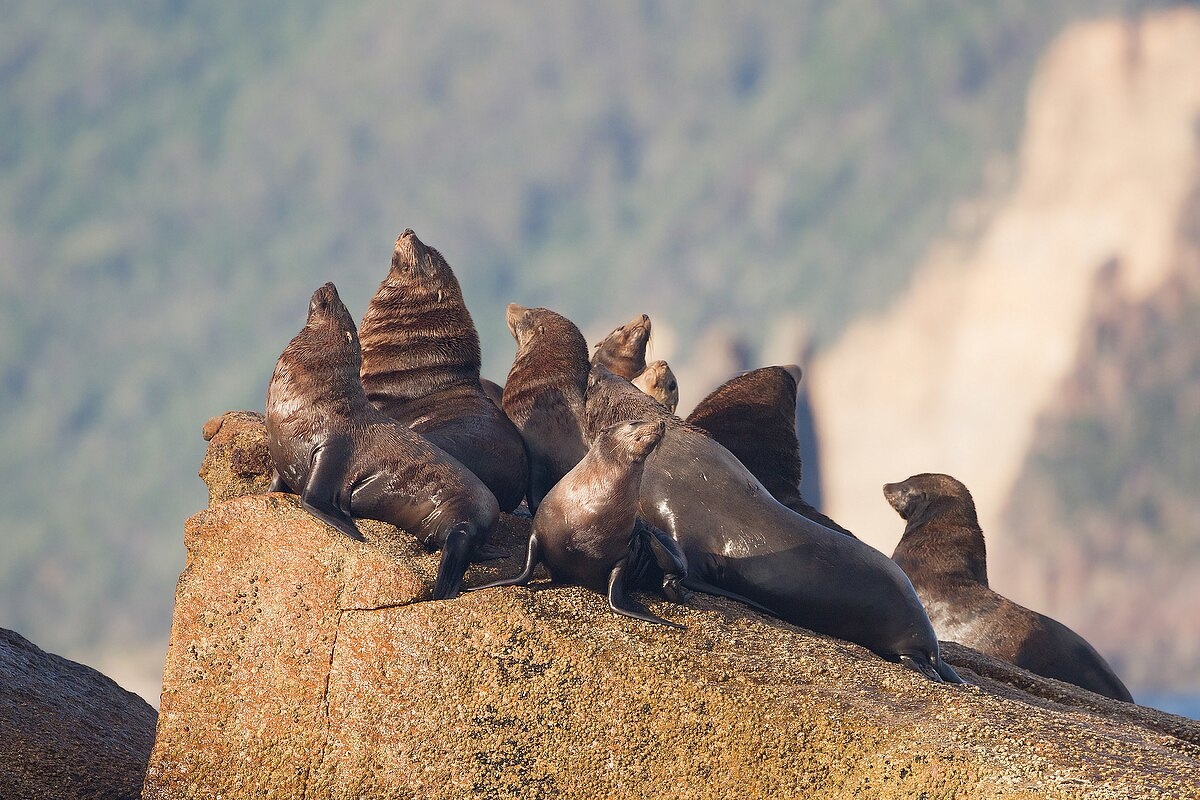
Australian fur seals basking in sun on the coast of Tasmani
Australia is home to three resident seal and sea lion species — endemic Australian sea lions, Australian fur seals and New Zealand fur seals — as well as species more typically associated with Antarctic waters — vagrant leopard seals, southern elephant seals and crabeater seals — which may visit southern coasts or islands. The main vagrant species primarily breed in the Antarctic region.
Australian sea lions (Neophoca cinerea) are Australia's only endemic pinniped. They are found along the southern and southwestern coastlines. They have an unusual 18-month breeding cycle and are listed as a threatened species. Australian fur seals (Arctocephalus pusillus doriferus) seals breed on islands and coasts of southern Australia. They are known for their ability to dive to significant depths in search of food. New Zealand fur seal (Arctocephalus forsteri): are also known as long-nosed fur seal. They are found on the southern coast of Australia.
Most of the species found Australia are sea lions and fur seals not real seals. Seals have furry, generally stubby front feet — thinly webbed flippers, actually, with a claw on each small toe — that seem petite in comparison to the mostly skin-covered, elongated fore flippers that sea lions possess. Sea lions have small flaps for outer ears. The "earless" or "true" seals lack external ears altogether. You have to get very close to see the tiny holes on the sides of a seal’s sleek head. Sea lions are noisy. Seals are quieter, vocalizing via soft grunts. [Source: NOAA]
While both species spend time both in and out of the water, seals are better adapted to live in the water than on land. Though their bodies can appear chubby, seals are generally smaller and more aquadynamic than sea lions. At the same time, their hind flippers angle backward and don't rotate. This makes them fast in the water but basic belly crawlers on terra firma. Sea lions, on the other hand, are able to "walk" on land by rotating their hind flippers forward and underneath their big bodies. Sea lions congregate in gregarious groups called herds or rafts that can reach upwards of 1,500 individuals. It's common for scores of them to haul out together and loll about in the sand, comprising an amorphous pile in the noonday sun.
Seals are protected under the Environment Protection and Biodiversity Conservation Act 1999 (EPBC Act). Fur seals (both Australian and New Zealand) are "eared seals," meaning they have visible external ear flaps and can use all four flippers to move on land. Sea lions are also eared seals. The term "seal" is often used generically to include seals, sea lions and fur seals.
In 2006, Two fishermen were arrested in Australia after three university students witnessed them shoot over 40 fur seals on Kanowna Island inside a national park. The two men, aged 19 and 29, were arrested at the port of San Remo by local authorities who were informed by the students seals on the island off of Victoria. Police said they found two rifles onboard the fishermen's boat and located the bodies of the slain seals. "I can't imagine how anyone calling themselves a human being would do this sort of thing," said John Thwaites, the environment minister of Victoria. "These are protected animals, they are rare animals and they're one of the most important species we have." There were reports the incident was the worst since Victoria declared seal hunting illegal in 1891. The suspects faced numerous charges including aggravated cruelty to animals. [Source: UPI, September 2, 2006]
Related Articles:
SEALS AND SEA LIONS IN NEW ZEALAND: SPECIES, CHARACTERISTICS, BEHAVIOR, REPRODUCTION ioa.factsanddetails.com
SEALS: CHARACTERISTICS, SENSES, WHISKERS, SPECIES ioa.factsanddetails.com;
SEALS: HISTORY, BEHAVIOR, DIVING, FEEDING, REPRODUCTION ioa.factsanddetails.com
SEA LIONS AND FUR SEALS: CHARACTERISTICS, BEHAVIOR, SPECIES, REPRODUCTION ioa.factsanddetails.com
SEALS AS PREY FOR ORCAS, GREAT WHITES AND POLAR BEARS ioa.factsanddetails.com ;
SEALS AND HUMANS: CLOTHES, HUNTS AND THE MILITARY ioa.factsanddetails.com ;
FUR SEALS: CHARACTERISTICS, BEHAVIOR, SPECIES ioa.factsanddetails.com ;
ELEPHANT SEALS, THEIR BEHAVIOR AND AMAZING DIVING ABILITY ioa.factsanddetails.com ;
SOUTHERN ELEPHANT SEALS: CHARACTERISTICS, BEHAVIOR, MATING ioa.factsanddetails.com
Australian and South African Fur Seals
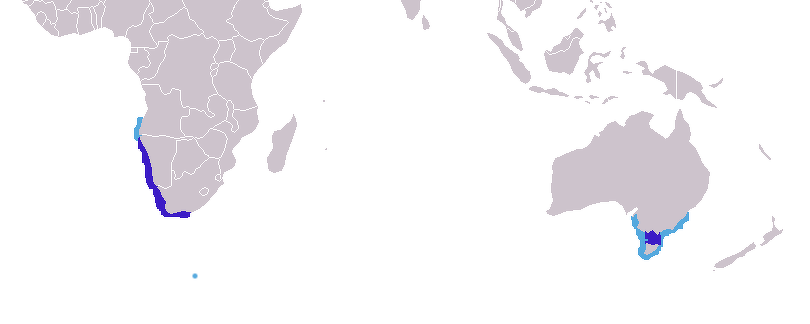
Range of Australia and South African fur seals: breeding (dark blue); non-breeding (blue)
Australia and South African fur seals (Arctocephalus pusillus) are the largest and most robust the fur seals. They are also known as Afro-Australian fur seals and there are two subspecies: 1) Australian fur seals (Arctocephalus pusillus doriferus), which breed on islands and coasts of southern Australia and are commonly spotted in Victoria, New South Wales, Tasmania and scattered islands; and 2) South African fur seals (Arctocephalus pusillus pusillus), which can be found along the southern and southwestern coast of Africa and are commonly spotted throughout Namibia and as far east as Port Elizabeth. The Southern African subspecies is, on average, slightly larger than the Australian subspecies. [Source: Cortney Hiller, Animal Diversity Web (ADW)
Southern African fur seals are are also known as Cape fur seals. They are, on average, slightly larger than the Australian fur seals. Both subspecies spend most of their year at sea but not too far from land. Venturing as far away as 160 kilometers (100 miles) from the shore is unusual for them. Breeding occurs on the mainland or small islands in the sand or rocks. Both subspecies prefer small rocky islands for mating and pupping. Australia and South African fur seals are separated by the large stretch of ocean between Africa and Australia. Skull characteristics of the two subspecies are similar enough to place them in one species. A notable difference between the two is the crest between the mastoid process and the jugular process of the exoccipital, which is proportionately larger in Cape fur seal.
Australia and South African fur seals are not endangered or threatened. They are designated as a species of least concern on the International Union for Conservation of Nature (IUCN) Red List but they are listed on the Trade in Endangered Species (CITES) in Appendix II, which lists species not necessarily threatened with extinction now but that may become so unless trade is closely controlled. |=|
South African fur seals are more abundant than are Australian fur seals. Both have been hunted by sealers, who often killed seals, in modern terms, quite brutally. Sealing has been practiced for centuries, with seals being taken for their skins, meat and blubber, a source of oil. Currently there are hunting seasons for different classes of the South African fur seal, but this is controversial. Seal pups are valued for their softer fur and male genitalia is taken and sold as an aphrodisiac in China and in some other placed in Asia. Australian fur seals are protected and is not legally hunted by humans today, but was so in the past. Both subspecies are taken poachers and killed by fishermen who regard them as competitors for fish. They are also unintentionally killed by drowning after getting caught up in fishing nets. Plastic, pieces of netting, and pieces of fishing line kill or injure thousands of these seals a year. Natural predators include great white sharks and orcas (killer whales). Stingrays have seriously injuried these pinnipeds. Pups left on the mainland in South African have taken by terrestrial predators, such as the black-backed jackal.
Australian and South African Fur Seal Characteristics and Diet
Australia and South African fur seals range in weight from 36 to 360 kilograms (79.3 to 793 pounds). Sexual Dimorphism (differences between males and females) is present: Males are larger than females. These pinnipeds have a large and broad head with a pointed snout that may be flat or turned up slightly. Their external ear flaps (pinnae) and whiskers (vibrissae) are long. Fore-flippers seal are dark brown to black. are covered with sparse hairs over about three-quarters of their length. The hind-flippers are short relative to their large body, with short, fleshy tips on the digits.
Adult male Australian fur seals weigh between 190 and 280 kilograms (420 to 620 pounds) are 2.0 to 2.2 meters (6.6 to 7.2 feet) in length. Females are weigh 36 to 110 kilograms (79 to 243 pounds) and 1.2 to 1.8 meters (3.9 to 5.9 feet) in length. Male Australian fur seals are gray-brown and they have a thick mane about their neck region which is slightly lighter colored. Female Australian fur seals vary greatly in size/ Their coat is a silver-gray with a yellow colored throat and brown underside.
Adult male South African or Cape fur seals are 2.3 meters (7.5 feet) in length on average and weigh 200 to 300 kilograms (440 to 660 pounds). Females are smaller, averaging 1.8 meters (5.9 feet) in length and typically weighing 120 kilograms (260 pounds). The coat of African males is dark gray, brown or black in color and is lighter on the underside. They have darker mane of short, coarse hairs The coats female African fur seals are brown with a light throat and darker back and belly.
Stomach contents of South African fur seals indicate that fish make up about 70 percent of their diet; squid and octopus, 20 percent; crabs and lobsters, 2 percent, and other, 8 percent. Like most air-breathing marine mammals Australia and South African fur seals dive for their food. Different prey often occupies different depths and may require different hunting methods. South African fur seals are surface divers with an average dive of about 45 meters and 2.1 minutes although they can dive as deep as 204 meters and for as long as 7.5 minutes. Australian fur seals generally feed at a much lower depths. Their average dive is about 12 meters and they commonly go as deep as 200 meters.
Australian and South African Fur Seal Behavior and Reproduction
Neither subspecies of Australian and South African fur seals migrates and they never completely leave their rookeries as mothers and pups return to them throughout the year. For most of the year, however, they are at sea. During this time they often travel in small feeding groups. Some individual seals have been found at rookeries that have traditionally not been their own. There are often no set boundaries between colonies, these pinnipeds travel throughout the year until the breeding season.
Groups of seals that share a rookery every year are called colonies. South African fur seal generally have 500 to 3000 bulls, although some have been spotted with over 3000. Australian fur seals colonies tend have 500 to 1500 bulls. During the breeding season both subspecies are polygynous but males do not herd the females, who are free to choose their own mates and do so by the value of their territory. In Australian fur seals 82 percent of the copulations in one breeding season were by males whose harems were located directly on the water.
The breeding season for both Australian and South African fur seals begins in the middle of October. At this time males haul out on shore at the breeding grounds, or rookeries, to establish territories by displays, sparring, or actual battle. They do not eat again until they mate in November or December. Females come ashore slightly later and also fight amongst each other for smaller territories in which to give birth. Female territories are always within male territories and females who are located on a certain male's territory become part of his harem. While harem sizes of both subspecies can reach as many as 50 females, or cows, the average size of the South African fur seal harem is 28 cows, the Australian fur seal harem averages 10 cows percent. Breeding occurs between the male and each of his harem members. While copulation occurs about 6 days after cows give birth to a single pup there is a delay in implantation of the blastocyst. In South African fur seals this delay is approximately 4 months while in Australian fur seals it is about 3 months. Gestation in both subspecies averages 11.75 months.
Usually one pup is born. South African fur seal pups weigh 4.5 to 7 kilograms and are 60 to 70 centimeters in length at birth, which occurs in late November or early December. The pups go through two different molts in their first year and a half. Their original coat is black and curly. This coat is replaced between 4 and 5 weeks with an olive-gray coat. The second molt takes place at about 13 months and replaces the olive-gray coat with a silver one which later fades in color. Pups, when alone, stay in groups and play during the evenings. Both subspecies have what is called a pup call. When the mother returns from sea to feed her pup she emits a loud call. Upon hearing this all of the pups on land come to her but she responds only her own pup. It is suggested that she uses smell, not sight, to distinguish her pup from the others.
Nursing begins immediately after birth and is continuous for the first six days. At this time the mother mates with her male harem leader and then begins going out to sea for food for a few days at a time. By the second month, however, she can be gone for up to two weeks before returning to feed the pup. At four to five months old pups begin supplementing their diet with crustaceans and fish. Lactation does continue, however, until the next pup is born. Pups begin swimming early and continually increase the amount of time that they can spend in the water. At seven months they can swim for two or three days at a time. Sexual maturity is widely varied within the subspecies. Females reach maturity any time between 3 and 6 years of age. Males probably reach maturity between four and five years of age but cannot hold a harem until they are closer to seven or eight years old.
Australian Sea Lions
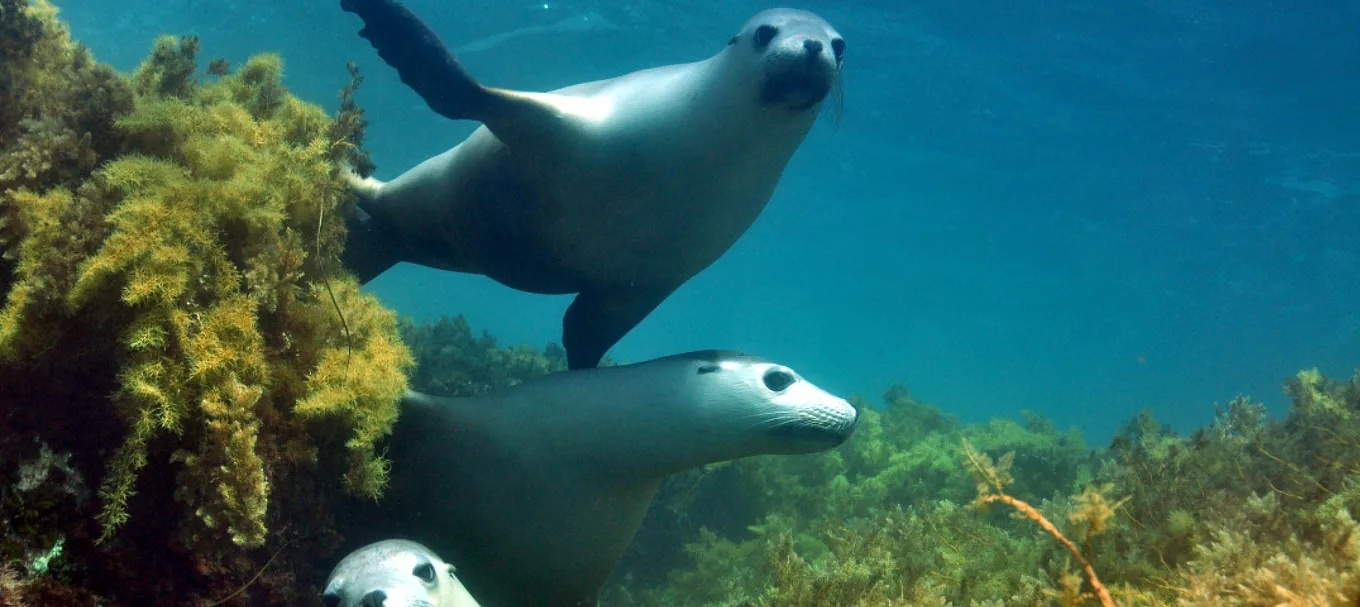
Australian sea lions
Australian sea lions (Neophoca cinerea) are also known as the Australian sea-lions and Australian sealions. Are also known as hair seala, white-necked hair seals, white-capped hair seals, and counselor seals, they are the only endemic pinniped in Australia and are the only living member of genus Neophoca (the extinct Pleistocene New Zealand sea lion Neophoca palatina is the only known congener). Australian sea lions are known for their unusual breeding cycles, which goes back and forth between a five-month breeding cycle and a 17-18-month aseasonal breeding cycle. Most pinnipeds have a 12-month reproductive cycle.
Australian sea lions are found on islands offshore of Australia from western Australia to islands in southern Australia. The largest populations are found on Kangaroo Island and Dangerous Reef (near Port Lincoln) in southern Australia. The smallest numbers are found on the west coast of southern Australia and in Western Australia. Some live in Tasmania but are few in number. They once bred in the Bass Strait, but the entire population there was wiped out by the sealing industry. [Source: Kara Hoglund, Animal Diversity Web (ADW) |=|]
Australian sea lions are non-migratory. They live and breed on sandy beaches near their birth site in relatively large colonies. The greatest distance recorded for a tagged animal has been 300 kilometers (490 miles) from its birth site. During times of tumultuous weather, they will often travel inland to seek shelter in dunes and coastal vegetation. Unlike many pinnipeds, Australian sea lions are very capable out of the water, and have been found as far as 9.4 kilometers inland. Many have been found at the tops of cliffs as high as 30 meters (98 feet), as they are also excellent climbers. In the water, Australia sea lions has been seen at depths up to 40 meters (131 feet).
Australian sea lions are listed a endangered on International Union for Conservation of Nature (IUCN) Red List. Their estimated population is 14,730 animals. The Wildlife Conservation Act of Western Australia (1950) classifies them as "in need of special protection". They are popular with divers and tourists to Seal Bay on Kangaroo Island every year. Fishermen often consider see them as a pest nuisance as they rob fishing nets and rock lobster traps. In the past, some populations were decimated by sealers. Others suffered great fluctuations believed to be as a result of parasites such as hookworm. Male aggression, human harassment, injuries from fishing gear, and competition for resources with the New Zealand fur seal, may all have played a part in their population decline. Great white shark famously prey on Australian sea lions, especially near the Dangerous Reef region of the Port Lincoln area. Fishermen occasionally kill them accidentally by entangling them in their nets.
Australian Sea Lion Characteristics and Diet
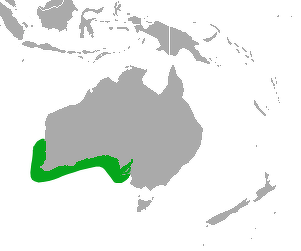
Australian sea lion range
Adult Australian sea lions range in weight from 105 to 300 kilograms (231.3 to 660.8 pounds) and range in length from 1.8 to 2.5 meters (5.9 to 8.2 feet). Their lifespan in captivity has been up to 24.1 years. Sexual Dimorphism (differences between males and females): Males are larger than females. Males are the one that grow to about 2.5 meters and weigh 300 kilograms. Females grow to a length of about 1.8 meters and weigh approximately 105 kilograms. Females are either silver or fawn with a cream underbelly, and males are dark brown with a yellow mane. Males darken even further as they mature, and go through a transition phase where they have spots on their chests. Males have a much larger head than females and juveniles, as well as significantly broader shoulders. Mature males are dark brown with a cream-colored crown and nape, and a paler chest and throat area. [Source: Kara Hoglund, Animal Diversity Web (ADW) |=|]
Australian sea lions are endothermic (use their metabolism to generate heat and regulate body temperature independent of the temperatures around them) and homoiothermic (warm-blooded, having a constant body temperature, usually higher than the temperature of their surroundings). They have a large head with a long, narrow, and tapered muzzle. The skull has a sagittal crest approximately three centimeters (1.2 inches) in height. Their pinnae, or ears, are incredibly small and lie close to the head.
Australian sea lions are carnivores (mainly eat meat or animal parts) but also recognized as piscivores (eat mainly eats fish) and molluscivore (eat mollusks) They feed on a relatively small number of fishes such as whiting, rays, and small shark) as well as squid, cuttlefish, and fairy penguins (Eudyptula minor). Their main food items are blue-throated wrasse (Notolabrus tetricus) fishes and octopus. They usually feed on shallow-water, benthic (bottom-dwelling) prey, and generally dive for food to depths no greater than 37 meters (121.4 feet). |=|
Australian Sea Lion Behavior
Australian sea lions are natatorial (equipped for swimming), motile (move around as opposed to being stationary), sedentary (remain in the same area),territorial (defend an area within the home range), social (associates with others of its species; forms social groups), and have dominance hierarchies (ranking systems or pecking orders among members of a long-term social group, where dominance status affects access to resources or mates). While Australian sealions have a reputation for being curios and playful around humans, they do bite rarely and this may require hospitalisation. [Source: Kara Hoglund, Animal Diversity Web (ADW) |=|]
Australian sea lions engage in “fostering behavior” in which females nurse and protect the young that are not their own. In some cases, they even adopt the young of others if the mother is killed. Some females living in the Seal Bay region have even displayed “babysitting behavior,” where a female protects a group of pups that are not hers. When she gets tired, another female takes her place. By the same token, there have also been reports of females showing agonistic behavior toward pups that are not their own. It has hypothesized that females take care of the pups of close family relatives but not those of more distantly related sea lions. |=|
Males do not take of the pups and occasionally engage in infanticide. They can sometimes be seen viciously attacking pups, often biting or shaking them to death. Males also sexually harass groups of females, and engage in play behavior with other males. Australian sea lions swallowing gastroliths (small stones). It is believed that they do to balance their weight when diving for food.
Australian sea lions are very vocal. Their vocalizations including guttural threat and growl.Mothers and their offspring communicate to identify each other among the masses. Males have been observed produced three different call types: A barking call, a bleating call, and a female-like call. The barking call is the predominant one. It is a short sound produced repetitively in a series. Mature Australian sea lion males have been found making barking calls in almost all social interactions, despite. [Source: Wikipedia]
Australian Sea Lion Mating and Reproduction
Australian sea lions are polygynous (males having more than one female as a mate at one time) and cooperative breeders (helpers provide assistance in raising young that are not their own). They are viviparous, meaning they give birth to live young that developed in the body of the mother, like most mammals, and engage in delayed implantation (a condition in which a fertilized egg reaches the uterus but delays its implantation in the uterine lining, sometimes for several months). Australian sea lions are seasonal breeders but their breeding intervals are oddly spaced, and breeding season changes from year to year. The gestation period ranges from 512 to 576 days (believed to be around nine months of actual gestation plus delayed implantation). The average number of offspring is one. The weaning age ranges from 15 to 18 months. Females can reach sexual maturity as early as three years of age, but usually do so later, whereas males usually do not mature until they are six years of age or older. [Source: Kara Hoglund, Animal Diversity Web (ADW) |=|]
During the early breeding season, Australian sea lion males secures a breeding territory on the beach and actively defends it against other males though ritualized posturing, aggressive displays and actual battles. When they leave their territory to feed in the ocean, they do so for only a few hours and when they return, they may have to battle to regain their territory. Males keep several females in their territories. If the female strays, the male will aggressively herd her back, sometimes entering another male's territory to do so.
Australian sea lions have a breeding cycle of approximately 17.6 months. The reason they do this is still unknown and is not believed to be the result of environmental influences as was once thought. During the breeding season, males copulate with harems of four or five females at a time. They sometimes herd females into mating groups, a characteristic that is rare in among other sea lion species. Some females do not produce young in consecutive breeding seasons. Births can occur over a period of four to six months making births highly unsynchronized in Australian sea lion colonies.
Australia Sea Lion Offspring and Parenting
Australian sea lion young are relatively altricial. This means they young are born relatively underdeveloped and are unable to feed or care for themselves or move independently for a period of time after birth. During the pre-weaning stage provisioning and protecting are done by females. Some parental care is provided by males in terms of protecting and maintaining territories, where their female mates and their offspring reside. Fathers may protect their offspring from other males. [Source: Kara Hoglund, Animal Diversity Web (ADW) |=|]
Female Australian sea lions enter estrous about six days after giving birth, and are mated by the male at this time. They come ashore about two days before they give birth in order to establish a natal site. After giving birth to a pup, a female stays at the natal site for approximately 10 days before returning to the sea to forage. She returns to land every couple of days to nurse her young, staying with the pup for about 33 hours at a time. A mother uses both vocal and scent communication to locate and identify her pup.
At birth, Australian sea lion pups are roughly 60 to 70 centimeters (2 to 2.3 feet) long and weigh approximately 6.5 to eight kilograms (14.4 to 17.6 pounds). Their coat is initially chocolate brown, but changes to an adult-like fawn color by the age of two months. Juveniles are a dark brown with a pale crown and a dark facial mask. The pelage of subadult males and females is fawn to silvery-gray on top and tan to pale yellow on the bottom. As pups grow up, they often form small groups and swim in shallow rock pools before they venture into the ocean with their mothers. Males have been seen killing pups, although presumably not their own. Defense of territories may be an indirect mechanism of paternal care for young. Young are typically weaned just before the birth of subsequent offspring, at 15 to 18 months. However, females have been seen nursing pups of different ages at the same time.
New Zealand Fur Seals
Some New Zealand fur seals (Arctocephalus forsteri) are found in Australia. Also known as Australasian fur seals, South Australian fur seals, Antipodean fur seals and long-nosed fur seals, they are "eared seals," meaning they have visible external ear flaps and can use all four flippers to move on land. Sea lions are also eared seals. The name New Zealand fur seal is used by English speakers in New Zealand; kekeno is used in the Māori language. In 2014, the name long-nosed fur seal has was proposed for the population living in Australia.
New Zealand fur seals are a generally non-migratory coastal species. Before being driven to near extinction during the sealing era, they were were found all around the North and South Islands including many offshore islands and sub-Antarctic islands. Today, they are found in New Zealand mainly on and around the South Island at Big Green Island, Open Bay Islands, West Coast, Cape Foulwind, Cascade Point, Wekakura Point, Three Kings Islands, eastern Bass Strait, the Nelson-northern Marlborough region, Fjordland, New Zealand's sub-Antarctic islands Snares, Campbell, Chatham Islands, Antipodes, Bounty Islands, Stewart Island, and the islands of the Foveaux Strait. [Source: Dorothy Landgren, Animal Diversity Web (ADW) |=|]
New Zealand fur seals are typically found in the water at depths between zero to 380 meters (1247 feet) and on land on rocky coastlines and offshore islands that provide protection from strong ocean waves. They seem to prefer beaches with large rocks, reefs just off the coast and smooth rocky ledges to gain easy access to the sea. Warmer islands tend to have rock pools that the seals use for cooling. Vegetation such as tussock and scrub are often in breeding areas and nurseries. Non-breeding colonies are more flexible in where they live.
See New Zealand Fur Seals Under SEALS AND SEA LIONS IN NEW ZEALAND: SPECIES, CHARACTERISTICS, BEHAVIOR, REPRODUCTION ioa.factsanddetails.com
Leopard Seals
Leopard seals (Scientific name: Hydrurga leptonyx) are one of the world’s most dangerous animals. Weighing up to 380 kilograms (840 pounds), they rarely attack humans but they have and killed some. Their lifespan in the wild is estimated to be 26 years, with a high of 30 years. The scientific name of leopard seals, Hydrurga leptonyx, literally translated means 'slender-clawed water-worker'. Their common name comes from their patterned skin.[Source: Taiyler Simone Mitchell, Business Insider December 24, 2022]
Leopard seals are apex predators at the top of the Antarctic food chain. Their only known natural predators are killer whales, however leopard seals are rarely eaten. Leopard seals themselves are notorious predators who feed on penguins, fish, squid, krill and other seals, mostly crabeater seal and fur seal pups. They are the only seals that to regularly hunt warm-blooded prey and kill other mammals and seals. Despite their reputation as fearsome predators, leopard seals feed primarily on krill, using their lobodont teeth to filter these small crustaceans from the water. They also eat fish and squid. [Source:Paul Nicklen, Kim. Heacox, National Geographic, November 2006]
Leopard Seals are found throughout the Antarctic and nearby islands and have been seen as far north as Australia, South America and South Africa. They reside mostly on and around the ice packs but are occasionally seen on Antarctic beaches and subantarctic islands if there is enough ice substrate nearby. These seals roam a huge area. Little is known about their biology and even their numbers. Estimates range from 200,000 to 400,000. Because they eat whatever is available scientists track their diets to get a sense of the available food supply in an area. By chemically analyzing their whiskers, scientists can determine roughly three years of feeding patterns.
See Separate Article: LEOPARD SEALS: CHARACTERISTICS, BEHAVIOR AND PENGUINS ioa.factsanddetails.com
Crabeater Seals
Crabeater seals (Lobodon carcinophaga) are also known as krill-eater seals. True seals with a circumpolar distribution around the coast of Antarctica, they are the only member of the genus Lobodon and are occasionally sighted on the extreme southern coasts of Argentina, South Africa, Australia and New Zealand. They spend the entire year in the pack ice zone as it advances and retreats seasonally, primarily staying within the continental shelf area in waters less than 600 meters (2,000 feet) deep. [Source: Wikipedia]
Crabeater seals are medium to large in size (over 2 meters, 6.6 feet in length), relatively slender and pale-colored.They are far and away the most abundant seal species in the world. Population estimates are very sketchy but it has been determined that there are at least 7 million of them and possibly as many as 75 million. This success of this species is due to their specialized predation on the abundant Antarctic krill of the Southern Ocean, for which it has uniquely adapted, sieve-like tooth structure. Their scientific name means "lobe-toothed (lobodon) crab eater (carcinophaga)" — a reference to their finely lobed teeth adapted to filtering krill.
In spite of their name, crabeater seals do not eat crabs. Especially young are an important food source for leopard seals. Crabeater seals share a common recent ancestor with the other Antarctic seals such as leopard seals, Ross seals and Weddell seals. These species, collectively belonging to the Lobodontini tribe of seals, share teeth adaptations including lobes and cusps useful for straining smaller prey items out of the water column. The large population of crabeater seals is claimed to be a threat to large baleen whales as they both eat krill and crabeater seals .
Southern Elephant Seals
Southern elephant seals(Scientific name: Mirounga leonina) are slightly larger, more numerous but less studied than northern elephant seals, the other elephant seal species. The range of these species do not overlap. Male southern elephant seals can live to be 14 years old while females can live to be 20 years old. On average, southern elephant seals live about 9.5 years. There are around 325,000 of them, [Source: Maelan Hauswirth, Animal Diversity Web (ADW) /=]
Southern elephant seals inhabit large portions of the southern hemisphere. This includes coastal areas and islands of Antarctica and islands south of and the southern tips of Africa, South America, Australia and New Zealand. When foraging for food, Southern elephant seals travel between 40º latitude south and the Antarctica mainland. Southern elephant seals inhabit a large portion of the southern hemisphere, but major breeding populations are only in a handful of places sub-Antarctic islands and in Antarctica. They are also found on the Valdes Peninsula in South America. They spend much of their time in the open seas of the Southern Ocean and the southern Pacific, Atlantic, and Indian oceans. They only come to land when they breed, moult, give birth, and take care of their offspring. When on land, they stay on beaches close to the ocean. Southern elephant seals are typically found in deep water at depths of 200 to 1000 meters (656 to 3280 feet). They feed in deep water and can dive up to 1,000 meters (3,300 feet) deep, even reaching the sea floor in areas. When sometimes rest on ice flows.
See Separate Article: SOUTHERN ELEPHANT SEALS: CHARACTERISTICS, BEHAVIOR, MATING ioa.factsanddetails.com
Image Sources: Wikimedia Commons
Text Sources: Animal Diversity Web animaldiversity.org , National Geographic, Live Science, Natural History magazine, Australian Museum, David Attenborough books, Australia Geographic, New York Times, Washington Post, Los Angeles Times, Smithsonian magazine, Discover magazine, The Conversation, The New Yorker, Time, BBC, CNN, Reuters, Associated Press, AFP, Lonely Planet Guides, Wikipedia, The Guardian, Top Secret Animal Attack Files website and various books and other publications.
Last updated September 2025