
GRAY-HEADED FLYING FOXES
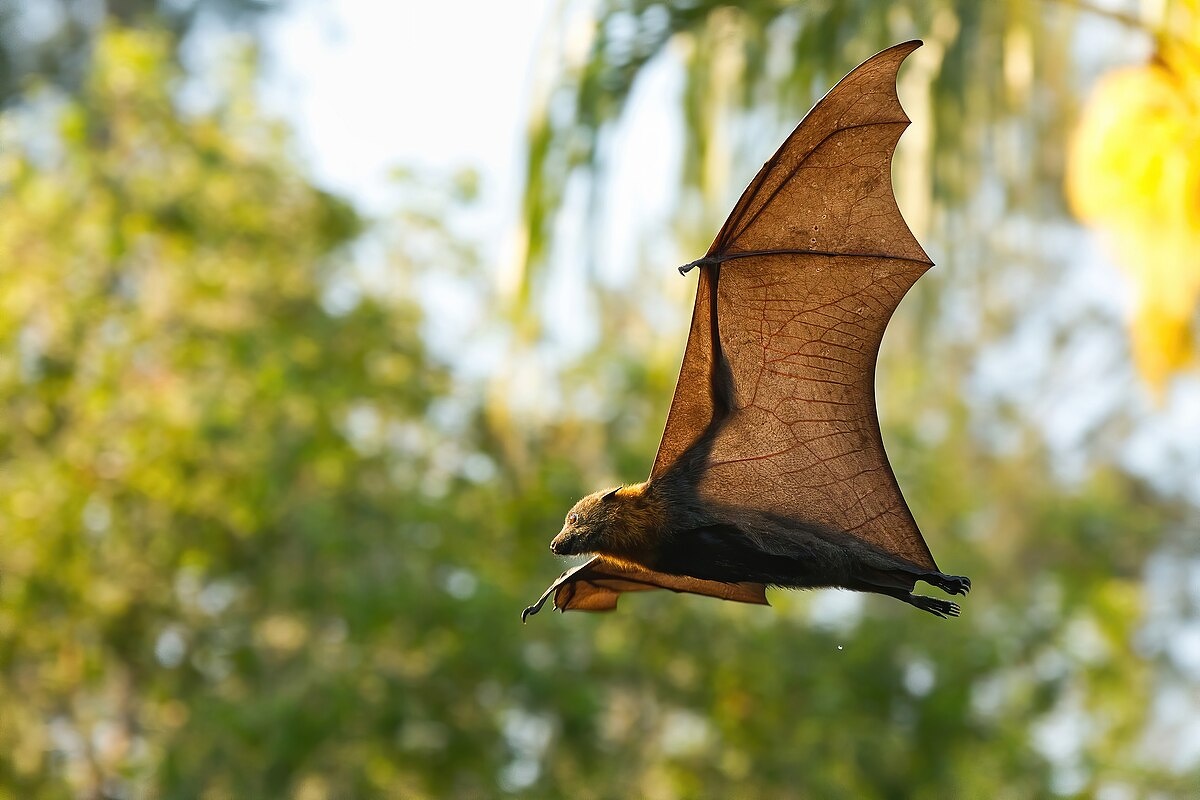
Grey-headed flying fox
Grey-headed flying foxes (Pteropus poliocephalus) are the largest bats and most widespread flying foxes in Australia. They share mainland Australia with three other members of the flying fox genus Pteropus — little red, spectacled black flying foxes — and live in the forests of southeastern Australia, mostly east of the Great Dividing Range, occupying more extreme latitudes than any other Pteropus species.
Carlyn Kranking wrote in Smithsonian magazine: As darkness descends across the eastern coast of Australia, thousands of grey-headed flying foxes take to the skies. Armed with a keen sense of smell and sharp night vision, they roam to find food after resting all day. Some might travel as far as 30 miles in one night, foraging for fruits such as figs and pollinating trees as they go. [Source: Carlyn Kranking, Smithsonian magazine, November 2024]
Grey-headed flying foxes are is listed as "Vulnerable" on the On the International Union for Conservation of Nature (IUCN) Red List. Other Pteropus species are known to be preyed upon by snakes, such as brown tree snakes, but other than of humans there have been no reports of other animals killing or preying on grey-headed flying foxes. [Source: Christina DeHaven, Animal Diversity Web (ADW) |=|]
Grey-headed flying foxes have a major impact on ecosystems in Australia mainly as seed dispersers and pollinators. Many different fruits and pollen are consumed and come in contact with grey-headed flying foxes, making this species and they are highly important in seed dispersal and pollination for a wide variety of plants. Certain plants enjoy a wider range due to the long-distance seed dispersal of these flying foxes.
Grey-headed flying foxes have lived to 23.6 years in captivity and often reach the peak of reproductive activity between six and 10 years old. However their expected lifespan in the wild is only 1.8 to 5 years. Lifespan can be affected by drought and food availability and negative human interactions. Measurements of flight speed of Grey-headed flying foxes in a wind tunnel only came with values between 21 to 24 kilometers per hour (13 to 15 miles per hour). However, higher speeds of 49, 52, and 63 kilometers per hour (30, 32 and 39 miles per hour) were recorded with assistance from wind currents.
RELATED ARTICLES:
FLYING FOXES: CHARACTERISTICS, BEHAVIOR AND REPRODUCTION factsanddetails.com
BATS AND FLYING FOXES IN AUSTRALIA: CHARACTERISTICS, BEHAVIOR AND REPRODUCTION ioa. factsanddetails.com
WORLD’S BIGGEST BATS — LARGE, INDIAN AND GREAT FLYING FOXES — AND THEIR CHARACTERISTICS AND BEHAVIOR factsanddetails.com
FLYING FOXES OF THE ISLANDS OF INDONESIA AND THE PHILIPPINES factsanddetails.com
BATS, CHARACTERISTICS, FLIGHT, REPRODUCTION factsanddetails.com ;
BAT SENSES AND ECHOLOCATION factsanddetails.com
BATS AND HUMANS: GOOD THINGS, DISEASE, RABIES AND DEATHS factsanddetails.com
KINDS OF BATS: SMALLEST, BIGGEST, VAMPIRE BATS factsanddetails.com
HORSESHOE BATS: CHARACTERISTICS, BEHAVIOR AND COVID-19 factsanddetails.com
ASIAN FALSE VAMPIRE BATS: CHARACTERISTICS, BEHAVIOR AND REPRODUCTION factsanddetails.com
BUMBLEBEE BATS (WORLD'S SMALLEST MAMMALS): CHARACTERISTICS, BEHAVIOR, CONSERVATION factsanddetails.com
Grey-Headed Flying Fox Habitat and Where They Are Found
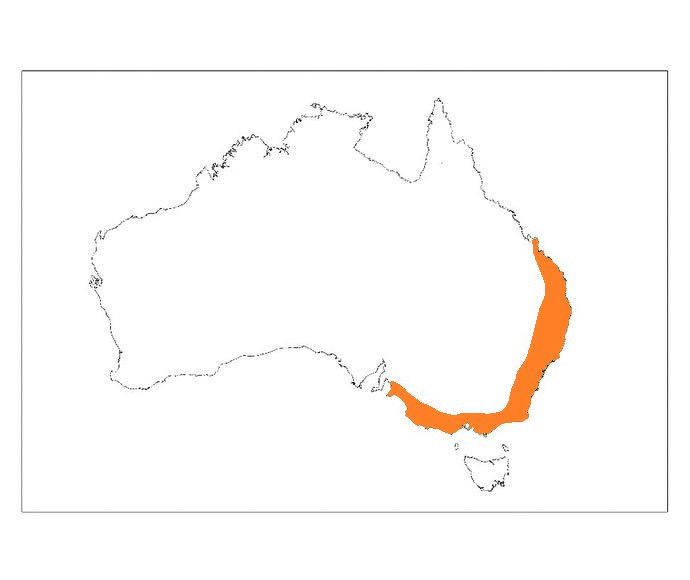
range of grey-headed flying foxes
Grey-headed flying foxes are found on the eastern coast of Australia from from Bundaberg and Mayborough in Queensland to Melbourne in Victoria. The previous range has shifted southward by approximately 750 kilometers, possibly due to a change in climate. [Source: Christina DeHaven, Animal Diversity Web (ADW) |=|]
Grey-headed flying foxes occur in a variety of habitats in temperate and tropical land environments including rainforests, woodlands, forests, swamps, in wetlands, suburban areas, agricultural areas and riparian environments (near a river or other freshwater body) in Eastern Australia. They are typically found at elevations less than 200 meters (786 feet), but have been found at elevations as great as 700 meters (2297 feet). They are usually not found more than 150 kilometers inland and are even present on some secluded islands.
Grey-headed flying foxes prefer to roost in the branches of large trees. Because of the encroachment of human activity into their habitats, they are sometimes found in suburban areas, using the agricultural lands of their human neighbors as a food source. Grey-headed flying foxes are semi-migratory. Their migrations have been attributed to different reasons. They often go where the food supply is abundant, although it has been hypothesized that they also undertake long-distance flights to increase mating success, or to collect more information about other parts of their range.
Grey-Headed Flying Fox Characteristics
Grey-headed flying foxes range in weight from 0.6 to one kilogram (1.3 to 2.2 pounds), with an average weight of 0.68 grams (1.4 pounds). They have a head and body length of 23 to 28.9 centimeters (9 to 11.4 inches), with their average length being 25.3 centimeters (9.96 inches). Their average wingspan is one meters (3.28 feet). Their average basal metabolic rate is 1.768 watts (316.2 cubic centimeters of oxygen per gram per hour). Sexual Dimorphism (differences between males and females) is present: Males are larger than females. [Source: Christina DeHaven, Animal Diversity Web (ADW) |=|]
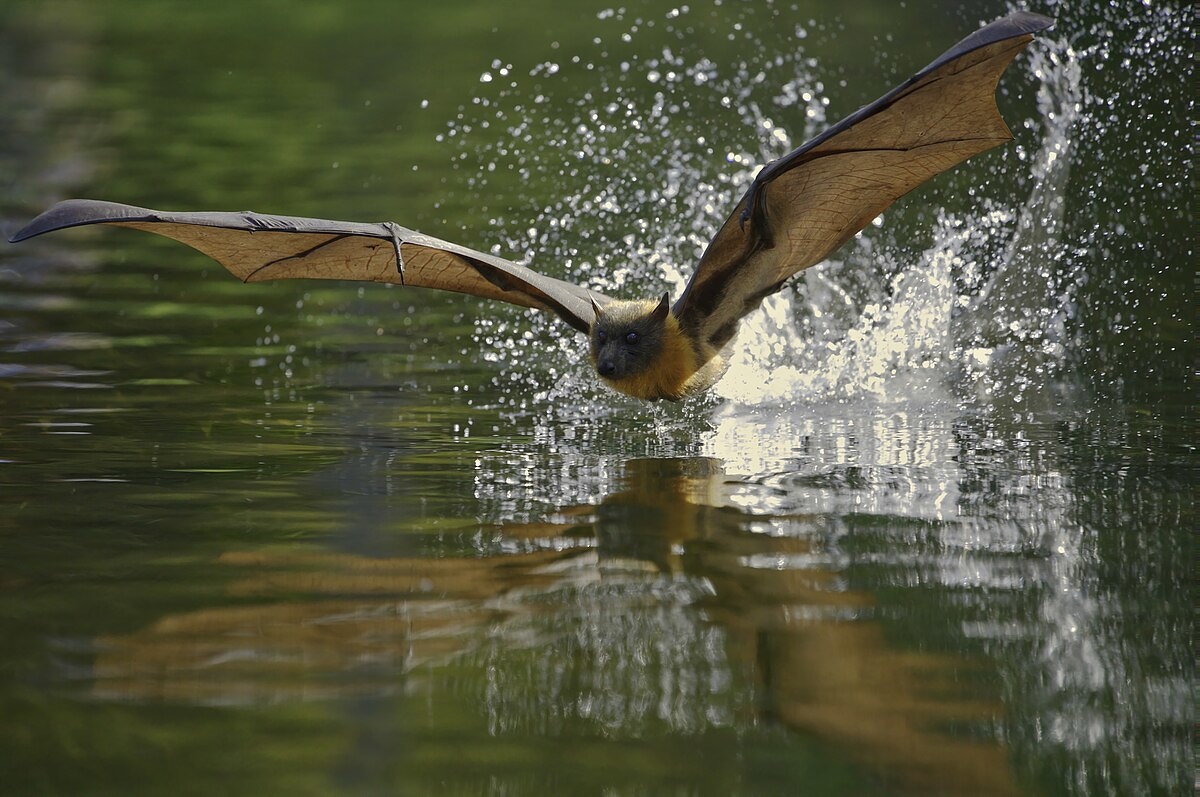
Grey-headed flying fox skimming a pond to get a drink of water
As is the case with all flying foxes, grey-headed flying foxes do not have a tail, and claws are present on the first and second digits. They do not echolocate, and therefore, the distinctive enlarged tragus or leaf-ornamentation found in most species of bat is not present. Since they do not echolocate, they must rely on their large eyes for navigation and finding food.
As their common name implies, grey-headed flying foxes have faces which are fox-like. The fur on their body is dark grey, while the fur on their head of a lighter shade of grey. A ring of reddish-brown fur encircles their neck. Fur on the legs extends all the way to the ankle, which is one thing that distinguishes grey-headed flying foxes from other flying fox species. The patagium (membrane or fold of skin a bat used in flying) is black. The forearm length of grey-headed flying foxes is between 13.8 and 18 centimeters (5.4 and 7 inches) with an average of 16.1 centimeters (6.3 inches).
Grey-Headed Flying Fox Food and Eating Behavior
Grey-headed flying foxes are herbivores (eat plants or plants parts) and frugivores (eat fruit). Their diet includes fruits, pollen, nectar, bark, leaves, wood, stems, and flowers. Their preferred foods are eucalyptus blossoms, of which Eucalyptus gummifera, Eucalyptus muellerana, Eucalyptus globoidea and Eucalyptus botryoides are most often consumed. The main pollen sources ate in the families Myrtaceae and Proteaceae, although pollens from other families are consumed if availablewhen present. [Source: Christina DeHaven, Animal Diversity Web (ADW) |=|]
Grey-headed flying foxes really like figs and have been observed consuming stone fruits (peaches, plums, and nectarines). Occasionally they feed on the leaves of poplar (g. Populus) and grey mangrove (Avicennia marina) trees. Other food items that have been found in fecal matter include fruits from Phoenix canariensis, Ligustrum and Solanum mauritianum, among many others. Different foods are eaten at different times of the year, depending on availability.
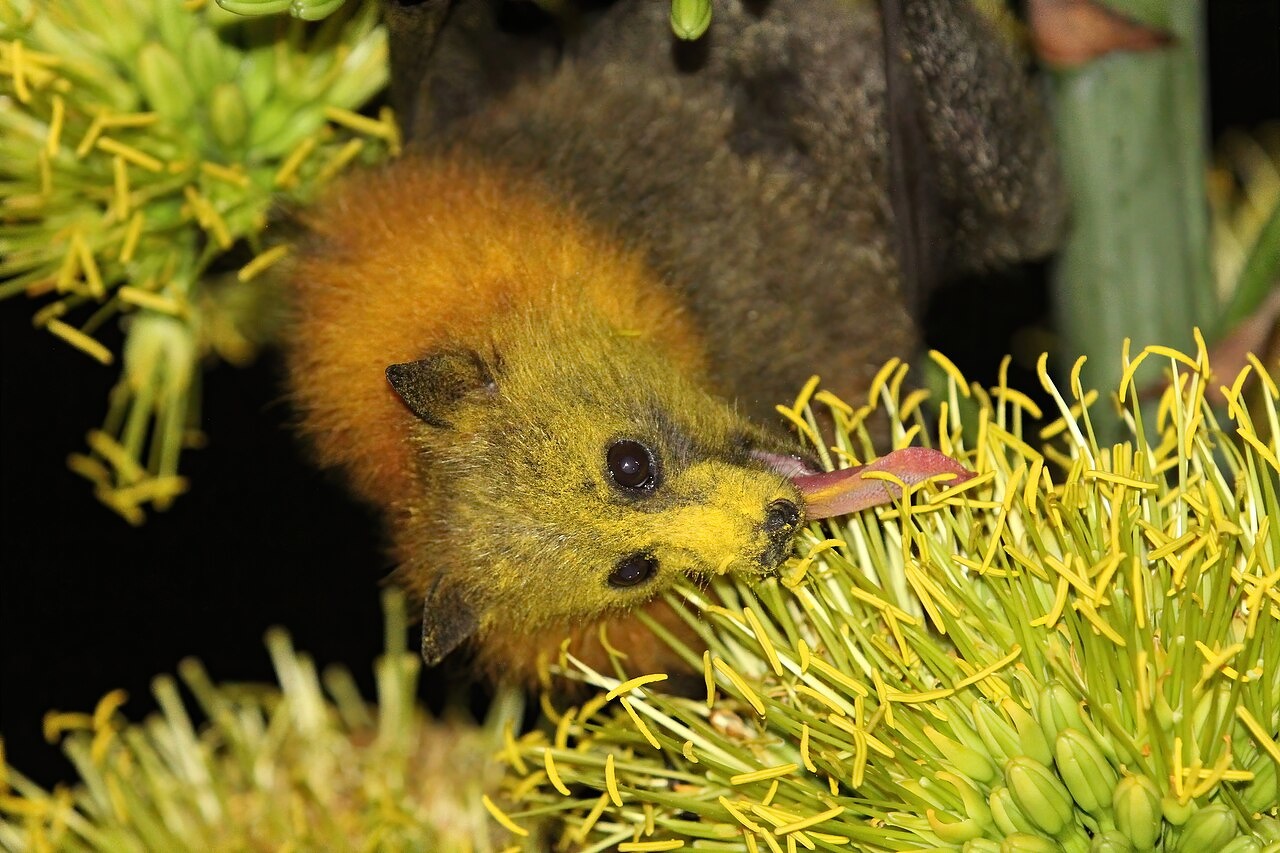
Grey-headed flying fox feeding on nectar
Grey-headed flying foxes usually forage at night. It is not unusual for individuals to fly up to 50 kilometers away from their roosts in search of food, although most tend to stay within a 15 kilometer radius of their roosting areas. These flying foxes tend to forage in forest canopies, open forests, rainforests, and swamps; however, they sometimes make appearance at cultivated gardens, orchards and other places with fruiting trees. Most of the trees on which these bats forages produce nectar and pollen seasonally but abundance is unpredictable, and this is one reason why the migrate and travel so far in search of food. The time when flying foxes leave their roosts to feed depends on foraging light. They have more time and light when foraging if they leave their roosts early in the day.
When eating, the bats bite pieces off of their food, and then chew it vigorously, spitting out portions that are not swallowed. The teeth, tongue and palate of flying fox are designed to extract plant juices from food. Incisors hold items such as fruit, and the fibrous material is ejected from the mouth after it is masticated and the juice is swallowed; larger seeds may be held in the mouth and dispersed several kilometers from the tree. Because they extract nutritious juices and spit out fibrous material they don't need the elaborate intestinal tract that most herbivores have.
Grey-Headed Flying Fox Behavior
Grey-headed flying are arboreal (live mainly in trees), nocturnal (active at night), motile (move around as opposed to being stationary), migratory (make seasonal movements between regions, such as between breeding and wintering grounds), territorial (defend an area within the home range), social (associates with others of its species; forms social groups) and colonial (live together in groups or in close proximity to each other). The places where grey-headed flying foxes root together permanently or semi-permanently are called camps. Individuals may fly many kilometers from their camp to forage foo food. [Source: Christina DeHaven, Animal Diversity Web (ADW) |=|]
As with many species of bats, Grey-headed flying foxes are very social animals, with a complex social arrangement. Feeding occurs at night, and they roost during the day. They congregate in large numbers, up to several thousand animals, especially during times of mating. Territorial activity occurs mainly during the nursing period, when a male marks his and his mate’ territory and both defend it. The territory usually consists of a length of a branch and little more. Also during the nursing period, family units are formed, with non-breeding bats living on the periphery of the group. Males sometimes exhibit philopatry (returning to their birth site in order to breed).
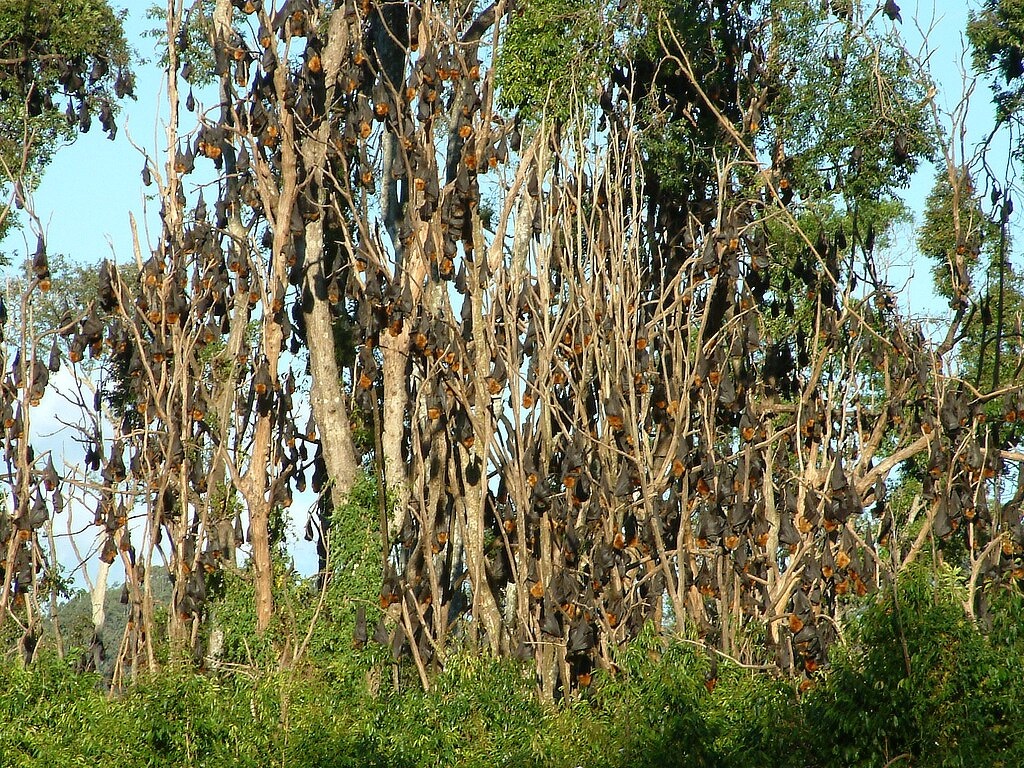
Grey-headed flying fox camp
Camps are often formed in gullies usually close to a water source and in dense canopies of vegetation. These camps are often returned to year after year. Otherwise Grey-headed flying foxes are highly mobile animals. They migrate with the seasons, which influence the amount and kinds of food present around a particular camp. It appears that the abundance of food is the main reason camps are occupied when they are. It not unusual for camps to be occupied during seasons when they are normally abandoned if food is plentiful there.
Grey-Headed Flying Fox Senses and Communication
Grey-headed flying foxes sense and communicate with vision, touch, sound and chemicals usually detected by smelling. They also leave scent marks produced by special glands and placed so others can smell and taste them. Grey-headed flying foxes use smell and vision to locate food. Some fruiting plants produce food such as flowers and fruits with scent that the flying foxes are attracted to. They are also able to locate the pale color of some flowers and fruits. Plants that are adapted to bat dispersal tend to have light-colored fruits, in contrast to the brightly-colored fruits of species adapted to avian dispersal and pollination. [Source: Wikipedia; Christina DeHaven, Animal Diversity Web (ADW) |=|]
Grey-headed flying foxes don’t use echolocation (emitting sound waves and sensing their reflections to determine the location of objects) like bats. Instead they rely heavily on vision and olfaction in perceiving their environment. Their large eyes help them in navigating through their habitat. Males are known to use a strongly scented secretion in marking territory, and females are able to find their young by scent.
Grey-headed flying foxes are very vocal. They use a sophisticated array of vocalizations, many of which are series of complicated squeaks and squeals. More than 20 different calls which these bats use to communicate with each other have been recognized. Because they form large groups, roosting sites can be quite noisy.
Grey-Headed Flying Fox Mating, Reproduction and Offspring
Grey-headed flying foxes are monogamous (have one mate at a time) and are viviparous (give birth to live young that developed in the body of the mother) like most most mammals. They engage in seasonal breeding — once a year, from April to May. The average gestation period is six months. The number of offspring is usually one, rarely two. When twins are born usually one or both don’t survive. On average females and males reach sexual or reproductive maturity at 30 months. [Source: Christina DeHaven, Animal Diversity Web (ADW) |=|]
During the nursing period, males and females form monogamous mating-pairs. Males utilize strong-smelling secretions from their scapular glands (located on the shoulder) and loud calls in order to establish territories and ward off unwanted males. Mating has been observed throughout the year; however, males are only fertile during the mating period. Females that are close to giving birth segregate from the males.
Parental care is provided by mainly females. Mothers give birth between October and November Young are altricial, meaning they are relatively underdeveloped at birth. During the pre-weaning and pre-independence stages provisioning is done by females and protecting is done by males and females. Weaning occurs between five and six months of age, and offspring are independent after about six months.
Young weigh between 46 and 92 grams when they are born. They cannot fly and have no fur on their underside. Female Grey-headed flying foxes carry their young, which cling to the fur on the mother's belly, for the first four to five weeks after birth. Females carry their young even while foraging. After this period, for 12 weeks or so, the young are left at the nesting site at night while the mother forages. At about three months of age the young are independent enough to forage on their own; however, they continue to nurse for three more months. Bats generally provide their young with milk until they have attained at least 70 percent of their adult body weight. Juveniles cannot achieve sustained flight until they have reached this size. Although males do not directly care for the young, they do mark and defend territories for their families during the period of nursing. Females have been known to abandon their young in times of food shortages.
Grey-Headed Flying Foxes, Humans and Conservation
On the International Union for Conservation of Nature (IUCN) Red List, Grey-headed flying foxes are listed as Vulnerable. In CITES (Convention on International Trade in Endangered Species of Wild) they have no special status. Currently these flying foxes are listed as vulnerable under the New South Wales Threatened Species Conservation Act 1995, schedule 2, and under the Environment Protection and Biodiversity Conservation Act 1999. Grey-headed flying foxes are believed to have numbered in the millions in the early 1900s but not any more. Their population declined by 30 percent in the 1990s. It is estimated that fewer than 400,000 existed in the 2020s. [Source: Smithsonian magazine; Christina DeHaven, Animal Diversity Web (ADW) |=|]
The main threats to grey-headed flying foxes are the destruction of habitat through deforestation and development. Females are particularly subject to spontaneous abortions due to loss of habitat and food sources, or when they are disturbed at the nesting site during the last few weeks of pregnancy. There are no regulations banning the shooting of these flying foxes and farmers who perceive them as crop threats are free to kill them. These bats also die after flying into power lines and getting electrocuted Black flying foxes pose a threat because they are competitors over food and habitat, and Grey-headed flying foxes have been known to mate and thus hybridize with them.
Grey-headed flying foxes help humans by pollinates crops but they also eat crops and carry diseases that can infect domestic animals, even humans. Generally, these bats resort to eating fruit crops only when other food sources are unavailable. At one time the range of Grey-headed flying foxes had a much larger range; however, that range is now shrinking due to habitat destruction. Many areas of their habitat are becoming increasingly urbanized, such as in southeast Queensland and northern New South Wales. Less than 15 percent of the suitable habitat for these bats is within protected reserves. The range of grey-headed flying foxes appears to be shifting southward; perhaps climate change is involved.
Carlyn Kranking wrote in Smithsonian magazine: With less of their natural habitat remaining, the bats are forced to seek food closer to people, bringing them into contact with new threats. Mesh netting over urban fruit trees can wrap around them when they try to eat, and barbed wire, a fixture on many Australian farms, might snare the bats as they fly. Some residents of cities are not happy to share their neighborhoods with congregations of flying foxes, which can be noisy at dusk and dawn, and generate lots of poop. As a result, local governments try to disperse the “camps” — each one could include thousands of bats — with smoke guns, loud noises or fireworks. It’s not an effective strategy, as the bats have a tendency to move between roosts. “They’re continually replacing each other,” says Clare Wynter, flying fox coordinator with Canberra-based rescue organization ACT Wildlife. “You don’t have one bat coming back to the same place every night. So, they’re not really going to learn not to come back.” [Source: Carlyn Kranking, Smithsonian magazine, November 2024]
Australians Growing to Appreciate Grey-Headed Flying Foxes
Grey-headed flying foxes have traditionally been regarded as crop pests by many Australia farmers but in recent years, especially after devastating wildfires, their role in bringing new life and helping ecosystems recover is becoming more appreciated. Carlyn Kranking wrote in Smithsonian magazine: Australia’s bushfire season of 2019 to 2020 was devastating to the flying fox population, killing tens of thousands. But the fires also represented a turning point for the bats’ reputation. Because they fly long distances during their nightly travels, the bats play a pivotal role in re-pollinating swaths of scorched land. Pollen sticks to their fur, and they also ingest fruits, which makes them excellent seed-spreaders. A single flying fox can spread as many as 60,000 seeds per night. [Source: Carlyn Kranking, Smithsonian magazine, November 2024]
“Everybody realized, ‘Hey, we’re going to need as much help as we can get to regenerate all of this,’” says John Grant, a spokesman for the Australian wildlife rescue organization WIRES (Wildlife Information, Rescue and Education Service). “And the flying foxes are the best animals to do that.” In 2020, the New South Wales government posted a video praising the bats for their super-pollinating powers.
So when some 85,000 flying foxes descended upon the city of Tamworth last year, news coverage wasn’t all bad. In one account, a local resident called the bats “flying vermin” and complained about their smell, but others focused on how such vast bat congregations are an amazing sight. One resident compared the gathering to a local music festival and proclaimed, “We’ve got to live with them, they are great for our ecology.” The fire “changed the mind-sets of a lot of people,” Grant says. “Most of New South Wales was in flames. And I think that people began to realize just how precious our wildlife is.”
Image Sources: Wikimedia Commons
Text Sources: Animal Diversity Web animaldiversity.org , National Geographic, Live Science, Natural History magazine, Australian Museum, David Attenborough books, Australia Geographic, New York Times, Washington Post, Los Angeles Times, Smithsonian magazine, Discover magazine, The Conversation, The New Yorker, Time, BBC, CNN, Reuters, Associated Press, AFP, Lonely Planet Guides, Wikipedia, The Guardian, Top Secret Animal Attack Files website and various books and other publications.
Last updated August 2025