
Home | Category: Oceans and Sea Life
OCEAN ENVIRONMENTS AND LIFE FOUND THERE

Under the surface of the ocean, light is greatly altered. By just 200 meters below the surface, photosynthesis becomes impossible. At 1,000 meters down, sunlight disappears completely. The Arctic and northern seas have traditionally been defined as a “benthic ecosystems,” where there are relatively few fish but many bottom-dwelling creatures such as crustaceans, mollusks and marines worms. These creatures in turn food for animals such as walruses, seals and some whales.
The midwater region, located at underwater depths of more than one kilometer, is far from the ocean surface and much of the the sea floor. Forms of life found here are supported almost entirely by “marine snow,” organic debris that drifts down from near the surface. Encompassing more than a quarter billion cubic miles, it is the world’s largest habitat, and believed to be home more than a million undescribed species and more biomass than any other system. Creatures found here include angler fish; 120-foot-long colonies of gelatinous creatures; and vampire squids that have lights and spikes on the tips of their arms and posses the ability to squirt clouds ob glowing liquid.
Deep sea vents are the hottest environment known to sustain life. Archeea, primitive unicellular microbes, thrive in mineral chimneys known as black smokers in temperature sup to 250̊C. Archeea are believed to be similar to the first forms of life found in earth. Deep sea vents, over two kilometers deep, are home to six-foot-long tube worms and variety of crustaceans and mollusk. Life here is produced without sunlight or photosynthesis.
Deep-sea, cold water coral make up two thirds of all known corals and are among the oldest organism on Earth. Found as deep as three miles below the surface, and discovered only in the 1980s, they are as diverse as shallow reef corals and protect marine life from strong ocean currents. Basophilic (pressure-loving) microbes have been recovered by a Japanese submersible in the 36,000-foot-deep Mariana Trench.
Related Articles:
STROMATOLITES, THROMBOLITES AND THE WORLD'S OLDEST LIFE FORMS ioa.factsanddetails.com
CAMBRIAN EXPLOSION AND THE WORLD'S OLDEST ANIMALS ioa.factsanddetails.com
DINOSAUR-ERA AND PRE-DINOSAUR-ERA SEA CREATURES ioa.factsanddetails.com
PLANKTON: PLANT, ANIMAL, COPEPODS, NEUSTON AND MUCOUS-MESH GRAZERS ioa.factsanddetails.com
DEEP SEA LIFE: IN THE DEEPEST TRENCHES, AROUND VENTS, NEW SPECIES ioa.factsanddetails.com
DEEP SEA FISH: STRANGEST, DEEPEST AND UGLIEST ioa.factsanddetails.com
BIOLUMINESCENCE IN THE SEA: WHY, HOW AND CREATURES THAT USE IT ioa.factsanddetails.com
SEAWEED: FOOD, HEALTH, FARMING AND CLIMATE CHANGE ioa.factsanddetails.com
STUDYING OCEAN LIFE: TAGGING, TELEMETRY, CENSUSES AND TOPP ioa.factsanddetails.com
Websites: Animal Diversity Web (ADW) animaldiversity.org;
NOAA site fisheries.noaa.gov;
Fish Base fishbase.se; World Register of Fish Species marinespecies.org; Smithsonian Ocean ocean.si.edu;
RECOMMENDED BOOKS:
“The Unnatural History of the Sea” by Callum Roberts (Island Press (2009) Amazon.com
“Ocean: The World's Last Wilderness Revealed” by Robert Dinwiddie , Philip Eales, et al. (2008) Amazon.com
“The Sea Around Us” by Rachel Carson, an influential work that highlights the importance of ocean conservation (1950) Amazon.com
“The Life & Love of the Sea” by Lewis Blackwell Amazon.com
“Blue Hope: Exploring and Caring for Earth's Magnificent Ocean” by Sylvia Earle (2014) Amazon.com
“National Geographic Ocean: A Global Odyssey” by Sylvia Earle (2021) Amazon.com
“Ocean, New Edition (DK Definitive Visual Encyclopedias)” Amazon.com
“Oceanology: The Secrets of the Sea Revealed” (DK Secret World Encyclopedias) Amazon.com
“Marine Biology For The Non-Biologist” by Andrew Caine Amazon.com
“Introduction to the Biology of Marine Life:” by John Morrissey, James L. Sumich Amazon.com
“Strange Sea Creatures Hardcover” by Erich Hoyt Amazon.com
“The Extreme Life of the Sea”“ by Stephen and Anthony Palumbi, Princeton University Press (2014) Amazon.com
“Biological Oceanography” by Charles B. Miller (2004) Amazon.com
“Biological Oceanography: An Introduction” by Timothy R. Parsons (1993) Amazon.com
“The Marine World: A Natural History of Ocean Life” by Frances Dipper (2016) Amazon.com
“Dive into the Ocean: Exploring Different Types of Sea Life” by Shane McAleer , Cameron McAleer, et al. (2023) Amazon.com
“The Soul of an Octopus: A Surprising Exploration into the Wonder of Consciousness” by Sy Montgomery (2015), a book about marine biology, with an emphasis on the intelligence and consciousness of octopuses. Amazon.com
Living in the Ocean
Olivia Judson wrote in National Geographic: “As a place to live, the ocean has a couple of peculiarities. The first is that in most of it, there is nowhere to hide. This means invisibility is at a premium. The second odd thing is that as you descend, the sunlight disappears. First red light is absorbed. Then the yellow and green parts of the spectrum disappear, leaving just the blue. By 700 feet deep, the ocean has become a kind of perpetual twilight, and by 2,000 feet, the blue fades out too. This means that most of the ocean is pitch-dark. All day, all night. Together these factors make light uniquely useful as a weapon — or a veil. [Source: Olivia Judson, National Geographic, March 2015]
“Consider the problem of invisibility. In the upper layers of the ocean — the part where light penetrates — any life-form that does not manage, somehow, to blend in with the water is in danger of being spotted by a predator — especially a predator swimming beneath, looking up. To get a sense of this, imagine that you’re scuba diving in the middle of the Pacific. Above you, the place where the sea meets the sky looks silver. Below you, the water shades into a dark blue. In all other directions, it is a murky greenish gray. The seafloor, though you can’t see it, is a vertiginous 11,000-plus feet below you. And wait — what’s that shadow down there? Is it a shark? All of a sudden you become aware of how vulnerable you are: a great dark silhouette against the silvery surface, visible to any hungry animal that might be swimming about below.
“Many life-forms solve this problem by not being there at all. They avoid the light zone during the day, rising toward the surface only at night. Many others solve it by evolving into transparent, ghosty creatures. On the dive, the first thing you’d notice is that nearly all the life-forms you meet, from jellyfish to swimming snails, are see-through. In another approach, some fish — think sardines — dissolve their silhouettes by having silvery sides. The silver functions as a mirror and allows the animal to blend in by reflecting the water around it.
“And some creatures — such as the shrimp Sergestes similis, certain fish, and many squid — use light. How? By illuminating their bellies so as to match the light coming down from above. This allows the animals to mask their silhouettes, donning a kind of invisibility cloak. The cloak can be turned on and off at will — and even has a dimmer switch. S. similis, for example, can alter how much light it gives off depending on the brightness of the water around it. If a cloud passes overhead, briefly blocking the light, the shrimp will dim itself accordingly.
Oceanic Zones
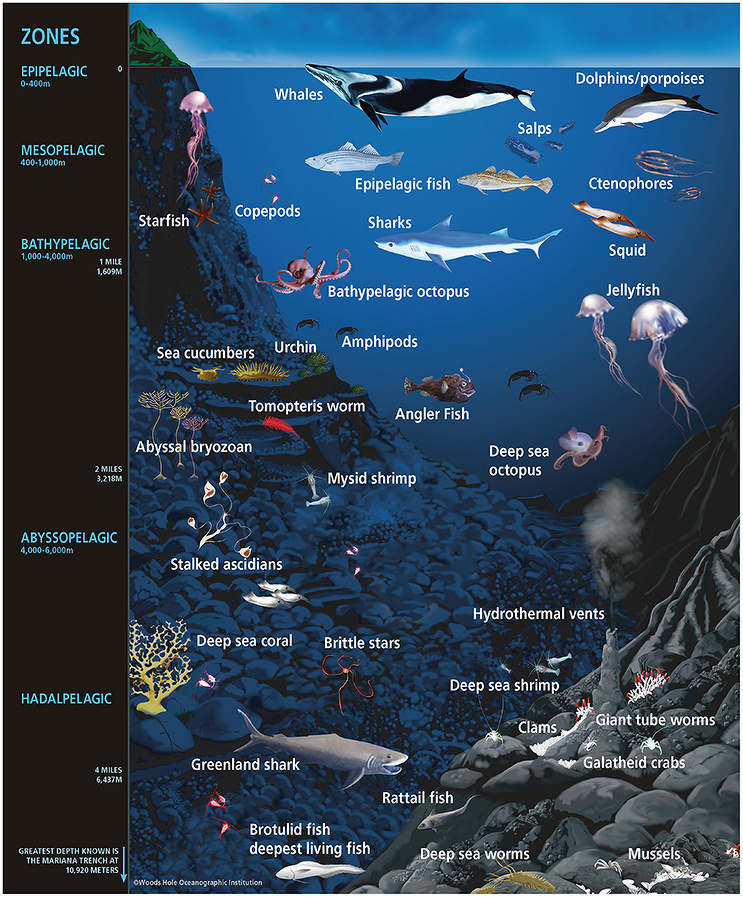
sea life in different ocean zones
Pelagic Zone (Open Ocean): includes all open-ocean waters not touching the shore or seafloor. Although often called the ocean’s “deserts,” it supports a surprising range of life. It is divided into vertical layers based on light and depth.
Epipelagic Zone (Surface to 200 meters) – The Sunlit Zone is the brightest, warmest layer, where sunlight supports photosynthesis. Wind-driven mixing spreads heat across the globe—from nearly 97°F in the Persian Gulf to 28°F near the poles. At its base lies the thermocline, a region of rapidly dropping temperature whose depth shifts seasonally and with weather patterns.
Mesopelagic Zone (200–1,000 meters) – The Twilight Zone is where light fades quickly and temperatures plunge. This zone contains about 90 percent of Earth’s fish biomass. During WWII, dense schools confused sonar by creating a “false bottom.” Typical residents include hatchetfish, lanternfish, barreleyes, and bristlemouths. Most are small, but giants like the megamouth shark (13–18 feet) filter-feed through the darkness.
Bathypelagic Zone (1,000–4,000 meters) – The Midnight Zone is not reached by sunlight. The only light comes from bioluminescent organisms. Temperatures hover around 39°F, and pressure reaches 5,800 psi. Despite the harsh conditions, soft-bodied creatures and even some bony fish survive here, feeding on organic debris drifting down from above. Species like the Sloane viperfish migrate upward at night to hunt.
Abyssopelagic Zone (4,000–6,000 meters) – The Abyss covers three-quarters of the ocean floor. It is completely dark, near freezing, and under crushing pressure. Life depends entirely on sinking detritus. Abyssal animals tend to have slow metabolisms, flexible stomachs, large mouths, and often bioluminescence. Despite their extreme lifestyles, many are related to species found on continental shelves.
Benthic Zone (Seafloor) includes the sediment surface and the waters just above it, from the shore to the deepest trenches. It hosts 98 percent of all marine species, making it the ocean’s greatest reservoir of biodiversity. Bottom life includes: 1) Infauna, organisms living within the sediment (e.g., clams); 2) Epifauna – animals on the seafloor surface (e.g., sea stars, polyps); and 3) Nektobenthos – free-swimming animals living near the bottom (e.g., shrimp, flounder). Most benthic organisms rely on falling organic material from upper layers and are highly specialized for life in darkness, cold, and extreme pressure.
Mesopelagic Zone — the Ocean’s Twilight Zone
The mesopelagic zone, also known as the "twilight zone," is the ocean layer between approximately 200 and 1,000 meters (660 to 3,280 feet) deep. It receives very little sunlight, , with only about one percent of light reaching its upper boundary, making it impossible for photosynthesis, but it is not complete darkness. This zone hosts a diverse community of bioluminescent organisms and plays a critical role in the ocean's biological pump and climate regulation. Temperatures are cold and decrease with depth. Pressure and salinity increase with depth.
Helen Scales wrote in National Geographic: The twilight zone makes up a fifth of the ocean’s total volume, and much of it remains largely unexplored. The zone begins at a depth where photosynthesis fails and continues down until the last remnants of sunlight taper out. To a human inside a submersible, this realm appears pitch-black, but animals there have evolved all sorts of tricks to navigate the lack of light while at the same time avoiding predators in the open ocean. “We see all these cool shapes and sizes: transparent animals, mirrored animals, red animals, and ultrablack animals,” says Karen Osborn, Osborn, an invertebrate zoologist at the Smithsonian Institution’s National Museum of Natural History in Washington, D.C.. “They’re solving the same problem in a bunch of different ways.” [Source: Helen Scales, National Geographic, February13, 2024]

The mesopelagic zone is home to diverse life, including lanternfish, blobfish, and giant squid. Many creatures have large eyes and adaptations like bioluminescence (the ability to produce their own light) to navigate and hunt in the low-light conditions. “Most intriguing is a hand-size squid that gleams ruby red. Strawberry squid, as they’re known, are well adapted to their habitat. Their red color, when absorbed in the sunless deep, fades into a brownish black, blending them into their surroundings. Occasional flashes of bioluminescent light that shimmer across their bodies startle intruders. And their mismatched eyes look in two directions at once: One, huge and yellow, gazes upward, detecting silhouettes passing overhead. The other, smaller and blue, stares down, watching for glowing prey in the darkness. What look like strawberry seeds on the skin of this strawberry squid are photophores that emit their own light.
Paraphronima are crustaceanscalled hyperiid amphipods that are distant relatives of sand hoppers and can be flea-size or even tinier. In the twilight zone, amphipods have evolved a variety of unique and elaborate eyes, to catch any snatches of light that make it through to the depths. Glassy eyes take up Paraphronima’s entire head; another species in the Streetsia genus has a single, cone-shaped eye. Osborn wants to find out why so many highly specialized eyes have evolved among twilight zone amphipods. “This doesn’t happen anywhere else,” she says, as most animals that live in darkness have reduced eyes or no eyes at all. “Not in caves, not on the deep seafloor.” Glass squid, another squid resident of the twilight zone, rely on transparency to camouflage themselves. The dots on their three inch-long bodies are pigment sacs called chromatophores, which can expand to darken their appearance.
Diel Vertical Migration and Deep Scattering Layer (DSL)
During World War II, U.S. Navy sonar operators noticed something uncanny: each night, the “seafloor” appeared to rise toward the surface, only to sink again by day. By 1948, scientists realized this false bottom wasn’t geology at all, but biology—a vast, shifting mass of fish and zooplankton whose dense swim bladders scattered sound waves. They named it the deep scattering layer (DSL). [Source: Eric Wagner, Smithsonian magazine, December 2011]
This layer, stretching between 300 and 3,000 feet during the day and rising to within 30 feet of the surface at night, consists of creatures adapted to dim twilight waters: lanternfish (or myctophids) with oversized eyes, glowing photophores, and millions of tiny invertebrates. At night, these animals ascend to feed under the cover of darkness. It is now recognized as the largest daily animal migration on Earth—a global, nightly ascent involving trillions of fish, squid, amphipods, jellyfish, siphonophores, and more.
Contrary to early assumptions that DSL creatures simply drift with currents, new research shows they are highly selective and active. Even microscopic phytoplankton form thin, miles-wide sheets to find optimal light and chemistry. Zooplankton track these layers, and lanternfish swim against currents to exploit them. Predators—from jumbo squid in the Sea of Cortez to sperm whales—follow the migrating prey up and down the water column.
Diel vertical migration (DVM) refers to the daily, synchronized movement of marine and freshwater organisms, such as zooplankton, between deep waters during the day and shallow waters at night. This behavior is driven by the need to balance feeding opportunities with predator avoidance, with animals ascending to feed on phytoplankton near the surface under the cover of darkness and descending to hide from visual predators during the day. It is the largest migration on Earth and has significant impacts on the global climate and nutrient cycles. In Monterey Bay, submersible pilots describe driving through lanternfish shoals so dense that sonar cannot see beyond them.
The migration includes animals at all life stages, from zoea crab larvae to delicate copepods with featherlike sensors, and dramatic predators like the Atolla jelly, which spins rings of blue light when attacked. Twilight-zone fish form the backbone of marine food webs: tuna, sharks, swordfish, sea lions, dolphins, and even some salmon depend on them, either picking them off at night near the surface or diving deep to hunt them by day. High-frequency echo sounders now monitor the DSL continuously, revealing that migrations can pause for hours, days, or even weeks, influenced by predators such as Risso’s dolphins.
The daily migration of organisms helps transfer carbon from the surface to the deep ocean, a process vital for climate regulation. Migrating animals retreat to the deep, usually before dawn, with their bellies full of food, including carbon harnessed from the atmosphere by phytoplankton. Waves of migrants then release much of that carbon down deep, in their feces and through their gills. “Vertical migration is this rapid elevator or conveyor belt connecting the surface ocean to the deep sea,” says Kelly Benoit-Bird, a marine acoustician at MBARI. Approximately a quarter of carbon dioxide emissions from fossil fuel burning and other human-made sources get absorbed by ocean life, a process called the biological carbon pump. Scientific models have tended to focus on processes such as sinking dead plankton and their feces, but more recently attention is turning to living animals. Studies suggest migrating twilight zone animals may move as much as 50 percent of the pump’s carbon load into the deep where it’s stored, away from the atmosphere, for hundreds or thousands of years. [Source: Helen Scales, National Geographic, February13, 2024]
Sea Animal Migrations
“Just off the West Coast may be one of the greatest hot spots for open ocean predators in the world,” said Barbara Block of Stanford University’s Hopkins Marine Station, the lead author of study of about sea animal migrations along with Daniel Costa, professor of ecology and evolutionary biology at the University of California at Santa Cruz. Block told the Washington Post she was struck by how each spring the rich nutrients in the cool water along the California Current, which flows south along the West Coast of the United States, Canada and Mexico, drew an array of animals to the same place. Young bluefin tuna make their way from Japan for the area’s soup of krill, sardines, anchovies and squid, as do leatherback turtles from Indonesia and sooty shearwater birds from New Zealand. [Source: Juliet Eilperin, Washington Post , June 22, 2011]
“They have their favorite haunts, they clearly have the places they keep going back to,” Block said. “The upwelling [of nutrients] is so intense there in the springtime it really sets the table for the whales, the tuna and the sharks. They come and lunch at that table, from everywhere in the entire Pacific realm.” The California Current is “a predictably and persistently productive region” many marine creatures gravitate to over and over again, said Steven Bograd, a research oceanographer at the National Oceanic and Atmospheric Administration’s Southwest Fisheries Science Center and one of the paper’s co-authors. “We’ve characterized, better than ever before, that it is a really critical area in the life history of these animals,” he said.
The scientists emphasized that the fact that many of these commutes largely take place within the exclusive economic zones of the United States, Canada and Mexico — the 200-mile stretch from shore that individual countries can govern — means that the three countries can adequately protect these areas. On the importance of conservation, Block told Natural History magazine: “It will take enormous vision to preserve this wild place. Without conservation of such ocean realms, the bluefin tunas and blue whales, whale sharks and great whites might not be there in future generations.”
California Current — the Serengeti of the Sea?
The waters of the California Current off the west coast of the United States have been compared with the Serengeti grasslands of East Africa because of the huge animal migrations that occur there. Cheryl Lyn Dybas wrote in Natural History magazine: Water temperature is key to the seasonal migrations of many North Pacific Ocean species. That’s especially true in the marine ecosystem defined by the California Current, where whales, sharks, tuna, seals, seabirds, and turtles migrate each year. Like the African savanna, says Costa, the Pacific Ocean has a “Big Five”: he compares great white sharks to lions, bluefin tuna to leopards, blue whales to African elephants, leatherback sea turtles to black rhinos, and elephant seals to Cape buffaloes. [Source: Cheryl Lyn Dybas, Natural History magazine, September-October 2012]
“Scientists see parallels between migration patterns of prey, predators, and scavengers in East Africa’s Serengeti region and movements of species in the Pacific. Mapped here are (top left and right) zebra and wildebeest, (middle left and right) nomadic lion and hyena, and (bottom) vultures. Most lion prides occupy defended territories; nomadic lions, usually single males, tend to follow migrating herds while trying to avoid detection by resident males. “The Serengeti is an ecosystem that’s synonymous with animal movements,” says ecologist Grant Hopcraft of the Frankfurt Zoological Society–Africa, headquartered in the Serengeti. “Each year more than one and a half million ungulates cross its plains.” Their seasonal migrations follow cyclic rains that lead to the growth of savanna grasses. Where grasses sprout up, ungulates such as wildebeest follow. Predators such as nomadic lions trail closely behind. (Although most lion prides occupy defended territories, nomadic lions, usually single males, tend to follow migrating herds while trying to avoid detection by resident males.) “The movements of marine species in the California Current are similar to those in the Serengeti,” says Hopcraft, “which raises the question: Why? Research at the population level suggests that it’s a changing food supply that drives animal migrations. But recent animal collaring [tracking] projects in the Serengeti show a huge amount of variation in individual species’ responses.”
There’s a lot more going on, Hopcraft believes, beneath the surface. “For the Serengeti — and the California Current — does an animal’s internal condition determine how it responds? Is it remembering previous routes and responding to the same cues? How will environmental change affect these great migrations of the land and the sea?”
Some predators spend their lives in the California Current, but others migrate long distances across the Pacific Ocean to reach the current’s abundant prey, including krill, sardines, anchovies, and squid. “Why a young bluefin tuna less than two years old wakes up in the light of the Japan Sea and decides to swim to Baja is unknown,” Block says. “But once it arrives, tagging data indicate that it lives there for years, taking advantage of the rich ‘forage’ along the coast.” Many species — including black-footed albatrosses, sooty shearwaters, bluefin tuna, and salmon sharks — migrate more than 1,200 miles from the western, central, or southern Pacific Ocean to reach the California Current’s rich food resources.
Different Species Follow the Same Migrations Routes in the Pacific
uliet Eilperin wrote in the Washington Post, “Tagging revealed that several species — including leatherback sea turtles, black-footed albatrosses and salmon sharks — followed similar routes from the western, central or south Pacific to reach the current’s rich resources.While scientists tracked most animals for less than a year, they followed several tunas, sharks and turtles for longer: in the case of one salmon shark, well more than 3 ½ years. [Source: Juliet Eilperin, Washington Post , June 22, 2011]
Costa said the fact that these different creatures are following the same path helps account for why some of them, including leatherback turtles, get caught by fishing vessels that are targeting other species. In one instance, he noted, the same female elephant seal tagged in 1995 off the island of Ano Nuevo north of Santa Cruz “took the same exact path 11 years later” when researchers tagged her again. “It’s not genetic; it’s some sort of learned behavior,” Costa said in an interview.
Ocean temperatures In the case of sharks, Block said, researchers were able to determine that species with a common ancestor — salmon, white and mako sharks — preferred to spend time in slightly different temperatures. In Alaska, salmon sharks swim in water as cold as 42.8 degrees but can manage in temperatures as high as 53.6 degrees; great whites stick close to the California coast at 53.6 degrees but journey to Hawaiian waters as balmy as 69.8 degrees; and makos inhabit seas as warm as 80.6 degrees.
Image Sources: Wikimedia Commons; YouTube, Animal Diversity Web, NOAA
Text Sources: Animal Diversity Web (ADW) animaldiversity.org; National Oceanic and Atmospheric Administration (NOAA) noaa.gov; “Introduction to Physical Oceanography” by Robert Stewart , Texas A&M University, 2008 uv.es/hegigui/Kasper ; Wikipedia, National Geographic, Live Science, BBC, Smithsonian, New York Times, Washington Post, Los Angeles Times, The New Yorker, Reuters, Associated Press, Lonely Planet Guides and various books and other publications.
Last Updated November 2025