
Home | Category: Oceans and Sea Life / Sea Life Around Australia / Nature, Environment, Animals
DEEP SEA CREATURES ON SEAMOUNTS OFF OF CHILE
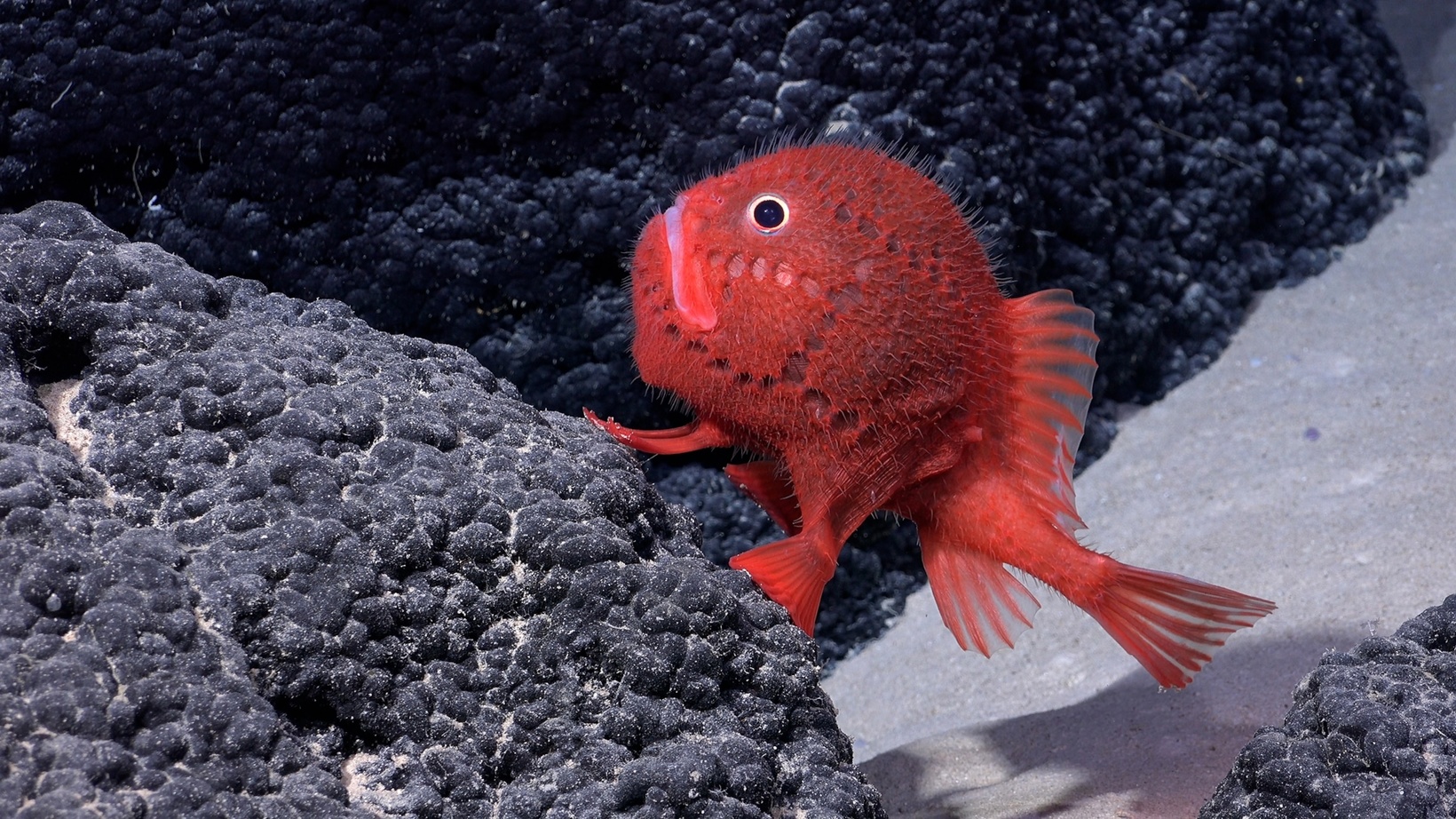
Deep sea toadfish found off Chile
A series of recent deep-sea expeditions off the coast of Chile in the early 2020s revealed a world of astonishing creatures and previously unknown underwater mountains. Using advanced robotic submersibles and high-resolution mapping, scientists on the Falkor (too)—a 363-foot Schmidt Ocean Institute research vessel—have documented new ecosystems, uncovered more than 100 new species, and captured the first-ever footage of several elusive deep-sea animals. [Sources: Stephanie Pappas, Live Science, April 20, 2022; Ashley Balzer Vigil, National Geographic, February28, 2024; Mashable, August 28, 2024]
Working along the 1,800-mile Salas y Gómez Ridge and the Nazca Ridge—chains of more than 200 seamounts stretching from Chile to Rapa Nui—researchers mapped four never-before-seen underwater mountains and surveyed six others already on record. These seamounts rise thousands of feet from the seafloor, forming isolated biological “islands” in what has long been considered a marine desert. “The unique nature of each seamount allows certain species to adapt exclusively to that mountain,” said Jan Maximiliano Guerra of the Catholic University of the North. “Many of the organisms we find are unique and exist nowhere else on Earth.” Across the expeditions, researchers encountered creatures so strange they look like they swam straight out of a science-fiction film.
Among the highlights were: 1) A “living constellation” that drifts like an underwater tumbleweed; 2) a spiny crimson crustaceans with needle-covered legs; 3) Vast displays of bioluminescence streaking through the darkness; 4) giant bamboo corals rising more than three meters (10 feet) from the sea floor; and 5) fields of sea lilies, giant sponges, octopuses, and deep-sea coral reefs.
Some of the most striking finds came from the ROV SuBastian, a remotely operated vehicle capable of descending more than 14,000 feet into the Pacific’s black depths. The ROV’s cameras captured: 1) The first-ever footage of a live Promachoteuthis squid, previously known only from specimens in trawl nets; 2) the rarely seen “flying spaghetti monster” siphonophore (Bathyphysa conifera) drifting through the water column; 3) A whiplash squid, which inked at 3,600 feet before drifting off into the dark.4) Urchins, sponges, corals, squat lobsters, and other creatures thriving in steep, rocky habitats.
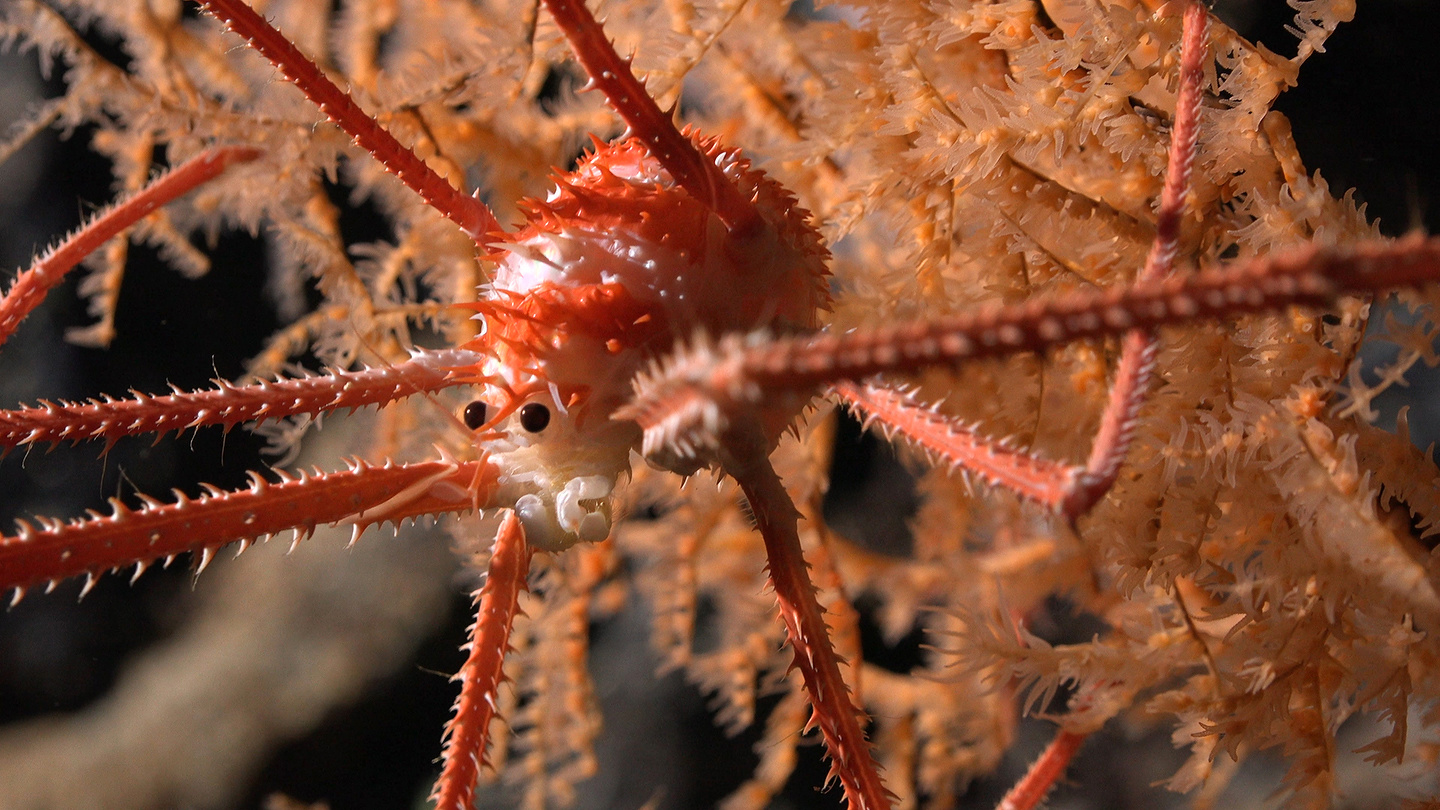
squat lobster found in coral at a depth of 669 meters on Seamount JF2 off Chile
In previous studies, Sellanes and colleagues also discovered the bizarre worm Eunice decolorhami, with bulging eyes and an exaggerated underbite—“a Muppet-like” species living in tubes on the Nazca Ridge. Another find was the eerie crab Ebalia sculpta, its carapace marked with a face-like pattern “resembling an underworld being”—earning it the nickname “the deviled crab.”
One standout discovery is a bright red “walking” fish—a new species of sea toad (Chaunacops), a type of deep-sea anglerfish. With googly eyes and skin that looks hand-crocheted, its lacy texture is formed by tiny spines that both protect the animal and host sensory structures. Sea toads use specially modified fins to walk across the seabed, conserving energy and enabling a slow, stealthy hunting style. The discovery marks the first scientific record of a sea toad in the southeastern Pacific.
The expedition aboard the Falkor (too)—a 363-foot Schmidt Ocean Institute research vessel—mapped more than 20,000 square miles of seafloor and uncovered ecosystems distinct to each seamount. Some underwater mountains were already within Chilean marine protected areas, but most are not.
Related Articles:
OCEAN LIFE: SPECIES, BIODIVERSITY, OLDEST AND MOST NUMEROUS ioa.factsanddetails.com
DEEP SEA FISH: STRANGEST, DEEPEST AND UGLIEST ioa.factsanddetails.com
BIOLUMINESCENCE IN THE SEA: WHY, HOW AND CREATURES THAT USE IT ioa.factsanddetails.com ;
See Vents Under PHYSICAL FEATURES OF THE OCEAN FLOOR: TRENCHES, VENTS, MOUNTAINS ioa.factsanddetails.com
See Vent Clams Under Clams: Characteristics, Behavior, Mating and Unusual, 500-Year-Old Ones See Deep Sea Scallops ioa.factsanddetails.com
Websites and Resources: Animal Diversity Web (ADW) animaldiversity.org; National Oceanic and Atmospheric Administration (NOAA) noaa.gov; “Introduction to Physical Oceanography” by Robert Stewart , Texas A&M University, 2008 uv.es/hegigui/Kasper ; Fishbase fishbase.se ; Encyclopedia of Life eol.org ; Smithsonian Oceans Portal ocean.si.edu/ocean-life-ecosystems ; Woods Hole Oceanographic Institute whoi.edu ; Cousteau Society cousteau.org ; Monterey Bay Aquarium montereybayaquarium.org ; MarineBio marinebio.org/oceans/creatures
RECOMMENDED BOOKS:
“Creatures of the Deep: In Search of the Sea’s Monsters and the World They Live In” by Erich Hoyt Amazon.com
“Below the Edge of Darkness: A Memoir of Exploring Light and Life in the Deep Sea” by Edith Widder (2021) Amazon.com
“The Brilliant Abyss: Exploring the Majestic Hidden Life of the Deep Ocean, and the Looming Threat That Imperils It” by Helen Scales, a British marine biologist (Grove Atlantic), Amazon.com
“The Deep Ocean: Life in the Abyss” by Michael Vecchione, Louise Allcock , et al. (2023) Amazon.com
“The Underworld: Journeys to the Depths of the Ocean” by Susan Casey (2023) Amazon.com
“Oceanology: The Secrets of the Sea Revealed” (DK Secret World Encyclopedias) Amazon.com
“Marine Biology For The Non-Biologist” by Andrew Caine Amazon.com
“Strange Sea Creatures” by Erich Hoyt Amazon.com
“The Extreme Life of the Sea”“ by Stephen and Anthony Palumbi, Princeton University Press (2014) Amazon.com
“Biological Oceanography” by Charles B. Miller (2004) Amazon.com
“The Marine World: A Natural History of Ocean Life” by Frances Dipper (2016) Amazon.com
“Dive into the Ocean: Exploring Different Types of Sea Life” by Shane McAleer , Cameron McAleer, et al. (2023) Amazon.com
“The Unnatural History of the Sea” by Callum Roberts (Island Press (2009) Amazon.com
“Ocean: The World's Last Wilderness Revealed” by Robert Dinwiddie , Philip Eales, et al. (2008) Amazon.com
“Blue Hope: Exploring and Caring for Earth's Magnificent Ocean” by Sylvia Earle (2014) Amazon.com
“National Geographic Ocean: A Global Odyssey” by Sylvia Earle (2021) Amazon.com
New Species Discovered at 8,000 Meters (25,900 Feet) Deep in the Atacama Trench
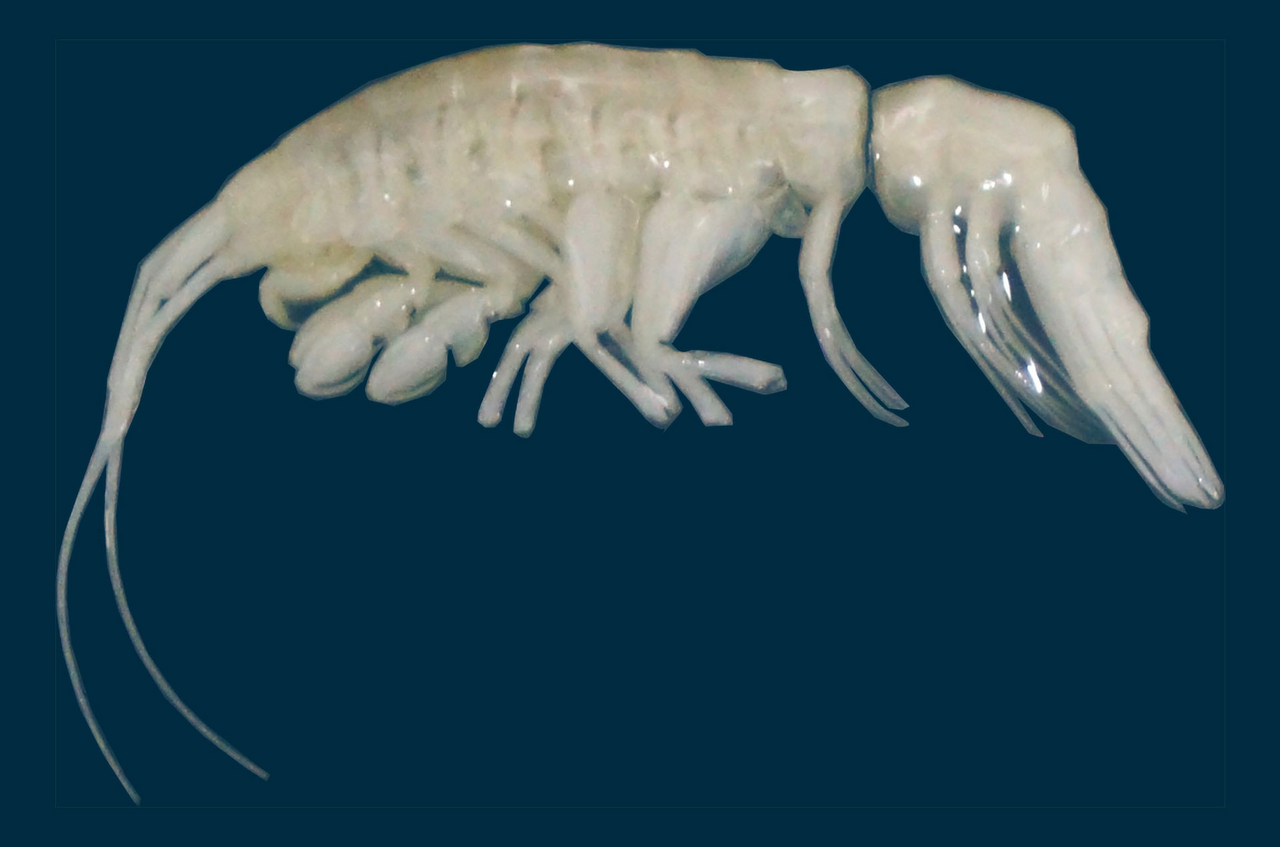
female Dulcibella camanchaca
Scientists from the U.S. and Chile have discovered Dulcibella camanchaca, a new species—and new genus—of deep-sea amphipod living nearly 8,000 meters down in the Atacama Trench, one of the deepest places in the Pacific Ocean. Measuring about 4 centimeters (1.57 inches), it is the first large, fast-swimming predatory amphipod ever found in these extreme hadal depths, where perpetual darkness, scarce food, and immense pressure prevail. [Source: Russell McLendon, ScienceAlert, December 12, 2024; Mrigakshi Dixit, Interesting Engineering, December 12, 2024]
Collected during a 2023 expedition using a baited lander system, the pale, ghostlike crustaceans were later analyzed in Chile, revealing distinctive morphology and DNA that set them apart from all known relatives. The species name camanchaca references words for “darkness” in Andean Indigenous languages, while the genus name Dulcibella continues a tradition of naming related amphipods after characters from Don Quixote.
The discovery highlights the Atacama Trench as a hotspot of endemic life, adding to evidence that deep-ocean trenches, like isolated islands, harbor unique species found nowhere else. Researchers emphasize that improved exploration technology will likely reveal many more unfamiliar organisms, offering insight into how life adapts to one of Earth’s harshest environments—and helping guide efforts to protect these fragile ecosystems from pollution, climate change, and other human impacts.
One Hundred New Deep Sea Species Found off New Zealand
In February 2024, a team of 21 researchers launched an expedition into the largely unexplored 500-mile-long Bounty Trough off New Zealand’s South Island. They expected to find new life, but the results exceeded their hopes. “We’ve already identified around 100 new species, and I expect that number to rise into the hundreds,” expedition leader Dr. Alex Rogers told The New York Times. [Source: Sorcha Bradley, The Week UK, March 14, 2024]
The team, working under Ocean Census, a nonprofit aiming to catalog 100,000 new marine species, collected nearly 1,800 samples from depths reaching 4,800 meters—as deep as Mont Blanc is tall. Among the discoveries is a star-shaped creature so unusual that experts are unsure how to classify it. Initially thought to be a sea anemone or sea star, the animal may instead be a previously unknown type of octocoral—or potentially something even more extraordinary. “It could represent an entirely new group outside the octocorals,” said taxonomist Dr. Michela Mitchell. “If so, it’s a major deep-sea discovery and gives us a clearer picture of the planet’s hidden biodiversity.”
The team also identified a new species of eelpout, a deep-sea fish immediately recognized as different from any known species. “Finding new vertebrates is rare,” said marine biologist Dr. Daniel Moore. “We like to think we know all the fish out there, but the reality is we don’t.”
Bizarre Deep-Sea Creatures Found Off Australia
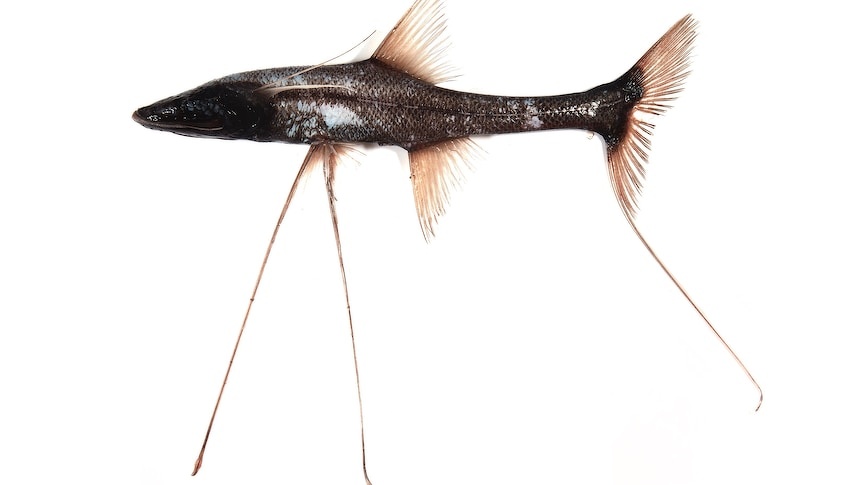
tripod fish, with fins that allow it to stand above the sea floor and catch food, found off Australia, Museums Victoria
In 2022, scientists exploring two new marine parks 2,500 kilometers off Western Australia uncovered a trove of bizarre deep-sea life — from “walking” fish to ooze-like animals. Expedition leader Tim O’Hara of Museums Victoria said the region’s ancient seamounts, formed in the dinosaur era at the junction of the Pacific and Indian Oceans, offered prime territory for discovering entirely new species. [Source: Tessa Koumoundouros, Nature, November 4, 2022, Franz Lidz, Smithsonian magazine, November 2015; Marianne Guenot, Business Insider, December 2, 2022; Fox News, December 9, 2022]
The parks protect 740,000 square kilometers around Cocos Keeling and Christmas Islands. During a 35-day, 13,000-kilometer voyage, researchers aboard the RV Investigator used sonar to reveal volcanic cones, ridges, canyons, and a massive seamount rising nearly 5,000 meters from the seafloor. Sampling from depths of 60 to 5,500 meters produced an extraordinary catch — O’Hara estimated that a third of the specimens may be new to science. Among them was a blind cusk eel with loose, transparent, gelatinous skin and tiny gold pits for eyes. Other finds included a hermit crab living inside a soft zoanthid coral, ornate sea cucumbers, sea stars, snails, and an array of other deep-sea oddities.
Among the standout animals were the tribute spiderfish and bony-eared assfish. A newly discovered blind cusk eel, found five kilometers down, gives birth to live young — unusual for deep-sea fish, which typically lay eggs. Its body is almost entirely gelatinous and transparent.
The batfish, a deep-sea ray, uses a glowing lure on its snout to attract prey. The stoplight loosejaw hunts with red and blue bioluminescent “headlights” produced by photophores. Not every creature is drab: researchers also found bright red starfish, vivid squat lobsters, and the pancake sea urchin, which flattens itself and carries poison-tipped spines.
The tripod fish may be the most remarkable. It balances on three elongated fin rays, facing into the current to feed. Even stranger, it is a simultaneous hermaphrodite: each fish has both functioning ovaries and testes and can mate with any other tripod fish it encounters — a useful strategy in the sparsely populated deep.
A 2003 Australian–New Zealand survey around Norfolk and Lord Howe islands similarly hauled up more than 100 new species from 1,200 meters deep, including gulper eels, fangtooths, viperfish, prickly dogfish, giant sea spiders, corals, and even a fossil megalodon tooth. Researchers described spookfish with electrically sensitive snouts, ten-foot sponges, and black-devil anglerfish glowing with bacterial light.
Deep Sea Creatures Found Off Argentina
A deep-sea expedition off the coast of Argentina revealed a remarkable collections of previously unknown marine life ever documented in the South Atlantic. Led by Argentina’s National Scientific and Technical Research Council (CONICET) in partnership with the Schmidt Ocean Institute, the mission explored the Mar del Plata Submarine Canyon using the ROV SuBastian — deployed for the first time in Argentine waters. [Source: María de los Ángeles Orfila, Live Science, August 6, 2025; [Source: Mar Puig, United Press International, August 6, 2025]
In July and August 2025, SuBastian livestreamed ultra-high-definition footage from depths of nearly 4,000 meters (13,100 feet), capturing intact habitats, rare behaviors and more than 40 species that appear to be new to science, including carnivorous sponges, translucent fishes, vivid rays, and a range of crustaceans and invertebrates specially adapted to the deep.
One breakout star is a plump sea star of the genus Hippasteria, whose rounded central disc earned it the nickname “big-butt starfish” — or estrella culona — from livestream viewers who noted its resemblance to Patrick Star from SpongeBob SquarePants. Biologists explained that starfish have no “rear end”; the effect likely comes from the animal hanging on a vertical surface or simply being well fed. Even so, scientists and the public alike have embraced the comical comparison. Another fan favorite is a violet sea cucumber in the genus Benthodytes, promptly dubbed “Batatita” (“Little Sweet Potato”) for its plump shape and purple coloring. The specimen was collected and brought safely to the surface for further study.
The expedition took place along a biologically rich stretch of the continental slope where the warm Brazil Current meets the cold Falklands Current—an ecological crossroads that creates a unique biogeographic boundary. More than 30 Argentine specialists are surveying multiple stations to study species distribution, water chemistry, sediment dynamics and the presence of microplastics. The use of SuBastian marks a major shift from earlier Argentine deep-sea campaigns, which relied on trawl nets. Now, scientists can observe organisms in their natural habitat, document undisturbed behaviors and gather biological and geochemical samples with minimal impact. According to chief scientist Daniel Lauretta, the robot provides “ultra-sensitive eyes” that reveal seascapes “like something from another planet.”
Image Sources: Wikimedia Commons; Schmidt Ocean Institute
Text Sources: Animal Diversity Web (ADW) animaldiversity.org; National Oceanic and Atmospheric Administration (NOAA) noaa.gov; Wikipedia, National Geographic, Live Science, BBC, Smithsonian, New York Times, Washington Post, Los Angeles Times, The New Yorker, Reuters, Associated Press, Lonely Planet Guides and various books and other publications.
Last Updated November 2025