
Home | Category: History and Religion
FORMATION OF NEW ZEALAND
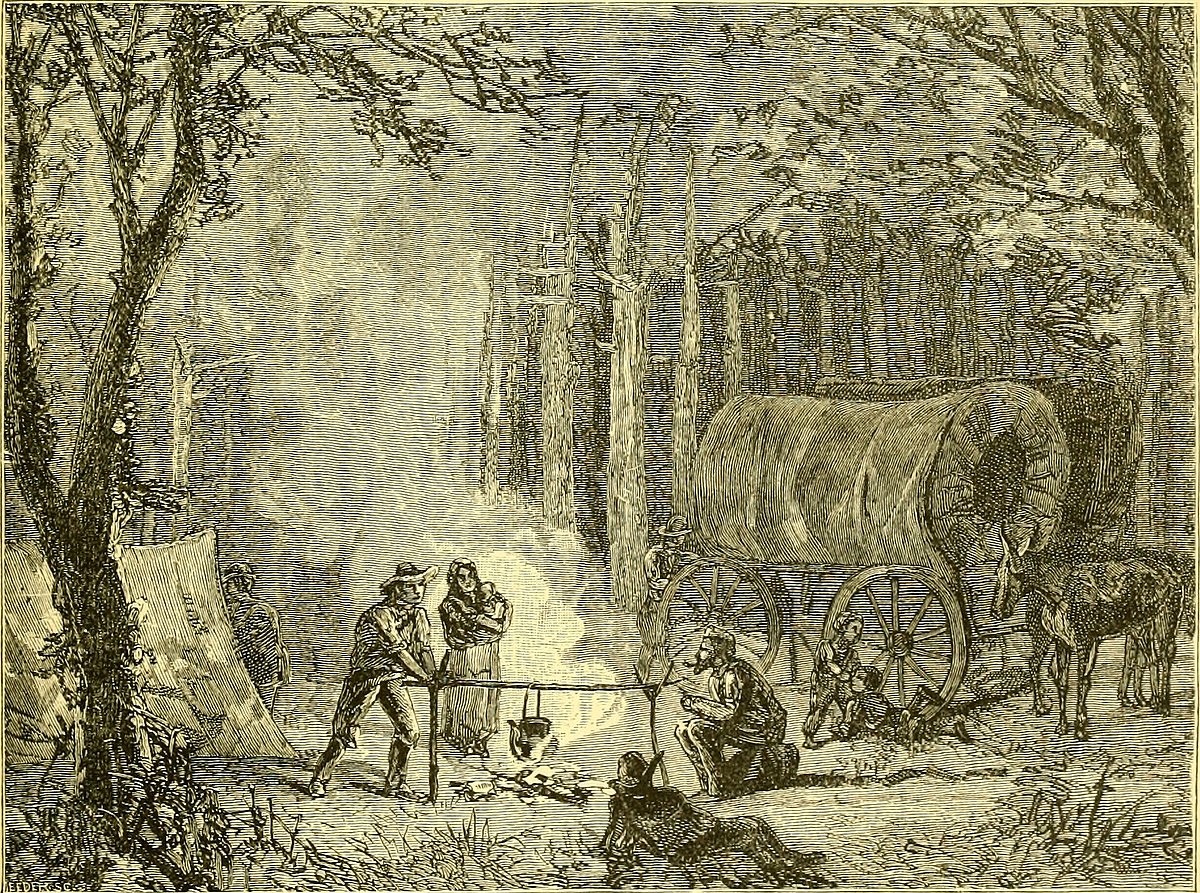
Two boy travelers in New Zealand and Australia in 1889
Constitutional government began to develop in the 1850s. New Zealand was given some self government and allowed to set up an elected general assembly in 1852. In 1867, the Maori won the right to a certain number of reserved seats in parliament.
During this period, the livestock industry began to expand, and the foundations of New Zealand's modern economy took shape. By the end of the 19th century, improved transportation facilities made possible a great overseas trade in wool, meat, and dairy products.
By the 1890s, parliamentary government along democratic lines was well-established, and New Zealand's social institutions assumed their present form. Women received the right to vote in national elections in 1893 — the earliest women were allowed to vote in any state, according to some sources. In the 1890s, New Zealand initially expressed interest in joining independence talks with Australia but ultimately opted against it and changed its status to an independent dominion in 1907.
Dominion status was granted in 1907. In the years that followed New Zealand gradually achieved more autonomy and became so secure in its position it annexed the Cook Islands and took over German Samoa in 1914.
Independence was offered to New Zealand by Britain in 1931 in the form of the Statute of Westminster, a document which formally relinquished the powers of the British Parliament to enact laws for the dominion. The New Zealand government didn't accept the statute until 1947.
Settlers Begin Pouring Into New Zealand in the Late 1800s
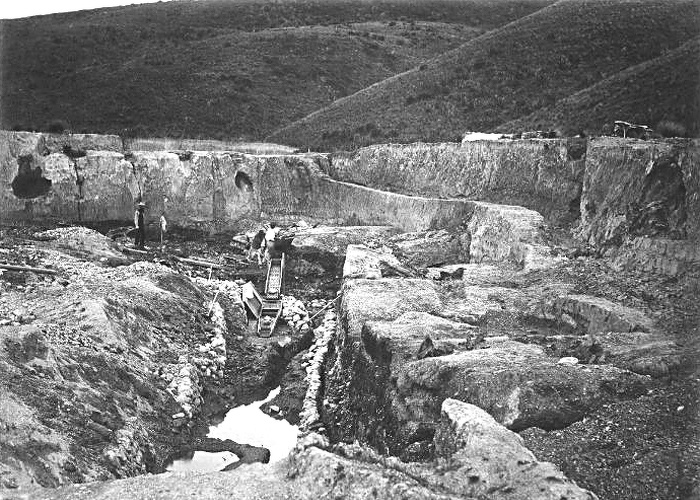
After the Maori Wars (1860–70), which resulted largely from discontent with the official land policy, the colony of New Zealand rapidly increased in wealth and population. The discovery of gold in 1861 resulted in a large influx of settlers. The introduction of refrigerated shipping in 1882 enabled New Zealand to become one of the world's greatest exporters of dairy produce and meat. [Source: “Worldmark Encyclopedia of Nations”, 2006]
Extensive archaeological work has taken place at Christchurch on New Zealand’s South Island after a big earthquake there in February 2011. According to Archaeology magazine: Small porcelain dolls are among the thousands of Victorian age artifacts retrieved from the site of a former ladies’ school in Christchurch. Ranging from 1 to 18 inches tall, the figurines were originally manufactured in Germany. They were also widespread in the United States in the mid-19th century, where they were later known as “Frozen Charlottes.” The name stems from a macabre popular poem about a vain young girl who refused to cover up on a cold evening and froze to death during an open sleigh ride. [Source: Archaeology Magazine, September 2022]
Archaeological work has taken place at Otago on New Zealand’s South Island. According to Archaeology magazine: In the mid-nineteenth century, thousands of settlers from diverse European and Asian backgrounds began to arrive in Britain’s young colony of New Zealand. Many were drawn to the South Island region of Otago by dreams of a pastoral lifestyle, or by the discovery of gold in the 1860s. A picture of the multicultural society these colonists formed is beginning to emerge through analysis of human remains recovered from unmarked graves at three cemetery sites. Researchers conducted isotope and DNA analysis, hoping to determine where the people came from. Isotope analysis, explains University of Otago archaeologist Charlotte King, can help indicate where someone grew up, while DNA provides information about genetic heritage, narrowing down where someone’s ancestors are from. “The combination of isotope and mitochondrial DNA analysis can tell us quite complex stories about a person,” says King. “For instance, we identified one person in the study who has European DNA, but an isotopic signature and material culture in their burial that match Chinese individuals in our sample.” [Source: Marley Brown, Archaeology Magazine, September/October 2021]
New Zealand in the Early 20th Century
The turn of the century brought sweeping social reforms that built the foundation for New Zealand's version of the welfare state. The depression of the early 1930s revealed to New Zealand the extent of its dependence on this export trade and led to the establishment of more local light industry.
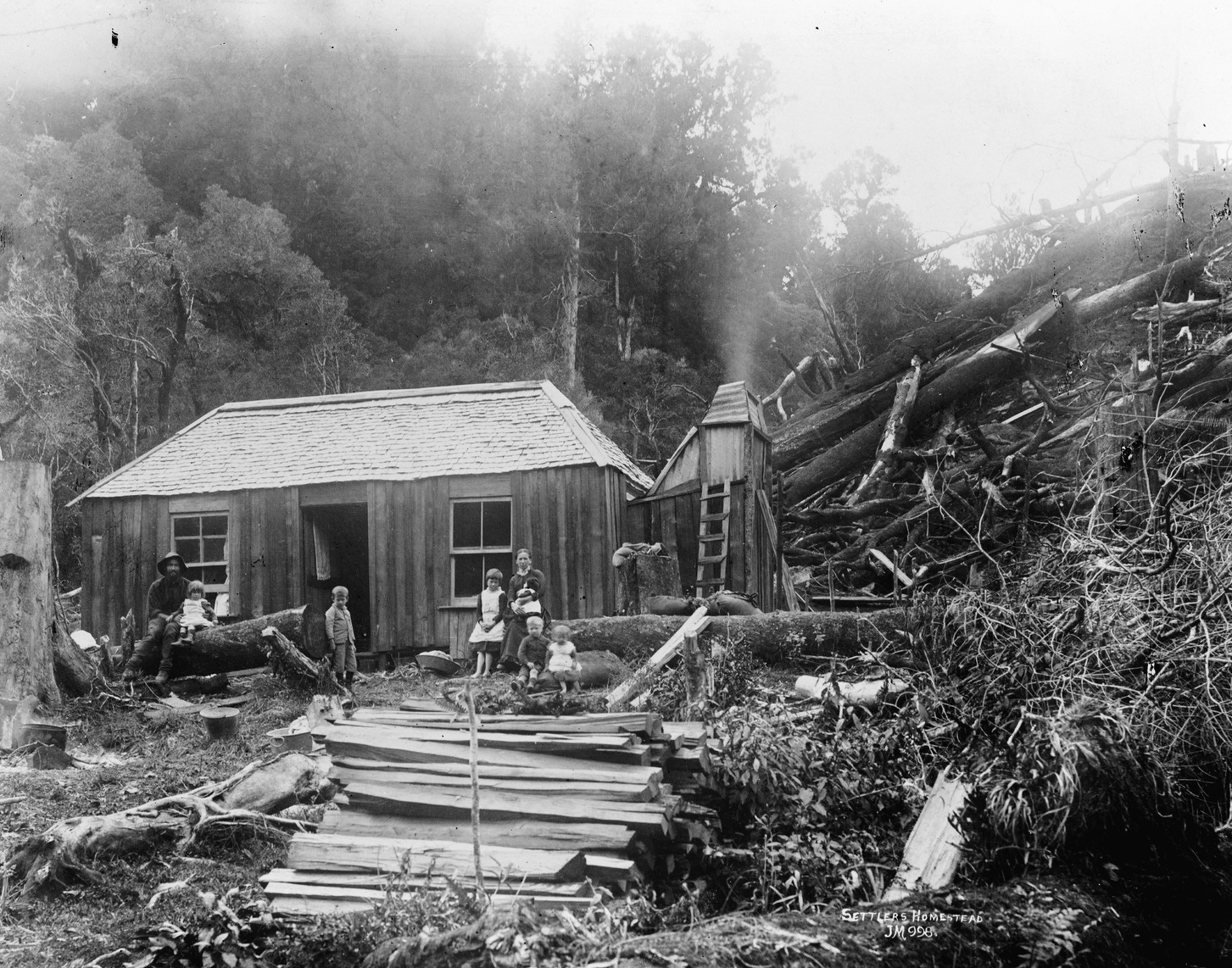
New Zealand homestead settlers in 1907
The First Labour government elected in 1935. A state housing program started that year. During 14 years in office, the Labour Party implemented a broad array of social and economic legislation, including comprehensive social security, a large-scale public works program, a 40-hour workweek, a minimum basic wage, and compulsory unionism.
The traditionally conservative National Party and left-leaning Labour Party have dominated New Zealand political life since a Labour government came to power in 1935.
New Zealand entered World Wars I and II on the side of the United Kingdom; New Zealand troops served in Europe in both wars and in the Pacific in World War II. New Zealand provided more than 100,000 troops during each World War, many of whom fought as part of the Australia and New Zealand Army Corps (ANZAC). During World War I, New Zealand takes over Samoa from Germany.
New Zealand in World War I
As part of the British Empire, New Zealand Australia joined forces with Britain in World War I. Over 100,000 New Zealanders served in World War I, About 18,000 were killed and over 41,000 were wounded. The total New Zealand Expeditionary Force numbered 100,471, and 120,000 New Zealanders joined the armed forces in total, though not all served overseas.
New Zealander and Australian forces took part in the naval and landing actions that eliminated the German presence in the South Pacific early in the war. They also participated in the campaigns in the Middle East that ended with Turkey’s surrender. New Zealand’s economy and politics were profoundly affected by the scope of the measures that the government took to support the country’s war effort. [Source: Library of Congress, September 2005]
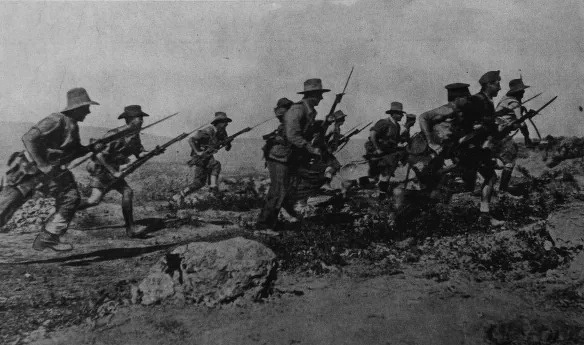
Gallipoli landing
There are a lot of war memorials in New Zealand. Many of them honor New Zealander who were slaughtered alongside Australians at the Battle Gallipoli in World War I. Gallipoli, a battle named after a peninsula in Turkey and one of the bloodiest military campaigns of bloody World War I, brings back bitter memories for New Zealanders and Australians. The most tragic Allied error at Gallipoli took place on April 25, 1915 when Australian and New Zealand units were carried by strong currents to cliff-surrounded Anzac beach, a mile away from where they were supposed to be dropped. In this one battle — a sort of D-Day that didn't succeed — 50,000 men were lost. April 25 is now a commemorated with ANZAC day. Between April 1915 and January 1916 over 500,000 men died on both sides.
See Gallipoli Under WORLD WAR I AND THE END OF THE OTTOMAN EMPIRE factsanddetails.com
New Zealand During World War II
Some 157,000 troops from New Zealand fought in World War II (1939-45), including 17,000 Maori volunteers. New Zealand soldiers fought in in Africa, Europe and Pacific and distinguished themselves at Tobruk and El Alamein in North Africa.
Approximately 194,000 men and 10,000 women served in New Zealand's armed forces during World War II, with a total of about 140,000 serving overseas. The country's contribution was significant, as its population was about 1.6 million at the time.
During a World War II battle on the island of Crete, Maori units reportedly sent German soldiers running for the hills with their fierce war cries, chants of "Ka mate, ka mate" ("it is death, it is death!"), and haka war dances, with eyeball rolling and tongue sticking out.
World War II was a boost for the New Zealand economy. There huge bulk purchases of farm product for war effort.
New Zealand Formally Achieves Independence in 1947 and Afterwards
New Zealand achieved full internal and external autonomy by the Statute of Westminster Adoption Act in 1947, although this merely formalized a situation that had existed for many years. The New Zealand government formally claimed complete independence while remaining a member of the British Commonwealth. New Zealand also signed the Australia, New Zealand, and US (ANZUS) Treaty in 1947.
The foreign policies of New Zealand and the US were increasingly intertwined. New Zealand signed the ANZUS Pact in 1951 and became a founding member of the Southeast Asia Treaty Organization (SEATO) in 1954. New Zealand troops fought alongside UN forces in Korea and alongside US forces in Vietnam. However, the involvement in Vietnam sparked a national debate on foreign policy, and all New Zealand troops were withdrawn by the end of 1971. New Zealand's military participation in SEATO was later terminated.[Source: “Worldmark Encyclopedia of Nations”, 2006]
The National Party won control of the government in 1949 and adopted many welfare measures instituted by the Labour Party. Except for two brief periods of Labour governments in 1957-60 and 1972-75, National held power until 1984.
During the 1950s, the manufacturing industry in New Zealand expanded; Maori urbanization increased as they sought employment; and a substantial Pacific immigration began. In the 1960s, the National government was in power and open access to British market for farm products helped the economy.
New Zealand in the Korean War
New Zealand military forces were involved in Korea from 1950 to 1957. Initially, they took part in the United Nations’ ‘police action’ to repel communist North Korea’s invasion of its southern neighbour. Better known as the Korean War, the conflict lasted from 25 June 1950 until 27 July 1953, when an armistice was signed. A smaller New Zealand contingent remained in South Korea in a garrison role until the final troops were withdrawn in 1957. [Source: New Zealand government, nzhistory.gov.nz]
A total of 4,700 New Zealanders served as part of the New Zealand contingent — known as Kayforce — under United Nations command. An additional 1,300 personnel served on Royal New Zealand Navy frigates during the war and in the subsequent post-armistice period (1953–1957). Forty-five New Zealand servicemen lost their lives, 33 of them during the conflict.
Although New Zealand’s contribution to the United Nations force was relatively small, the Korean crisis had a profound impact on the country’s foreign policy. Like many Western nations, New Zealand viewed North Korea’s aggression as directed by the Soviet Union and believed that strong resistance to communist expansion was essential.
The events in Korea also gave New Zealand an opportunity to strengthen its security relationship with the United States. This goal was achieved in 1951 with the signing of the ANZUS Treaty, a defence pact between Australia, New Zealand, and the United States, which would have long-term implications for New Zealand’s international relations. The Korean crisis also significantly affected New Zealand’s economy: a wartime wool boom brought widespread prosperity but coincided with the bitter waterfront dispute of 1951, one of the most divisive industrial conflicts in the nation’s history.
For the complete article from which the material here is derived see nzhistory.govt.nz
New Zealand in the Vietnam War
More than 3,000 New Zealand military and civilian personnel served in Vietnam between 1963 and 1975. In contrast to the world wars, New Zealand’s contribution was modest. At its peak in 1968, the New Zealand military force numbered only 548. Thirty-seven men lost their lives while on active service, and 187 were wounded. Two civilians serving with surgical and Red Cross teams also died. [Source: New Zealand government, nzhistory.gov.nz]
This was the first major conflict in which New Zealand did not fight alongside its traditional ally, Great Britain. Instead, its participation reflected the country’s increasingly close defence ties with the United States and Australia.
New Zealand’s involvement in the Vietnam War was highly controversial, provoking widespread protest and condemnation both at home and abroad. Few New Zealanders carried placards in 1965, but by the end of the decade thousands were marching in opposition to the war. For a growing number of people, the conflict prompted a deep re-examination of New Zealand’s foreign policy, values, and national identity.
The end of the Vietnam War coincided with a significant shift in New Zealand’s approach to regional security. Following the French withdrawal from Indochina and the Geneva Conference’s ‘temporary’ division of Vietnam at the 17th Parallel, New Zealand became a founding member of the South-East Asia Treaty Organisation (SEATO) — a regional alliance against the spread of communism, sponsored chiefly by the United States and Britain. During this period, New Zealand’s defence strategy centred on a policy of ‘forward defence’ in Asia — the belief that communism should be contained as far from its shores as possible.
For the complete article from which the material here is derived see nzhistory.govt.nz
New Zealand in the 1970s and 80s
A Labour government held office from 1972 to 1975, followed by a National government from 1975 to 1984. During this period, the New Zealand economy suffered from the loss of preferential access to the British market and from European Community butter quotas, which restricted dairy exports. The government responded to mounting inflation and economic difficulties with a series of wage and price freezes. [Sources: CIA World Factbook, 2023; “Worldmark Encyclopedia of Cultures and Daily Life,” Cengage Learning, 2009; U.S. State Department report; November 2007]
Beginning in 1984, New Zealand’s foreign and domestic policies underwent major transformation. The Labour government led by Prime Minister David Lange introduced an ambitious programme of economic reform and social change. Confronted by rising external debt, the government implemented a series of radical, market-oriented measures — later known as “Rogernomics” (after Finance Minister Roger Douglas). These included large-scale economic restructuring, tariff reductions, the abolition of agricultural and regional subsidies, privatization of state enterprises, and cuts to government services.
At the same time, the Labour government adopted a firm nuclear-free policy, pledging to ban nuclear-armed or nuclear-powered vessels from New Zealand’s harbours. When the United States requested a port visit by one of its warships in 1985, the Lange government refused entry because it could not confirm whether the ship carried nuclear weapons. This decision provoked a diplomatic rift with the United States. In 1986, the U.S. suspended its defence obligations to New Zealand under the 1951 ANZUS Treaty and imposed a ban on high-level official contact. While the ban was lifted in 1990, New Zealand’s nuclear-free stance remained a central and enduring feature of its national identity.
The mid- to late 1980s were also marked by turbulence in New Zealand’s economy and society. Following a period of rapid property speculation, the 1987 international stock market crash severely impacted New Zealand’s financial sector. In December 1989, the government established a Cabinet-level committee to develop policy responses to extensive Māori land and resource claims, which encompassed the nation’s entire coastline, large portions of its land, and half of its fishing rights.
Sinking of the Rainbow Warrior
On July 10, 1985, the 400-ton Greenpeace ship Rainbow Warrior was sunk by French agents in Auckland Harbor. French government, reportedly acting with the okay of French President Francious Mitterand, ordered the sinking of ship to prevent it from interfering with French nuclear tests in the Pacific. One person, Greenpeace photographer Fernando Periera, was killed. The
At the time of the bombing, the crew of the Rainbow Warrior was preparing to sail to waters north of Tahiti, where a nuclear test was slated to occur. The incident led to the New Zealand ban on nuclear weapons and strained relations between New Zealand and France for many years.
The two French saboteurs who planted the bomb were caught and stood trial for murder and bombing the ship. They were "imprisoned" on Hao atoll in French Polynesia for two years and then set free. Several high-level French government officials were forced to resign after being implicated in the sinking. Two French agents, Alain Mafart and Dominique Prieur, who were involved in the operation, said they may have been targeted for assassination by the French government to keep them from revealing who they worked for.
Image Sources: Wikimedia Commons
Text Sources: “Encyclopedia of World Cultures, Volume 2: Oceania,” edited by Terence E. Hays, 1996, National Geographic, New Zealand Tourism Board, New Zealand Herald, New Zealand government, Te Ara Encyclopedia of New Zealand, Live Science, Natural History magazine, New Zealand Geographic, New York Times, Washington Post, Los Angeles Times, Smithsonian magazine, Encyclopedia.com, Library of Congress, The Conversation, The New Yorker, BBC, CNN, Reuters, Associated Press, AFP, Lonely Planet Guides, Culture Shock! New Zealand, Wikipedia, The Guardian and various websites, books and other publications.
Last updated October 2025