
Home | Category: Nature, Environment, Animals
PLANTS IN NEW ZEALAND
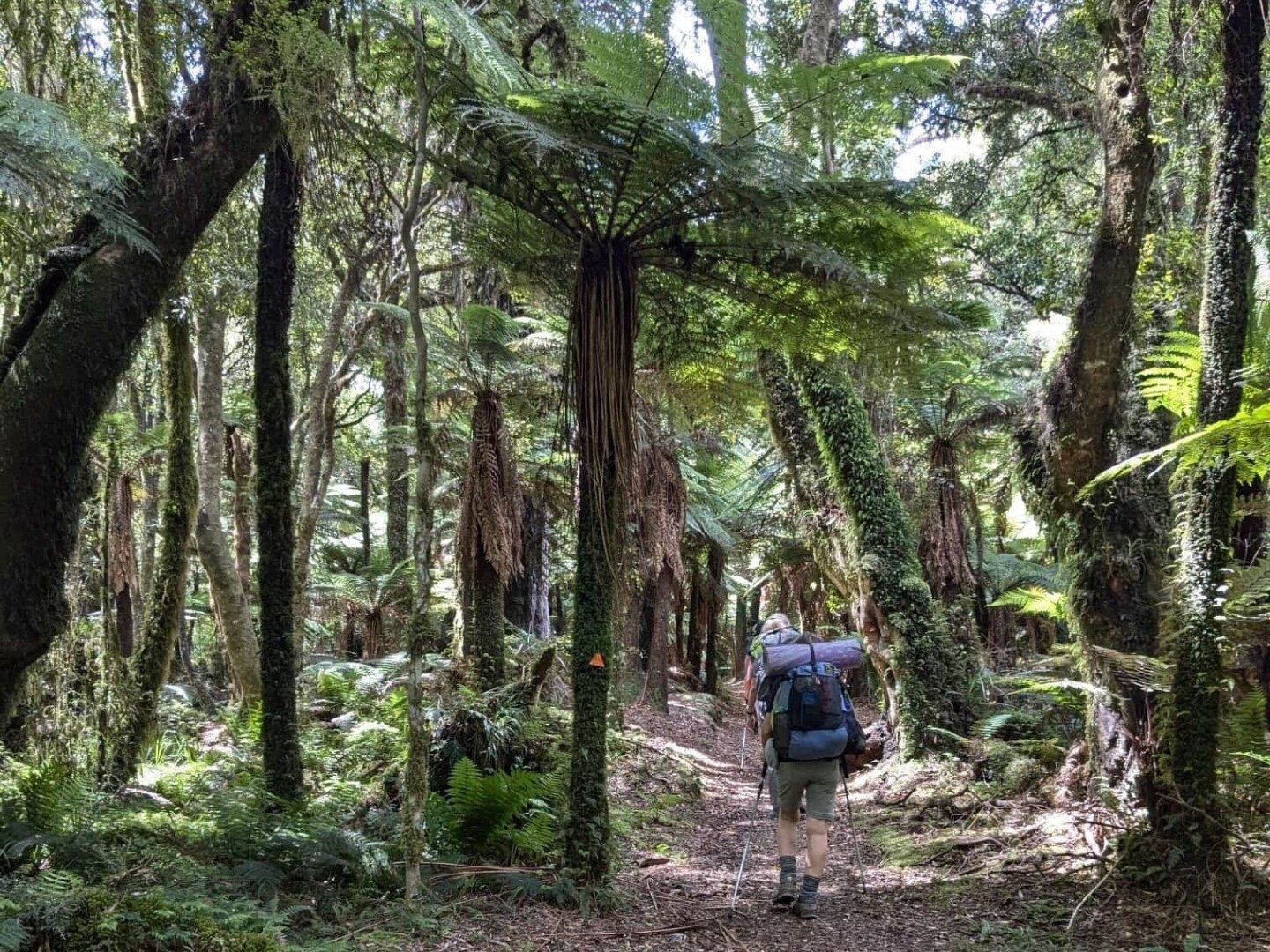
hiking among giant ferns Hiking New Zealand
Before people came to New Zealand about 80 percent of its flowering plants grew no where else in the world. Today it is home to around 2,000 plant species that are unique to New Zealand, which is regarded as a biodiversity hot spot. Native New Zealand flora includes 40-foot-tall fuchsias; four-inch-in-diameter buttercups; flax produced from a lily; and moss that is two feet thick in some places. A species of fern found in New Zealand is consumed as food. The leaf of the giant tree fern is a symbol of New Zealand.
Like other places that have been separated from the rest of the world for a long period, New Zealand has developed a distinct flora that includes some of the world's oldest plant forms. However, many flowering plants, conifers, ferns, lycopods, and other vascular tracheophytes have similarities with plants of Southeast Asia and Indonesia supporting the theory that some plants may have floated between the two regions. More than 250 species are common to both Australia and New Zealand. Botanists are interested in links between plants found in New Zealand and those found in Antarctica and South America.[Source: “Worldmark Encyclopedia of Nations”, 2006]
New Zealand flax was of great importance in the Maori economy. It is found in swampy places. Undergrowth in the damp forests consists largely of ferns, of which there are 145 species. They can be found growing around tree trunks and sometimes on branches. Tree ferns grow like epiphytes on trees. Tussock grass occurs on all mountains above the scrub line and over large areas in the South Island.
Giant Ferns of New Zealand
The giant ferns for which New Zealand is famous — and which are a symbol of the country — include: 1) Mamaku (Black Tree Ferns), the tallest, with black, scaly trunks and hexagonal frond scars; 2) Silver Fern (Ponga), known for their silvery underside and used by Māori as track markers in the dark; 3) Whekī (Rough Tree Ferns), hardy, smaller tree ferns with peg-like stipe scars; and the 4) Kātote (Soft Tree Ferns), which are half the size of mamaku.

The giant ferns of New Zealand's native forests can reach heights over 20 meters (66 feet). Silver ferns are nationally recognized symbol of New Zealand. Whekī are widespread and can be recognized by their "skirt" of dead, brown fronds that hang from the crown. Their trunks have traditionally provided materials for fencing. Kātote have traditionally been a favorite food of South Island Māori tribes.
Silver ferns appears on the uniforms of national sports teams, such as the All Blacks and the Silver Ferns netball team. Historically, the fronds and trunks of various tree ferns were used by Māori for shelter, food, and marking pathways. And it goes without saying that giant forest and tree ferns are vital parts of the New Zealand ecosystem.
Trees in New Zealand
Native New Zealand trees includes “kauris”, massive tress with trunks as large as 22 feet in diameter and ages that rival the sequoias in their girth; and the smallest known pine trees (pygmy pine are only 70 centimeters tall). Other kinds of trees found in New Zealand include temperate evergreen podocarps (such as rimu, totara, mata, miro and kahikatea) and evergreen beech trees.
Kauri are now found only in parts of the North Island. For more than a century it was harvested for its famous timber. The rimu and the totara also are timber trees. Other handsome trees include species of rata and kowhai.
A few years ago a 65 million year old fossil leaf was found in New Zealand that looked almost exactly like a modern maple leave from Canada or the United States. The tree from which the fossil came evolved independently of maple trees, showing, scientist say, "that nature designs solutions to similar environmental solutions, no matter how far apart in time or space." [National Geographic Geographica, August 1993].
Pohutukawa trees are regarded as the New Zealand Christmas tree. Related to eucalyptus trees, they produce a lovely red flower around Christmas time. The largest trees, which are 400 to 800 years, are found on the northern coastline.
Kauri Trees
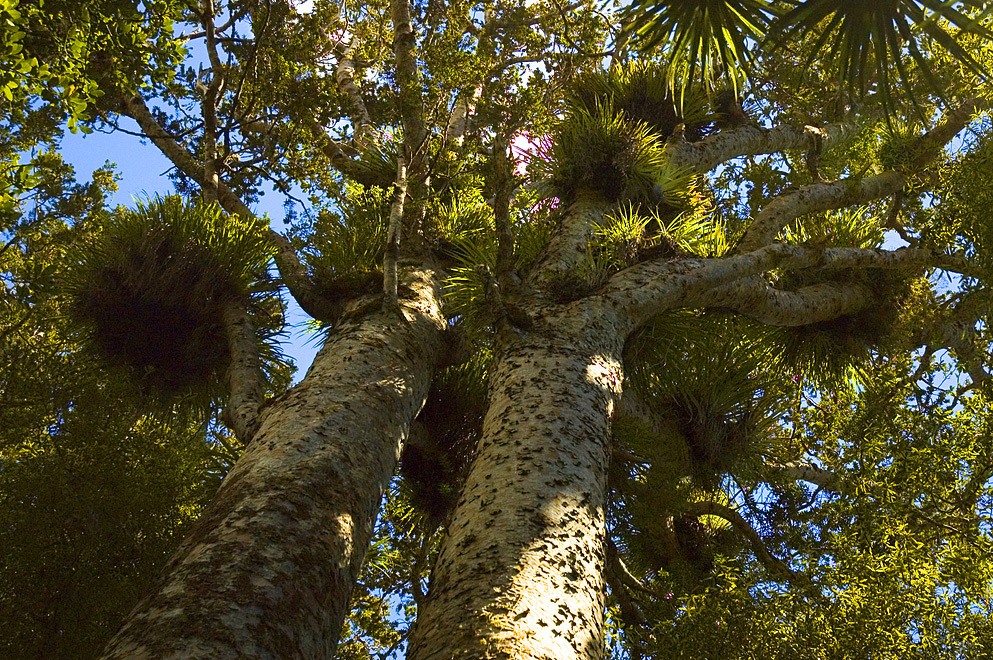
Crowns of two kauri trees in Trounson Kauri Park, North Island, New Zealand; Also visible are the epiphytes, including Astelia spp, which are a common feature of the New Zealand rainforests
Kauris (Agathis australis) are among the largest trees in the world: the most massive ones are just a tad smaller in terms of mass than the largest redwoods and sequoias. In some ways though kauris are more interesting because the look like something out of the dinosaur era. The giant punga ferns and vines that often surrounds them add to that impression. Lori Erickson wrote in Spiritual Travels: Kauri trees are found only at a certain latitude and are exceedingly slow growing. They make up for their dallying by growing for a long, long, long time. By the time they’re mature, the kauri are second in size only to sequoia. The Waipoua Forest preserves a stand of kauri that because of its inaccessibility was never logged. “The Maori believe that the ancestor of the kauri tree created life,” her Maori guide said. “When Sky Father and Mother Earth were locked in a passionate embrace, it was the kauri tree that separated them, creating space for light.” [Source: Lori Erickson, Spiritual Travels]
Kauris once covered large areas of New Zealand. Today, they are only found in isolated areas on the northern North Island. Most of New Zealand's kauri trees were cut down for the shipping and gum industries. Kauri timber was used for finely-crafted furniture amd ship masts and spars and the gum and oil was used to seal ships and other industrial purposes. According to “CultureShock! New Zealand”: the kauri “has a long, straight trunk, branching out only near the top. The wood from the kauri tree was used for making masts and planks for ships. In the 19th century, forests were stripped of many kauri trees. The kauri is a slow growing tree and, while it is now protected, it will take a long time for them to reestablish themselves. The average kauri takes about 200 years to mature. [Source: Peter Oettli, “CultureShock! A Survival Guide to Customs and Etiquette: New Zealand”, Marshall Cavendish International, 2009]
New Zealand artists and artisans make small bowls and other small wooden utensils out of much older kauri wood called ‘swamp’ kauri. This refers to the timber from trees that were felled, possibly by volcanic activity, and then buried in peat swamps about 50,000 years ago. After the wood has been dried out — a delicate process that can take several years — it is made into attractive and unique souvenirs.
Northland Forest Park (south of Rawene about 70 miles southwest of Paihia and 35 miles north of Dargaville) is home of several massive kauri trees. Tane Mahuta (See Below) is here, A grove of Kauri trees can also be seen near Mangamuka Bridge. Northland Forest covers 200,000 acres. It has many short nature trails and several long tracks. Forest nightwalks are organized at the Kauri Coast Motor Camp. People who go on these walks often see huge weta insects, kiwis, large kauri snails, owls and glow worms.
Tane Mahuta — the Great Kauri Tree
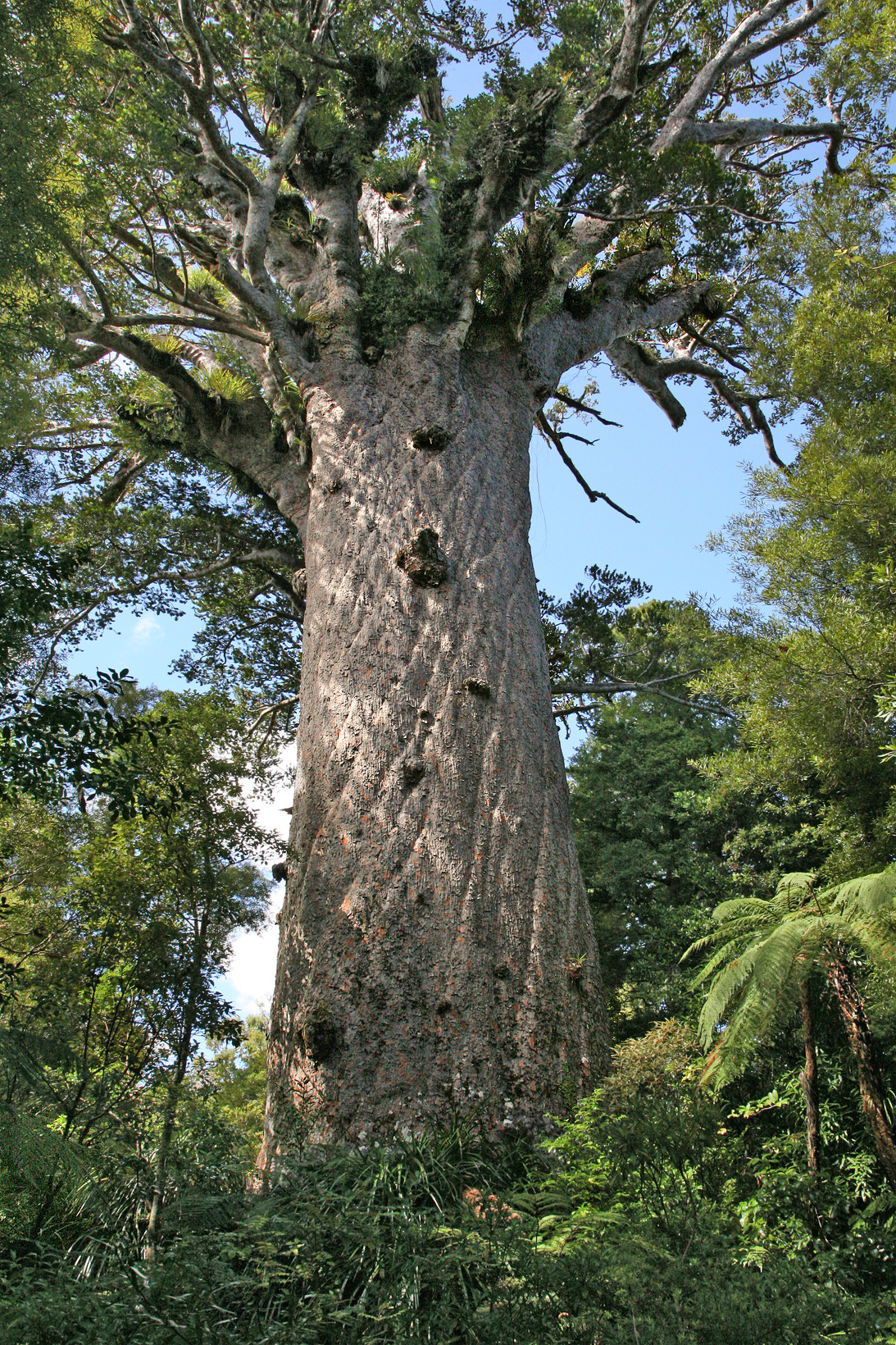
Tane Mahuta
The largest kauri left, known as “Tane Mahuta” (Lord of the Forest) has a circumference of 15.4 meters (50.7 feet) and an overall height of 45.2 meters (148 feet). Tane Mahuta is located in the Waipoua Forest in Northland Region of New Zealand, about three hours drive north of Auckland. Its age is unknown but is estimated to be between 1,250 and 2,500 years. It is the largest living kauri tree known to stand today. It is named for Tane, the Maori god of forests and of birds.
Measurements of Tane Mahuta
Tree girth 15.44 meters (50.7 feet)
Trunk height 17.8 meters (58 feet)
Tree height 45.2 meters (148 feet)
Trunk volume 255.5 cubic meters (9,020 cubic feet)
Tree volume 516.7 cubic meters (18,250 cubic feet)
The measurements above were taken in 2002 by Dr. Robert Van Pelt, a forest ecology researcher and affiliate assistant professor at the University of Washington. Former measurements taken in 1971 by the New Zealand Forestry Service may be found on The New Zealand Tree Register.
The tree is a remnant of the ancient subtropical rainforest that once grew on the Northland Peninsula. Other giant kauri are found nearby, notably Te Matua Ngahere. Tane Mahuta is the most famous tree in New Zealand, along with Te Matua Ngahere. It was discovered and identified in early January 1924 when contractors surveyed the present State Highway 12 route through the forest. In 1928, Nicholas Yakas and other bushmen, who were building the road, also identified the tree.
In April 2009,Tane Mahuta was formally partnered with the tree Jomon Sugi on Yakushima Island, Japan. During the New Zealand drought of 2013, 10,000 litres of water from a nearby stream was diverted to Tane Mahuta, which was showing signs of dehydration. In 2018, the tree was considered threatened by kauri dieback, a generally fatal disease caused by a fungus which has already infected many nearby kauri trees. New Zealand's Department of Conservation initiated a plan to protect and save the tree from kauri dieback.
For New Zealand's Maori people, touching this sacred tree... In 2012, Lady Davina Lewis, daughter of Prince Richard, Duke of Gloucester and Birgitte, Duchess of Gloucester, and her husband, the New Zealander Gary Lewis, named their son Tane Mahuta, after the tree.
Curio Bay Petrified Forest
Once part of the ancient supercontinent Gondwana, Curio Bay on the South Island of New Zealand is home to one of the few accessible petrified forests. Marian McGuinness wrote the BBC: Within this curve of coast lies the clue to the birthplace of New Zealand. Around 180 million years ago during the Jurassic Period, Curio Bay area was part of the eastern margin of the supercontinent Gondwana, connected to Australia and Antarctica while most of future New Zealand lay beneath the waves. Back then, the region was a broad forested coastal floodplain flanked by active volcanoes that continually destroyed the forests with massive sheets of volcanic debris. Covered with silt and mud, starved of oxygen and impregnated with silica from volcanic ash-filled floodwaters, the felled tree trunks eventually solidified and turned to rock through the process of petrification. [Source: Marian McGuinness, BBC, November 13, 2021]
"Liquid full of dissolved silica would have permeated the buried wood, then solidified within the wood cells," explained New Zealand palaeontologist, geologist and palaeobotanist, Dr Mike Pole. "Sometime later, the wood itself would have decayed away, and silica would have solidified in those spaces. The end result is a replacement of the wood, often right down to cell-level detail."
Over the past 10,000 years, the sea has become an archaeologist, scraping away the layers of clay and sandstone to expose this buried forest bit by bit. What makes Curio Bay unique is the forest's horizontal position due to its felling by volcanic ash-filled floodwaters, whereas others — such as Arizona's Petrified Forest and Svalbard's tropical fossil forest — are vertical. It is also one of the few in the world that is accessible. According to the New Zealand Geological Survey, "Known fossil forests of the Jurassic period are very few throughout the world and this is the most varied and remarkable of them all."
In addition, while most petrified forests are far removed from the modern forests that grow near them, Curio Bay's petrified forest, which is a representation of an ancient Gondwana forest of cycads, gingkos, conifers and ferns, still has its descendants in the present-day forests found here. About 80 percent of New Zealand's trees, ferns and flowering plants are native having evolved in isolation for millions of years. As well as native beech forests, there are forests of unique Southern Hemisphere conifers, called podocarp, whose species include rimu, totara, matai, kahikatea and miro, whose lineage stretches back to Gondwana.
While completing her geology studies at Victoria University in Wellington, New Zealand, Dr Vanessa Thorn concluded that this fossil forest preserved in its original growth position was rare. To study the fossil forest in its original environment, where it was volcanically buried in a geological instant, gives greater insight into its natural ecosystem, as opposed to a fossil forest ex situ, or out of place, when other factors come into play such as being disturbed by urban activities. When New Zealand was connected to the Antarctic margin of Gondwana, Thorn suggests the forest grew at approximately 75-78°S, "well within the polar circle". The ancestors of the present-day kauri and rimu trees could fluctuate quickly between long, pitch-black winters and perpetually sunny summers of continuous light. "This is a huge difference to the present time," said Thorn. "No trees are known to do this now." This conundrum adds to the uniqueness and scientific importance of the Curio Bay site.
Introduced Plants and Trees to New Zealand
Plants species introduced to New Zealand, which now make up entire forests, include Douglas fir, silver birch and spruce. Gorse and broom, brought from Scotland, has become a real scourge. Peter Oettli wrote in “CultureShock! New Zealand”: “ While the early Maori settlers brought with them yam and kumara (sweet potato) to supplement their diet of birds and seafood, the European colonists introduced many plant species to the land. For example, gorse, which is grown in Europe as a decorative hedge plant, has become a serious weed that has, for the past 100 years, taken over thousands of hectares of productive land. Gorse is also expensive to remove and control. Other introduced species, such as the European pine, pinus radiata, have proved more useful. The European pine trees have been planted to become huge forests, actively supplying a major New Zealand industry — timber. [Source: Peter Oettli, “CultureShock! A Survival Guide to Customs and Etiquette: New Zealand”, Marshall Cavendish International, 2009]
Another import that is easily mistaken for a native New Zealand plant is the kiwi fruit. This brown, fuzzy fruit with its bright green flesh and decorative star-shaped seeds is actually a native of China. The seeds were brought to New Zealand in the early 20th century and planted in Wanganui in 1910. Horticulturists improved it over time, and it thrived in the volcanic soil of New Zealand. When I arrived in New Zealand, it was known as the Chinese gooseberry, and most home gardeners had a vine or two in their gardens. After all, they were tasty, decorative, and loaded with vitamin C. Although small quantities had been exported earlier, the 1970s marked an upswing in exports, during which new varieties were developed. Kiwi fruit soon became the darling of the New Zealand export fruit industry. It is now grown all over the world where the climate is right, but while I am, of course, totally unbiased, I still think that the New Zealand kiwi fruit is by far the best.
On the eradication of non-native tree species in New Zealand, Elizabeth Kolbert wrote in The New Yorker: We flew over Tasman Bay, and then over the park, which was studded with ghostly white trees. “We like to see all those dead trees,” Devon McLean, the director of the restoration project, announced cheerfully into his headset. He explained that the trees were invasive pines, known in New Zealand as “wilding conifers.” I had a brief vision of scrawny seedlings rampaging through the forest. Each dead tree, McLean said, had been individually sprayed with herbicide. He was also happy to report that the park had recently been doused with 1080. [Source: Elizabeth Kolbert, The New Yorker, December 22 & 29, 2014]
Strange, Sealed Flowers of New Zealand Mistletoes
Laura A. Sessions wrote in Natural History magazine: Every year in December, the beginning of the austral summer, the green temperate rainforests in parts of New Zealand come alive with bright-red mistletoe flowers. One of my favorite places to see this natural display of Christmas color is a thirty-acre fragment of southern beech forest on the shore of South Island’s Lake Ohau. This turquoise glacial lake lies in the shadow of the central Southern Alps’ snowy peaks. Nearly every southern beech in this patch of forest is host to one or more large mistletoe plants.
While mistletoes grow in temperate and tropical regions worldwide, New Zealand is home to eight species that occur nowhere else and one that is also found only on Norfolk Island in the Tasman Sea, between New Zealand and Australia. Two of the most beautiful are red mistletoe (Peraxilla tetrapetala) and scarlet mistletoe (P. colensoi).
Botanists categorize mistletoes as hemiparasites- plants that can make food through photosynthesis after siphoning water and mineral nutrients from a host plant via rootlike structures that penetrate the host’s bark and vascular system. The mistletoes that grow on the Ohau beeches can reach nine feet in both length and width and can virtually envelop a tree, but unlike their European and North American counterparts, they do not damage their hosts. When the mistletoe flowers mature, they drop from the plant and form red piles on the forest floor, like confetti from a holiday party. [Source: Laura A. Sessions, Natural History magazine, September 2000]
A visitor to the Ohau forest who examines these fallen blossoms will notice that many of them have opened upside-down. While the petals of most other flowers are joined at the bottom and fold back from each other at their tips, these mistletoe petals are fused at the top and detached at the base. The stigma, or pollen-receiving structure, stays sealed within the flower tip, hidden from any pollinators that might fertilize the bloom and thus stimulate fruit and seed production, leading to a new generation of mistletoes. Why would a plant produce hundreds of flowers if they remain inaccessible to pollinators? In 1969, referring to these sealed flowers, botanist Job Kuijt declared, “We cannot even guess at the meaning of this bizarre performance.”
Birds and Bees That Open and Pollinate New Zealand Mistletoe Flowers
The New Zealand red mistletoe is the only plant in the world with bird-pollinated explosive flowers that are also opened by insects. Laura A. Sessions wrote in Natural History magazine: On Christmas Eve of 1992, Jenny Ladley, of the University of Canterbury in Christchurch, from just a few feet away as a tui, a native honeyeater (a nectar-eating bird), moved deftly among the nearby unbagged flowers on the tree. Using its beak, the bird reached for a bud and gave it a quick twist, which released the four petals. Within a second after the bud sprang apart, pollen was catapulted onto the tui’s head as the bird sipped a pool of nectar. [Source: Laura A. Sessions, Natural History magazine, September 2000]
Until this revelation, no one had known that any New Zealand mistletoes — or any other New Zealand flowers — relied on this unusual pollination mechanism. Flowers that can be popped open in this way by animals are called explosive. Various plant families from different parts of the world have such flowers, many of which are easily tripped by the touch of an insect or even by the wind. But flowers that require forceful opening are rarer and must attract pollinators that know the trick. From the bird’s perspective, explosive twist-top buds unequivocally signal the presence of a sweet fast food (nectar) wrapped in a tamperproof package. The mistletoe also benefits from this setup. Sealed buds protect pollen against rain and mist until a pollinator is available, and once it is, the miniexplosion effectively showers the bird with pollen. The mistletoe usually ceases to produce nectar within the flower once it is opened, thereby encouraging birds to concentrate on opening new flowers rather than revisiting old ones.
In addition to the tui, another New Zealand species of honeyeater, known as the bellbird for its clear, bell-like call, commonly opens mistletoe flowers. Of the 170 species of honeyeaters in Australia and the Pacific Islands, only three — the tui, the bellbird, and the stitchbird (the latter surviving only on offshore islands) — are found in New Zealand. For their mutually beneficial relationship to have evolved, the honeyeaters and the mistletoes with explosive flowers presumably have been coexisting for thousands or perhaps millions of years. Introduced birds, such as blackbirds and finches (which are casual nectar feeders), rarely twist the flowers open. Perhaps these exotic species have not been living long enough with mistletoes in New Zealand to learn the opening maneuver. Occasionally we have seen bellbirds trying unsuccessfully to hasten the opening of the flowers of yellow mistletoe, or Alepis flavida, which open on their own. This suggests that explosive opening in red and scarlet mistletoe flowers might have evolved as the birds sought to be the first to reach an untapped nectar source.
Two years after their discovery of the exploding mistletoe flowers, the team found that birds were not the only animals that had learned how to access mistletoe riches. Several species of native solitary bees (Hylaeus agilis and various Leioproctus species) are barely one-fifth the size of a red mistletoe bud, but with persistent gnawing and heaving, they occasionally manage to pry one open with their mandible (lower jaw bone) s. The bees are not interested in nectar; instead, they harvest pollen and haul it back to their nests to feed their larvae. In contrast to the birds’ instant twist-and-sip method, the tiny bees often take more than a minute just to release the petals. On average, they succeed in opening one bud in every four they attempt to spring.
But their efforts are generously rewarded. A bee that manages to jimmy open a mistletoe bud gets first access to an untapped store. The New Zealand red mistletoe is the only plant in the world with bird-pollinated explosive flowers that are also opened by insects. This challenges the common notion that plants usually have only one guild of pollinators-for example, either birds or butterflies, but not both.
Also unusual is the flower structure of red and scarlet mistletoes, which allows for visits by pollinators of vastly different sizes. A solitary bee weighs only one three-thousandth as much as a bellbird. When a tui or a bellbird pops open a bud, all four petals spring back, and as the bird inserts its beak into the corolla to drink nectar, its head often brushes pollen onto the receptive stigma. If the flower reacted the same way to a bee’s probings, the insect could easily gather pollen from the anthers (the pollen-producing structures) without ever touching the stigma, and pollination would be unlikely. But bees seldom “detonate” flowers the same way birds do. Instead the bee makes a small slit in the end of the bud, creating just enough room to push its way inside. In such cramped quarters, the bee is more likely to touch the stigma-and pollinate the mistletoe-as it harvests pollen from the anthers. Our experiments show that on average, and despite their size, bees deposit about the same number of pollen grains during a single visit as birds do.
Decline of New Zealand Mistletoes Due to Invasive Mammals
Laura A. Sessions wrote in Natural History magazine: Because of the mistletoe’s reliance on honeyeaters for both pollination and dispersal (in addition to the honeyeaters, only one other bird, the waxeye, frequently eats the fruit), mistletoe plants are particularly subject to reproductive failure if their avian partners become scarce or disappear, At the turn of the last century, botanists reported forests ablaze with the scarlet blooms of native mistletoes, but today few areas of New Zealand support profuse growth. In most places, unpollinated dead blooms littering the ground are more common than flowers twisted open by birds and bees. [Source: Laura A. Sessions, Natural History magazine, September 2000]
The decline of New Zealand mistletoes is one of a series of ecological changes stemming from the introduction of land mammals into plant and animal communities that evolved without such creatures. Rats, stoats, ferrets, cats, and possums have decimated native animals that were unaccustomed to mammalian predators. Native birds in particular have drastically declined, and some have been forced to seek refuge on mammal-free offshore islands.
One mammal I have studied, the Australian brush-tailed possum, harms mistletoe in a direct way, by devouring it. But another cause of the gradual disappearance of mistletoes throughout New Zealand is the elimination of avian pollinators by mammals. This chain of ecological events may already have doomed a close relative of the red and the scarlet species, the mistletoe known as Trilepidia adamsii, which has been extinct since the mid-1950s. New Zealand has risen to the challenge, however, and measures are being taken to control exotics and to conserve native species, including honeyeaters and the remaining mistletoes.
Image Sources: Wikimedia Commons
Text Sources: Animal Diversity Web animaldiversity.org , National Geographic, Live Science, Natural History magazine, David Attenborough books, New Zealand Geographic, New Zealand Tourism, New Zealand Herald, Te Ara Encyclopedia of New Zealand, New York Times, Washington Post, Los Angeles Times, Smithsonian magazine, Discover magazine, The Conversation, The New Yorker, Time, BBC, CNN, Reuters, Associated Press, AFP, Lonely Planet Guides, Wikipedia, The Guardian and various books, websites and other publications
Last updated September 2025