
Home | Category: Nature, Environment, Animals
BATS IN NEW ZEALAND
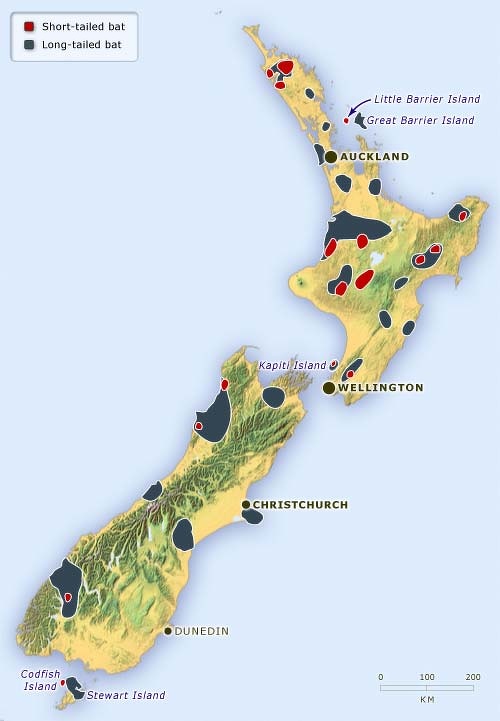
Bats are New Zealand's only native land mammals. There are two species of bats in New Zealand: the long-tailed bat and the lesser short-tailed bat. The long-tailed bat is classified as ‘Nationally Critical’ and short-tailed bat subspecies range from ‘Nationally Vulnerable’ to ‘Recovering’. A third bat species, the greater short-tailed bat was last seen in 1965 and is considered extinct. [Source: New Zealand Department of Conservation (DOC)]
Māori folklore refer to bats as pekapeka and associate them with the mythical, night-flying bird, hōkioi, which foretells death or disaster. Once found throughout forested areas of New Zealand, both species of bat became severely restricted in range during the 20th century as forests were felled, and bat colonies were attacked by introduced predators (rats, stoats, cats). The short-tailed species is threatened with extinction, and survives only in small isolated stands of old native forest. [Source: New Zealand government]
In 2018, scientists found the remains of a giant burrowing bat that lived millions of years ago in near St Bathans in southern New Zealand, From the teeth and bones of the animal, which lived 16 to 19 million years ago, it is estimated to be three times the size of an average modern bat and weighed 40 grams (1.4 ounces). [Source: AFP, August 7, 2019]
Bats are the world's only flying mammal (flying squirrels glide). They are the dominant flying creatures of the night while birds are the dominant flying creatures of the day. Bats are found everywhere on the earth's surface except a few isolated islands, the polar regions and the most inhospitable deserts. Most of the billions of individual bats are found in the tropics. [Sources: Merlin Tuttle, National Geographic, April 1986;Alvin Novick M.D., National Geographic, May 1973]
RELATED ARTICLES:
BATS, CHARACTERISTICS, FLIGHT, REPRODUCTION factsanddetails.com ;
BAT SENSES AND ECHOLOCATION factsanddetails.com
BATS AND HUMANS: GOOD THINGS, DISEASE, RABIES AND DEATHS factsanddetails.com
KINDS OF BATS: SMALLEST, BIGGEST, VAMPIRE BATS factsanddetails.com
New Zealand Short-Tailed Bats
New Zealand short-tailed bats belong to the family Mystacinidae which is composed of a single genus containing two species (one of which is believed to be be extinct). Mystacinids are found only on the islands of New Zealand. According to Animal Diversity Web: These bats are unique in their ability to hide their wings beneath a leathery membrane when not in use. Partially as a result of this adaptation, mystacinids are unusually well adapted to foraging on the ground, and spend a large percentage of their waking time hunting prey on the forest floor. They are also known to burrow. They also have very tough wing membranes and relatively broad wings, which allow them to take off from a flat surface. [Source: Bret Weinstein and Phil Myers
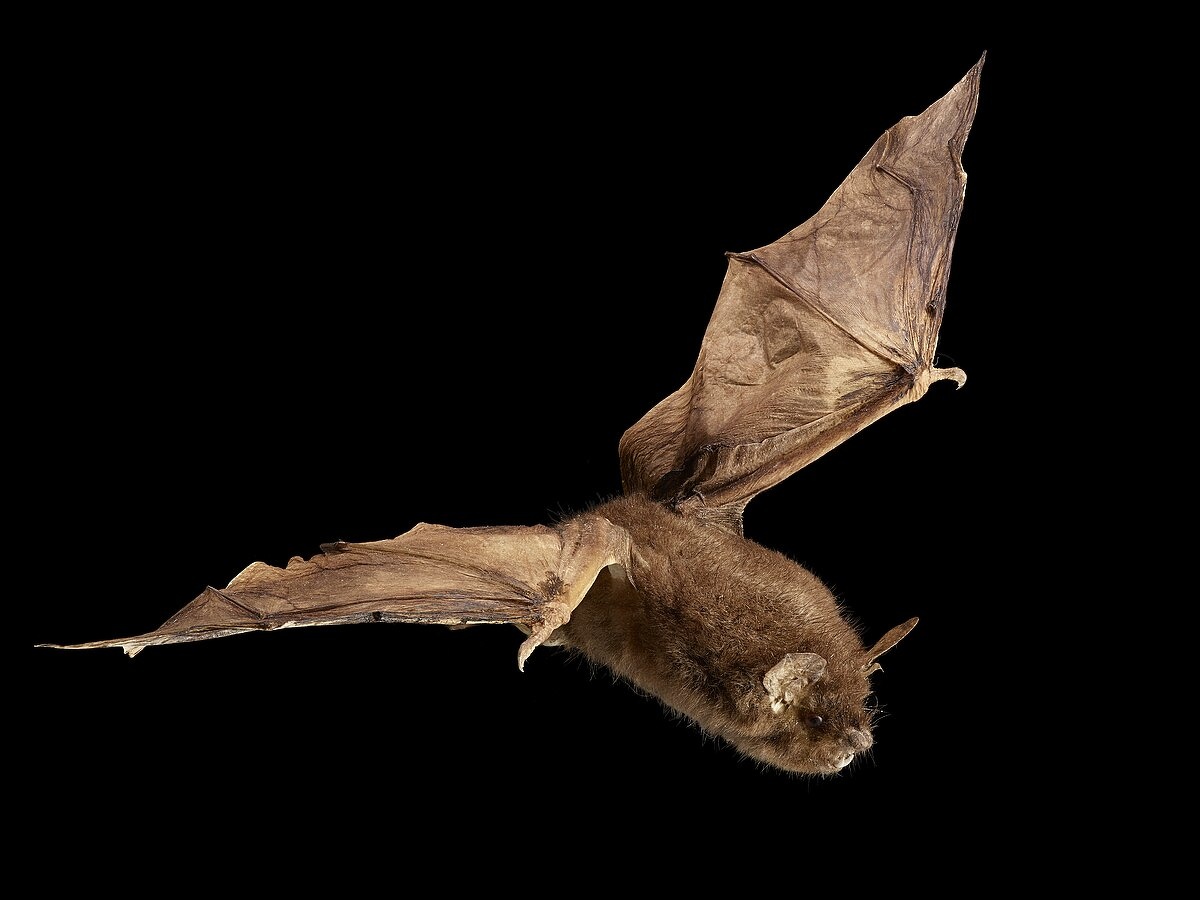
New Zealand lesser short-tailed bat
Mystacinids are medium-sized bats with a long snout. The nose projects well over the lips, and the slit-like nostrils are located in a pad covered with stiff, short bristles. The ears are moderately large and contain a long, narrow and pointed tragus. Their tails project above the surface of the uropatagium (membrane or fold of skin a bat used in flying) for a short distance. The legs are short but strongly built, and the feet are broad and end in sharp, strong claws (the claw on their thumb is also unusually well developed). The fibulae are unusually well developed, which probably contributes to the strength and manueverability of the hind legs. Short-tailed bats are gray-brown or black-brown in color. Individual hairs are tipped grayish, giving the bat a "frosted" appearance. The fur is somewhat velvety in texture. The skulls of mystacinids have well developed premaxilla (upper jaw bone) e, the palatal branches of which isolate two lateral foramina. Their teeth are dilambdadont; the dental formula is 1/1, 1/1, 2/2, 3/3 = 28. |=|
Unlike some other bats found in New Zealand, mystacinids do not experience prolonged hibernation and are sometimes observed actively foraging on warm winter nights. Their diet includes resting and flying arthropods, and lesser amounts of fruit, nectar and pollen. They sometimes also forage on carrion. Roosting mystacinids are typically found in large trees and colony size ranges greatly. The greatest risk to these bats is from invasive species such as rats and habitat loss and degradation. Recent molecular analysis has moved these bats from the superfamily Vespertilionoidea to the superfamily Phyllostomatoidea, but the phylogenetic affinities of the mystacinids are not well understood. No fossils have been discovered. |=|
New Zealand Lesser Short-Tailed Bats
New Zealand lesser short-tailed bats (Mystacina tuberculata) are small-sized omnivorous bats endemic to the islands of New Zealand. Their closest relative, New Zealand greater short-tailed bats (Mystacina robusta), were last seen in 1965 and are presumed extinct mainly as a result of predation from invasive rats. Lesser short-tailed bats are commonly referred to as pekapeka, their Māori-language name. They are fully capable of moving along the ground to search for food, and males sing to attract partners, taking turns to do
New Zealand lesser short-tailed bats live mostly in forests and are only found on New Zealand and the islands immediately adjacent to it. These islands include North Island, South Island, Little Barrier Island, and several smaller islands off of Stewart Island. [Source: Francesca Ivaldi, Animal Diversity Web (ADW) |=|]
On the International Union for Conservation of Nature (IUCN) Red List New Zealand lesser short-tailed bats are listed as Vulnerable. Their numbers have declines due to destruction of their forest habitat, predation by introduced rats and other non-native mammals, accidental poisoning, and human disturbance of roosts. Lesser short-tailed bats have been the subject of extensive conservation work and research. Their average lifespan in captivity is 7.6 years. |=|
New Zealand Lesser Short-Tailed Bat Characteristics
New Zealand lesser short-tailed bats are small bats, with a head-body lengths of six to eight centimeters (2.3 to 3.1 inches). On average they weigh 23.5 grams (0.83 ounces) The forearm length for New Zealand lesser short-tailed bat ranges in length from four to 4.5 centimeters (1.6 to 1.8 inches. They are endothermic (use their metabolism to generate heat and regulate body temperature independent of the temperatures around them). Their wings are relatively small compared to other bat species. Because of this, they have reduced agility, and cannot fly as fast. Despite this, they are still very capable of flight; just less so than other bat species. [Source: Francesca Ivaldi, Animal Diversity Web (ADW); Wikipedia |=|]
New Zealand lesser short-tailed bats have thick fur — thicker than that found on other species of bats. The upper portion of their body is gray brown, while the underparts are paler. The claws are very sharp. The wings have unique, thick and leathery membranes that can be rolled under when the bats are not flying, enabling them to use them arms as forelegs for moving around when on the ground. The first phalanx of each digit folds to the outer side of the metacarpal when the wing is folded, unlike in other species of bat, in which the phalanx folds in. The thumb is also unique in that it has a large claw with a small talon projecting from it. The claws of the feet also have talons. The tail perforates the dorsal surface of the tail membrane, which is thick and wrinkled at the base of the tail.
New Zealand lesser short-tailed bat have an obliquely truncated muzzle, primitive nostril patterns, and a scattering of stiff bristles with spoon-shaped tips on their snout. The nostrils are oblong and vertical. The ears have a long, pointed tragus. The feet are short and broad and the sole of the foot has a grooved covering, as do the short, thick legs. A well developed calcar is present. The cheekteeth are tritubercular, and the upper molars are very well developed. New Zealand lesser short-tailed bat do not have a postorbital process. The tongue is partly extensible, with papillae at its tip.
New Zealand lesser short-tailed bat have relatively large ears compared to their head and body sizes, which face forward to assist with echolocation. They also have relatively large nostrils that face outwards, allowing these animals to use olfaction to guide their movements. Their eyes are small and their vision is relatively weak, justifying their reliance on sound and olfactory senses — traits that are common among bats.
New Zealand Lesser Short-Tailed Bat Behavior and Reproduction
New Zealand lesser short-tailed bats live in forests, often in small groups using hollow trees, caves, and rock crevices. They are thus characterized as colonial (live together in groups or in close proximity to each other). Groups of these bats use their teeth to burrow, making roosting cavities and tunnels in trees and underground. Lesser short-tailed bats form fission-fusion societies. This means populations congregate at certain times, separate, and recongregate later. Where these animals group together are known as roosts. For roosting, they prefer to find trees with large internal cavities, where they create their 'home'. A roosting site will contain multiple trees within the same general vicinity. The number of individuals present at a roosting site vary greatly, with some colonies consisting of hundreds or thousands of individual bats.[24]
New Zealand lesser short-tailed bat are very strong, agile climbers and crawlers. Their foldable wing membrane assists them in these physical maneuvers, allowing them to use their forewings much like rodents use their forelegs, to burrow, climb, and walk. The basal talons on the claws of their thumbs, as well as on their toes are also adapted for a terrestrial, arboreal (live mainly in trees), and fossorial (engaged in a burrowing life-style or behavior, and good at digging or burrowing), lifestyle. This particular species does not hibernate, and is active in the late evening.
New Zealand lesser short-tailed bat are omnivores (eat a variety of things, including plants and animals), eating fruit, nectar, and pollen, as well as insects and other arthropods, and they have been seen to eating carrion. One study found traces of moths, spiders, and huhu beetles present in their guano. Another study determined that they bats are capable of consuming half their body weight in moths.
New Zealand lesser short-tailed bats have the unusual ability to forage on the ground as well as in the air. New Zealand's early geographic separation around 80 million years ago meant the islands developed free from predators. Without predators, the lesser short-tailed bat evolved to survive in both aerial and ground habitats. Like other bats, in the air, they catch food by using echolocation to detect the location of prey. On the ground they forage by moving around on their limbs, using smell to source prey and their limbs for quadrupedal locomotion to reach it. In addition, they have talons specialised in helping them dig down among leaf litter and dirt layers for prey. New Zealand lesser short-tailed bats have an increased sense of smell compared with other bats, as seen in their relatively larger and rounder nostrils. Foraging on the ground is used to dig up insects and spiders, collect flowers or fallen fruit, and collect other stationary forms of food. Foraging in the air is often associated with hunting flying insects, such as moths.
New Zealand lesser short-tailed bat are polyestrus (females have multiple estrous cycles, periods of sexual receptivity, per year). Births occur at any time, with the single young being born between spring and autumn. Male bats attempt to attract a mate during the spring and summer months before mating begins, which is usually during autumn (March–May in New Zealand). Like many other species, the males attract mates at night by using vocal calls. The males sing from one of the roosting trees within the colony for several minutes. Multiple males aggregate at this same roost, taking turns singing. This behaviour is classified as a lek breeding system. In this type of mating, sexual selection occurs, as the males signal to potential females in the hopes they will be impressed and mate with the male. Lek breeding is how the male bats 'prove their worth'. The mating events that follow are non-monogamous, and males have been observed to mate with multiple different females. While lek breeding systems are observed throughout the animal kingdom, they are rare in bats and have only been observed in one other species.
New Zealand Greater Short-Tailed Bat
A confirmed sighting of New Zealand greater short-tailed bats (Mystacina robusta) has not occurred since 1965 and the species is considered to be critically endangered, or extinct. In prehistoric times they lived in the North and South Islands but by the time of European arrival they were restricted to small islands — namely Big South Cape and Solomon Islands I— near Stewart Island south of the South Island of New Zealand. A rat invasion of Big South Cape Island (Taukihepa) in 1963 was thought to have led to the species' extinction, however, recent surveys have raised hopes that the species may still exist. [Source: Wikipedia]
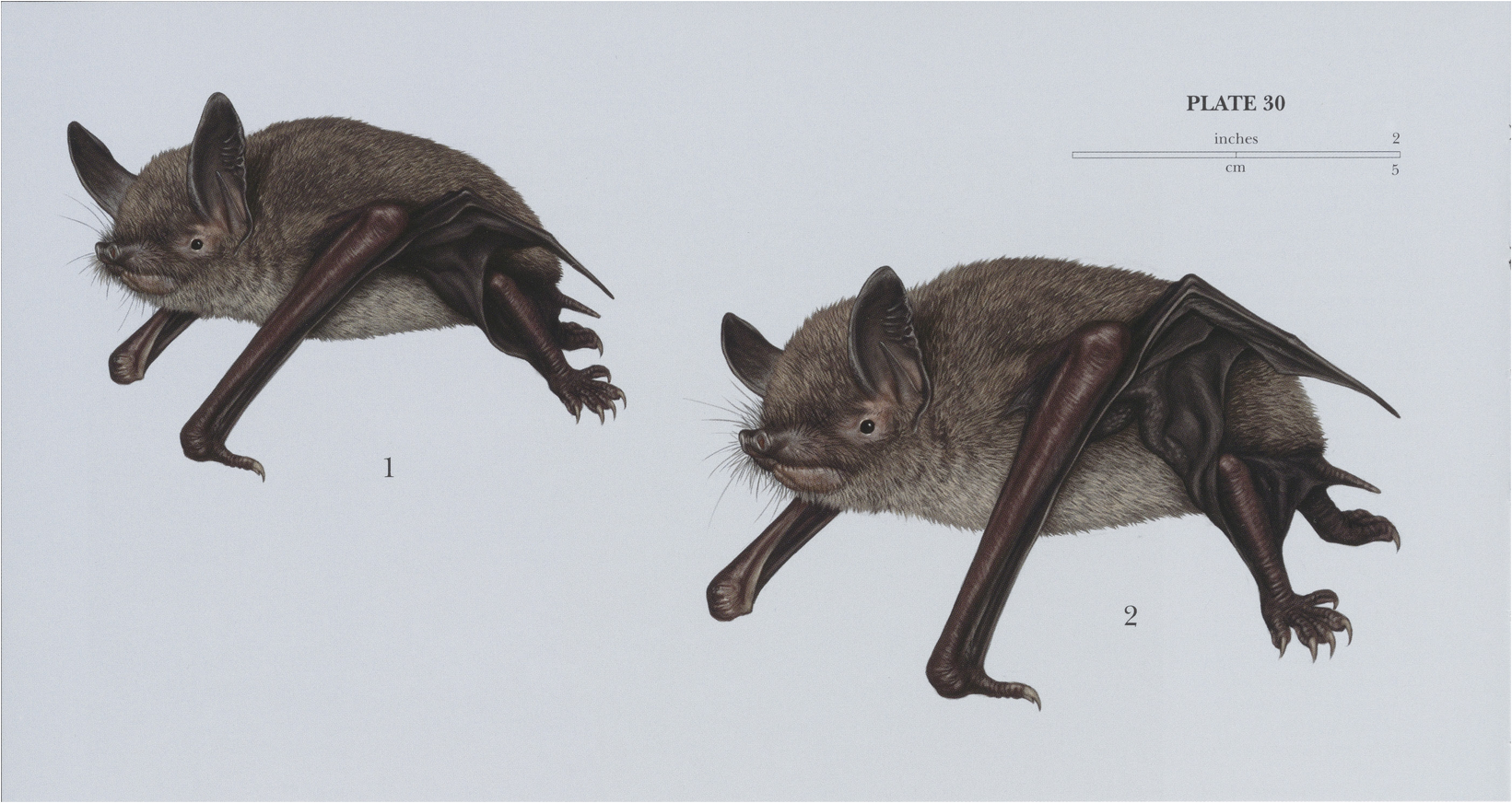
New Zealand greater short-tailed bat
New Zealand greater short-tailed bats were medium-sized and extremely robust bats. They ranged in weight from 25 to 35 grams (0.88 to 1.23 ounces), with a head and body length of nine centimeters (3.54 inches) or more and a wingspan ranges of 29 to 31 centimeters (11.42 t 12.2 inches).They were about about one-third larger than New Zealand lesser short-tailed bata. Individuals had stocky bodies with prominent, pointed ears and nostrils and a set of short whiskers. The short tail penetrated the tail membrane on its dorsal surface. The hind legs and feet were very robust, positioned under the body for quadrupedal locomotion on the ground. The fur was dark brown. The tail measured approximately 1.5 centimeters in length. Source: Brendan Boyes, Animal Diversity Web (ADW) |=|]
Very little is known about the biology of New Zealand greater short-tailed bats since they were not recognised as a separate species until after they are believed to have become extinct. Edgar Stead visited Big South Cape Island in 1936. He described the species as flying no more than “ten feet above the ground” and always after dusk. At one point he found seven bats roosting in a tree cavity in a state of torpor. After capturing a few and putting them in a cage they crawled around on the floor, much like New Zealand lesser short-tailed bats are known to do. As well as roosting in tree cavities, it is known that they roosted in granite caves on Big South Cape Island and Solomon Island.
New Zealand Long-Tailed Bats
New Zealand long-tailed bats (Chalinolobus tuberculatus) are also known as long-tailed wattle bats and pekapeka tou-roa. They are small insectivorous bats and are one of seven species belonging to the genus Chalinolobus, which are commonly referred to as “wattled bats,” “pied bats” and “long-tailed bats."The genus Chalinolobus is characterised by fleshy lobes located on their lower lips and at the bottom of their ears. [Source: Wikipedia]
Long-tailed bats are now incredibly rare in New Zealand. They are listed as Critically Endangered on the IUCN Red List and Threatened – Nationally Critical in New Zealand. These are the highest threat classifications, indicating they are teetering on the edge of extinction and this is mainly the result of habitat loss from forest degradation and the impact of introduced predators like rats, stoats, and cats.
Long-tailed bats are very widespread and a patchy distribution. They are found on both of the main islands of New Zealand as well as on Stewart Island, Little Barrier Island, Great Barrier Island and Kapiti Island. They are considered extinct in urban habitats. One of the few main populations reside in Eglinton Valley, Fiordland.
New Zealand Long-Tailed Characteristics and Diet
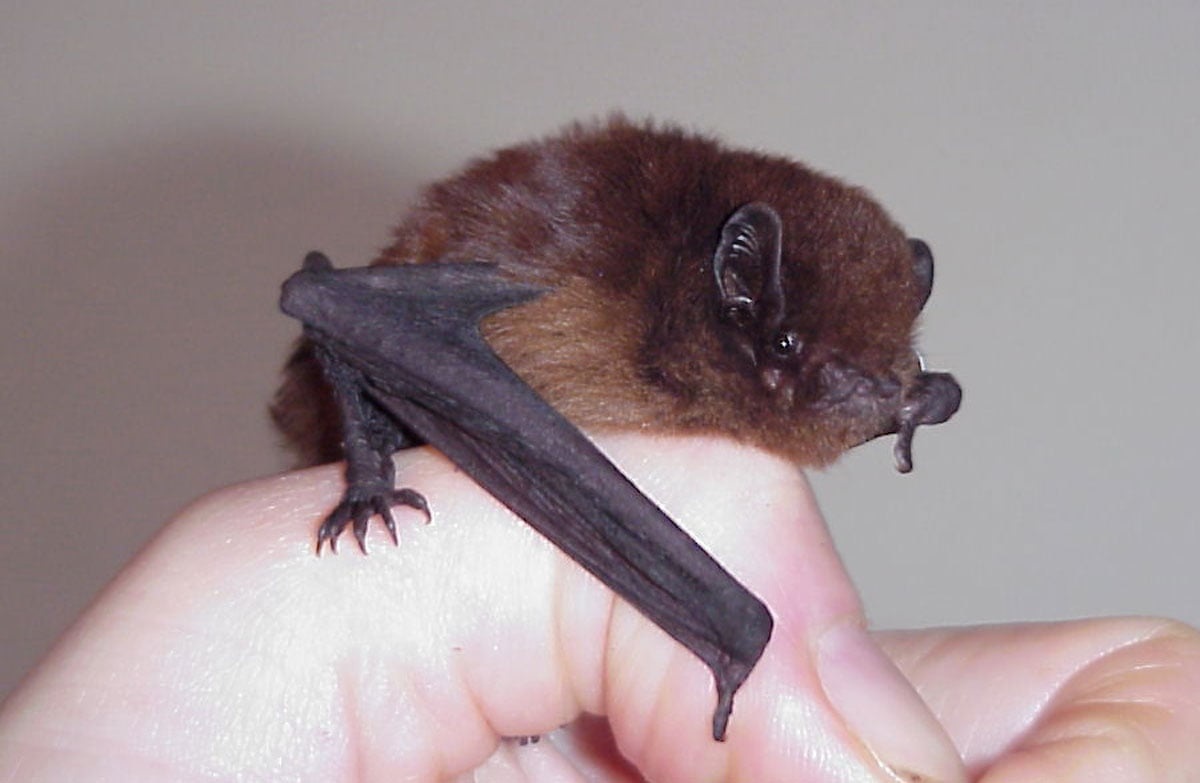
New Zealand long-tailed bat
New Zealand long-tailed bats are very small, bordering on being microbats. They typically weigh between 8 and 12 grams, more if a female is pregnant or if they have just finished foraging. Their body size is comparable to a human thumb, around 5 to 6 centimeters (2 to 2.35 inches) in length. There wingspan is around 30 centimeters (one foot). This is considered medium-size and typical of bats that forage along forest edges. The name long-tailed bat refers to the long tail connected by a patygium to the bats’ hind legs. This is what distinguishes them from short-tailed bats. Females often having chestnut-colored fur with white tips. Males and juveniles are darker, with near blackish fur. In both sexes, the under layer of fur is pale brown and the wings are essentially hairless. [Source: Wikipedia]
Long-tailed bats are insectivores (eat insects). Feces samples indicate they feed on both terrestrial and aquatic invertebrates, mostly flies, beetles and moths. Flies (Diptera) make up the greatest proportion of their diet but they are considered generalists that readily consume whatever is abundant in their habitat. Moths (Lepidoptera), are the most common insect consumed during warmer months, and they are regarded as nutritious prey as they are relatively large. Crane flies and midges are common prey by bats inhabiting wetlands.
Long-tailed bats are quick, agile fliers and aerial hawking and gleaning are their two primary methods of foraging, Aerial hawking involves capturing and consuming aerial insects whilst in flight, which is mainly over bodies of water and forest edges, close to the water or ground which allows for effective access to flying insects. Gleaning means that the bats take insects directly from a surface, which is most useful when targeting slower moving insects.
New Zealand Long-Tailed Bat Behavior and Reproduction
Long-tailed bats are nocturnal (active at night) and have very large home ranges — up to 20 kilometers in radius. They begin foraging between 14 and 30 minutes after sunset and spend around 70 percent of the night actively foraging. Among the Fiordland population minimum temperature whether the bats fly or not and insect abundance determines how long they forage. In winter, the long-tailed bat becomes less active as insect availability becomes less and temperature drops. The lowest recorded temperature that the long-tailed bat has been recorded to forage at is -1.5°C, lower than this and slightly above this they fall into a torpor (a period of reduced activity, sometimes accompanied by a reduction in the metabolic rate, especially among animals with high metabolic rates). [Source: Wikipedia]
Roosts are places where bats rest during the day. Long-tailed bat roosts both individually and in groups. On the North Island, around 37.3 percent of bats engage in solitary roosting and whereas 62.7 percent are communal. In the South Island, 70 percent are solitary and 30 percent are communal. At communal roost sites, groups with 34 to 86 individuals have been recorded. There are also usually sub-populations within larger populations. Reproductive females are the most dominant individuals at communal roosts, accounting for 63 percent of adults, followed by non-reproductive females at 22.1 percent and males at 15.1 percent. Roost sites are selected based on tree type, available insects and topography. Long-tailed bats prefer New Zealand cabbage trees (Cordyline australis), kānuka (Kunzea ericoides), and tōtara (Podocarpus totara).
Male long-tailed bats are able to engage in mating behaviours when their epididymides (ducts behind the testes) are grey and swollen. Sperm presence begins to occur in late summer, when the mating season begins. These bats practice delayed implantation (when a fertilized embryo pauses its development in a dormant state for an extended period before implanting into the uterus) and pregnancy does not occur until late spring. Female bats become reproductively active at around two years of age and give birth annually to one pup until they are nine years. The gestation period is six to eight weeks, giving birth in December a pup that isabout one centimeter in length. Offspring are hairless and blind at birth. The mother feed the pup every one to three hours after birth. Pups start to fly after four to five 4–5 weeks of development when they reach a weight of around seven grams. It is estimated the lifespan of these bats is 7 to 11 years.
Image Sources: Wikimedia Commons
Text Sources: Animal Diversity Web animaldiversity.org , National Geographic, Live Science, Natural History magazine, David Attenborough books, New Zealand Geographic, New Zealand Tourism, New Zealand Herald, Te Ara Encyclopedia of New Zealand, New York Times, Washington Post, Los Angeles Times, Smithsonian magazine, Discover magazine, The Conversation, The New Yorker, Time, BBC, CNN, Reuters, Associated Press, AFP, Lonely Planet Guides, Wikipedia, The Guardian and various books, websites and other publications
Last updated September 2025