
Home | Category: Nature and Environment
TREES IN AUSTRALIA
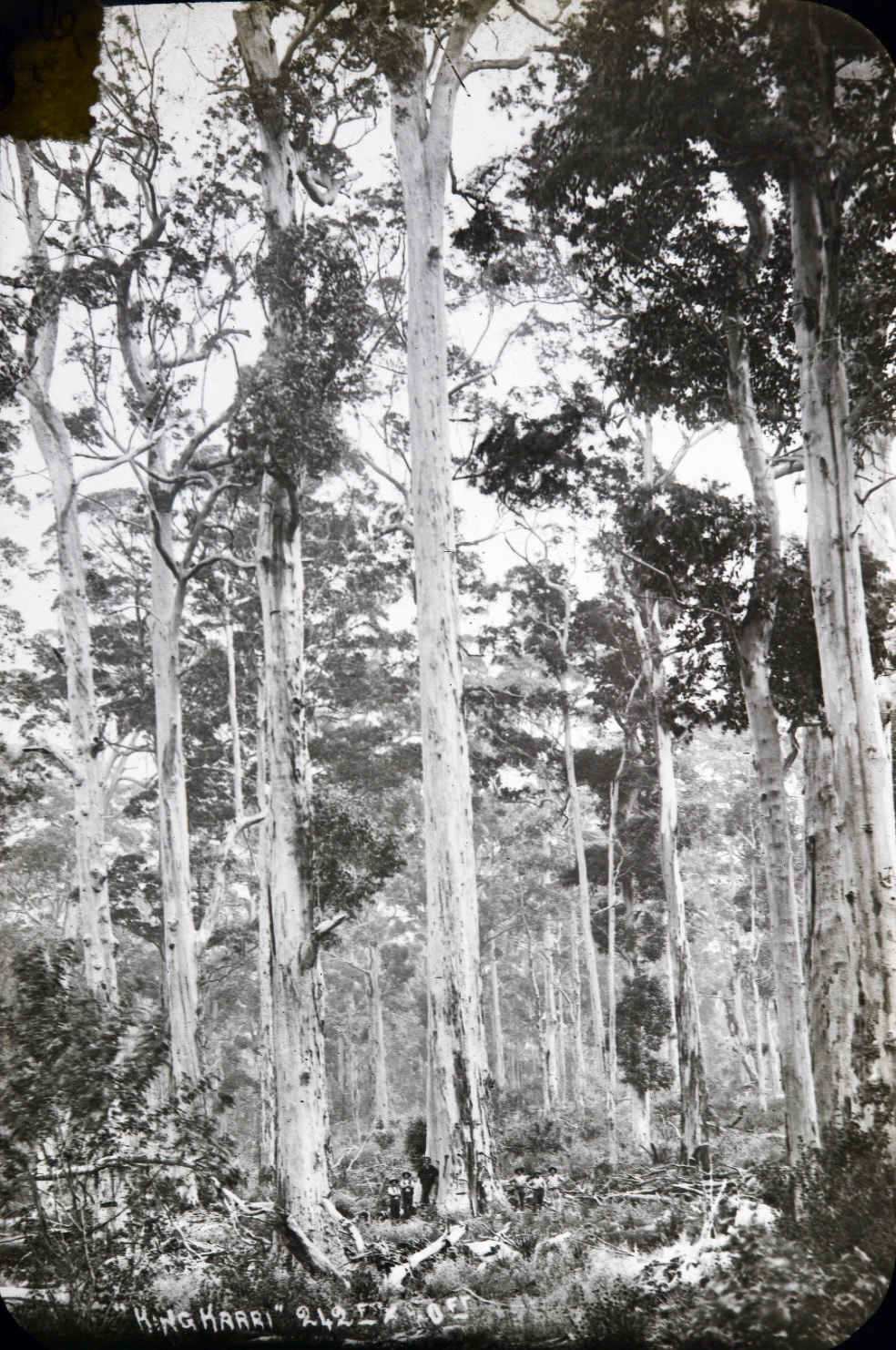
King Karri from 1900, showing its full trunk to about 40 meters; Notice the men at the base; The total volume of the tree is estimated at around 190 cubic meters
A 2022 study said Australia has around 7,000 known tree species and an estimated 2,000 unknown ones. There are over 500 species of eucalyptus and 600 species of acacia (wattle). Among the more noteworthy trees are jarrahs, baobabs, silky oaks, blackwoods, coachwoods, red cedars, Queensland maples, and walnuts. Some native trees shed bark instead of leaves.
The giant Karri forests of southwest Western Australia contain some of the world's tallest trees. Ilsa Sharp wrote in “CultureShock! Australia”: The Jarrah, from the same region as the Karri, has a fine red-grained timber often found as polished flooring in older Western Australian homes. In Tasmania are some the finest Gum trees can produce delicate and attractive blossoms. [Source: Ilsa Sharp, “CultureShock! A Survival Guide to Customs and Etiquette: Australia”, Marshall Cavendish, 2009]
Tea trees are a national symbol. They belong to genus Leptospermum genus, included Lemon-scented tea trees. Wattles (acacias) are very common. There are also stands of cool temperate rainforest in the world, featuring pine and beech species as well as myrtles that largely predate the mainland gums. Tree fern (a kind of fern not a tree) can reach a height of 22 meters (70 feet). They are found across eastern Australia. There are also hardy Australian cabbage, or fan, palms.
Native Australian conifers include the Norfolk island pine and King William pine. The Cook pine (Araucaria columnaris) is the only species that seems to orient itself globally toward the equator. Stems lean to the south in California, to the north in Australia, and hardly at all in Hawaii.
Among the unique species in Australia are grass trees and eucalyptus trees that consist of several trunks (that look like individual trees) that sprout up form a single root system. These trees can survive in areas with few nutrients in the soil. They do so in part with the help of fires that burn the trunks and provide nutrients that the roots to make the tree as whole survive. Many plants produce seeds that only germinate after fires. The soil is poor and the fires burn material which provide nutrients for new plants. There are some small plants that require smoke to make their seeds germinate. The bottlebrush is a member of the eucalyptus family. It produces groups of scarlet flowers that do not shed seeds unless there is a fire. Scientists can determine the amount of time from the last fire by examining the seeds.
Mountain Ash — the Tallest Trees in Australia, Tallest Flowering Trees in the World
A mountain ash (Eucalyptus regnans) found on the island of Tasmania, which stands 99.82 meters (327.5 feet) tall, is Australia's tallest tree. The remarkable thing about Australia's tallest trees is that their trunks are not that much wider than shorter eucalyptus trees. In the old days, the largest trees were usually cut down by timber companies either before or after their height was discovered. Baobab trees have large trunks. The trunk of one Australia boabab was so big it was used as a prison.
By contrast the famous giant sequoia, the General Sherman tree, in California is 84 meters (275 feet) tall. According to Guinness World Records, a cypress tree found in a forested area of Tibet is the tallest tree ever discovered in Asia. It is also believed to be the second-tallest tree in the world, standing at an astonishing 102 meters (335 feet) tall. The second tallest tree in Asia a yellow meranti tree (Shorea faguetiana), was found in Sabah, Malaysia. It is 100.8 meters (330 feet) tall. The tallest trees on Earth are the coastal redwoods (Sequoia sempervirens) in northern California and the biggest one of them all is a giant known as Hyperion, according to Guinness World Records, when it was last measured in 2019, it was 116.07 meters (380 feet, 9.7 inches) tall from top to base — taller than a 35-story building.
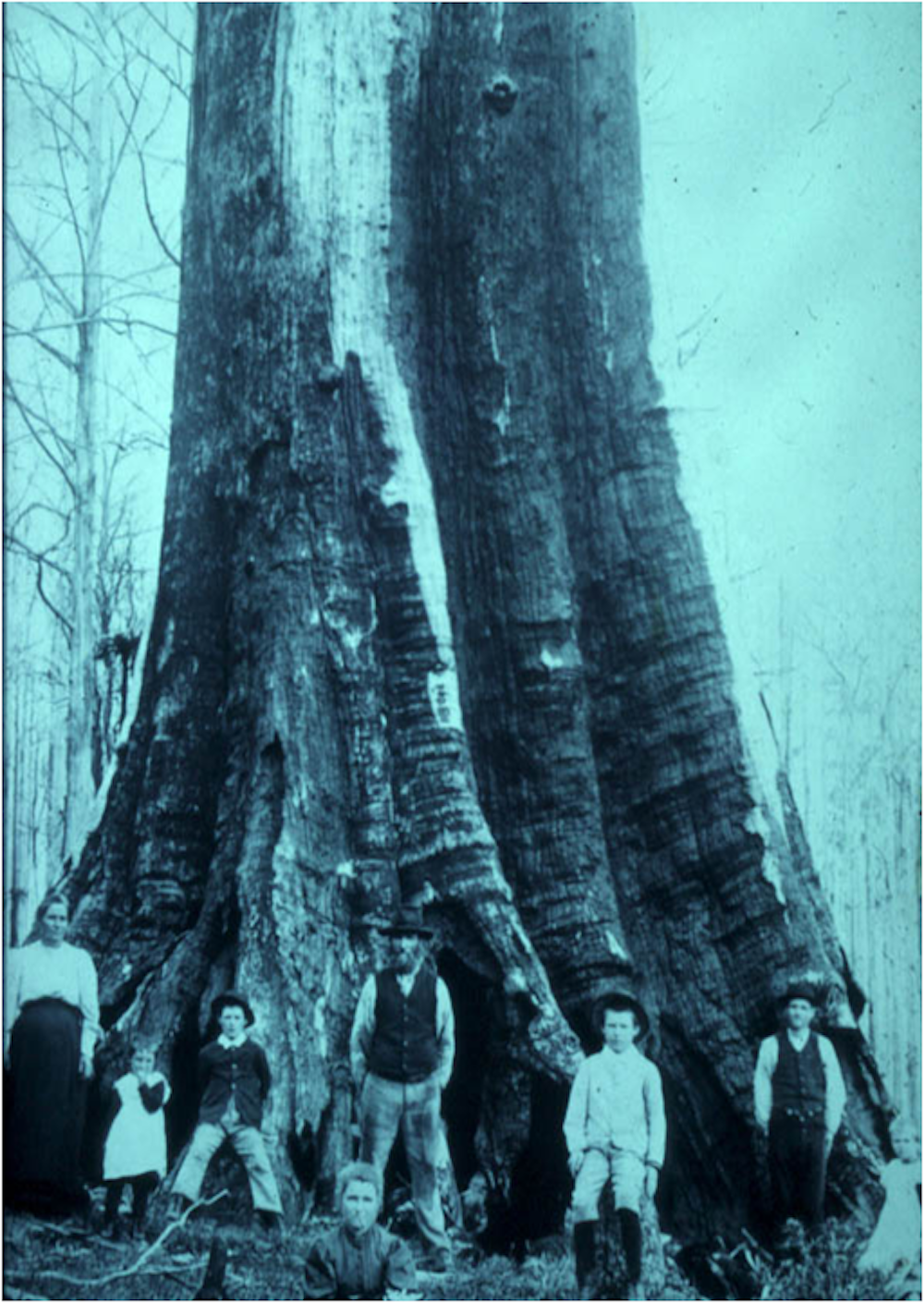
Hollowed-out mountain ash were used as shelters by settler families
The Australian mountain ash is the tallest flowering plant. The were named ash by British settlers even though they have little in common with ash trees found in Europe. It is a kind of eucalyptus. A mountain ash was measured at 114.3 meters (375 feet) in 1880 and cut down. There are reports of The 132.6 meter (435 foot) tree that was discovered after it had been cut down. See Eucalyptus below.
Dr. Gregory Moore wrote in the The Conversation: Mountain ash lack many of the typical eucalypt adaptations to environmental stresses like fire, drought and poor soils. They compensate by growing very fast under the right conditions; eventually over-topping all the other species present. They have huge and often deep root systems to supply adequate amounts of water. To grow successfully they need plenty of water and sunlight – so they are not really very hardy – but in the right environment they are unbeatable. [Source: Gregory Moore, Doctor of Botany, The University of Melbourne, The Conversation, June 1, 2018]
Their mature leaves are about 3mm wide and can be as long as 15 centimeters, while their flowers are white to cream in color and 8 millimeters across. The buds and flowers grow in clusters, but like the flowers of many eucalypts they often go unnoticed, especially on the taller trees. The fruits or gumnuts are again in clusters, about 10mm across and, somewhat surprisingly for such a large tree, contain hundreds of tiny seeds.The bark is rough and fibrous at the base and for up to about 10m from the ground, but then is a beautiful smooth, mottled cream and grey with long ribbons of dead bark hanging from the canopy. These ribbons burn in bushfires and can carry fire for many kilometres ahead of a fire. These trees were so large, an old forester told me in the early 1970s, that when they felled them by hand with cross-cut saws, air could be heard being sucked into the cuts – the so-called sighing of the trees as they died.
Australia’s 66-Million-Year-Old 'Living Fossil' Tree
In 1994, hikers discovered a group of strange trees growing in an isolated gorge in Wollemi National Park in the Blue Mountains region about 100 kilometers (60 miles) northwest of Sydney, Australia. One hiker notified a park service naturalist, who then showed leaf specimens to botanists at the Royal Botanical Gardens in Sydney who determined the trees were representatives of an ancient species that lived in the Cretaceous period (145 million to 66 million years ago).
This tree, the Wollemi pine (Wollemia nobilis), is now referred to as a "living fossil" and has been called the oldest living tree species in the world. It is nearly identical to preserved remains dating to Cretaceous period. As of 2023, there were 60 of them in the wild. In the late 1990s 23 adult trees and 16 juveniles had been identified. The tallest is about 40 meters (130 feet) tall. They have survived bushfires in the region and were thought to have gone extinct around two million years ago.
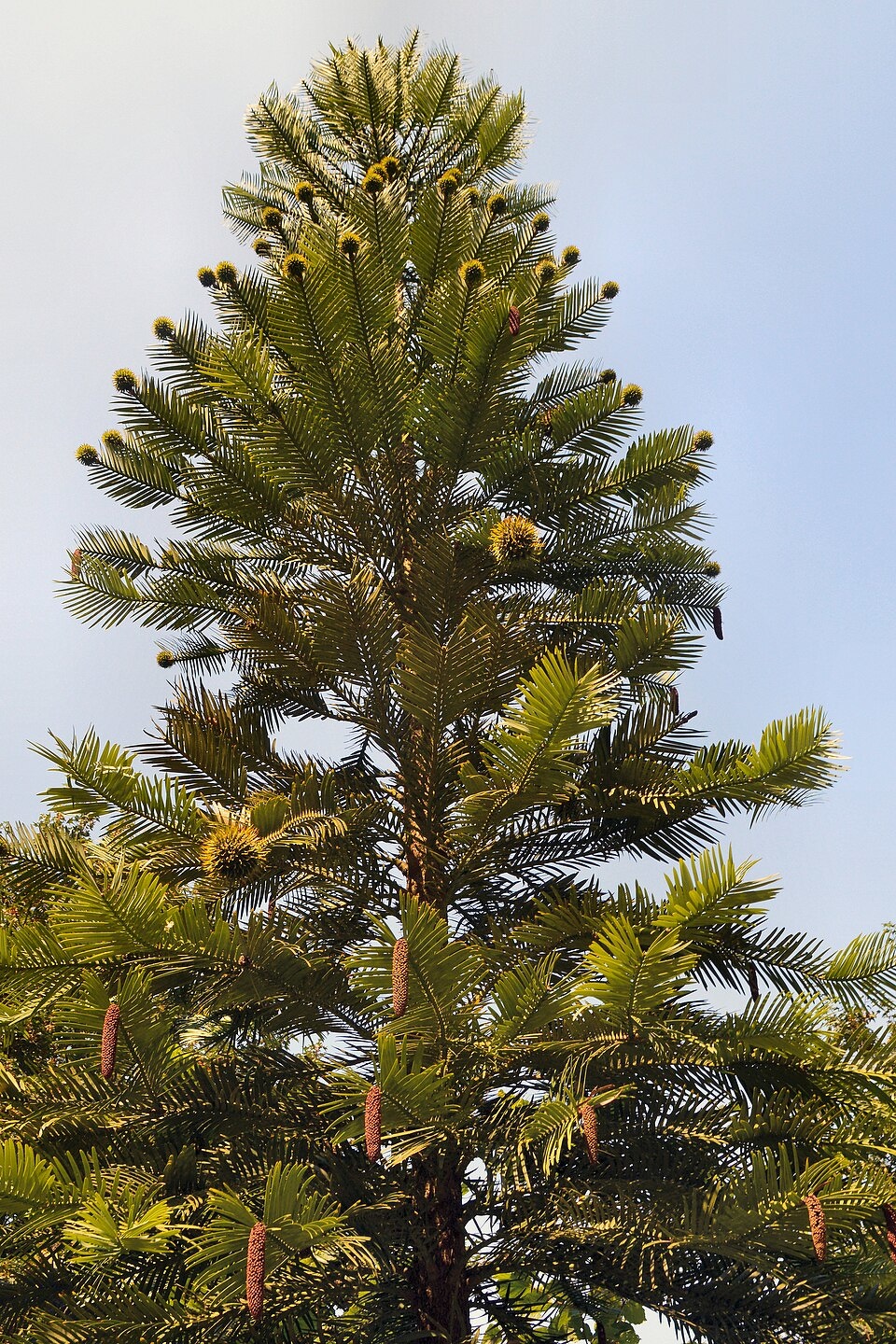
Wollemi pine
With only four small populations remaining in the wild, the pines have been extensively propagated by botanic gardens and other institutions in an effort to conserve them and study their unique biology. The species is considered critically endangered by the International Union for Conservation of Nature and Natural Resources (IUCN). The locations of the trees have been kept secret to prevent thefts. Cuttings are raised in greenhouses protected by electric fences. Saplings have been sold commercially, with the money being used to protect the trees in the wild.
The long-term regeneration of Wollemi pines from seeds is unknown but seems doubtful due to competition with other trees. In June 2018, scientists at the New South Wales Office of Environment and Heritage announced that new population of Wollemi Pine had been cultivated in greenhouses and translocated as an "insurance policy" for the original group. "It's one of the world's oldest and rarest plants from the time of the dinosaurs and there are less than 100 trees left in the wild," New South Wales Environment Minister Gabrielle Upton said. "Creating a self-sustaining insurance population will ultimately boost numbers to secure species in the wild," Upton said. [Source: NDTV, June 25, 2018]
Cathy Offord, principal research scientist at The Royal Botanic Garden Sydney, said the insurance plantation has started producing seeds and cones and is doing better than those in the wild. "Some 83 per cent of the insurance Wollemi pines are surviving and have increased in size by up to 37 per cent making them mature enough to produce potentially viable seeds much earlier than expected," she said.
Genome of 66-Million-Year-Old Tree and What It Tells Us
On August 24, 2023, on the preprint database bioRxiv, scientists from Australia, the United States and Italy announced that they decoded the genome of Wollemi pine, providing insights into its unique evolution and reproductive habits, as well as aiding conservation efforts. Richard Pallardy wrote in Live Science: The pine has 26 chromosomes — containing a staggering 12.2 billion base pairs. In comparison, humans have only around three billion base pairs. Despite the size of their genome, Wollemi pines are extremely low in genetic diversity, suggesting a bottleneck (when the population is reduced dramatically) some 10,000 to 26,000 years ago. Indeed, the plants do not exchange much genetic material. The remaining trees appear to reproduce mostly by cloning themselves through coppicing — in which suckers emerge from the base and become new trees. [Source: Richard Pallardy, Live Science, September 15, 2023]
Their rarity may be partly due to the high number of transposons, or "jumping genes" — stretches of DNA that can change their position within the genome. These elements also account for the genome's size. "The tiniest plant genome and the largest plant genome have almost the same number of genes. Large differences in size usually come from transposons," Gerald Schoenknecht, program director for the National Science Foundation’s Plant Genome Research Program told Live Science. Schoenknecht was not involved with the research, but the NSF did provide funding.

Fossil of the Wollemi pine ancestor next to part of a branch from a modern Wollemi pine
As transposons leap to new locations, they can change the sequence of "letters" in a DNA molecule, thus causing or reversing mutations in genes. They may carry functional DNA with them or alter DNA at the site of insertion, and thus have a substantial impact on the evolution of an organism. If the transposons induced harmful mutations, they may have contributed to population decline precipitated by a changing climate and other factors, the researchers said. These stressful conditions may have led the plant to switch to clonal reproduction. Because increases in transposons correlate to sexual reproduction, a change to asexual reproduction may have reduced their potential introduction of damaging mutations. Paradoxically, while the trees were still reliant on sexual reproduction, the transposons may have played a role in increasing genetic diversity and thus at least temporarily made them more resilient to changing conditions. "In 99 percent of all cases, mutations are probably not a good idea," Schoenknecht said. "But over millions of years, the one percent that helps can move the species forward. In this case it may have been a bit of an advantage."
Decoding the genome has also revealed why the Wollemi pine appears to be susceptible to disease — in particular, Phytophthora cinnamomi, a pathogenic water mold that causes dieback. The tree's disease resistant genes are suppressed by a type of its own RNA that is associated with the development of wider leaves. Wollemi pines, unlike most conifers, have wide needles. So, the evolution of wider leaves may have led to the suppression of disease resistance and opened the species up to pathogenic threats — which may have been inadvertently tracked in by hikers who illegally visited the protected spot. P. cinnamomi is common in cultivated plants.
Prehistoric Rainforests and Rainforest Trees in Australia
Olivia Judson wrote in National Geographic: The rain forests of the far north of Australia, such as the Daintree, are relicts from the ancient supercontinent of Gondwana. That is, many of the plants are descendants of those that lived in rain forests that once covered much of Australia and Antarctica, way back, 100 million years ago, when the two continents were sutured together. As such, they are a living museum, a riot of evolutionary pathways, a showcase of different ways to be a plant. There are ferns that look like coconut palms — tall, thin trunks crowned with long, frondlike leaves — and palms with leaves like huge Japanese fans. There are trees on trees, and orchids on trees, and way up high, ferns like baskets. [Source: Olivia Judson, National Geographic, September 2013]
The temperate rainforests of Australia are just as old and they include a living fossil tree that is at least 90 million years. According to ABC News: The tree, which grows to above 40 meters (130) feet tall, has been christened unofficially the Nightcap Oak after itsdiscovery in the Nightcap Range rainforest near Byron Bay, 650 kilometers (400 miles) north of Sydney. The tree’s history spans more than 90 million years, back to when Australia was part of the Gondwanaland, said Dr. Peter Weston of Sydney’s Royal Botanic Gardens. “It’s a very, very old lineage indeed,” Weston told Reuters. [Source: ABC News, December 15, 2000]
Weston identified the new tree after a stand of about 20 mature trees was discovered by botanist Robert Kooyman in August, 2000. Weston said it was remarkable that such a unique tree could have gone unnoticed in a rainforest which has been well researched and documented by botanists. “I was really amazed... this rainforest has been scoured to within an inch of its life by some very good botanists,” he said. He said the tree belonged to the Proteaceae family, of which native Australian banksias, waratahs, macadamias and grevilleas and South Africa’s proteas are members.
Weston said the tree was a “relatively non-descript”rainforest tree with dark green leaves, nuts about the same size as macadamias and small white flowers in dense clumps. Kooyman said the flowers smelled faintly of sweet aniseed. One of the larger trees in the Nightcap Range had a circumference of more than 74 inches (29 inches).
The exact location of the Nightcap trees is being kept a closely guarded secret so the trees can be protected. The New South Wales state government said it was considering a request to grant the tree emergency protection under the state’s legislation covering threatened species. Cuttings from the trees have been taken and are being cultivated at Sydney’s Royal Botanic Gardens. Weston said it was likely Australia, known for its unique wildlife which includes kangaroos and koala bears, probably still contained many species of undiscovered fauna. “That something that big can escape detection until now... what small, interesting plants are there now that we know nothing about?,” he said. Image Sources: Wikimedia Commons
Eucalyptus Trees
Aussies call eucalyptus trees “gum trees”. Their tough bark and deep, broad roots help them survive both fire and drought. The stumps of eucalyptus resprout to ensure a continual harvest for many years. Eucalyptus are also considered the fastest growing trees in the world. One tree in New Guinea grew 7.6 meters (25 feet) in one year. These features have made them an ideal windbreak and source of shade in dry regions around the world, where they have been planted. For Aboriginals "eucalypti was a healing aid. When you ate koalshzoom, you healed the insides." Cineole is a toxic substance which gives eucalyptus its distinctive smell,
The tallest tree ever measured was a eucalyptus tree — a mountain ash — found near Wyatt River, Victoria. It was measured at 132 meters (435 feet) in height in 1872 and likely reached a height of 500 feet before that, which makes it almost a 20 meters (100 feet higher) than the tallest redwoods in California.
According to “CultureShock! Australia”: It is hard to mistake the look, and resin-laden smell, of an Australian ‘gum’ forest, the soft-white peeling trunk of a Paperbark tree, or the nose-twitching aroma of a Lemon-scented Gum. Eucalypts are a genus classified within the Myrtle family, especially the smoother-barked versions known popularly as ‘Gums’. Eucalypts have a tall and spindly look, with foliage sparsely dispersed along scarecrow branches, that is quite distinctive. They also give off a very special resinous aroma that says ‘Australia’ as soon as it reaches the nose on a summer’s breeze. Or, as with the Lemon-scented or Peppermint versions, their leaves may yield a wonderful perfume when crushed between the fingers. [Source: Ilsa Sharp, “CultureShock! A Survival Guide to Customs and Etiquette: Australia”, Marshall Cavendish, 2009]
Kinds of Eucalyptus
There are around 700 species of eucalyptus in Australia, 95 percent of which are native to Australia. The other are native to New Guinea, Indonesia and the Philippines. The giant Karri of southwest Western Australia are eucalypts. Ilsa Sharp wrote in “CultureShock! Australia”: The Jarrah, from the same region as the Karri, has a fine red-grained timber often found as polished flooring in older Western Australian homes. In Tasmania are some the finest Gum trees can produce delicate and attractive blossoms. Tea trees, are a national symbol. [Source: Ilsa Sharp, “CultureShock! A Survival Guide to Customs and Etiquette: Australia”, Marshall Cavendish, 2009]
Eucalyptus are found in a variety of habitats and include: the mountain ash (the world's tallest flowering plant, see above), stunted Alpine gums, red river gums (reaching an age of a thousand years), coolabhs (mentioned in “Waltzing Matilda”), melaleucas (known for their loose, papery bark), tough desert gums. Giant karri trees are sort of like eucalyptus redwoods. There are also the Stringybark eucalypts of the east, with their rough barks, and the largely tropical Ironbarks. The troll-like red tingle in a forest in Western Australia resemples something out of Tolkien film.
Mallee are low-growing bushy Australian eucalyptus which have several slender stems. They are common and have an entire habitat named after them. They grow all over the outback and ones in the outback near the Murray River are small and scrubby. Small marsupials can survive dry spells by getting fluids out of insects and seeds that are found inside the plant. Aboriginal get water from it as well by cutting it into small pieces and draining water from it over night.
Wattle (Acacia Trees)
Acacias are called wattles. There are 650 native species. They vary in size and often flower in late winter and spring. Blackwood is the largest acacia, reaching a height of 100 feet. The mulga is drought resistant. An introduced tree — the prickly acacia — has turned native pastures in shrubland.
Golden wattle is an important symbol of modern Australia and serves as its national flower. According to Archaeology magazine: However, its roots run much deeper among the continent’s original inhabitants. Charcoal remains from Karnatukul cave shelter in the Carnarvon Range show that the hardy tree was an important resource for the Aboriginal Martu people, especially as a source of fuel. The 50,000-year-old cave site is the oldest known inhabited site in the Western Desert and contains the area’s earliest known use of firewood. [Source: Archaeology Magazine, July 2022]
One study found that Acacia trees were amongst the coolest places during hot days. They are therefore sought out by koalas and other animals in the summer. Green tree monitor lizard can often be seen cooling themselves under or on the branches of acacia trees. [Source: AFP, July 28, 2018]
Grass Trees and Baobabs
The grass trees of southwestern Australia are neither grass nor trees. They are members of the lily family. The get their names from their long narrow leaves that resemble grass and sprout from a stem that looks like a trunk. The stems may be up to three meters (ten feet) long. The material that looks like bark is actually tightly compacted bases of leaves, which are held from the beneath the crown as the trees grow higher. [Source: David Attenborough, The Private Life of Plants, Princeton University Press, 1995]
Grass tress burn spectacularly during fires but survive. Only the grass tip is consumed by flames. The stems survive and the leaves quicky grow back, The heat generates ethylene gas, which caused the new leaves to emerge and produce small white flowers and later seeds that sprout in fire-fertilized soil.
There are baobab trees in Australia. They are famous for their enormous, cylindrical trunks, which allow them to store water during dry periods. In times of heavy rainfall, its trunk can span up to three meters across. Baobab trees are found mostly near Australia's northwest coast from the southwestern Kimberly to the flood plains of Northern Territory's Victoria River. Sometimes called the "tree that god planted upsidedown," baobabs are also found in Africa and Madagascar.
Growing in forests or alone in fields, baobad trees have large, grey, swollen trunks topped by an array of branches. They have an animated almost human quality to them similar to the talking trees in the Wizard of Oz, especially in the dry season when they lose their leaves. Baobad trunks often have a diameter as large as their 10 meter (33-foot) heights. They are great source of water and Aboriginal tap into them during the hot summer months. Near Derby there used to be a giant hollow trunked baobad called the "Prison Tree", which was once a jail. It could still be there.
Christmas Trees and Edible, Drinkable Trees
The Christmas tree is leafy tree that grown in the western Australian heathlands. Attaining a height of 13.7 meters (45 feet), making them the tallest tree in the region, they get their name from the fact they bloom with golden-yellow flowers in the hot months around Christmas time when other plants are conserving energy.
Christmas trees are a member of the mistletoe parasitic family of plants. They have proved to be so successful in such a harsh region because their roots have suckers and pincers that attach to the roots of other plaints and steal their water. The roots of Christmas trees may extended for hundreds of meters in every direction taking water from many different kinds of plants scattered over a large area. Christmas trees have disrupted NASA communications by piercing the plastic skins of underground communication cables and reaching the copper cores, They trees re also fond of fiber optic cables. [Source: David Attenborough, The Private Life of Plants, Princeton University Press, 1995]
Cabbage palms are the most well known of Australia's 40 palm species. They grow as high as 30 meters (100 feet) high in gorges in the Outback near Alice Springs and have been eaten as bush tucker by Aboriginals, hence the name. Bunya pines have cones than can weigh over seven kilograms (15.5 pounds). The seeds found inside are favorite source of food for Aboriginals. Melaleuca are hardy trees. Water can be taken from trunk, The bark can be made into water carriers and homes.
Text Sources: Animal Diversity Web animaldiversity.org , National Geographic, Live Science, Natural History magazine, Australian Museum, David Attenborough books, Australia Geographic, New York Times, Washington Post, Los Angeles Times, Smithsonian magazine, Discover magazine, The Conversation, The New Yorker, Time, BBC, CNN, Reuters, Associated Press, AFP, Lonely Planet Guides, Wikipedia, The Guardian, Top Secret Animal Attack Files website and various books and other publications.
Last updated September 2025