
Home | Category: Nature and Environment
SOUTHWEST AUSTRALIA
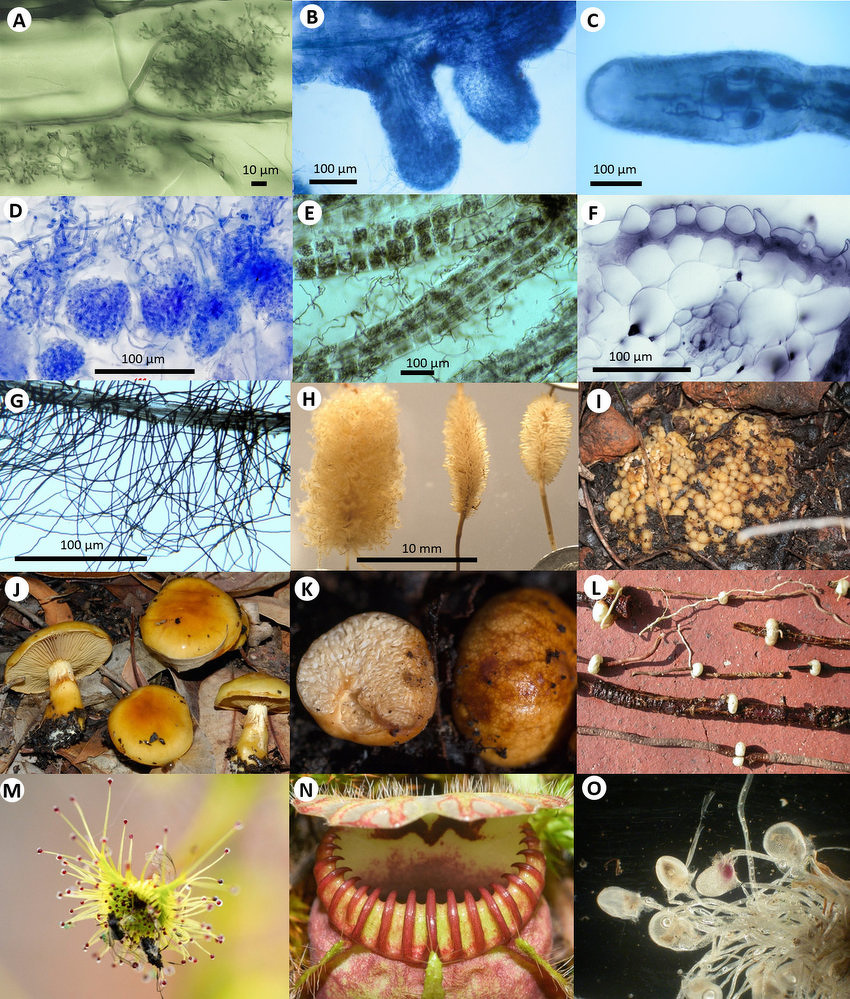
Southwestern Australia plants with mycorrhizal root types and other highly specialised nutrient uptake mechanisms: A) arbuscular mycorrhizas, B) ectomycorrhizas, or C) dual arbuscular mycorrhizas and ectomycorrhizas in Melaleuca hamata; D) orchid mycorrhizas in Pterostylis sanguinea; E) ericoid mycorrhizas in Leucopogon verticillatus; F) unique sub-epidermal associations of Thysanotus; G) long root hairs of a nonmycorrhizal carnivorous plant Drosera erythrorhiza; H) nonmycorrhizal cluster roots of Hakea prostrata; I) coralloid nitrogen-fixing roots of Macrozamia riedlei; J) ectomycorrhizal fungus Cortinarius sinapicolor; K) animal dispersed truffle-like ectomycorrhizal fungus Zelleromyces; L) parasitic root haustoria of Nuytsia floribunda; M) glandular leaf invertebrate traps of Drosera menziesii; N) leaf pitcher invertebrate traps of Cephalotus follicularis; and O) suction invertebrate traps of Utricularia multifida, Mark C Brundrett
Southwest Australia is characterized by Mediterranean forests, woodlands, and scrub ecoregions. The region covers 356,717 square kilometers (137,730 square miles) and consists of a broad coastal plain 20 to 120 kilometers (13 to 80 miles) wide, transitioning to gently undulating uplands made up of weathered granite, gneiss and laterite. Ecoregions of Southwest Australia, as defined by the World Wildlife Fund (WWF) are: 1) Jarrah-Karri forest and shrublands; 2) Southwest Australia woodlands and Swan Coastal Plain; 3) Southwest Australia savanna; 4) Coolgardie woodlands; 5) Esperance mallee. Bluff Knoll in the Stirling Range is the highest peak in the region, at 1,099 meters (3,606 feet) elevation. Desert and xeric shrublands lie to the north and east across the center of Australia, separating Southwest Australia from the other Mediterranean and humid-climate regions of the continent.
Southwest Australia lies in the state of Western Australia, which is about as large as the entire western United States west of the Rockies. Most of it lies on a harsh, barren, broad plateau. The northern and western coasts border the Indian Ocean. The southern coast borders the Southern Ocean. Western Australia, especially southwest Australia, are famous for their wildflowers. Over 8,000 different ones are found here, many of them found nowhere else in the world. Most of them bloom from August to October.
Perth is capital of Western Australia and is situated in the heart of southwest Australia. It is the main commercial manufacturing city of the region and a bustling cosmopolitan city with 2.4 million people. The suburbs are endless and beyond them is open bush. Perth is arguably the most isolated big city in the world. It is located all by its lonesome self, a few kilometers inland from the Indian Ocean, about 250 kilometers north of the southwestern tip of Australia. If you exclude Freemantle and a few neighboring towns, the nearest places with populations of over 50,000 people are 3,200 kilometers (2000 miles) away. The town is so remote that in 1962 Perth resident's turned on every light in their city to help astronaut John Glenn get his bearings.
Some people say that southwest Australia has the nicest and sunniest weather in Australia. Winds coming off the Indian Ocean help cool it down. Perth receives an average of eight hours sunshine a day. It has wet winters and dry summers, with an average rainfall of 84 centimeters (33 inches). Temperatures average about 23°C (73°F) in summer and about 13°C (55°F) in winter. In summer a number of days of above 38°C (100°F) may occur, but low humidity and evening sea breezes make most summer nights comfortable. The winter rainfall makes that time of the year kind of chilly.
Rich Biodiversity in the Flora of Southwest Australia
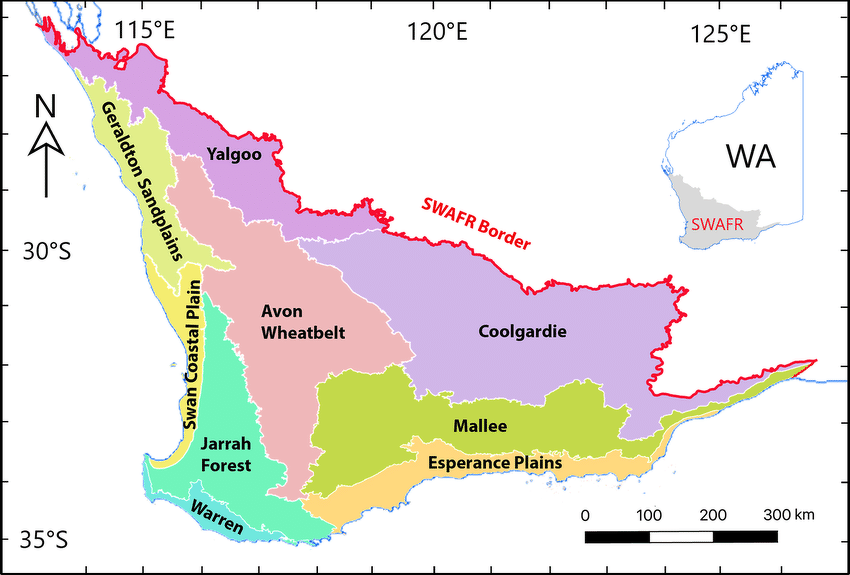
Southwest Australian Floristic Region (SWAFR)
In southwestern Australia there are 12,000 different plant species, 87 percent of which grow nowhere else in the world. The uniqueness of this area is due in part to the fact that 50 million years ago much of Australia was covered by a shallow sea and this sea separated southwestern Australia from the rest of the continent. When the sea dried up, what remained behind was mostly a vast desert that kept the two area separated and hence the biological community that arose in southwest Australia remained isolated.
The biosphere of Southwestern Australia is sometimes referred to as the Southwest Australian Floristic Region (SWAFR). It is a global biodiversity hotspot with unique, ancient, stable climate that has fostered the evolution of a vast number of unique plant species. Unlike many other parts of the world, southwestern Australia has not experienced major glaciation or ice ages, allowing its flora to evolve over a long period without mass extinction events. The region’s infertile soils and complex habitats have also contributed to the unique evolution of plant life there.
Tim Flannery wrote in Discover magazine: In Australia’s sandy southwestern corner, a barely perceptible topography stretches as far as the eye can see. Even spiny, knee-high bushes can’t cloak the skeletal soil, and in summer the heat is so intense that haze swallows the horizon, and wind is the only sound to be heard.” Many of the plants there “are carnivores that eat insects. Some others, like a type of mistletoe that grows here, are imposing trees that suck the life from nearby, lesser plants. Still, it was the flowers that captivated me and posed the most difficult questions. Some looked as if they had been crafted in enamel, while others had great fuzzy heads, like torches. Some, I learned, bloom deep underground. This is a world of diversity, abundance, and downright outrageousness.
The mystery deepened as I learned about the strange pollinators that serve some of the flowers. One is a mouse-size marsupial that eats nothing but nectar, pollen, and small insects — the ecological equivalent of a flightless hummingbird. Why has such a marvel evolved? At first I believed the curiosities were unrelated, but research has shown that many stem from a single strange attribute of the region’s soils.
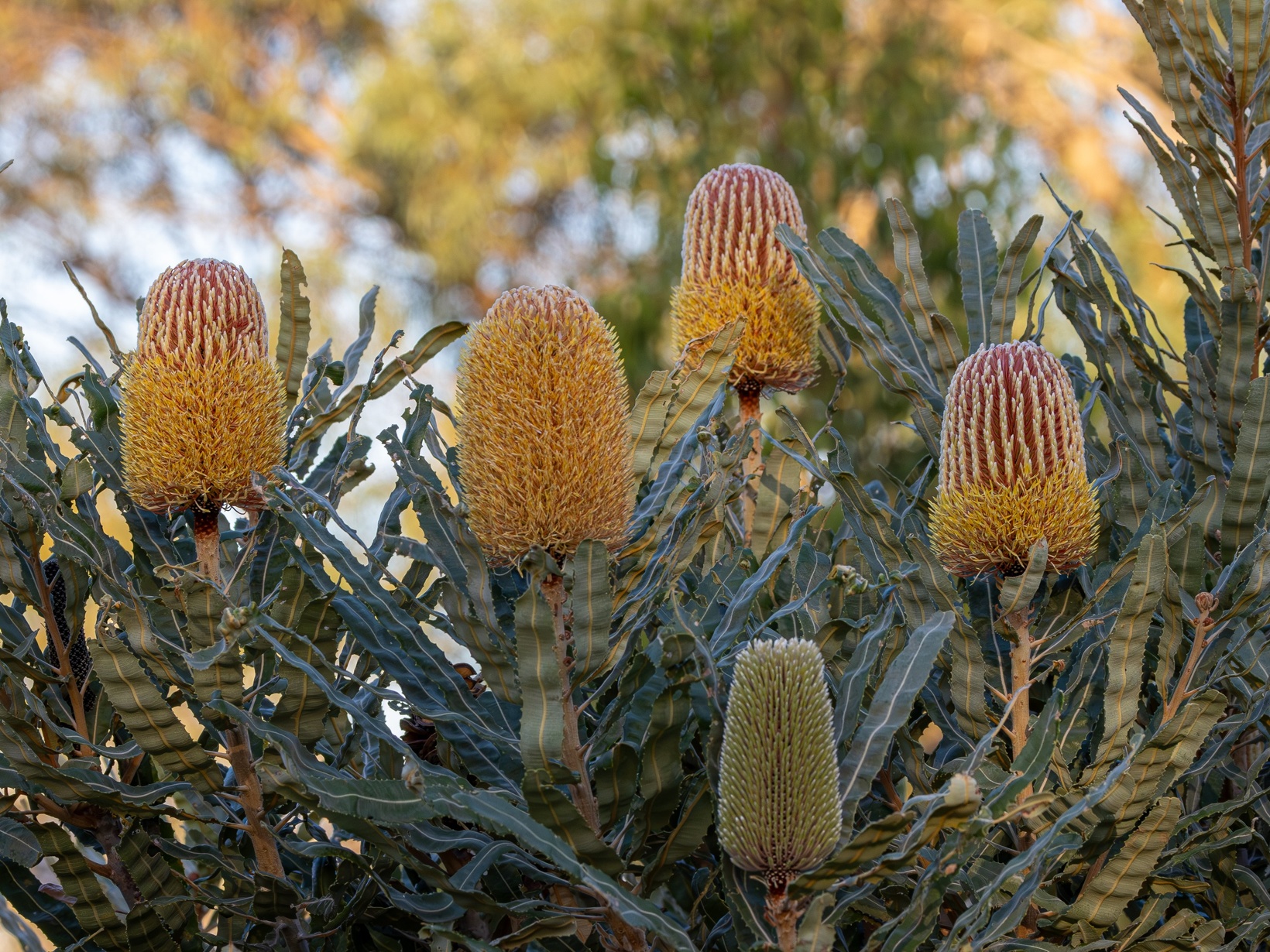
Banksia menziesii flowers
There are many interesting plants in the region The fruit of the woody pear (Xylomelum angustifolium) is encased in a hard, velvety shell about the size of an ordinary pear. Each pear contains two edible seeds. Usually balgas grow little more than an inch a year; after a fire, they can grow almost five inches in a season. The shrubs are old; they were dominant Australian vegetation when dinosaurs roamed the continents. Xanthorrhoea drummondii shrumbs are called grass trees and grow out the sand plain. Aborigines named them balga, meaning "black boy," because fires often burn away the bottom and then leaves, leaving a humanlike silhouette.
Much of the 2.6 million square kilometers (one million square miles) that make up the state of Western Australia are unexplored and new species of plant are being discovered all the time.
The unique flora in Southwest Australia is endangered by agriculture, clearing, mining and introduced species.
Beautiful and Unique Wildflowers of Southwest Australia
Southwestern Australia is rich in wild flowers. Many of the them are unique to the region. The area around of Perth is known for it bizarre flowers. Among them are cut leaf banksia, which resembles a giant red bottle brushes; cowlick plants, with their spring loaded pollen applicators that drop on the insect like a mousetrap smearing them with pollen; the fan-leaved sundew, which captures insects with sticky tentacles which actually grab the insect; the blackboy with a flower over ten feet long; and pink pigaface, which nestels into crevices of rocks of the pinnacles area. [Source: Australian Windflowers: by Carol Wolinsky, January 1995]
The 75 species of banksias grow only in Australia. Of these 60 grow only in southwest Australia. They produce inflorescence that consist of several thousand small florets grouped together in vertical line along a spike. The flowers colors are yellow, red and multi-colored. They take several months to develop and stay open for several weeks. Banksaias are named after the botanist Joseph Banks. The scarlet banksia produces a red flowers, whose sweet nectar has been used by Aboriginals for centuries to make a delicious drink.
The kangaroo paw is native to southwest Australia and found in many gardens elsewhere in Australia. The shrubs are named after velvety paw-shaped flowers that come in a variety of colors, including black, green and yellow. The Mangle's kangaroo paw is the state flower of Western Australia. It has red stems and hanging green and white flowers. [Source: David Attenborough, The Private Life of Plants, Princeton University Press, 1995
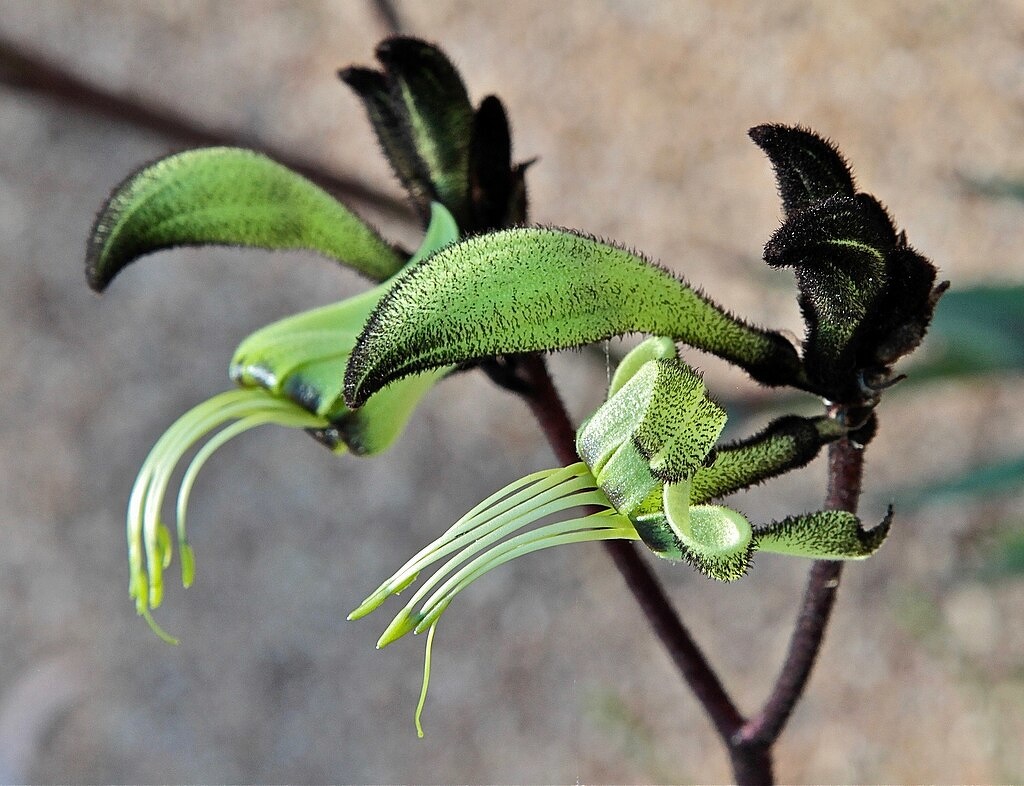
black kangaroo paw
Tim Flannery wrote in Discover magazine: A landscape of wildflowers — including a species known as paper daisies — stretches into the distance at Coalseam Conservation Park in southwestern Australia. The nectar-tipped blossoms of Banksiaprionotes unfurl from the bottom up to look like a bottlebrush. The Banksia is named after Joseph Banks, the botanist who traveled with Captain Cook on his voyage to Tahiti, Australia, and New Zealand. The taxonomist Linnaeus later suggested that Australia be named Banksia in honor of Banks's contribution to Australian natural history. [Source: Tim Flannery and Martin Mischkulig, Discover magazine, December 3, 2003]
The blossoms of Gastrolobium, a pea called prickly poison, contain toxic compounds. Black kangaroo paw (Macropidia fulginosa) looks black because a dense layer of black fibers covers the green stalk and the flowers. A bush flower, Conostylis canteriata, blooms in bunches. Dryandra nobilis, or golden dryandra, has thistlelike blossoms and barbed leaves. The plant is named after Jonas Dryander, an English botanist who described many Australian plants that Captain Cook brought back to England after his first voyage around the world. Although Dryander was originally slated to be aboard with Cook, he decided to remain in England with his family, and botanist Joseph Banks joined the crew instead. Perhaps Dryander made the prudent decisions: Only two of the eight men Banks took along survived the voyage. Lachnostachys eriobotrya is called lambswool or lamb's tail. Its flower has fuzzy blooms. Drosera micrantha offers pink blossoms to pollinators while trapping other potential pollinators, such as insects its sticky glands. A single white blossom tops Drosera marchantii.
Kwongan
Kwongan is a plant community found in southwestern Western Australia. The name is a Bibulman Aboriginal term of wide geographical use defined by J.S. Beard in 1976 as “a type of country” that is “sandy and is open without timber-sized trees but with a scrubby vegetation. It consists of plains in an Australian sense of open country rather than in a strict sense of flat country...There are two principal plant formations in the kwongan, scrub heath and broombush thicket” and both “ are sclerophyll shrublands and possess a certain unity when contrasted with woodland and forest or steppe and succulent steppe communities.”
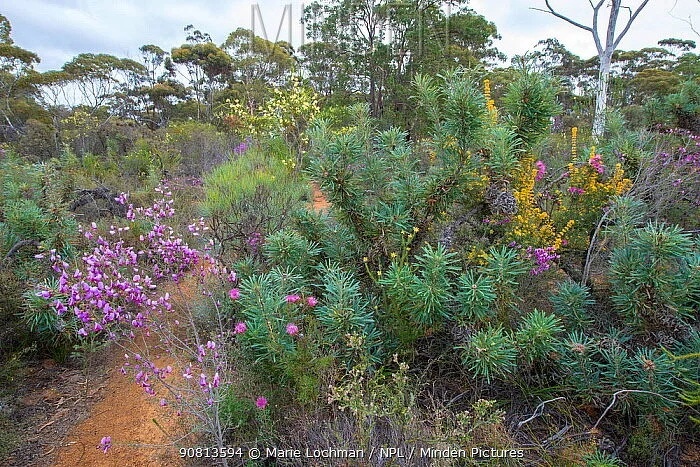
Dryandra forest Kwongan in Wheatbelt, of southwest Australia
Tim Flannery wrote in Discover magazine: The kwongan is a biological marvel. In spring the land bursts into uncountable blooms of breathtaking color and shape that attract tourists from around the world. My first view of this bizarre ecosystem came in 1973...For several days I traveled relentlessly across the featureless Nullarbor Plain on a national highway that had not yet been paved. As I entered the better-watered southwest, the scenery refused to improve. The monotonous kwongan baked under a harsh sun. Many of the plants were perched on stilt roots that held their main stems a few centimeters above the surface, as if the soil had eroded under them. It hadn’t, but like most things here, no one has a satisfactory explanation for it. [Source: Tim Flannery and Martin Mischkulig, Discover magazine, December 3, 2003]
Most of the bushes looked almost dead, but I could see taller growth ahead. When my eye caught a flash of brilliant orange, I eased the throttle and came up on blooms of orange banksia (Banksiaprionotes), six-inch-long cones packed with hundreds of tiny spiraled flowers that turn the snowy white structure flame orange as they open from the bottom up. The cones were dripping with nectar and had attracted beetles, flies, and other insects. Beneath the flowers grew strange, stiff leaves that looked as if they had been cut with pinking shears. The flamboyance seemed out of place on this parched, dusty roadside. Why did this struggling plant expend so much precious energy on flowers, and why was it wasting so much moisture producing nectar in the midst of summer?
The kwongan is one of only a few habitats on earth with a Mediterranean climate — hot, dry summers and cold, wet winters. Others are found in South Africa, California, and of course, southern Europe. These regions depart from the dominant pattern of plant biodiversity: They support so many plant species they can rival rain forests, which are widely accepted as the richest areas of flora on our planet. The rain forests of Panama, for instance, have about 8,000 species of plants, and the rain forests of Africa’s Ivory Coast support about 4,000. That diversity can be matched in Mediterranean climates. South Africa’s fynbos sand plain, for example, has about 8,000 species, and the kwongan has 3,600. There is another surprise in this desert: The kwongan outdoes any rain forest anywhere in its diversity of species per square foot. In just 500 square feet of kwongan a biologist can find as many as 100 species of woody plants.
Poor Soils of the Kwongan
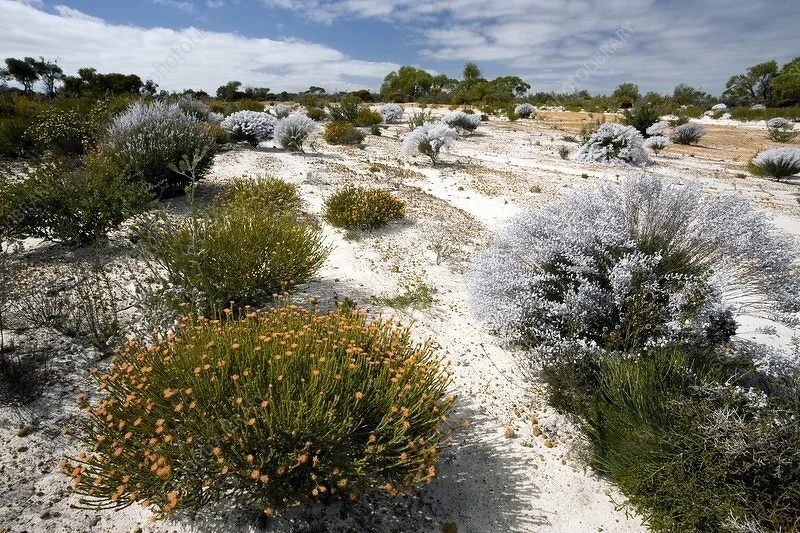
Kwongan soils and heath, dominated by orange Eremaea brevifolia, Lambswool bush (Lachnostachys eriobotrya) and other Spring flowers in Alexander Morrison National Park,
Tim Flannery wrote in Discover magazine: Paradoxically, the kwongan’s diversity is provided by only a few plant families. Just three —the myrtle, pea, and protea families — account for half the species in any one area. Researchers have argued for years about the causes of this peculiarity, but recently a remarkably counterintuitive argument has gained ground: Poor soils can foster the growth of rich plant communities. In Australia’s case, the southwestern province encompasses some of the most ancient continental crust on Earth. The landscape has remained unchanged for hundreds of millions of years, without mountain building or volcanism or glaciers. The region has experienced only a slow leaching that stripped the soil of almost everything except quartz. [Source: Tim Flannery and Martin Mischkulig, Discover magazine, December 3, 2003]
The soil is so infertile that agriculture here is best described as hydroponics — farmers add nutrients to a sterile medium, the rains come, the crops grow. The strategy works only in the short term, for under the sandy kwongan soil lies salt. When deep-rooted native vegetation is destroyed during attempts to farm, a salty water table forms that slowly rises, killing all.
Far too little phosphorus is another significant problem. No nutrient may be more essential to life than phosphorus, but the levels here are so low that few plant families can cope. Nonetheless, those that do survive tend to be spectacularly successful. In the 1970s David Tilman of the University of Minnesota published a fundamental insight into this mystery. He argued that in specific ecological niches, such as wetlands or hardwood forests, plant species that grow most rapidly come to dominate because they monopolize resources. Cattails and sugar maples are examples of those species, which Tilman called superspecies. In areas where soil nutrients are limited, such species cannot take hold. Instead, a series of specialist species may learn to coexist.
On the monotonous sand plain, for example, the terrain varies just enough to offer options for specialists. One species can flourish around tiny hollows where a bit more phosphorus accumulates; another can tolerate the dryness of a slightly higher elevation; and yet another may thrive on the midslope.
Carnivorous Plants of Southwest Australia
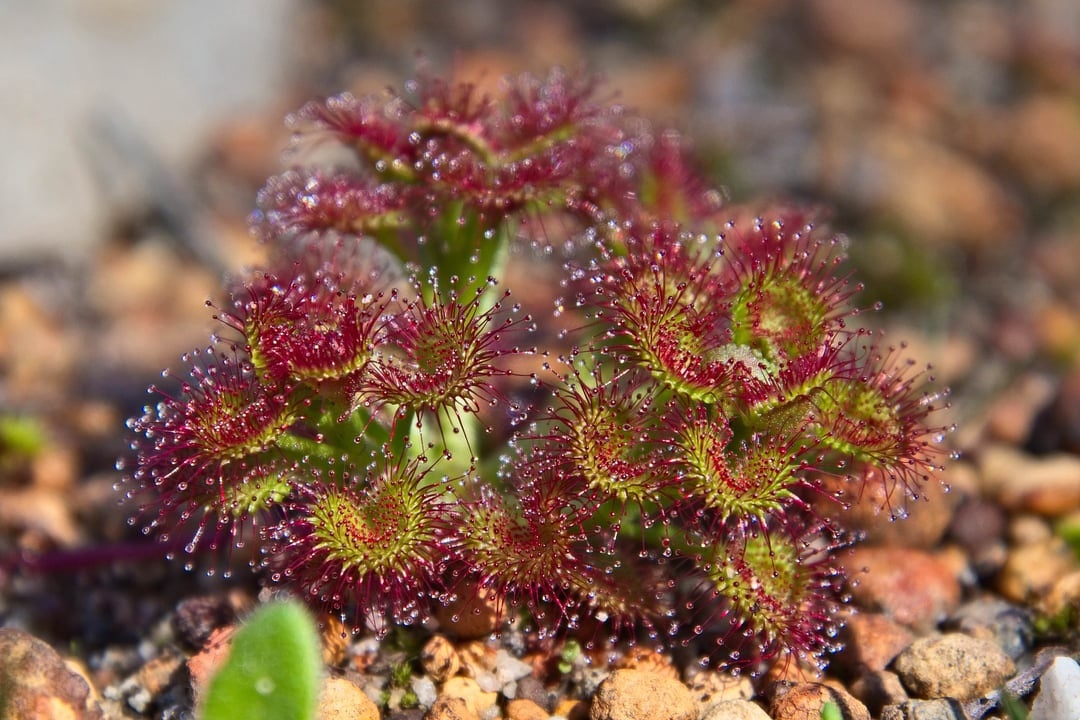
sundew
Southwest Australia is home to many carnivorous plants, including members of the genus Drosera(called sundew). The plant’s sticky glands trap insects, which are slowly digested and absorbed. The carnivorous Drosera erythrorhiza lies close to the ground in order to trap insects as they walk over it. A species of Drosera proffers its sticky glands to prospective insect victims. The many sticky, insect-trapping glands of Drosera stolonifera glisten like a fringe of dewdrops. [Source: Tim Flannery and Martin Mischkulig, Discover magazine, December 3, 2003]
Tim Flannery wrote in Discover magazine: The poor soil promotes other survival strategies. Take, for example, the delicate, glistening carnivorous sundews (Drosera). Sixty-eight of the more than 160 sundew species in the world thrive in Australia’s southwest. During the wet winter and spring, their sticky leaves are astonishingly effective at trapping insects.
One species found near Perth (Drosera erythrorhiza) eats an average of 80 tiny arthropods a day in spring. Another similar carnivore (Byblis gigantea), which belongs to an entirely different plant family found only in Australia, can trap four flies per centimeter of each leaf’s length. Insects provide the plants with an essential supply of nitrogen, phosphorus, potassium, sodium, and zinc.
Parasitic and Fungus-Eating Plants of Southwest Australia
Tim Flannery wrote in Discover magazine: Still, most kwongan plants cannot trap insects. So they obtain a portion of their nutrients from mycorrhizal soil fungi, which live on the roots of plants and help import nutrients. The fungus generally derives some benefit from the relationship by drawing on carbohydrates manufactured by its plant partner during photosynthesis. But a few plant species have managed to so thoroughly exploit the fungus that they no longer make any of their own food. For example, the underground orchid (Rhizanthella gardneri) has given up photosynthesis; it flowers and fruits deep in the earth, where it must be pollinated and dispersed by burrowing invertebrates. [Source: Tim Flannery and Martin Mischkulig, Discover magazine, December 3, 2003]
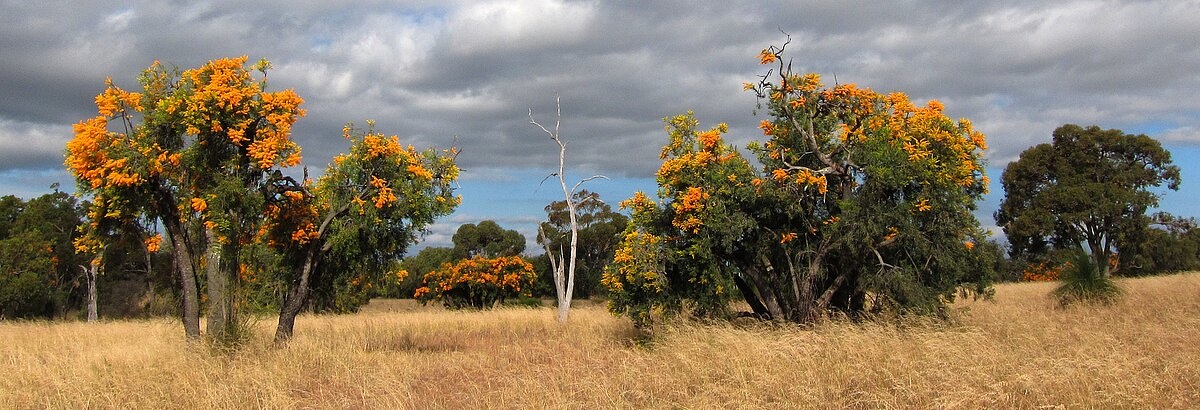
christmas trees
The orchid is not alone in its thievery. At least 42 other kwongan plant species get by as outright parasites. One is the Christmas tree (Nuytsia floribunda), which earns its name from the great masses of flame orange flowers that appear around it each summer. The blooms of this type of mistletoe look like great clusters of brilliant orange grapes and can seem hallucinatory in the summer heat. It lives by sucking the life out of grasses and lesser plants growing within its reach. The roots are armed with structures called haustoria, which throw a collar around the rootlets of neighbors. Spigotlike outgrowths from the collar pierce the roots and drain off nutrients and moisture. Its discarded leaves, which contain considerable nitrogen and phosphorus, create a niche for herbs growing under the tree’s canopy.
Other plants rely on less predatory methods. The banksia and other members of the protea family extend roots across the soil surface to collect the tiny amount of nutrients that come with rainfall or decaying plant matter. To fund extravagant summer blossoms, an extraordinary taproot penetrates deep into the earth to reach sweet groundwater and less-weathered rock.
Unusual Pollinators and Poisonous Plants of Southwest Australia
Tim Flannery wrote in Discover magazine: Against a backdrop of scarcity and struggle, the features of the honey possum — an important pollinator — no longer seem strange. Tarsipes rostratus is the sole surviving representative of an ancient marsupial family found only in the southwest of Western Australia. It is also the only land mammal on Earth that subsists mostly on flower nectar and pollen, which it probes for with an elongated muzzle. Many aspects of its biology are even more surprising. [Source: Tim Flannery and Martin Mischkulig, Discover magazine, December 3, 2003]
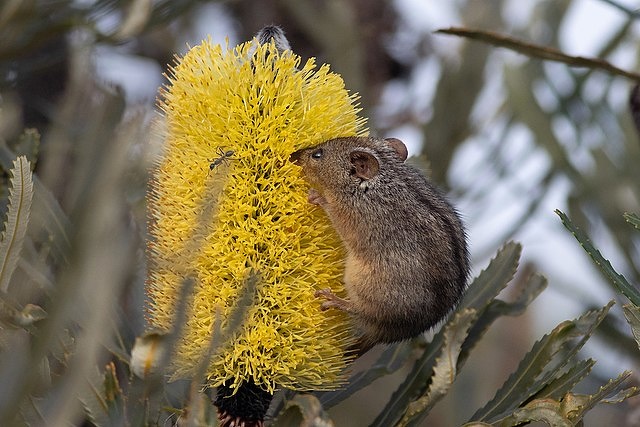
honey possum feeding on nectar from a banksia
The male’s huge testes make up four percent of its body weight (human testes of this proportion would weigh about two kilograms, or 4.4 pounds each), and the tiny animal’s sperm are larger than those of the blue whale. With the abundance of protea and myrtle species and their diverse flowering schedules, the honey possum thrives year-round, sometimes extracting all the food it needs from just 430 square feet.
Some kwongan plants have evolved chemical defenses and manufacture poisons to keep their leaves from being eaten. Gastrolobium peas produce fluoroacetate, a poison so deadly that just one mouthful of leaves can kill a sheep. Acidic compounds such as tannin and phenolics also are favored, and their presence in shed dead leaves prevents their consumption by soil invertebrates.
Spring Bloom and Fires in Southwest Australia
Tim Flannery wrote in Discover magazine: In spring, after a wet winter, the kwongan goes berserk. Some bushes obscure foliage with red, white, and blue flowers, while others produce compound flowers that look like pinecones, toothbrushes, even feather boas. At first, the astonishing floral exuberance seems puzzling, given the limited conditions. But plants actually expend little of their nutrient store to make flowers. [Source: Tim Flannery and Martin Mischkulig, Discover magazine, December 3, 2003]
All that is needed to produce nectar is sunlight and water, and during the Australian spring both are abundant in the southwest. The real challenge is spreading pollen. Without nutrients, potential pollinators such as insects and birds are scarce, and the appetites of carnivorous plants compound the problem. Each plant must therefore compete intensely to attract a pollinator. Only the most handsome and nectar-filled blooms win out.
The accumulation of leaf litter in a dry climate sets the stage for periodic fires. Every few decades the kwongan is reduced to ashes. Although a few species resprout from woody, underground rootstocks, most plants are killed. Then woody, hard seed capsules created by many of the plants open, sometimes after years of dormancy, to release seeds into a rich bed of ash. With the winter rains, the seedlings emerge, and the cycle begins again.
Where to See Wildflowers in Southwest Australia
The best time to see wildflowers in Southwest Australia is between September and November. Among the best places to see them are the southern coastal areas and forests such as the Cape to Cape Track, Boranup Karri Forest and Nannup. You can also find interesting and diverse displays in Porongurup National Park, Stirling Range National Park, Alexander Morrison National Park, along the coast at D'entrecasteaux National Park, Ambergate Reserve, Meelup Reserve, and the local trails around Busselton and Margaret River.
The Cape to Cape Track is a scenic trail between Cape Naturaliste and Cape Leeuwin, offering views of wildflowers along the coast. Boranup Karri Forest is a beautiful forest south of Margaret River where with a forest floor is alive with greenery and flowers. Pemberton (245 kilometers. 150 miles south of Perth) is the center of karri forests. There are national parks here with karri trees and other wonders. The Walpole-Nornalup contains a stand of very large karri trees in a place called the "Valley of the Giants." The town of Nannup is known for its floral displays. It hosts the Nannup Flower and Garden Festival in August and offers the "Wildflower Wander" trail.
D'entrecasteaux National Park features rare orchids and a variety of other flowers in a coastal area. Ambergate Reserve near Busselton with a walking track with hundreds of wildflower species. The Meelup Reserve located in the Dunsborough has a 7.4-kilometer walking trail through its beautiful flora. Stirling Range National Park is to 1099-meter-high Bluff Knoll, the highest point in Western Australia, and over 1,000 species of wildflowers. Porongurup National Park features numerous wildflowers carpeting the landscape beneath its granite domes. Fitzgerald River National Park is botanically diverse region with a significant percentage of Western Australia's flora.
Self-Drive Tours are in the Margaret River and Wheatbelt regions are recommended. Wildflowers Way (north of Perth) is a region famous for its wildflowers. This route follows the Great Northern Highway via New Norcia to Dalwallinu. The return trip is along the Midland Road via Mingenew. The most dense concentrations of flowers are around Moora, Dalwallinu, Perenjori Morawa and Mullewa. Among the flowers that are seen from August to October are wattles, foxgloves, everlastings and wreath leschenaultia.
Near Perth is open country with 8,000 species of wildflowers, many found nowhere else in the world. Many unique species grow in the 64 square kilometer (25 square mile) area around the town of Eneabba and nowhere else. Yanchep National Park (48 kilometers, 30 miles northwest of Perth) is a favorite picnic area with ocean beaches, sand dunes, lakes, windflowers and mobs of kangaroos. There is also an imported a colony of "imported" koalas. From August to October there are a lot wildflowers here.
Image Sources: Wikimedia Commons
Text Sources: Animal Diversity Web animaldiversity.org , National Geographic, Live Science, Natural History magazine, Australian Museum, David Attenborough books, Australia Geographic, New York Times, Washington Post, Los Angeles Times, Smithsonian magazine, Discover magazine, The Conversation, The New Yorker, Time, BBC, CNN, Reuters, Associated Press, AFP, Lonely Planet Guides, Wikipedia, The Guardian, Top Secret Animal Attack Files website and various books and other publications.
Last updated September 2025