
Home | Category: Nature and Environment
PLANTS IN AUSTRALIA
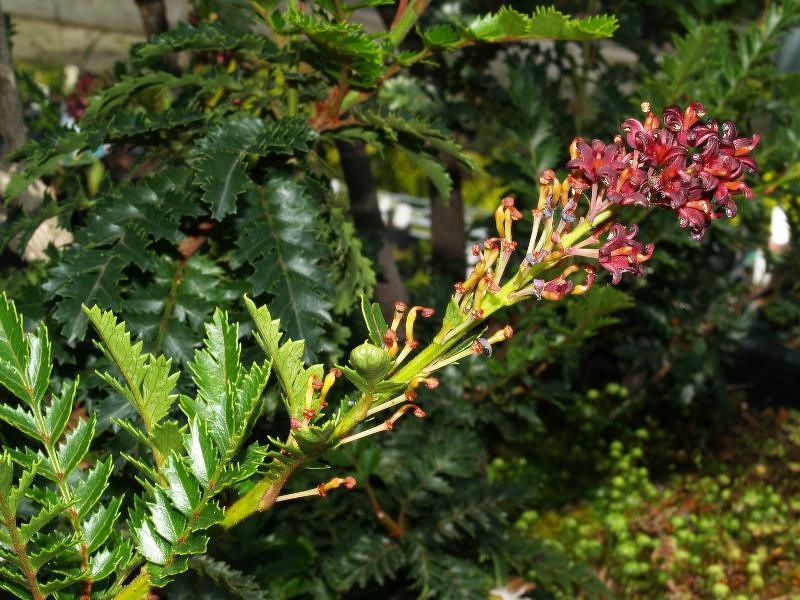
King's Holly, the world's oldest plant
Many distinctive forms of plant life are found in Australia, especially in the coastal and tropical areas. Numerous types of wild flowers grow in the bush country, including kangaroo paw, boronia, Christmas bush, desert pea, Geraldton wax plant, flanner flower, pomaderris, and waratah. There are 1,500 varieties of orchids. Perhaps as many as 7,200 plant species are unique to southwestern Australia, which is regarded as a biodiversity hot spot. [Source: “Worldmark Encyclopedia of Nations”, 2007; Google AI]
Settlers often gave erroneous names to plants and animals, placing them in the wrong biological families, because they bore a passing resemblances to plants and animals found back home. One bird with a red breast, for example, was named a robin even though it was a flycatcher. [Source: David Attenborough, The Private Life of Plants, Princeton University Press, 1995]
According to “CultureShock! Australia”: Of Australia’s more than 30,000 total plant species, 90 per cent of the 18,000 ‘vascular’ plant species are not found anywhere else. One of the loveliest sights of the Perth summer is the flowering of countless Jacaranda trees (actually South American imports from way back when), clouds of lavender-blue...and our very own Christmas tree — a Bottlebrush, ablaze with tall red flower ‘candles’ In the same Myrtle family again — there are 1,300 species of myrtle in Australia — are the Paperbarks, sometimes referred to in Australia by their genus name, Melaleuca, and quite often identified by their peeling, papery bark. Other familiar myrtles are the Mimosa family, with its familiar yellow blossoms often cascading in drooping spring, about October — golden showers. There are 900 resident species of wattle in Australia. There are also the most spectacular displays of gorgeous wildflowers in the countryside and in the bush. It is literally a case of the desert blooming, in profusion. [Source: Ilsa Sharp, “CultureShock! A Survival Guide to Customs and Etiquette: Australia”, Marshall Cavendish, 2009]
Plants, Animals and Fires in Australia
The are many species of small marsupial that feed on flower nectar. The pygmy possum uses the nectar to sweeten its meals of insects. The honey possum feeds almost exclusively on nectar and its teeth and claws have almost evolved out of existence.

Soft Spinifex that requires a burn to maintain forage value
In many places forest fires are necessary to burn off the tree ferns so the eucalyptus seedlings can grow and survive without the ferns blocking off their sunlight. Mountain gums have bark that strips off like ribbons and easily catches fire. The crown of the trees are high off the ground, usually out of range of forest fire flames.
Some species like the mountain ash hold onto their seeds for years and don’t release them until after a fire. With no competitors the seeds quickly germinate and grow into seedlings that grow fast enough to stay ahead of and crowd out ferns. A lack of fires rather than too many fires cause the mountain ash to die out. When trees die from old age and tumble to the ground. With no fires there are no seedlings to grow and take its place.
Birds like lorikeets and marsupials such as honey possums drink the nectar produced by flowering plants such as eucalypts, banksias, bottlebrushes (Callistemon), grevilleas, and mistletoes. The animals spread the pollen but among some plants only a small number of the plants produce seeds. The seeds may take more than a year to mature and are released from their capsules only when there is a fire. The plants employ this strategy because fires leave the nutrients in the soil near plants they need to survive.
Grasses, Mistletoe and Shrubs in Australia
There are more than 700 native Australian grasses. The toughest and most widespread are spinifex species, the main source of food for many Outback animals. These grasses grow well in sandy and rocky areas and grow in dense clumps that are difficult to walk through. Spinifex resins was once used by Aboriginal to attach spear heads to shafts. Mitchell Grass grows over large tracts of land in Northern Territory. It is drought resistance and the main source of food for cattle in the region.
Millions of sheep and cattle feed on saltbush, a shrubby plant that grows well in desert areas and resistance to slat. There are 30 species of this plant. Very few sheep live in the Cape York Peninsula because the savannahs are fulled spear grass, a stalk with needle-sharp point that lodges in the flesh and produces such terrible infections that victim often die.
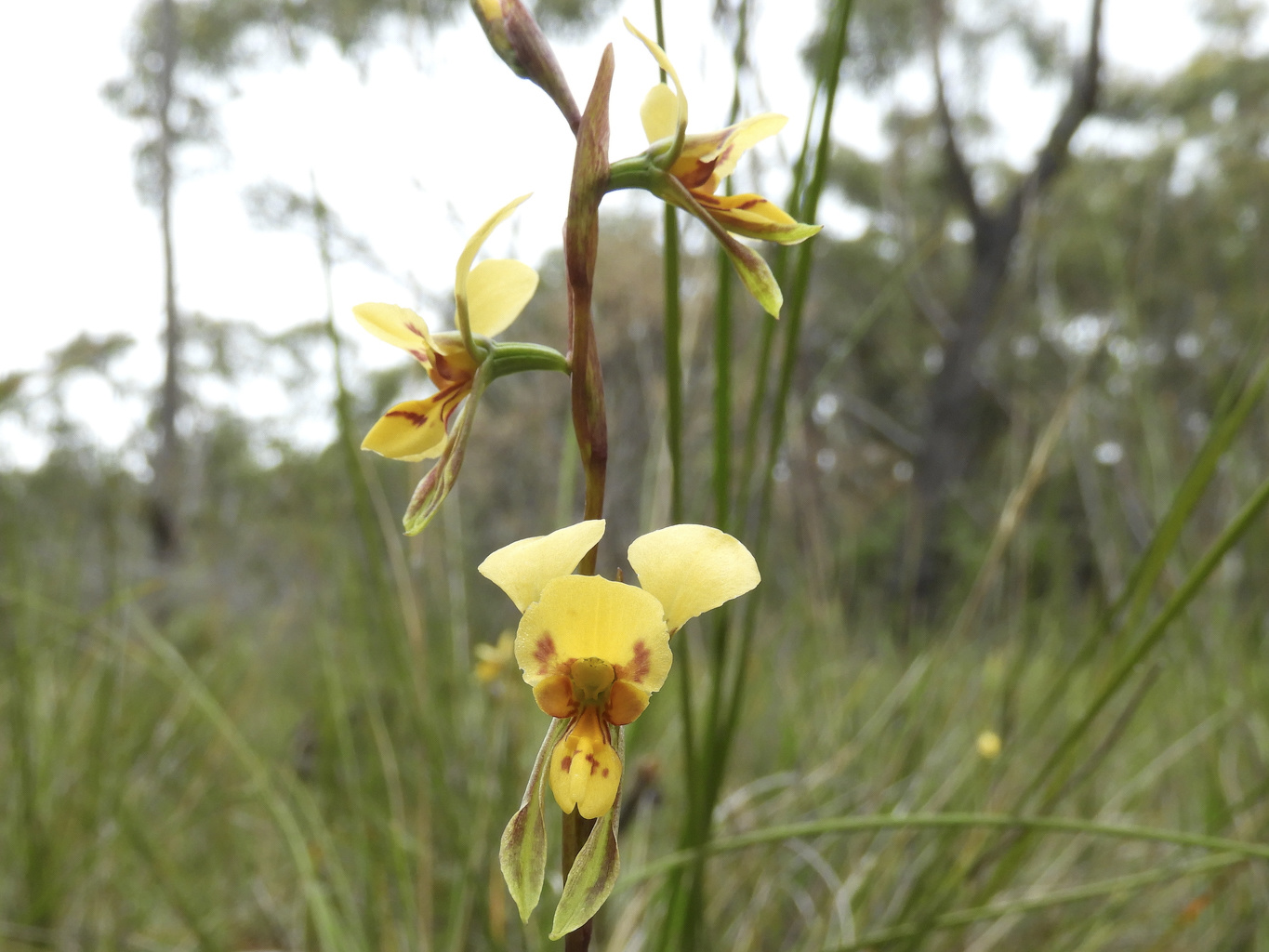
donkey orchids
Callistemon, or bottlebrushes, are shrubs with brush-like flowers. There are 25 different species. They are found throughout Australia and are particularly common in New South Wales. revilleas are another common family of shrubs found in Australia.
Australia is rich in mistletoe species. There are nearly 100 different species that live in variety of environments. Mistletoe are parasitic plants that need hosts to survive. Some feed on one species. Some feed on several. Some have leaves that closely resemble those of their hosts. The berries of one mistletoe are fed on almost exclusively by the Australian mistletoe bird. These birds digest the berries in less than an hour. The seeds emerges from the anus and retain their it natural adhesiveness and are so sticky they sticks to the birds’ butt. The birds wipe the seeds off on a tree which allows the mistletoe to disperse itself.
Unusual Plants in Australia
The world's oldest plant, commonly known as King's Holly, was discovered in the Tasmanian rain forest. It is a self-propagating clone, which reproduces by shedding genetically identical clones rather than releasing seeds. The plant was labeled as 43,000 years old or older because modern cutting are identical to fossilized remains dated at 43,000 years. Another unusual feature of the plant is that is produces flowers but no seeds.
In Australia, the land of the world’s most poionous snakers and spiders, even some of the plants are venomous. The Gympie stinger can cause a painful rash lasting over a week. In tropical Australia there are three species of nettles with such a powerful toxins that people who brush up against them have to be hospitalized. Unidentified venoms with no known antidote. can produce pain that lasts for weeks. One plant is a bush. One is a tree that grows 15.2 meters (50 feet) tall. These plants have distinctive heart-shaped leaves.
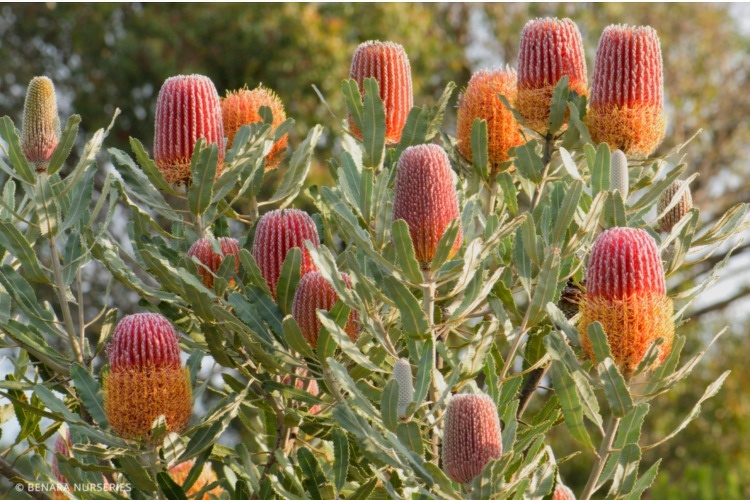
banksias, From Benara Nurseries
One unique species of plant survives in the scorching Australian desert by lifting itself above the ground, where temperatures are as much as 20̊F cooler than the sand, on aerial "stilt roots." On the other end of the spectrum, plants in the mountains of Tasmania protect themselves from the cold with cushions made up of stems packed closely together for warmth and they are protected by layers of shed fibers that form the cushion. The plant utilizes the cushions not to survive little snow but rather endure intense, chilly and wet winds. Most of the cushion plants are daisies and dandelions whose flowers have become extremely small. The cushions bond together and form a layer that is strong enough to walk on. A square meter may contain a hundred thousand stems. Some cushions cover boulders and surround trees and create a landscape that looks like a Japanese moss garden.
The 75 species of banksias grow only in Australia. Of these 60 grow only in southwest Australia. They produce inflorescence that consist of several thousand small florets grouped together in vertical line along a spike. The flowers colors are yellow, red and multi-colored. They take several months to develop and stay open for several weeks. [Source: David Attenborough, The Private Life of Plants, Princeton University Press, 1995]
"Extinct" Plants Found in Remote Australia
In April 2008, scientists announced that two plants that were thought to have been extinct since the late 1800s had been rediscovered in far northern Australia. A Queensland state government’s State of the Environment report said the two species were found on Cape York, in tropical far north Queensland. “The Rhaphidospora cavernarum, which is a large herb that stands about one and a half meters high, has reappeared,” state climate change minister Andrew McNamara told Australian Broadcasting Corp radio. “It hasn’t been seen in Queensland since 1873,” he said. [Source: Reuters, April 12, 2008]
He said the second plant that has reappeared, another herb called Teucrium ajugaceum, was last seen in 1891. The report was produced from research by more than 100 academic and government experts. “The rediscovery of two presumed extinct plant species has seen a decline in this category, with a corresponding increase in the endangered category,” the report said. It said more than 50 plant species new to science are discovered and described in Queensland every year and there are more than 12,000 native plant species known to science in the state.
Asterolasia buxifolia is so rare it doesn't have a common name. It was originally collected in the 1830s and thought to have gone extinct but was rediscovered in the Blue Mountains west of Sydney in the early 2000s by Sydney botonist Bob Makinson, who found a group of about 50 f the the two-meter-tall shrun with golden star-like flowers 80 kilometers west of Sydney. [Source: Associated Press]
Orchids in Australia
There are over 1,500 species of orchids in Australia with about 80 to 90 percent of them found only in Australia. Most Australian orchids are ground-dwelling and they are found diverse habitats: temperate forests, rainforests, grasslands, alpine regions and semi-arid mallee. There are even some that grow underground as is case with those in the genus Rhizanthella.
Australia is the home of several exotic species of orchids. "Beardies" have eye-like glands and nose-like columns and long red hairs that resembles a caterpillar, the prey of a wasp that fertilizes the orchid. The flying-duck orchid springs shut when an insect lands on it and douses it with pollen before it escapes to another flower. The donkey orchid has earlike petals and bug-eyed glands. Some of the world's only blue species of orchids are found in Australia.
The underground orchid blooms underground and is only the only known plant that uses termites as pollinators. It was discovered in Western Australia in 1928 and needless to say is difficult to find and thus far has only been found in western Australia.
An orchid is a terrestrial or epiphytic plant with a non-woody stem and, in most cases, a lovely flower. There are over 28,000 species in the orchid family, the largest of any flowering plant and nearly a seventh of all plant species. Some are extremely rare and hard for gardeners grow. These sometimes produces magnificent, showy flower that bloom only once every seven years of so. Others are common, easy to grow and produce small nondescript flowers that require a magnifying glass to see. [Source: Luis Marden, National Geographic, April 1971]
Image Sources: Wikimedia Commons
Text Sources: Animal Diversity Web animaldiversity.org , National Geographic, Live Science, Natural History magazine, Australian Museum, David Attenborough books, Australia Geographic, New York Times, Washington Post, Los Angeles Times, Smithsonian magazine, Discover magazine, The Conversation, The New Yorker, Time, BBC, CNN, Reuters, Associated Press, AFP, Lonely Planet Guides, Wikipedia, The Guardian, Top Secret Animal Attack Files website and various books and other publications.
Last updated September 2025