
INTERESTING FRESHWATER FISH IN AUSTRALIA
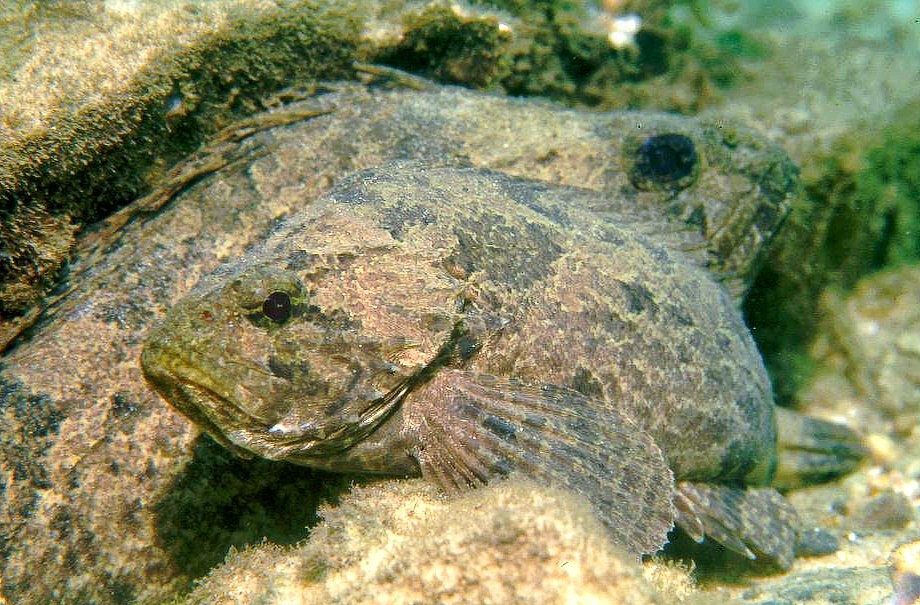
bullrout, a freshwater stonefish
Interesting Australian freshwater fish include the Murray cod (Australia's largest freshwater fish), prehistoric Australian lungfish, colorful rainbowfish and ambush predators like the Mary River Cod, and the unique river blackfish. Many native species such as Murray Cod, Macquarie Perch, and Trout Cod are now endangered, while others, such as the Barcoo Grunter and Jardini, remain an important part of Australian culture and ecosystems. Be careful of bullrouts, freshwater stonefish. The look like stones and hide in the weeds. Their spines are just as toxic as those of stonefish.
Murray cod (Maccullochella peelii) are the largest exclusively freshwater fish in Australia. They are an apex predator in the Murray-Darling Basin and a cultural icon. River blackfish (Gadopsis marmoratus) are south-eastern Australia known for its unique features and is regarded as an “underarted sports fish.” Rainbowfish (Melanotaenia species) are diverse family known for their vibrant colors. They are found in various freshwater habitats. Among the worrisome introduced species are Redfin Perch (Perca fluviatilis), a common introduced predator that competes with native fish and is a threat to native species in Western Australia, and goldfish (Carassius auratus), which in large numbers can degrade water quality and pose a threat to native species.
Salamanderfish, sometimes called "the instant fish of southwest Australia," live without water for months at a time. During in the wet season they live in pools of water. During the dry season when the pools evaporate the two-inch-fish burrow into the sand and wait there until the rains return. The American biologist who discovered the survival patterns of these fish borrowed a fire engine and sprayed 700 gallons of water on an empty dried-up pool, and sure enough with minutes salamanderfish emerged by the handful. [National Geographic Geographica, April 1992].
Tasmanian Giant Freshwater Crayfish
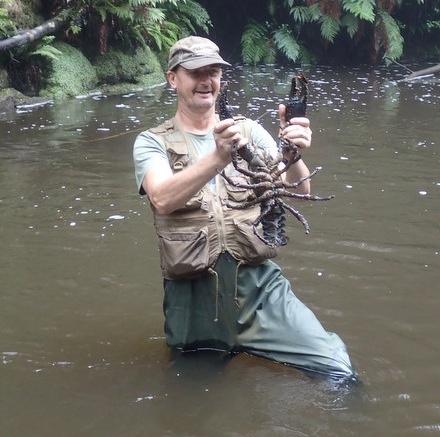
Tasmanian giant freshwater crawfish, from the Australian Crayfish Project
Tasmanian giant freshwater crawfish (Astacopsis gouldi) are also known as giant freshwater crayfish. Found in streams in some places in Tasmania, they can reach a length of 60 centimeters (two feet) and weigh four kilograms (8.8 nine pounds). According to the Guinness Book of Records, one specimen found in 1934 weighed 6.4 kilograms (14 pounds) and was 73.7 centimeters (29 inches) long.
Tasmanian giant freshwater crawfish are found in the rivers, streams, and reservoirs that drain into Bass Straight including the Arthur River System. They species can be found mostly in dark, slow moving rivers. They feed around large rotting logs and other submerged structures. The Tasmanian giant crayfish are omnivorous. They harvest fungi and bacteria that grows on rotting wood that, by accounts, is tended like a garden,. They also eat leaves and insects that fall into the water, as well as animal flesh.[Source: Bill McClain, Animal Diversity Web (ADW) /=]
Tasmanian giant freshwater crawfish are listed as endangered on the International Union for Conservation of Nature (IUCN) Red List. At one time, they were considered a gourmet dish but were heavily over-harvested and now they can no longer to be caught and eaten. The main reasons for their decline and endangered status in addition to over-harvestin are habitat loss and degradation and their long reproductive process and slow maturation
Tasmanian Giant Freshwater Crayfish Characteristics, Behavior, Reproduction
Tasmanian giant freshwater crayfish are the world’s largest freshwater invertebrates. Large ones , weigh around three kilograms (6.6 pounds) and are 40 centimeters (1.6 feet) long but their average weight is around half a kilograms (1.1 pounds) and their average length is around 12 centimeters (4.72 inches) long. They do not grow to a large size quickly, but can live around 30 years. [Source: Bill McClain, Animal Diversity Web (ADW) /=]

range Tasmanian giant freshwater crawfish: magenta: likely to occur; light pink: may occur; Purple: translocated populations, on Tasmania
Tasmanian giant freshwater crayfish have a dorso-ventrally flattened body with powerfully developed pinchers on their first set of walking legs. Their abdominal legs are longer, adapted for swimming. Females also attach their eggs to these legs. They are cold blooded (ectothermic, use heat from the environment and adapt their behavior to regulate body temperature) and are heterothermic (have a body temperature that fluctuates with the surrounding environment).
Tasmanian giant freshwater crayfish live a long time in part because traditionally they lacked of natural predators at full maturity. The species is too large for predators such as bass which are predators of smaller species of crawfish. When hiding is needed the crawfish backs into murky banks and under submerged obstructions. /=\
Tasmanian giant freshwater crayfish reaches reproductive maturity late in life. Males reach maturity at about nine years and females do not reach maturity until about 14 years. Even after they reach maturity, females only breed every two years. They mate and spawn in the autumn and the eggs hatch the next summer. The eggs remain attached to the female until May. This long reproductive process has a large impact on the species because a female spends much of her mature life with eggs attched to her. /=\
Archerfish
Archerfish are found in northern and some eastern regions of Australia. They inhabit freshwater and brackish estuarine environments. Specific Australian species include the Sevenspot Archerfish (Toxotes chatareus), the Banded Archerfish (Toxotes jaculatrix), the Kimberley Archerfish (Toxotes kimberleyensis), and the Primitive Archerfish (Toxotes lorentzi).
Archerfish shoot jets of water into the air to capture prey. Some have been observed knocking down insects a meter a half away (five feet) away. Reaching lengths of 25 centimeters, they have large eyes and excellent eyesight and are one of the few species of fish that is proficient at looking above the surface of water. When it takes aim at an insect it compensates for the way light bends when it passes from the air through the water.
Sometimes dubbed the “anti-aircraft gunners” of the aquatic world, according to NBC News, the sharp-shooting abilities of the archerfish are are legendary. There are stories from their native India relate that they could extinguish the cigarette of visiting Englishmen who got too close to a river or pond, apparently after mistaking the lit end for a glowing insect. [Source: Tom Metcalfe, NBC News, April 25, 2022]
Archerfish (also spelled archer fish) live in the Indo-Austroasiatic region: in India, New Guinea, Australia, the Phillipines, Southeast Asia, and Oceania. They are usually found in mangrove swamps, but occasionally show up in prawn ponds and river mouths. They can survive in a wide range of water types, from fresh water to salt water, and in temperatures ranging from 25 to 30 degrees C. Archerfish are typically found at or near the water surface where they hunt prey. [Source: Fred Dery, Animal Diversity Web (ADW) /=]
See Separate Article: STRANGE FISH IN ASIA: ARCHER FISH, GIANTS, SNAKEHEADS, MUDSKIPPERS factsanddetails.com
Australian Lungfish
Lungfish are freshwater vertebrates belonging to the order Dipnoi. Possibly related to creatures that first emerged from the ocean and walked on land way before the dinosaur age, they retain the ability to breathe air and breath underwater and have lobed fins like pre-dinosaur fish with a well-developed internal skeleton. Lungfish represent the closest living relatives of the tetrapods (four-limbed vertebrate animals that includes living and extinct amphibians, reptiles, dinosaurs, birds and mammals). Lungfish typically have tooth plates, rather than teeth, which are used to crush hard shelled organisms. [Source: Wikipedia]
Lungfish are regarded as living fossils. There are six living species — in Africa, South America, and Australia. They were formerly found around the globe The fossil record of the group extends into the Early Devonian, over 410 million years ago. The earliest known members of the group were marine, while almost all post-dinosaur era ones inhabit freshwater environments. The splitting of the prehistoric supercontinent Pangaea is believed to have geographically isolated Australian lungfish.
Australian lungfish (Neoceratodus forsteri) was discovered in 1869. They are almost exactly like lungfish that walked the earth 200 million years ago. They are found in southeastern Queensland in Australia, in the Burnett, Mary, North Pine, and Brisbane Rivers. Some were transplanted in 1898 to the Enoggera Reservoir, the North Pine River, the Brisbane River, and various other locations. With the exception of the Enoggera Reservoir It is not known for sure if they still exist in the places they were transplanted. Australian lungfish are restricted to their current range in part because they cannot survive in saline water. This inhibits their migration via the sea and estuaries to other places. [Source: Stewart Garner, Animal Diversity Web (ADW)]
The preferred habitat of Australian lungfish is of “still or slow-flowing, shallow, vegetated pools” in areas of constant, lasting water with lots of shade, away from open water and with little mud, and vegetation and a substrate composed of fine sand and gravel. Australian lungfish are found in shallower water in the spawning season and at night and in deep water in winter and during the day. In some places, mature lungfish dwell in or near dense and overhanging vegetation. Young lungfish often inhabit areas adjacent to weed banks and remain in such areas for months or years.
Australian Lungfish Characteristics
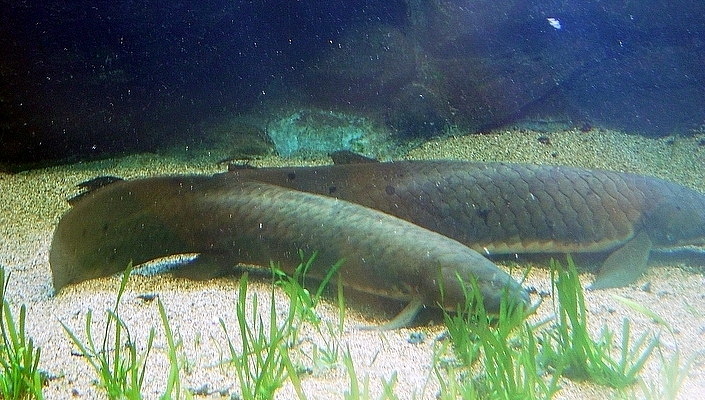
Australian lungfish
Australian lungfish reach weights of 48 kilograms (106 pounds) and range in length from 82.5 to 112.5 centimeters (32.48 to 44.29 inches). They are cold blooded (ectothermic, use heat from the environment and adapt their behavior to regulate body temperature), Sexual Dimorphism (differences between males and females) is not present: Both sexes are roughly equal in size and look similar though the belly color of males changes during the breeding season. Australian lungfish can live 50 to 100 years. [Source: Stewart Garner, Animal Diversity Web (ADW)]
Adult Australian lungfish possess a “wide flat head, a thick heavy body, a diphycercal tail (having upper and lower portions that are alike or nearly so), and paddle-shaped fins”. Except for the front part of the head, Australian lungfish are covered by bony overlapping scales that in some places are four scales thick, which provides some protection for their more vulnerable undersides. Adults have a tiny mouth with relatively large teeth-like structure on the palate and the lower jaw. Adult Australian lungfish are olive-green or grey-brown in color on their back side, and yellow-orange with some white on their undersides. Juvenile lungfish have a more circular head, shorter fins, thinner trunk, and their undersides are a faint pink color.
Australian lungfish have a single lung. Other lungfish species have two. This lung is mainly used for aerobic respiration when the lungfish are more active and need more oxygen. Increased dependency on oxygen in lungfish takes place only under specific circumstances, such as while grazing for food at night, during periods of flood when waters are highly turbid, or during spawning.
How Lungfish Breath on Land and in Water
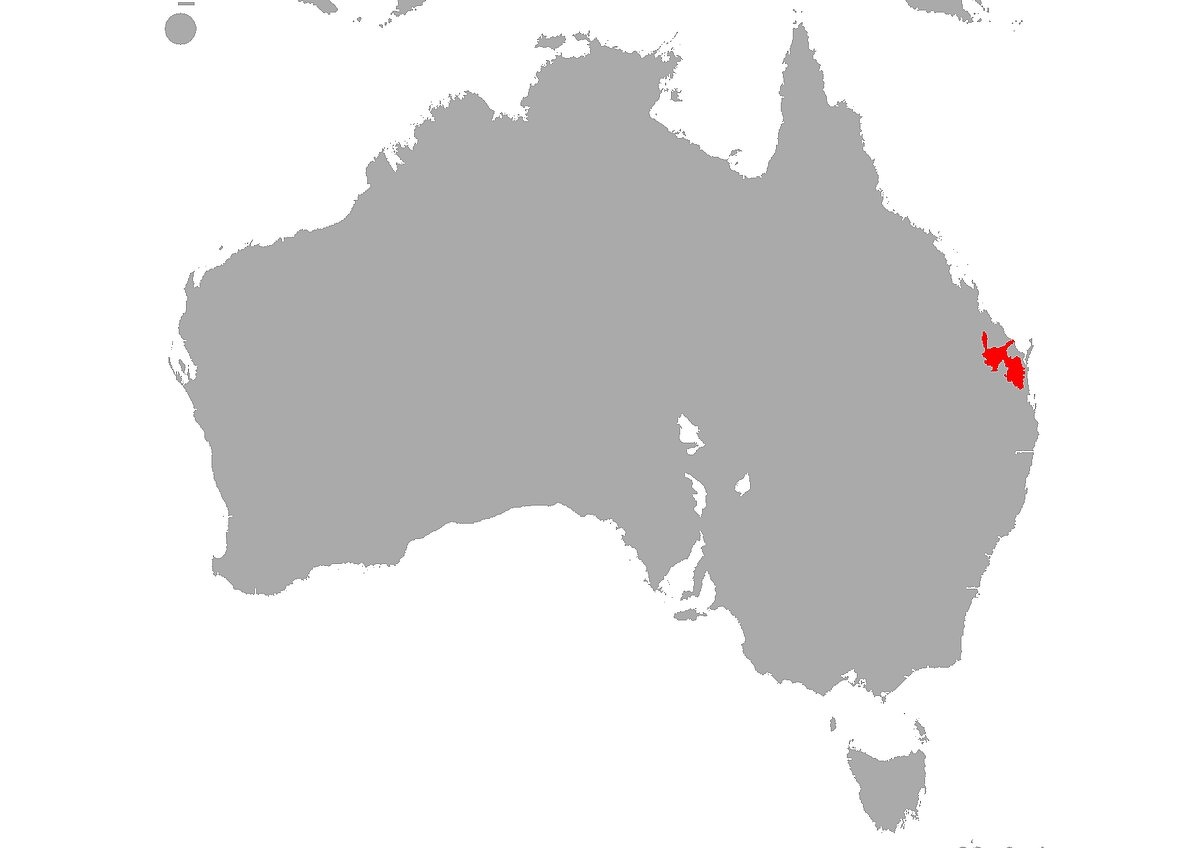
Australian lungfish range
Lungfish have highly specialized respiratory systems. Their lungs are connected to the larynx (voice box) and throat without a trachea (windpipe), which most other animals have. A few species of fish can breathe air using modified, vascularized gas bladders, but these bladders are usually simple sacs. The lungs of lungfish have the same basic structure of the lungs of reptiles, birds and mammals. They are subdivided into numerous smaller air sacs, maximizing the surface area available for gas exchange. Most modern lungfish species have two lungs; Australian lungfish are the only ones with one.[Source: Wikipedia]
Of living lungfish, only Australian lungfish can breathe through their gills without needing air from their lungs. In other species, the gills are too atrophied to allow for adequate gas exchange. In regard to their gills, lungfish have circulatory system that is similar to that to common fish. The bypass arterioles (small branches of an artery leading into capillaries) of the third and fourth gill arches (which do not actually have gills) are shut, the second, fifth and sixth gill arch arterioles are open. Gill arches, also called branchial arches, are a series of bony "loops" present in fish, which support the gills.
As the water passes through the gills, lungfish use a buccal pump in which it "breathes with its cheeks" — a method of breathing in which the animal moves the floor of its mouth in a rhythmic manner that is visible when you see them. This is the way all amphibians inflate their lungs. In the case of lungfish, flow through the mouth and gills is in one direction. Blood flow through the body is counter to the water so as to maintain a constant flow.
When a lungfish breathes air: 1) the spiral valve of the conus arteriosus (upper front part of the right ventricle of the heart) closes (minimizing the mixing of oxygenated and deoxygenated blood); 2) the third and fourth gill arches open; 3) the second and fifth gill arches close (minimizing the possible loss of the oxygen obtained in the lungs through the gills), and 4) and 5) the pulmonary arteries open. During air breathing, the sixth gill is still used in respiration; deoxygenated blood loses some of its carbon dioxide as it passes through the gill before reaching the lung. This is because carbon dioxide is more soluble in water. Air flow through the mouth is tidal (meaning that air flows in by the same route that it leaves) and through the lungs it is bidirectional and observes "uniform pool" diffusion of oxygen to the body within red cells through the solution of hemoglobin using capillaries,
Australian Lungfish Behavior, Diet and Senses
Australian lungfish are natatorial (equipped for swimming), nocturnal (active at night), motile (move around as opposed to being stationary), sedentary (remain in the same area) and territorial (defend an area within the home range). Australian lungfish tend move around one or two different pools at night and retreat to a shelter during the day to rest and recovery. Unlike adults, juvenile Australian lungfish behave territorially and aggressively towards other juveniles. Larger young fish have been observed physically shoving and biting smaller juveniles in order to drive them away from desirable habitats. [Source: Stewart Garner, Animal Diversity Web (ADW)]
Australian lungfish are omnivores (eat a variety of things, including plants and animals). Their diet changes as they grow and development, especially as their teeth-like structures develop. When young lungfish first begin feeding on their own they have several “sharp, cone-shaped teeth” that enable them to seize and hold prey. At this stage, they typically eat worms and small crustaceans such as brine shrimp. As they get older, the cone-shaped teeth of Australian lungfish expand and slightly erode into tooth plates. Adults feed on a variety of animals including “frogs, tadpoles, fishes, shrimps, prawns, earthworms, aquatic snails, bivalve mollusks... moss, fallen flowers from Eucalyptus trees and aquatic plants”. When foraging for food, lungfish often eat some plants, which pass through their body undigested. This vegetation may be ingested in order to also consume miniscule organisms bound to it.
Australian lungfish use electroreception to detect faint, electric fields of potential prey. They are also able of pick up vibrations produced by other animals, which is useful for hunting and sensing predators. Lungfish have small, primitive eyes but they do possess opsins, which allow them to “fine-tune [their] spectral sensitivity to environmental light”. They have different cone types which may perceive color. Some of these cones contain “brightly colored oil droplets or spectral filters... thought to improve color vision". These spectral filters also increase the ability of lungfish to distinguish between objects based on their color, “including those of ecological significance”. These seem like adaptions geared living relatively clear water. Young juveniles can undergo a color change as response to light stimulation.
Australian Lungfish Reproduction
Australian lungfish are oviparous (young are hatched from eggs) and reproduction is external, meaning the male’s sperm fertilizes the female’s egg outside her body. Australian lungfish engage in seasonal breeding, spawning from August to December, with most activity occurring in September and October.. The number of offspring ranges from 50 to 100. A nest or refuge is not produced by Australian lungfish parents. No protection or help is provided to offspring, as eggs are left on their own to develop after hatching. On average females reach sexual or reproductive maturity at 20 years of age; males do so at 15 years of age. [Source: Stewart Garner, Animal Diversity Web (ADW)]
Stewart Garner wrote in Animal Diversity Web Lungfish perform an elaborate routine of mating behaviors, but little is known about this process. Loud sounds made by lungfish when breathing air may also be involved in the mating process, though this is uncertain. Australian lungfish have been observed frequently and hastily circling in pairs near the water’s surface during mating season.
Australian lungfish lay their eggs lying on their side while they are attached to a partner. Eggs are usually deposited individually, though occasionally in pairs, within waters of 16 to 26 degrees Celsius in temperature. About 95 percent of emerging eggs are immediately fertilized by the male. There are records of the eggs being carefully directed into a designated environment but also records of them dispersed by males “thrashing their tails at the end of spawning.” Eggs can be produced both during the day and at night. Lungfish eggs best survive at depths of 20 to 80 centimeters.
The egg-producing process is triggered by increasing daylight and is not influenced by rainfall or chemicals in the water. Australian lungfish are picky about their spawning sites but exactly how they choose them is unknown. Factors such as water depth, substrate composition, vegetation in the area are believed to be involved. Australian lungfish often choose an area with plants with “complex branching or leaf worls... because eggs that detach from the surface of these are less likely to fall to the bottom”“ and ideally contain a mix of algae, protozoa, worms, small mollusks and crustaceans. In conditions of a potential spawning area conditions can be met, these lungfish will do not reproduce. Due to the specificity of breeding sites, complete progeneration has exclusively occurred about every 20 years for more than a century.
Australian Lungfish Development
Australian lungfish can lay their eggs in both stagnant water and moving water. In calm waters, eggs are rarely found deeper than five to 10 centimeters and the substrate is iften sandy. In flowing waters, eggs are often laid at depths of 20 to 60 centimeters in several different substrates. Egg survival is highest in shallow water that is lots of thick vegetation. Each egg produced is enveloped in a “vitelline” and a three-layered jelly membrane. Cleavage occurs briskly, and after 36 hours a large-celled blastula forms. After about 3.5 to 4.5 days, the small-celled blastula develops, and invagination occurs after a large fluid-filled blastocoel is produced around seven days. About ten days after fertilization head structures begin to appear as the head starts to extend forwards. Before hatching, the lungfish’s pigmentation and the lateral line system appears. Also around this time, body proportions and position of mouth and dorsal fin change, and a pre-anal fin grows. [Source: Stewart Garner, Animal Diversity Web (ADW)]
Length of each stage of development varies considerably among individual Australian lungfish. Hatching of Australian lungfish takes place as fish squeeze through a diminutive hole in the side of the capsule, which can occur as early as 23 days depending on environmental conditions. Hatching usually occurs after about 30 days. While the yolk is still available, the hatchling lies decumbently on its side.
Feeding starts four to six weeks after hatching. Over time, young Australian lungfish begin to forage over a larger area. They show no obvious external metamorphic activity and no clear distinction between individuals can be made until they become adults. Most lungfish appear in close proximity to adults for six to seven months after hatching. Adults retain some juvenile characteristics and “larval features”.
Australian Lungfish, Humans and Conservation
Australian lungfish have been classified as Endangered on the International Union for Conservation of Nature (IUCN) Red List since 2019. In CITES (Convention on International Trade in Endangered Species of Wild) they are in Appendix II, which lists species not necessarily threatened with extinction now but that may become so unless trade is closely controlled. |=|
There are estimated to be fewer than 10,000 Australian lungfish currently in existence. In 2003, they were declared a “vulnerable species” by the Environmental Protection and Biodiversity Conservation Act of Australia. The main threat to Australian lungfish is habitat loss and degradation resulting from agriculture, forestry, invasive species, and river impoundment. About 26 percent of lungfish’s core habitat in the Burnett and Mary Rivers is impounded by weirs and dams, which create barriers to movement and alter water flow. These changes disrupt breeding and decrease juvenile recruitment. [Source: Stewart Garner, Animal Diversity Web (ADW)]
Man-made barriers, such as dams, change water quality downstream and often cause release of oxygen-deprived, sediment-rich water that is detrimental to lungfish populations. Dams also limit lungfish movement, preventing the migration of adults to spawning areas. Dam construction and induced flooding damages algal macrophyte beds that are key components of lungfish habitats and outright kills lungfish. Among other environmental threats that affect Australian lungfish are fertilizer and sewage runoff from agricultural activities, human effluents, and animal production facilities. Australian lungfish populations lack genetic diversity, which may further threaten the long-term survival of the species, and they take a long time to develop and reach breeding age..
Australian lungfish are important to researchers because of their status as "living fossils" and the insights they give into evolution and life developed on land. Known predators include Australian wood ducks, crustaceans, insects and fish such as Tilapia, which are thought to feed on Australian lungfish juveniles and eggs.
Image Sources: Wikimedia Commons
Text Sources: Animal Diversity Web animaldiversity.org , National Geographic, Live Science, Natural History magazine, Australian Museum, David Attenborough books, Australia Geographic, New York Times, Washington Post, Los Angeles Times, Smithsonian magazine, Discover magazine, The Conversation, The New Yorker, Time, BBC, CNN, Reuters, Associated Press, AFP, Lonely Planet Guides, Wikipedia, The Guardian, Top Secret Animal Attack Files website and various books and other publications.
Last updated September 2025