
INTERESTING INSECTS OF AUSTRALIA

Spiny leaf insect female after its fourth moult
Five-centimeter (two-inch) -long caterpillars of the bag-shelter moth align themselves head to tail into five-meter (16-foot) -long strings comprised of a hundred or so individuals in the Outback of Northern Territory. The caterpillars eat leaves off acacia trees. When the leaves are depleted on one tree they form a conga line and lay down a silk road to show the way to another tree. These processionary caterpillars are often seen around Alice Springs. Don't touch them as their hairs are tipped with poison.
Spiny leaf insects (Extatosoma tiaratum) are masters of camouflage. They possess an exoskeleton that mimics the foliage of their forest habitat. Males can fly away when they feel threatened, but females are flightless so are completely reliant on their ability to blend into their environment, according to the Australian Museum. They have been found to sway in the wind to mimic the movement of vegetation in order to stay hidden from predators. Spiny leaf insects also curl up their abdomen to look like a scorpion. [Source: Scott Dutfield, How It Works magazine, May 19, 2021]
Australia is the home to insects with transsexual tendencies. After a male “Cotesia rubecula” parasitic wasp successfully mates it behaves like a member of the opposite sex to keep rival males from going after the recently fertilized female. The randy rival males try to mount the transvestite wasp, who keeps his abdomen and sexual region out of reach. And by the time they give up the female is safely away injecting her eggs into a cabbage caterpillar. [Discover May 1994].
In the early 1990s, a fossil of the 420 million-year-old ancestor of all insects was discovered in Australia. Known as Euthycarcinoids these early insects or proto-insects were land-crawling crustaceans that emerged on land between 450 and 500 million years ago. It had long been speculated that such an ancestral group existed and a fossil found in Australia in the early 1990s was the first hard evidence and also indicated they were among the first animals to colonize land. The Australia fossil can now be seen in Western Australia Museum in Perth. [National Geographic Geographica, August 1992].
Annoying and Scary Insects of Australia
Describing a camp in the Maamba Reserve in Western Australia, English writer Daisy Bates wrote, "Those ticks were revolting. I once had a whole string of them black and shining around my waist like belt. I tried to get them off by scorching them with a stock taken from the fire but when that didn't work I had to wait until they were well-fed and ready to drop of their own accord."

An Apankura, a 420-million-year-old Euthycarcinoid
In Australia, the common bush fly (Musca vetustissima) is attracted to the moisture in human sweat and tears, leading to the characteristic "Aussie salute" to shoo them away. In the desert, these moisture-seeking flies try to get water from people’s mouth, ears, eyes and nose. Sometimes they so bad people are afraid to leave their vehicles out of concern that they will be swarmed.
Swarms of buffalo flies come out in the tropical north after the torrential rains come, They are particularly attracted to cattle and cover their backs and heads. The bush fly can be a big annoyance to humans. National Geographic photographer Randy Olsen said: “They land on your skin and lick your sweat...They walk in circles around my eyes, trying to get moisture below my eyelids.” When he was carrying stuff in both hands it was hard to shoo them away.
Giant fishkiller (Lethocerus insulanus) are scary-looking water bugs that, as their name suggests, have prey on small fish as well as tadpoles, frogs and snails. According to How It Works: To catch their prey, they sit on a plant stem that's submerged underwater , grabbing passing fish using their long, needle-tipped front legs, according to the Australian Museum. They then inject digestive enzymes into the prey's body to liquefy tissues, making it ready for consumption.” [Source: Scott Dutfield, How It Works magazine, May 19, 2021]
One of the largest cockroach in the world is the giant burrowing cockroach from tropical northern Queensland. One specimen found was 7.9 centimeters (3.1 inches) long and 3.8 centimeters (1.5 inches) wide and weighed 22 grams (0.77 ounces). One of the world's largest flying insects, the Hercules moth, is found in the same area. One specimen found near a post office in the coastal town of Innisfail in 1948 was reported to have a wingspan over 35.6 centimeters (14 inches). Most, however, have a wingspan that doesn't exceed 28 centimeters (11 inches).
Giant Centipedes and Snails of Australia
Giant centipedes (Ethmostigmus rubripes) in Australia are over 16 centimeters (six inches) long and thick as a finger. They are made up of 27 body segments supporting up to 23 pairs of legs. One of the biggest centipedes in the world, they feed on insects, snails and worms, capturing and killing their prey, using modified legs called forcipules that curve around the head and can deliver a potent venom, according to Australian Geographic. The venom is strong enough to kill a large animal quickly, and can cause severe pain to humans if the arthropod is disturbed or handled, according to the Australian Museum. [Source: Scott Dutfield, How It Works magazine, May 19, 2021 ^^]
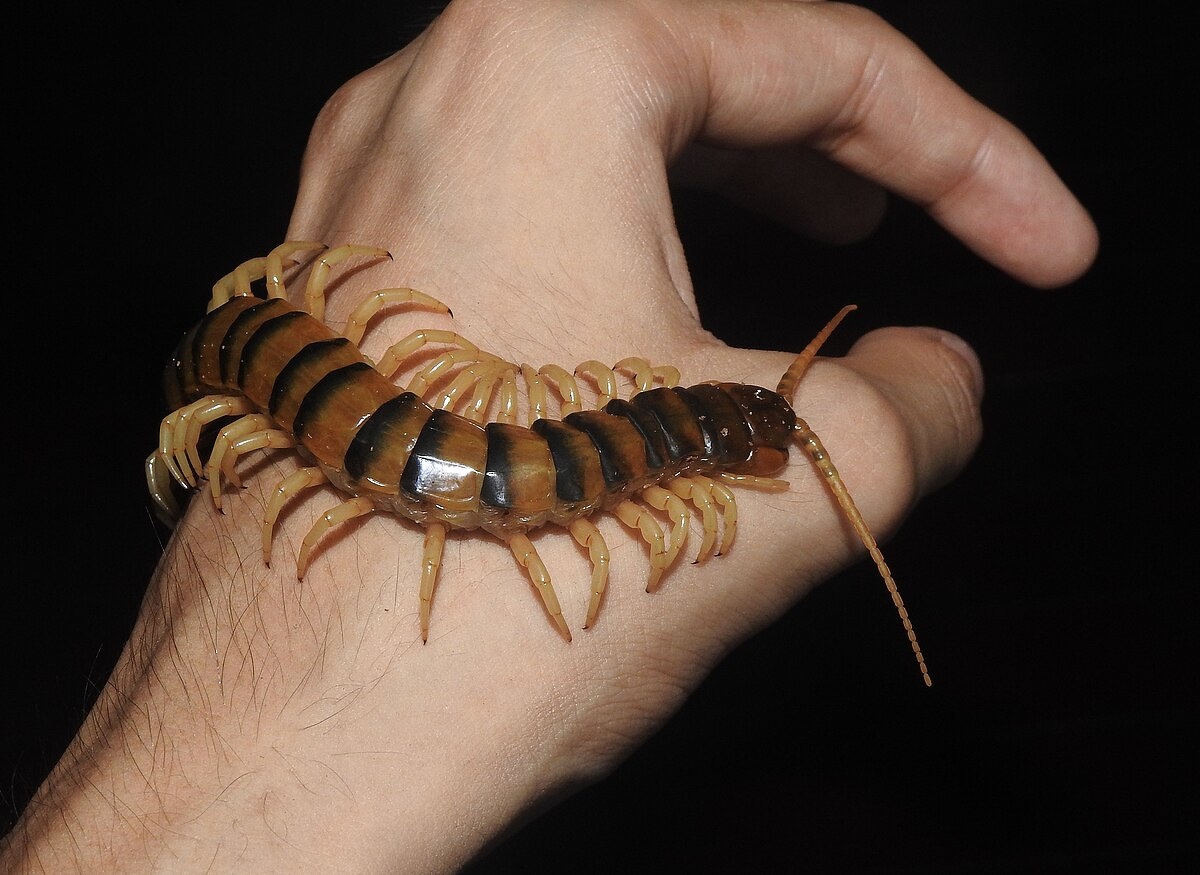
giant centipede from Queensland
Giant centipedes can also be found in Southeast Asia, Indonesia and Pacific islands. Their tergites (back section) of giant centipedes may be various shades of brown, green, orange, or yellow, sometimes with a dark border. The antennae are yellow and long to very long. These centipedes inhabits a variety of habitats including deserts, woodlands, rainforests, and urban areas. They can tolerate both dry and moist conditions, and can often be found beneath logs, bark, leaf litter, or rocks. [Source: Wikipedia
Giant panda snails (Hedleyella falconeri) are named for their long pair of black stalks and have a shell that can reach 10 centimeters (four inches), in length, making them the largest land snails in Australia, according to the Atlas of Living Australia. Giant panda snails spend their time in subtropical rainforests in eastern Australia, feeding on fungi on the forest floor after or during rainfall. ^^
Australian Assassin Bugs — Tool-Using Insects?
Assassin Bug is the common name used to describe Reduviidae, a large cosmopolitan family of insects in the order Hemiptera (true bugs). Most are terrestrial ambush predators; some are blood-sucking ectoparasites. Most are recognizable: they have a relatively narrow neck, sturdy build, and formidable curved proboscis (sometimes called a rostrum). It is advised to keep your hands off of large specimens because they sometimes defend themselves with a very painful stab from the proboscis.
There's an assassin bug in Australia that is regarded as a tool-using animal. In a study published in the spring of 2023 in the journal Biology Letters, scientists describe the creative — and deadly — hunting technique type of one type of assassin bug. Maggie Harrison wrote in Futurism: The insect meticulously coats itself in a sticky resin as a means of more effectively catching prey. Per the study, the assassin bug uses a specific resin from a native Australian grass called spinifex grass. "Tool use in animals is a complex and rare phenomenon, particularly in insects," reads the scientists' research. "Tool use in assassin bugs has been suggested as several species apply adhesive plant resins to their body, which has been hypothesized to function in enhancing prey capture." [Source: Maggie Harrison, Futurism, May 7, 2023]
To test the extent of the tiny assassins' tool use, the Australian researchers observed the bugs in the wild as well as in captivity, taking 26 different assassin bugs from the outdoors and placing them in a glass jar with one of two prey: flies or ants. As ScienceDirect notes, flies are particularly difficult to catch. Per the study, the resin-covered assassin bugs had a much easier time catching flies than their glueless counterparts did — of the 26 bugs, those with resin were 26 percent more successful at snagging the pesky winged prey. "Here, we staged predatory interactions of resin-deprived and resin-equipped assassin bugs (Gorareduvius sp.) and discovered that applying resin as a tool conveys a clear predatory advantage to the assassin bugs," reads the study. "Gorareduvius sp. can thus be considered a tool-user, and since this behaviour was present in all individuals, including newly hatched nymphs, tool-use can be considered to be stereotyped."
And apparently, according to the scientists' observations, the use of the spinifex resin isn't a learned behavior, as even newly-hatched nymphs were seen coating themselves in the glue-like substance. "Assassin bugs manipulated an environmental item (the resin), by taking it out of its usual context and applying it onto their bodies," the researchers concluded, "Thus gaining a selective advantage through improved prey capture."
Giant Stick Insect Species Discovered in Queensland
In August 2025, scientists announced that discovered a new species of stick insect in the rainforests of northeast Queensland that is 38 centimeters (15 inches) long — the length of bowling pin — and weighs 44 grams (1.6 ounces), "From what we know to date, this is Australia's heaviest insect," said Angus Emmott, co-author of a paper on the new species, per James Cook University. [Source: Daniel Gala, The Cool Down, August 2, 2025]
The stick insect is named Acrophylla alta. As the time of the discovery announcement only two specimens of the new species had been, leading researchers to suggest the insect lived mainly highest canopies of high-elevation rainforests. "Unless a bird knocks one down or you get a cyclone or a storm that knocks one down, we just can't find them up there in the canopy," said Emmott, per Gizmodo.
The Cool Dowm reported: Emmott and co-author Ross Coupland were tipped off to the potential new species by a photograph they received of the massive insect. After much fruitless searching, the duo finally happened upon a female of the species, which was in the process of laying eggs. Once they saw the eggs, Emmott and Coupland knew they were dealing with a new species entirely."We looked at its eggs after it laid some eggs, and we were absolutely certain it was a new species," said Emmott, per the Australian Broadcasting Corporation.
The researchers ultimately made their discovery in a remote, high-elevation area between Millaa Millaa and Mount Hypipamee in the Wet Tropics World Heritage Area of Queensland, according to ABC News. "Canopies are not well-studied, so there's a chance there are many more species in the canopy than we can even imagine," Peter Valentine, a former chair of the Wet Tropics Management Authority, told ABC News.
Lord Howe Island Stick Insect — Rarest Insect in the World?
Lord Howe Island stick insects have been described as the rarest insects in the world. They are listed as Critically Endangered on the International Union for Conservation of Nature (IUCN) Red List of Threatened Species, and Critically Endangered under Australia’s Environment Protection and Biodiversity Act. [Source: Anna Ashcraft, KSWB articles, December 24, 2023]
They live on he Lord Howe Island Group — a cluster of volcanic islands in the Tasman Sea between Australia and New Zealand. Previously thought to be extinct, they were were rediscovered in 2001, two pairs were taken to the Melbourne Zoo for breeding to help save the species. They are also now being bred at the San Diego Zoo. Since 2012, the two zoo’s have been working together to save the species.
Also known as tree lobsters, the Lord Howe Island stick insect is a large, flightless, nocturnal insect that can grow up to six inches in length. At the zoos the temperature and humidity in their habitat is closely controlled, while UV-transmissible skylights allow access to natural photoperiod cues. San Diego Zoo horticulturists have even traveled to Australia to gather plants and seeds for the insects that were otherwise unavailable in North America. The Lord Howe Island Board and residents have also been working for decades to bring the population back in that area. They even began rat eradication efforts in 2019, which helped bring back many other rare, presumed extinct plants and animals.
Australian Plague Locusts
The Nullabar Plain was once hit with cloud of locust 130 kilometers (80 miles) long. In 2004 after rains occurred after a long drought huge swarms of locusts caused havoc in northeastern Queensland and then spread to New South Wales where conditions were ideal for breeding, Rains thwarted efforts to spray insecticide, A New South Wales farmer told ABC before they hit. “In a few days, we will see locusts that will just black the sun out. There won’t be a green thing left. They’ll even eat the clothes off the washing line.”
The Australian plague locust, Chortoicetes terminifera, is the most significant pest species of locust in Australia due to the large areas infested, the frequency of outbreaks and its ability to produce several generations in a year. Adults of the Australian plague locust can be readily distinguished from other species by the large dark spot on the tip of the hindwings and distinctive scarlet hindleg shanks. Adult body color is variable and can be grey, brown or green. Adult males measure 2.5-3.0 centimeters long while females are 3.0-4.2 centimeters long.[Source: Australia government Department of Agriculture, Fisheries, Forestry]
The Australian plague locust is widespread on the mainland and is commonly found in a variety of grassland and open, wooded habitats. Adults are nomadic and swarms can move twenty kilometers in a day. They also make long distance nocturnal migratory flights at heights up to 1000 meters. They can be transported over long distances by upper-level winds and are therefore occasionally found in more coastal parts of the mainland and even in northern Tasmania. In eastern Australia migrant locusts sometimes establish populations in valleys east of the Great Dividing Range, such as the Hunter Valley, but these populations usually die out after several generations.
The Australian plague locust is inactive at temperatures below about 15 degrees C and most adults die during the winter months in the southern part of its distribution area. Most eggs laid in autumn in southern areas enter diapause and only resume development in late winter when cold temperatures continue to delay hatching until spring. Therefore at the start of spring the majority of the population occurs as eggs in the soil which hatch later in spring. The lifecycle of this species gives rise to several generations each year. There are typically three generations corresponding roughly to the spring, summer and autumn seasons, but there may sometimes be two or four depending on latitude and regional conditions.
When food and climatic conditions are favorable, huge swarms of locusts may develop. The first recorded swarm was in 1844, with further outbreaks from the 1870s onward. After 1900, the intensity and frequency of locust swarms increased, and since the 1920s, a pattern has developed of localized, high-density populations in some locations most years and less frequent major plagues over large areas persisting for one to two years. [Source: Wikipedia]
Infestations in Western Australia are less frequent. Widespread heavy inland rains, especially in summer, allow plague locusts to reach plague proportions with less regular rain maintaining these high-density populations. During these conditions, the lifecycle pattern may change to one in which the period from hatching to maturity is reduced to 2.5 months. Dry conditions reduce populations back to background levels. Locust damage is mainly confined to pasture, although crop damage can occur. Advanced winter crops have generally hardened off by early summer, when plague locusts become active and therefore are not favored, but dry conditions and less advanced crops can be highly susceptible to locust infestation as can young autumn
Termites in Australia
Termite mounds cover much of the Australian landscape. Some are 4.6 meters (15 feet) high and shaped like cathedrals. There are areas in the tablelands of northern Australia, where termite mounds are so dense, there are 125 one- to-1.3 meter (three-to-four) -high mound per hectare (50 per acre)
Out of the 258 described and 90 undescribed termite species in Australia, only a few wood-damaging species are of concern to humans. In many parts of Australia the soils are to dry to support earthworms so termites play a vital role aerated the soils and breaking down dead wood and grass into nutrients that be can be absorbing by living plants.
The so called magnetic termite mounds on Australia have a north-south orientation. The thin chisel-shaped mounds of the compass termites exposes them to a minimum of heat from the midday sun but catch rays from the morning and evening sun, which is useful in the cooler months.
Ants in Australia
Army ants are found mostly in the tropical rain forests of Asia, Africa, Australia and the Americas. There are 320 known species of them with 150 in the New World, mostly in tropical areas of Central America and northern South America. In Africa they are called drivers. In South America they can form armies three quarters of million strong. Army ants in the Old World and the New World are thought to have independently evolved the same lifestyle and method of hunting. See Army Ants Uner ANTS THAT MAKE MILK, EXPLODE AND FORM ARMIES factsanddetails.com ;
Weaver ants, found in Asia, Africa and Australia, are one of the world's most fascinating ant species. They claim territories of 20 or more trees, the largest of any ant species, and live in treetop nests woven from leaves. To get to hard to reach places weaver ants form chains, with one ant grasping on to the waist another and so on. For food, they raise aphids, as if they were cows, and consume their honeydew sweet feces as they were milk or cheese. They also work together to kill and carry prey. One scientist observed a group of 50 weaver ants carrying a hermit crab up a tree.
Parts of Queensland are littered with anthills seven to ten feet high. Honey-pot ants collect nectar and force feed it to a special caste of workers until their abdomens are distended to the size of peas and their skin is so transparent it almost transparent. The workers then hang them inside the colony as if they were storage containers. Some people like to eat them.
“Nothomyrmecia macrops” is a species of ant that is virtually identical to ant species that roamed the earth 100 million years ago. These ants form only small colonies with about 80 individuals, compared to other species with over a million members in their colonies, and forage at night when other insects, sluggish from the near freezing cold, are easy prey. Up until the late 1970s only two specimens of these "holy grails of the ant world" had been found and they were collected by the niece of amateur naturalist on a summer outing at remote Cape Arid in Western Australia. In 1977 entomologist Robert Taylor was traveling to this cape to look for specimens when his car developed brake trouble several hundred miles before his destination. While the brakes were being fixed he wandered into the bush to relieve himself to his surprise he found a colony of “Nothomyrmecia macrops”. In the years after his famous leak 70 other colonies have been found in an area called Poochera.
In March 2006 scientists announced that they had discovered a new type of ant in North Queensland, believed to be the only species that can live, swim and navigate under water. The team from Townsville's James Cook University discovered the ant, polyrhachis sokolova, and said the ants nest in submerged mangroves and survive by hiding in air pockets and then swimming to the surface.
Researcher Dr Simon Robson says he stumbled upon the ants while researching another project."I was actually working with a film crew working on insects in the mangroves and they wanted to film one of these ants and I said,'Well, lets put it on a rock in a puddle of water and that'll stop it going away and then you'll be able to film it,' and the ant promptly just leapt off the edge of the rock and swam across the water and disappeared. "We've been doing a lot of studies on their foraging behavior and there's a lot of things that eat them, so when they're swimming, fish will sometimes eat them, mud skippers will eat them, crabs will attack them," he said. "It seems a very nasty place to live and we're still trying to work out how they manage to do so." [Source: ABC, 12 Mar 2006]
Giant Earthworms of Australia
Giant earthworms found in Australia — Gippsland earthworm (Megascolides australis) — have a diameter up to two centimeters (three quarters of an inch) and reach lengths of three meters (9.8 feet). Giant earthworms also found in Columbia and Africa. A specimen from South Africa measured 6.7 meters (22 feet) in length (but may have been stretched). In Australia there are also three foot long carnivorous worms with teeth that live in the beaches. Fishermen use them as bait and lure them out of the sand with chunks of cat food.
Giant Gippsland earthworms average one meter (3.3 feet) in length; however, their body is able to expand and contract making them appear much larger. On average they weigh about 200 grams (0.44 pounds) and have a dark purple head and a blue-grey body, and about 300 to 400 body segments. [Source: Wikipedia]
Giant Gippsland earthworms live in the subsoil of blue, grey or red clay soils along stream banks and some south- or west-facing hills of their remaining habitat which is in Gippsland in Victoria, Australia. These worms live in deep burrow systems and require water in their environment to respire. They have relatively long life spans for invertebrates and can take five years to reach maturity. The breeding season period of the Giant Gippsland Earthworm is mainly from September to December when it starting to get warm. Egg capsules that are 4 to 7 centimeters (1.6 ro 2.8 inches) in length which are laid in their burrows. When these worms hatch in 12 months they are around 20 centimeters (7.9 inches) long at birth.
Unlike most earthworms which deposit castings on the surface, Giant Gippsland earthworms spend almost all their time in burrows about 52 centimeters (20 inches) in depth and deposit their castings there, and can generally only be flushed out by heavy rain. They eat organic matter as well as bacteria and fungi., which may have allowed them to better adapt to the change from a forest to pasture living area. They are usually very sluggish, but when they move rapidly through their burrows, it can cause an audible gurgling or sucking sound which allows them to be detected.
Gippsland earthworms are listed as endangered on the International Union for Conservation of Nature (IUCN) Red List, and faces threats such as toxins, disturbance to its habitat and shifts in hydrology that might cause flooding or drying of the soil. Gippsland earthworm colonies are small and isolated, and their low reproductive rates and slow maturation make those small populations vulnerable. Their natural habitats are grasslands, and while they can survive beneath pastures, cultivation, heavy cattle grazing and effluent run-off are adversarial to the species. The Gippsland earthworm requires moist loamy soil to thrive; dense tree planting negatively affects soil humidity, which in turn negatively affects the species' habitat.
Image Sources: Wikimedia Commons
Text Sources: Animal Diversity Web animaldiversity.org , National Geographic, Live Science, Natural History magazine, Australian Museum, David Attenborough books, Australia Geographic, New York Times, Washington Post, Los Angeles Times, Smithsonian magazine, Discover magazine, The Conversation, The New Yorker, Time, BBC, CNN, Reuters, Associated Press, AFP, Lonely Planet Guides, Wikipedia, The Guardian, Top Secret Animal Attack Files website and various books and other publications.
Last updated August 2025