
Home | Category: Dugongs, Manatees and Sea Otters
SEA OTTERS, HUMANS AND CONSERVATION
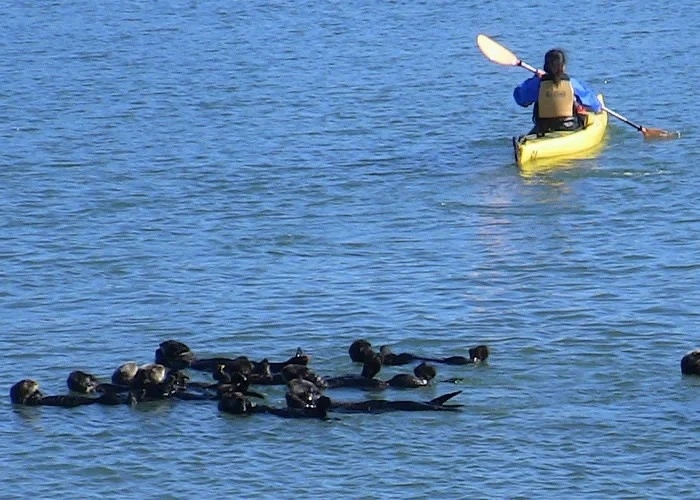
from Sea Otter Savvy
On the International Union for Conservation of Nature (IUCN) Red List sea otters are listed as Endangered. While populations have recovered in some areas, they still face threats including oil spills, pollution, diseases caused by human pets and habitat loss. On U.S. Federal List sea otters are Threatened; On the Convention on International Trade in Endangered Species (CITES) there are in Appendix I, which lists species that are the most endangered among CITES-listed animals and plants and Appendix II, which lists species not necessarily threatened with extinction now but that may become so unless trade is closely controlled. In Canada, sea otters are protected under the Species at Risk Act. [Source: Joe Allegra; Rhiannon Rath; Aren Gunderson, Animal Diversity Web (ADW) |=|]
U.S. and international law protects threatened sea otters. Hunted to the edge of extinction by fur traders in the 18th and 19th centuries, the few remaining sea otters (about 1,000 to 2,000 scattered in remnant colonies throughout the North Pacific rim) were first protected when the United States, Russia, Japan, and Great Britain reached an agreement in 1911 called the International Fur Seal Treaty, banning the hunting of fur-bearing sea mammals. In 1972, the U.S. Marine Mammal Protection Act offered further protection by banning capture and harassment of sea mammals. The Exxon Valdez oil spill of 1989 had a dramatic effect on the Alaskan sea otter population, killing approximately 5,000 individuals. [Source: U.S. Department of Interior, September 25, 2017]
According to the Otter Foundation, the California sea otter population declined from July 2008 to July 2011. Estimates suggest a California population of approximately 2700 individuals. Parasites and infectious disease contribute to sea otter mortality, specifically Toxoplasma gondii, which infects domestic cats, and Sarcosystis neurona, which infects opossums. It is postulated that cat and opossum feces travel to storm drains via runoff and disposal in toilets, eventually coming into contact with sea otters. In September 2006, Governor Arnold Schwarzenegger passed a law raising the maximum fine for harming a sea otter to $25,000, and required that all cat litter sold in California display a warning label that advises not to dump cat feces down storm drains or in toilets. |=|
RELATED ARTICLES:
SEA OTTERS: CHARACTERISTICS, BEHAVIOR AND REPRODUCTION factsanddetails.com
OTTERS: CHARACTERISTICS, BEHAVIOR, REPRODUCTION. ATTACKS factsanddetails.com ;
OTTER ATTACKS, CANNIBALISM AND INFANTICIDE factsanddetails.com ;
OTTERS IN ASIA: SPECIES, CHARACTERISTICS, BEHAVIOR AND REPRODUCTION factsanddetails.com
Sea Otters and Russian, Alaskan and Californian History
The sea otter is what drew early Russian explorers to eastern Siberia, the Bering Sea and Alaska. In the 19th century otters pelts were as valuable as sable and mink. The first Russian explorers were Cossacks, an ethnic group from the Black Sea known for their fierceness. The tsars also hired them as their elite front line soldiers." Cossacks were known for their fierceness and brutality. Some of the fur traders that moved into Russian America (Alaska) were so cruel they caused the local Aleuts to rebel. The uprising was brutally put down. One Russian leader, who was curious how many men he could kill with one shot, lined up a dozen Eskimos in a row, chest to back, and shot them with one musket ball. He killed nine.
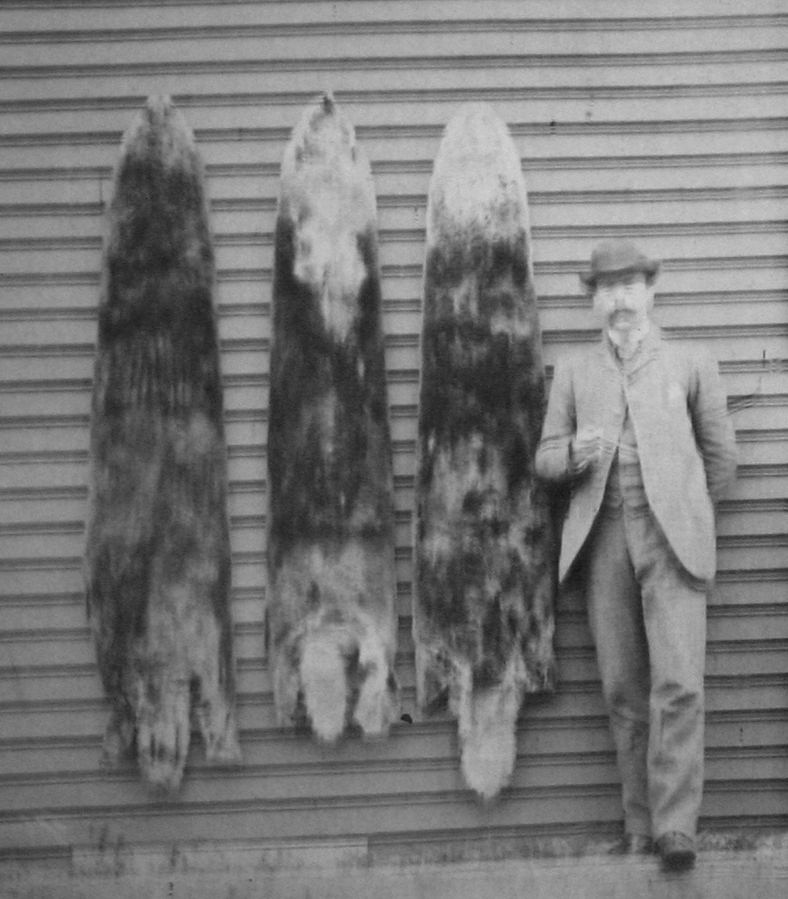
sea otter skins in Alaska in 1892
Russian fur traders heavily exploited sea otters in Alaska for their pelts, beginning in the mid-1700s. Russian explorers and traders, particularly those associated with the Shelikhov-Golikov Company (later the Russian-American Company), recognized the high value of sea otter pelts, which were considered "soft gold" in the fur trade. Native Aleut populations were often coerced into hunting sea otters for the Russians.
Sea otters was greatly coveted due to its extreme density and insulating quality. Pelts sold for as much as $1,125 each and were fashioned into hats, coats, and other garments sold in Russia, Canada, and the United States. As sea otter populations dwindled in some areas, the Russians expanded their hunting grounds further south, even reaching the coast of California. This led to a drastic decline in sea otter populations, almost to the point of extinction along the North American coast by the late 1800s. The intense hunting pressure, combined with habitat loss, resulted in a significant decrease in sea otter numbers. The sea otter fur trade in Alaska eventually declined due to the near extinction of the animals, the depletion of other resources, and changing economic conditions.
An international treaty banned otter and fur seal hunting in 1911. According to Smithsonian magazine: Californians believed that otters had disappeared from the coast until in 1938 a Big Sur rancher sighted a group of only about 50 animals. Since then, the California otter population has grown slowly, reaching some 2,700 in 2010. Researchers are concerned the rebound has lagged behind that of northern otters, which number in the tens of thousands off Washington, British Columbia and Alaska. [Source: Jess Righthand, Smithsonian magazine, September 2011]
Exercise Caution Around Sea Otters
Otters might look soft and cuddly but remember they are potentially dangerous wild animals. Otters have strong teeth and a powerful bite. So whether you see an otter on land or at sea, be sure to maintain a safe distance of at least 50 meters and never feed sea otters. [Source: U.S. Department of Interior, September 25, 2017]
“Sea otters are naturally wary of people, but some individuals exhibit aggressive tendencies that may be exacerbated by pregnancy, illegal feeding, or repeated exposure to close approaches by people,” Vanessa Morales, a spokeswoman for the U.S. Fish and Wildlife Service, told the Los Angeles Times. [Source: Susanne Rust, Los Angeles Times, May 29, 2024]
According to the U.S. Fish and Wildlife Service: 1) If an otter approaches: Stay calm and immediately move away. Do not try to photograph, touch, pet or feed the otter. 2) If the otter pursues you or somebody you are with: Wave your arms and get loud. Slap the water with your paddle, oar or hand. Try splashing water toward the otter. If you’re on a boat or board, bang on the vessel with a paddle or your hand.
3) If all none of that works and the otter persists or climbs aboard: Use a paddle or another object to block the otter, or push it off your craft. Morales noted that federal laws protect sea otters, and harassing or injuring a sea otter is illegal. However, a gentle nudge is considered acceptable if it was employed as a last-ditch effort to protect yourself and the otter from harm. She said you can also try to rock your kayak or board, making it an unstable platform. She said people should not attempt to move the otter with their hands, and by no means try to touch or pet the otter or pause to take pictures. As soon as the otter is off the vessel, leave.
4) If you are out with your dog and encounter an otter: Never allow your dog to chase, harass, play with or otherwise interact with an otter, she said. A dog can injure an otter, and an otter can injure or kill a dog. In addition, interactions can result in disease transmission that could harm the otter, your dog or you.
Surfboard-Stealing Otter 841
In 2023 and 2024 Santa Cruz, California was under assault by a sea otter that had a thing for surfboard. Susanne Rust wrote in the Los Angeles Times: Social media lighted up with the return of Santa Cruz’s most infamous sea mammal: the surfboard-stealing Otter 841. “841 is back in the 831 at Steamer Lane,” Mark Woodward posted on X. Steamer Lane is one of the seaside town’s most popular surfing sites, and 831 is the Santa Cruz area code. Woodward is a social media influencer known as Native Santa Cruz. Observers of the Santa Cruz Longboard Union Memorial Day contest captured photos and videos of an otter calmly cleaning herself atop a board she’d hijacked, which she shared peacefully with a gobsmacked surfer. Woodward said that although that critter was probably 841 — the behavior seemed entirely in line — he was unable to provide a 100% positive identification; he couldn’t see the hallmark blue tag affixed to her left flipper after being born in and then released from captivity.[Source: Susanne Rust, Los Angeles Times, May 29, 2024]
Otter 841 grabbed national attention last year as she chased surfers and their boards throughout the legendary surf spots hugging the California coast between Santa Cruz’s lighthouse and wharf. For months, federal officials tried to capture her, but she eluded their attempts. They finally gave up and urged surfers, swimmers and boaters to steer clear of the curious otter. Woodward said government agencies have reached out directly to him, pleading with him to tell his tens of thousands of followers on X, Instagram and Facebook to keep away from 841. For their safety, stay at least 50’ away from sea otters and all marine life, it’s the law and also common sense, so please help keep them safe,” he wrote on Facebook.
KSBW Action News reported: The Department of Fish and Wildlife has placed signs near beach access points at Cowell Beach warning of an aggressive otter. "This otter was born in captivity up at UC Santa Cruz. It was not bred in captivity, but its mother was in the wild and had to be re-captured. And when they captured the mother, she was pregnant," said Kevin Connor with the Monterey Bay Aquarium. Subsequently, the sea otter pup — tagged 841 — and its mother were taken to the aquarium to be examined and cared for. The pup was released in June 2020 after it was found to be healthy and old enough to survive in the wild. Connor says since 2021, one year after 841's release, there have been reports of a sea otter harassing kayakers and sea otters; both the aquarium and the Department of Fish and Wildlife believe all the incidents involve the same otter. [Source: Josh Copitch, KSBW Action News, July 20, 2023]
While 841 has reportedly been connected to surfer interactions for years it wasn't until June of 2023 that the pirate was caught on camera pirating surfboards. Police in Santa Cruz say 841 has had at least four encounters with surfers and is known to bite, scratch and get on top of surfboards. On June 18, Mark Woodward, @NativeSantaCruz on Twitter, posted photos and a video clip of 841 latching onto several surfboards and even stealing one for a quick joy ride. On June 26, video taken by Lori Pemberton shows the otter stealing an unattended surfboard. When the owner of the board attempts to get it back, 841 paws it, attempting to take the board into the deeper waters of the Monterey Bay. After about six minutes, five of which yakety sax should've accompanied, the surfer was able to reclaim their board.
According to Woodward, who has quickly become an ambassador of the moment to the national and international press, the otter also hung around surfboards on other occasions in the past month. Most recently, on July 9, the otter made its most brazen commandeering to date. As seen on video, 841 leaps onto a surfboard and becomes aggressive with the surfer. The end result? Several large bite marks and a surfer who tells KSBW 8 that he'll probably never surf again. On Saturday, July 15, Fish and Wildlife crews attempted to capture 841 by boat and with swimmers on surfboards. Photos taken by Mark Woodward show crews coming face to face with the otter but unable to snag it.
According to the Los Angeles Times: It is unclear what drives 841’s surfboard-aggressive behavior. Biologists noted that her mom had exhibited similar behaviors, suggesting that 841 either learned from her mother, inherited those tendencies or maybe a little of both. Her mother had been fed in the wild by people, which may have led to her comfort around humans — as well as her curiosity. Wildlife officials say it is dangerous to feed wild animals not only because of concerns about physical contact, but it also can create this kind of behavior — which ultimately endangers the animal.
Morgan, the Seal-Pup- Shagging Sea Otter
David L. Beck wrote in the Mercury News: “Morgan, the sexually predatory killer sea otter, is back in custody. And there, at least for now, he will remain. In solitary. Accused of horrific deeds against nature, Morgan was wanted by authorities for months. But this tale of an orphaned otter gone bad — an otter once thought to have so much promise — begins in childhood. Morgan was rescued as a baby in September 1995 and placed in the Monterey Bay Aquarium's Sea Otter Research and Conservation program, which prepares orphans for a life on their own once they return to the sea. Morgan, now about six years old, was one of the program's success stories. [Source: David L. Beck Mercury News, April 21, 2001]
A Discovery Channel piece noted his progress: “Two-week-old Morgan bonded with a caretaker and swam during his entire stay at the aquarium,'' reads a Discovery Web site. Released into the wild at the age of seven months, “he's been out, without a problem, for two years.'' But then something went terribly wrong. “We saw him with dead seals,'' said aquarium spokesman Ken Peterson, noting he knew it was Morgan because he still wore his flipper tag. “Later we saw him with live seals who wound up dying in his care.'' Morgan is, to put it in human terms, a sociopathic oversexed adolescent, still too young to compete for mature females but not too young to feel the need. “It's been seen before, in sea otters and other animals, this inclination to kind of take your opportunities where you can,'' said Andrew Johnson, who manages the sea otter program. “And sometimes it might be with a different species, or it might be with a dead animal of your own species.... Trying to get experience.''
After his release nearly five years ago, Morgan would pay a call at the aquarium now and then, “spend the night in the Great Tide Pool. We'd see him up on Cannery Row,'' said Johnson. “But not recently.'' Last spring, during seal pupping season, he began to be seen chasing young seals and then attempting to mate with them. “We were hoping he'd outgrow it,'' Johnson said. Instead, Morgan continued to prey on yearling seals. “We're still sort of mystified that he has the capacity to subdue these animals,'' Johnson said. “They're at least as big as he is; they can hold their breath longer; they can bite and scratch. But at a certain point he gets the total upper hand.''
Morgan weighs about 65 pounds. Young seals weigh “15 to 20 pounds and up,'' he said. Morgan is not the only predatory otter in the sea. “We definitely confirmed that there was another animal with dead harbor seals on a number of occasions,'' said Johnson, although he declined to use the term “copycat.'' But that one either stopped or moved on. There have been no further sightings since late last year. As for Morgan? “Morgan had ahold of a seal the day we caught him.'' Johnson said his staff wasn't sure how many victims Morgan has claimed. There are “seven or eight we're almost completely sure of,'' but the toll could be as high as 20. With the seal pupping season here again, “we made a decision to step in'' with the approval of the state Fish and Wildlife Department. The aquarium team knew where to look for Morgan. “He was fairly predictable in the areas he tended to inhabit in red deerhorn Slough'' — foraging in the main channel at slack tide, taking it easy in the back channels during riptides. They finally snared him two weeks ago. “As many sort-of-jokes as have been made about this situation, we've always tried to take it very seriously,'' Johnson said. “Animals' lives are at stake. His future's at stake, too.'' Morgan's tale has multiple possible endings.
At one time, Fish & Wildlife officials intended to release him somewhere far away from harbor seal pupping beaches. But when his pattern of depredation continued, it became unlikely the repeat offender would be returned to the wild. Nor can he be put in with young animals at the Monterey Bay Aquarium. But he needs some kind of stimulation, said Johnson. Quarantine, where he is now, is not a long-term option. He could be sent to another institution, if one can be found. Or he could be kept in for what Peterson called “minimally invasive research projects,'' involving, say, a surgically implanted radio transmitter in the belly. Worst case? Euthanasia. But “at this point,'' said Johnson, “that seems remote.''
Are Housecats Litter Killing California’s Sea Otters?
A feline parasite — Toxoplasma parasite — has been directly linked to the death of three percent of California’s wild sea otters. They’re catching it from feral and pet cats and, it is thought, mainly from kitty litter that finds its way into California seas. Francie Diep wrote in the New York Times: For a sea otter, a bad infection with the Toxoplasma parasite may feel a bit like drowning. “The brain is no longer able to function and tell the body how to swim,” said Dr. Karen Shapiro, a veterinarian and pathologist at the University of California, Davis. The parasite, Toxoplasma gondii, enters the otter orally and makes its way to the brain, where it can cause swelling, weakness, seizures, disorientation and death. If the parasite doesn’t kill the otter directly, it can render it more likely to be hit by a boat or eaten by a shark. Among California sea otters, a protected species whose numbers are closely monitored, Toxoplasma infections contribute to the deaths of eight percent of otters that are found dead, and is the primary cause of death in three percent. [Source: Francie Diep, New York Times, August 28, 2019]
Scientists have been working to determine where the Toxoplasma comes from and how to keep it from striking sea otters. They have long viewed one potential culprit with suspicion, and a study published in August 2019 identified the offender definitively: house cats. “This is the ultimate proof that strains that are killing sea otters are coming from domestic cats,” said Dr. Shapiro, a lead author of the study.
The Toxoplasma parasite, a single-celled organism, is able to infect a wide variety of warm-blooded animals, but it needs to colonize cats, either wild or domestic, to reproduce sexually. Once infected, a cat can shed millions of Toxoplasma in its feces, which can contaminate the soil and water if the animal relieves itself outdoors. Toxoplasma gondii is the reason doctors recommend that certain pregnant women avoid litter-box duty. The parasite can harm fetuses and anyone with a compromised immune system, although most people fight off Toxoplasma with few or no symptoms.
Toxoplasma can also kill marine mammals, as scientists who study them have long been aware. It has felled not just sea otters but also dolphins and endangered monk seals in Hawaii. Studies over the past two decades established that rain can wash Toxoplasma from land to sea, where the parasite accumulates in the kelp forests that otters love.
Although Toxoplasma may be best known as a feline parasite, researchers have hesitated to blame domesticated cats for the deaths of sea otters. Even as they issued warnings to keep pet cats indoors, there remained the possibility that wild cats, such as California’s bobcats or mountain lions, could be responsible. But the new study, which analyzed the DNA from 135 sea otters with Toxoplasma infections that died between 1998 and 2015, largely quashes that hypothesis. Dr. Shapiro and her team found that the 12 deadliest otter infections were a perfect genetic match to parasites gathered from feral cats, and a bobcat, living in the hills around the bay where the otters died. “What they’ve done, which hasn’t so far been done anywhere else, is found both ends of that chain,” said Dr. Wendi Roe, a veterinary pathologist at Massey University in New Zealand, who was not involved in Dr. Shapiro’s study. “Here’s the genotype that is more severe in sea otters, and here it is in this host in proximity to the location that they’re finding those sea otters.”
Not all sea otters that catch Toxoplasma die of it, Dr. Shapiro found. Most of the 135 otters examined by her team showed no evidence of brain damage, an indication that the parasite had not contributed to their deaths. Twelve deaths were determined to have been caused primarily by toxoplasmosis, and all of those otters succumbed to an unusual strain of the parasite, called Type X. Type X is more common among wild cats than domestic ones, which tend to become infected with Type II, a strain of Toxoplasma that isn’t as deadly to otters. But there are far more domestic cats in the United States than wild ones, leading scientists to think that most of the Toxoplasma in the ocean, including Type X, comes from house cats.
Image Sources: Wikimedia Commons
Text Sources: Animal Diversity Web animaldiversity.org ; National Geographic, Live Science, Natural History magazine, David Attenborough books, New York Times, Washington Post, Los Angeles Times, Smithsonian magazine, Discover magazine, The New Yorker, Time, BBC, CNN, Reuters, Associated Press, AFP, Lonely Planet Guides, Wikipedia, The Guardian, Top Secret Animal Attack Files website and various books and other publications.
Last updated June 2025