
Home | Category: Scuba Diving and Snorkeling
SCUBA DIVING
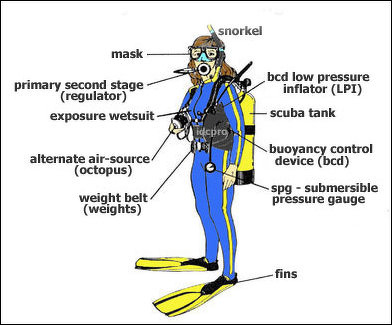
basic scuba gear
Scuba diving is a means of underwater diving in which individual use breathing equipment that is completely independent of a surface air supply. "SCUBA" stands for "Self-Contained Underwater Breathing Apparatus". The term was coined by Christian J. Lambertsen in a patent submitted in 1952. Scuba divers carry their own source of breathing gas, usually compressed air. This gives divers greater independence and movement over divers who use air supplied from the surface by a hose — the way people stayed underwater before scuba was invented. [Source: Wikipedia]
Divers have deal with a lack of air. People typically pass out after holding their breath for two minutes or being underwater for that time. They may also black out below 20 meters (66 feet) without equipment. With training people can hold their breath nearly 11 minutes. The best free divers have reached depths below 100 meters (330 feet).
Divers also have deal with pressure and the effects of a lack of air and pressure combined. As one descends, water exerts increasing hydrostatic pressure of approximately 1 bar (14.7 pounds per square inch) for every 10 meter (33 feet) of depth. The pressure of the inhaled breath must balance the surrounding or ambient pressure to allow controlled inflation of the lungs. It becomes virtually impossible to breathe air at normal atmospheric pressure through a tube below three feet under the water.
Divers can use compressed air or a gas blend with a higher oxygen content, known as enriched air or nitrox, which reduces nitrogen intake during long or repetitive dives. Breathing gas diluted with helium can reduce the chance of getting nitrogen narcosis (a dangerous condition caused by too much nitrogen in the brain) and minimize its effects during deeper dives.
Scuba diving may be done recreationally or professionally with number of commercial, industrial, scientific, military and public safety applications. Military divers have traditionally been called frogmen. Deep-saturation divers who work on undersea oil rigs and undersea cables and the like engage in one world’s most dangerous jobs. Normal “open circuit” diving discharge the breathing gas into the environment as it is exhaled Closed-circuit or semi-closed circuit rebreather scuba systems recycles exhaled gases. Rebreathers extend the time spent underwater compared to open circuit for the same gas consumption and produce fewer bubbles and less noise than open circuit scuba
Websites and Resources: PADI International 30151 Tomas, Rancho Santa Margarita, CA 92688 USA, Phone: +1 949 858 7234, US and Canada: 1 800 729 7234; website padi.com ; Scuba Diving International (SDI) tdisdi.com ; National Oceanic and Atmospheric Administration (NOAA) noaa.gov; Fishbase fishbase.se; Smithsonian Oceans Portal ocean.si.edu/ocean-life-ecosystems ; Monterey Bay Aquarium montereybayaquarium.org ;
Recreational Diving

the octopus — basic breathing gear and equipment attached to the tank
Recreational diving can be done from the shore or a boat. It typically costs US$100 to US$200 a day for two tank dive, $75 to $120 for a one tank dive, includes lunch and the boat trip to the site. Snorkeling tours $25 to $40. Most people stay in a hotel and go out diving during the day. Live-aboard diving refers to diving from a boat on which an individual is living, sleeping and eating.
Many divers dive at coral reefs. Ideal conditions include calm, clear water with temperatures around 27ºC (80̊F) and visibility of 100 meters (330 feet). Under less than perfect conditions but still okay the water is maybe colder and murkier, with a visibility of 10 to 15 meters (33 to 50 feet). Hard and soft corals, a variety of reef fish, sponges, sea urchins and sea anemones are seen. Common sights include sea turtles, sharks, barracuda, lion fish, moray eels, and giant clams (in the Indo-Pacific). Divers seek out manta rays, sperm whales, humpback whales, dolphins, giant cuttlefish, schools of sharks, whale sharks, spawning schools of reef fish. Rare encounters occur with marlins, sailfish and orcas.
Shallow reefs that are ideal for snorkeling are among the most diverse ecosystems on Earth but also the most vulnerable, Coral bleaching often occurs here. Wet suits not only protects against cold they prevent sunburn and provide protection from reef nasties such as sharp coral, sea urchin spines and toxic fish. Accidental abrasions can be particularly nasty in warm water where stubborn infections can occur.
Scuba Diving Equipment
Most scuba divers moves underwater by using fins attached to their feet, but external propulsion can be provided by a diver propulsion vehicle, or a sled pulled from the surface. Other necessary equipment for scuba includes 1) a mask to improve underwater vision, 2) a diving suit for protection from cold water and scrapes, 3) ballast weights to overcome excess buoyancy, 4) equipment to control buoyancy, usually a life-jacket like vest called a by buoyancy compensator (BC); 5) the air tanks (diving cylinders); and 6) a regulator, a devise between the air tanks and the diver that ensure the diver can inhale and exhale naturally and without excessive effort. Among the other pieces of equipment carried by a diver are a snorkel, a cutting tool to manage entanglement and different kinds of devices such as a a dive computer that provide information about depth, how much air is left and location. [Source: Wikipedia]
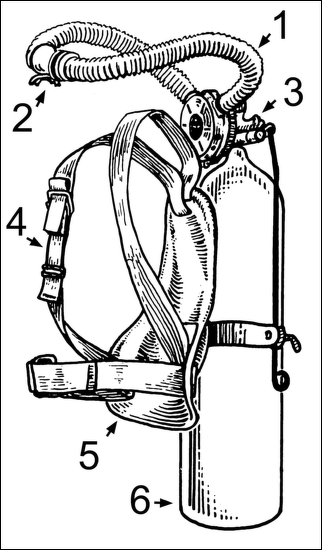
old-fashioned Aqualung scuba set: 1. Breathing hose 2. Mouthpiece 3. Cylinder valve and regulator 4. Harness 5. Backplate 6. Cylinder
Most recreational scuba diving is done using a half mask which covers the diver's eyes and nose, and a mouthpiece to supply the breathing gas. Inhaling from a regulator's mouthpiece becomes second nature very quickly. Some divers wear a full face mask which covers the eyes, nose and mouth, and often allows the diver to breathe through the nose. Professional scuba divers are more likely to use full face masks, which protect the diver's airway if the diver loses consciousness.
The breathing gas is usually provided from a high-pressure diving cylinder through a scuba regulator, which provides the breathing gas at ambient pressure and ensure the diver can inhale and exhale naturally and without excessive effort, regardless of depth. The most commonly used scuba set uses a "single-hose" open circuit two-stage demand regulator, connected to a single back-mounted high-pressure gas cylinder, with the first stage connected to the cylinder valve and the second stage at the mouthpiece.
In the "single-hose" two-stage design, the first stage regulator reduces the cylinder pressure of up to about 300 bars (4,400 psi) to an intermediate pressure (IP) of about 8 to 10 bars (120 to 150 psi) above ambient pressure. The second stage demand valve regulator, supplied by a low-pressure hose from the first stage, delivers the breathing gas at ambient pressure to the diver's mouth. The first stage typically has at least one outlet port delivering gas at full tank pressure which is connected to the diver's submersible pressure gauge or dive computer, to show how much breathing gas remains in the cylinder.
Scuba Diving Buoyancy Control
To dive safely, divers must control their rate of descent and ascent in the water and be able to maintain a constant depth in midwater — with divers’ overall buoyancy determining whether they ascends or descend. Equipment to achieve these ends are: 1) diving weighting systems (a weight belt), which makes a diver desend; 2) diving suits (wet, dry or semi-dry suits, depending on the water temperature), which make divers more buoyant; and 3) buoyancy compensators (Bcs), which are used to adjust the overall buoyancy. Divers want to remain at constant depth, they try to achieve neutral buoyancy. This minimises the effort of swimming to maintain depth, thus reducing gas consumption.
A buoyancy compensator is an important piece of scuba-diving equipment. It is an an inflatable vest used to control one's buoyancy underwater and float at the surface. It usually has a connecting hose for inflation or deflation by mouth or breathing gas cylinder (air tank) and often has a CO2 cartridge for rapid, emergency inflation. The buoyancy is usually controlled by adjusting the volume of gas in an inflatable bladder, which is filled with air from the diver's primary breathing gas cylinder via a low-pressure hose from the regulator first stage, directly from a small cylinder dedicated to this purpose, or from the diver's mouth through the oral inflation valve. A BC is is often combined with a jacket that holds the gas cylinders.

buoyancy compensator
The buoyancy of any object immersed in water is also affected by the density of the water. The density of fresh water is about 3 percent less than that of ocean water. Diving suits made of compressible materials decrease in volume as the diver descends, and expand again as the diver ascends, causing buoyancy changes. Diving in different environments also necessitates adjustments in the amount of weight carried to achieve neutral buoyancy. The diver can inject air into dry suits to counteract the compression effect and squeeze. Buoyancy compensators allow easy and fine adjustments in the diver's overall volume and therefore buoyancy.
Neutral buoyancy in a diver is an unstable state. It is changed by small differences in ambient pressure caused by a change in depth, and the change has a positive feedback effect. A small descent will increase the pressure, which will compress the gas-filled spaces and reduce the total volume of diver and equipment. This will further reduce the buoyancy, and unless counteracted, will result in sinking more rapidly. The equivalent effect applies to a small ascent, which will trigger an increased buoyancy and will result in an accelerated ascent unless counteracted. The diver must continuously adjust buoyancy or depth in order to remain neutral.
Minimising the volume of gas required in the buoyancy compensator will minimise the buoyancy fluctuations with changes in depth. This can be achieved by accurate selection of ballast weight, which should be the minimum to allow neutral buoyancy with depleted gas supplies at the end of the dive unless there is an operational requirement for greater negative buoyancy during the dive.
The ability to ascend at a controlled rate and remain at a constant depth is important for correct decompression. Recreational divers who do not incur decompression obligations can get away with imperfect buoyancy control, but when long decompression stops at specific depths are required, the risk of decompression sickness is increased by depth variations while at a stop.
Decompression stops are typically done when the breathing gas in the cylinders has been largely used up, and the reduction in weight of the cylinders increases the buoyancy of the diver. Enough weight must be carried to allow the diver to decompress at the end of the dive with nearly empty cylinders.
Underwater Vision and Pressure Equalization
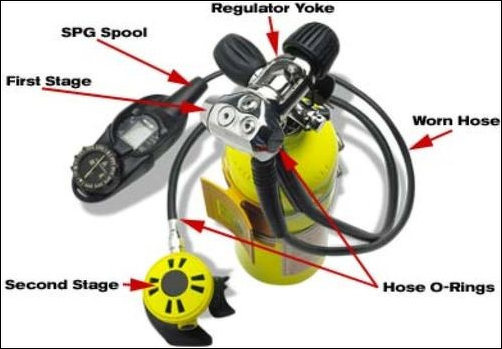
more modern set up
Water has a higher refractive index than air – similar to that of the cornea of the eye. Light entering the cornea from water is hardly refracted at all, leaving only the eye's crystalline lens to focus light. This leads to very severe hypermetropia. People with severe myopia, therefore, can see better underwater without a mask than normal-sighted people. Diving masks and helmets solve this problem by providing an air space in front of the diver's eyes. [Source: Wikipedia]
Divers who need corrective lenses (glasses) to see clearly outside the water normally need the same prescription while wearing a mask. Generic corrective lenses are available off the shelf for some two-window masks, and custom lenses can be bonded onto masks that have a single front window or two windows.
As divers descend, they must periodically exhale through their nose to equalise the internal pressure of the mask with that of the surrounding water. Swimming goggles are not suitable for diving because they only cover the eyes and thus do not allow for equalisation. Failure to equalize the pressure inside the mask may lead to a form of barotrauma known as mask squeeze.
Masks tend to fog when warm humid exhaled air condenses on the cold inside of the faceplate. To prevent fogging many divers spit into the dry mask before use, spread the saliva over the inside of the glass and rinse it out with a little water. The saliva residue allows condensation to wet the glass and form a continuous wet film, rather than tiny droplets. There are several commercial products that can be used as an alternative to saliva, some of which are more effective and last longer, but there is a risk of getting the anti-fog agent in the eyes.
Standard Scuba Diving Procedures
Some procedures are common to almost all scuba dives. These include entering and getting out of the water properly, having a buddy and staying in contact with other divers and the boat, and descending and ascending in a calm, controlled manner. Equalization of pressure in gas spaces to avoid barotrauma (physical damage to body tissues caused by differences in pressure between the body and the water). The lungs are susceptible to over-expansion and subsequent collapse if divers holds their breath while ascending. During training divers are taught not to hold their breath while diving. Ear clearing is another critical equalisation procedure, usually requiring conscious intervention by the diver.
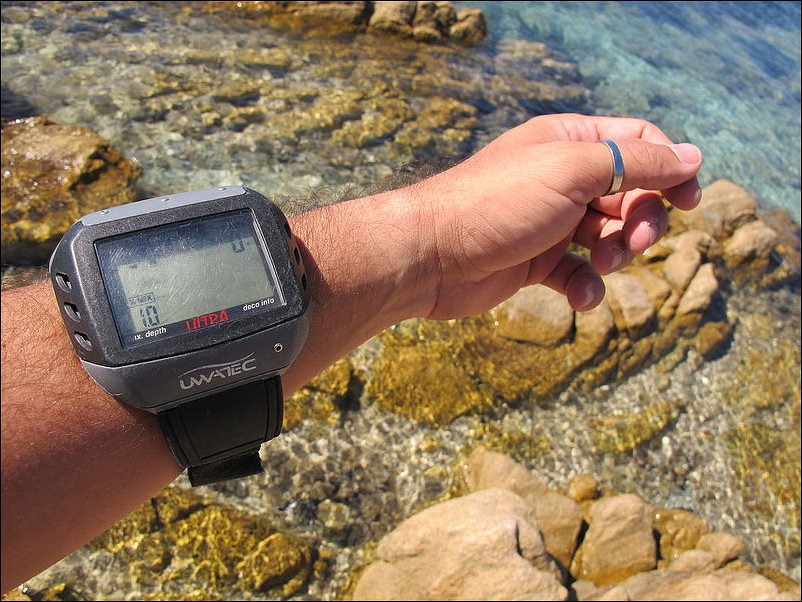
scuba diver computer
Mask and regulator clearing may be needed to ensure the ability to see and breathe in case of flooding. This can easily happen, and while immediate correct response is necessary, the procedure is simple and routine and is not considered an emergency. Buoyancy control and diver trim require frequent adjustment (particularly during depth changes) to ensure safe, effective, and convenient underwater mobility during the dive. Buddy checks, breathing gas monitoring, and decompression status monitoring are carried out to ensure that the dive plan is followed and that members of the group are safe and available to help each other in an emergency.
Post-dive procedures include equipment maintenance, to ensure that the equipment is good order for the next people who use it, and recording the dive in a logbook. The latter is mainly done in order to calculate residual inert gas levels if a diver is planning to two or more dives in one day and to record conditions if one plans to a similar dive in the future. Also, in order to achieve a level of certification and be allowed to go on certain kinds of dives, a diver may be required to present evidence of a specified number of logged and verified dives, sometimes of a ceratin type.
Scuba Certification
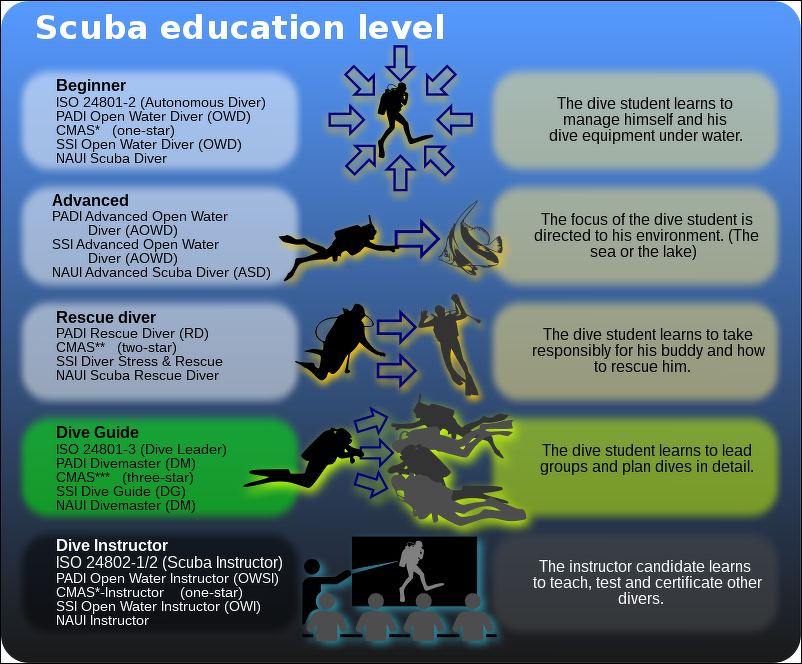
To engage in scuba diving one has to be certified. PADI (Professional Association of Diving Instructors) is the largest certifying organization. It has more than 10,000 affiliated dive center, resorts and individual instructors worldwide. There are PADI-member dive outfitters at nearly all places where people go diving. They generally offer air filing, gear rentals, instruction and transportation to the diving areas. Snorkeling is usually offered on the same boat trips that take scuba divers out but snorkelers often see a lot less — and pay less. For more information about diving instruction contact PADI International 30151 Tomas, Rancho Santa Margarita, CA 92688 USA, Phone: +1 949 858 7234, US and Canada: 1 800 729 7234; website padi.com
PADI’s Open Water Diver course is the world’s most popular and widely-recognized scuba diving certification. You can become a certified diver in as little as four days, or over the course of a year. Once certified you can: 1) Scuba dive with a partner (without supervision); 2) Rent or purchase scuba diving gear; 3) Book excursions with dive boats and resorts; 4) Get air fills at local dive shops. [Source: Megan Denny and Alina Myers, PADI, January 10, 2023]

dive computer and pressure gauge
Getting your Open Water scuba diving certificate can cost anywhere from $150 to $600 depending on how you go about deciding to complete your course. The average cost is about $250 to $300 per student. The course requires both knowledge development and in-water training for certification. You you purchase a PADI eLearning course from the PADI website, which covers the knowledge development portion only. There can be additional costs to complete your certification with a PADI Instructor depending on class size, location, and whether or not you need to rent equipment.
Most dive shops require students to provide their own mask, fins and snorkel. Basic scuba gear, including a regulator, buoyancy control device (BCD), dive computer and cylinder, may or may not be included with the inwater training cost. You may also need to buy or rent a wetsuit or drysuit depending on the diving environment. If you see an advertised price that’s drastically lower than all the others, ask what it includes. Some dive shops include everything for one price, while others charge separately for in-water training, online course tuition, scuba equipment, etc. If you already own a mask, snorkel and/or fins, we recommend bringing them to your instructor before your first pool session. Some snorkeling masks and fins are inadequate for scuba diving.
Tips from the Pros: 1) Fitting an Open Water Diver course into a short vacation can be a lot of pressure. If a relaxed, go-at-your-own-pace learning environment is important to you, choose online learning and start your in-water training at a local dive shop. It will prevent you from feeling time-pressured during your trip. 2) If trying something new in a large group makes you uncomfortable, consider a private or semi-private class.
PADI’s Open Water Diver Course
You must be at least 10 years old, able to swim, and in good physical health to enroll in a scuba diving course. In some countries, you may be required to attend a medical with a physician (your PADI Dive Centre will advise you if this is the case). If you meet these qualifications, the first thing you’ll do is learn scuba diving fundamentals during phase one, ‘Knowledge Development’. [Source: Megan Denny and Alina Myers, PADI, January 10, 2023]
According to PADI: During knowledge development, you’ll learn all about scuba equipment, familiarize yourself with scuba terminology, and watch videos of diving skills. It is self-study, so you control the time it takes for you to comfortably go through the material. Most people pace themselves and complete their knowledge development over a few weeks but it can be completed in a matter of days. The most popular choice for knowledge development is PADI eLearning, an independent study option where you read, watch videos, and take quizzes using your computer or mobile device. Complete your scuba studies whenever, wherever it’s convenient. On average, the program requires eight hours to complete. At the end of knowledge development, you’ll take a final exam to ensure you have a thorough understanding of scuba diving essentials. Your PADI Instructor will answer any questions you may have along the way.
According to Aussie Divers in Phuket: Your PADI Open Water Course will begin with some online theory that you can pre-study in your own time. It is best to have 100 percent of the theory completed prior to the first day of training. The PADI Open Water course online theory component is divided into five chapters. Each chapter consists of some videos, knowledge review questions, and a quick review quiz. Studying in your own time this can take anywhere from 4-6 hours, and having this completed will save you several hours on day 1 of the course. If all of the online theory is completed then on the first day you will review this theory with your PADI instructor. The instructor will assess your knowledge reviews, do 4 quick quizzes, and a final exam with you prior to heading to the pool for the practical skills. [Source: Aussie Divers in Phuket]
Confined Water Dives
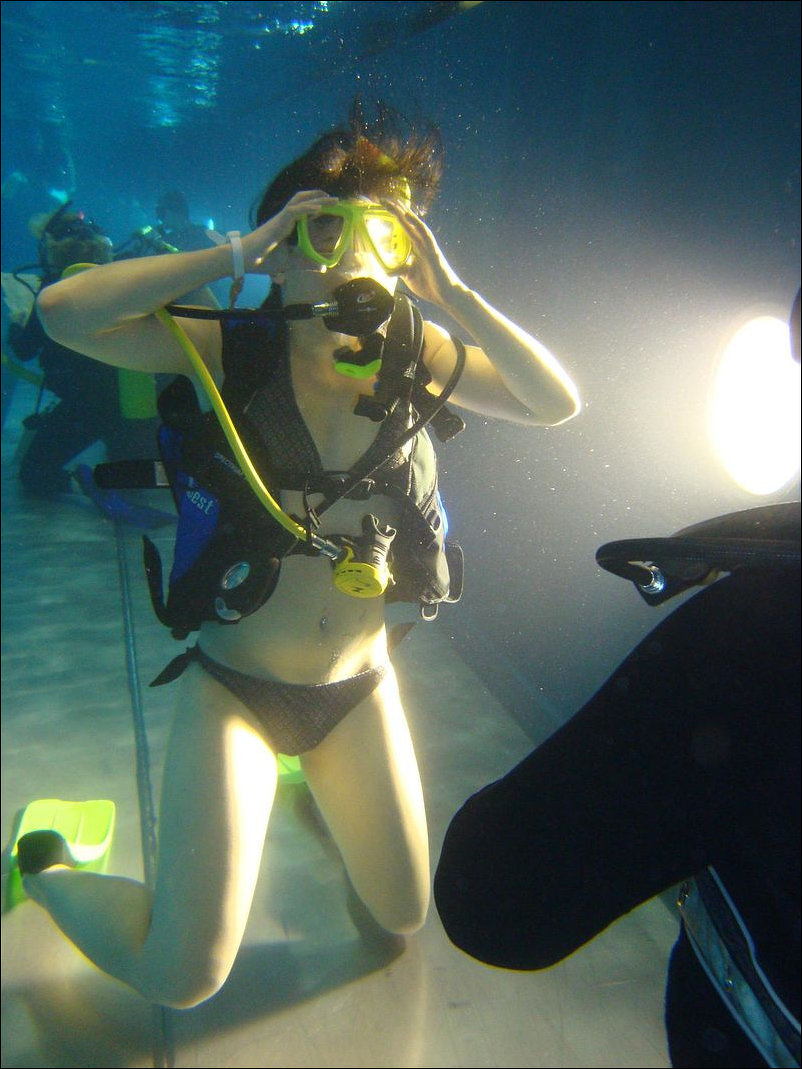
scuba lesson in a pool
During phase 2, you’ll take your first breath underwater in a calm environment such as a swimming pool or tranquil lagoon (known as “confined water”). You’ll practice basic diving skills such as clearing water from your mask, ascending and descending. Your instructor will demonstrate and review the skills with you until you’re comfortable performing them on your own. [Source: Megan Denny and Alina Myers, PADI, January 10, 2023]
According to Aussie Divers in Phuket: At the pool firstly you will complete your 200-meter swim and tread water for 10 minutes these are two skills required by PADI for your PADI Open Water certification. Then you will learn how to set up your scuba diving equipment, you will do this at least five times throughout the session. You will enter the pool for your five confined water dives. [Source: Aussie Divers in Phuket]
Your PADI instructor will teach you and have you demonstrate the in-water skills that you need to complete to move on to open water/ocean dives. The confined water section will take approximately 3 – 6 hours, depending on how quickly you pickup the skills.
The first day of the PADI Open Water course here at the Aussie Divers Phuket training center could be completed anywhere between 4 pm – 7 pm. This really depends on how much self-study you complete before the first day.
Open Water Dives
Phase 3, the final stage, is the open water dives. You’ll learn to dive by diving to a maximum depth of 18 metres (60 feet). The open water course includes four open water dives in total, usually done over two days. With your instructor by your side, you’ll practice the skills you learned in confined water, and explore the underwater world. Many student divers complete their dives close to home, in the ocean, local lake, quarry, or other body of water. You can also complete your four “check out dives” on a tropical holiday. After completing four open water dives and all course requirements, you become a certified diver – a title that will last a lifetime and you can now dive anywhere. [Source: Megan Denny and Alina Myers, PADI, January 10, 2023]
On what’s involved if you do your scuba certification course water dives in a resort area, Aussie Divers in Phuket reports: For the open water dives you will board your dive boat for the day. All the boats are specifically designed scuba diving boats and hold between 30 – 60 people when full. After setting your scuba diving equipment up you will be served breakfast while being given a dive briefing by your PADI Instructor. Your PADI instructor will explain to you what skills you will need to perform, the expected scuba diving conditions and the site and what you will likely to encounter under the water. [Source: Aussie Divers in Phuket]
In most cases your PADI Open Water Course for the first day open water scuba diving will begin at a beginner dive site that has the best local visibility, nice sandy bottoms, is well protected for the weather and is also often protected from strong currents. You will enter the water from the boat using what PADI call a deep water entry or giant stride. When you float initially and then you will swim on the surface to shallower water where you maybe demonstrate some surface skills for your PADI instructor. You will then descend into shallow water either by a buoy line or water deep enough to stand up in. Your first underwater scuba dive is free of underwater skills so hopefully you will have between 30 and 50 minutes to take in the amazing world that is scuba diving.
At the completion of the dive you will board the boat and head for a new dive site. Your PADI Instructor will then brief you on the new dive site and prepare you for the underwater skills of your second dive. During this dive you will have several skills to perform, these are some of the same skills that you practiced the day before in the confined water of the pool. Once the skills are completed you will be able to explore the underwater world some more. The first days diving you are limited to the depth of 12 metres. At the end of this day you should be back at your hotel between 5:30 – 6:30pm.
The second day of open water scuba diving will almost mirror the first however your most likely dive sites this day will be Phi Phi and Shark Point. This day you will be able to experience a bit deeper water and may head to the depth of 18 metres. There are less skills to perform on this day and you will have more free to explore the amazing underwater world. If we are able to get to the best dive sites at Phi Phi you will be blown away by the amount of marine life to be enjoyed at this world famous dive site. For this day you should return to your hotel somewhere between 6:30 -7:30pm. At the completion you will be a certified PADI Open Water diver and be licensed to scuba dive to the depth of 18 metres.
Ocean Etiquette
Marine Wildlife Viewing Guidelines: 1) Learn before you go. Read about the wildlife, viewing sites, and local regulations to get the most from your wildlife viewing experience.
2) Keep your distance. Use binoculars, spotting scopes, and cameras with zoom lenses to get a closer look.
3) Hands off. Never touch, handle, or ride marine wildlife. Touching wildlife, or attempting to do so, can injure the animal, put you at risk, and may also be illegal for certain species.
4) Do not feed or attract wildlife. Feeding or attempting to attract wildlife with food, decoys, sound, or light disrupts normal feeding cycles, may cause sickness or death from unnatural or contaminated food items, and habituates animals to people. [Source: NOAA]
5) Never chase or harass wildlife. Never completely surround the animal, trap an animal between a vessel and shore, block its escape route, or come between mother and young.
6) Stay away from wildlife that appears abandoned or sick. Some marine animals, such as seals, leave the water or are exposed at low tide as part of their natural life cycle — there may be nothing wrong with them. If you think an animal is in trouble, contact local authorities for advice or report it to the NOAA Fisheries stranding network.
Reef Tips for Divers, Snorkelers and Swimmers: 1) Maintain natural buoyancy to avoid knocking or brushing against coral and marine life.
2) Coral is alive and easily damaged. Avoid touching, grabbing or standing on coral.
3) Please watch your fin wash. Sand can injure or smother small creatures and coral.
4) The underside of rocks are home to small creatures that can not live anywhere else. Please leave rocks, shells and coral in place for the reef dwellers who need them.
5) Killing, damaging, riding or chasing are examples of poor diver behavior.
6) Trash can kill marine life. Please collect any trash you see on the beaches or in the water.
7) Feeding fish can make them pests, and some may even aggressive toward divers.
8) Use a permanent mooring buoy to secure your boat instead of dropping an anchor.
9) Do not collect live shells.
Image Sources: Wikimedia Commons, NOAA
Text Sources: National Oceanic and Atmospheric Administration (NOAA) noaa.gov; Wikipedia, PADI, Quora.com, National Geographic, Live Science, BBC, Smithsonian, New York Times, Washington Post, Los Angeles Times, Reuters, Associated Press, Lonely Planet Guides and various books and other publications.
Last Updated June 2023