
Home | Category: Dugongs, Manatees and Sea Otters
MANATEES
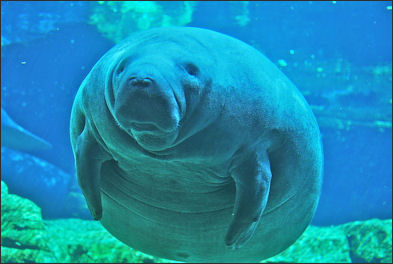
Manatee Manatees (Scientific name: Trichechus) are large aquatic mammals. What makes them unique compared to other sea mammals is that are herbivores. Whales, dolphin and seals are all carnivores. Manatees live in freshwater. They are closely related to dugongs who live in saltwater. Both are are slow-moving, gentle giants that consume large amounts of aquatic vegetation. They are said to be the source of legends about mermaids.
Manatees form the genus Trichechus. There three currently living species in the order Sirenia: 1) West Indian manatee (Trichechus manatus), 2) Amazonian manatee (Trichechus inunguis), and West African manatee (Trichechus senegalensis). A fourth extinct species (Trichechus hesperamazonicus) was described in 2020. [Source: An-Ping Yu, Animal Diversity Web (ADW) /=]
Manatees in the wild are able to live for over 60 years. Their long lifespans could be due to the minimal predation risk. A captive manatee has been able to live for over 45 years. Limits to lifespan can be attributed to common natural causes such as cold stress, pneumonia, or gastrointestinal diseases. Human-related activities have become a threat to manatee longevity. Human-related manatee mortality incidents are largely due to watercraft collisions.
Websites and Resources: Animal Diversity Web (ADW) animaldiversity.org; National Oceanic and Atmospheric Administration (NOAA) noaa.gov; Fishbase fishbase.se; Encyclopedia of Life eol.org; Smithsonian Oceans Portal ocean.si.edu/ocean-life-ecosystems ; Monterey Bay Aquarium montereybayaquarium.org ; MarineBio marinebio.org/oceans/creatures
Sirenia and Dugong and Manatee Species
Dugongs and manatees belong to an order call Sirenia. Sirenians get their name from the Spanish word for sirens (“sirenas”, after the Sirens with seductive songs from Homer’s “Odyssey”). They are distant relatives of elephants. They have mammary glands which some have said are like human breasts and nurse their young like humans. Another sirenian, the Stellar's sea cow, was hunted to extinction in the Bering Sea area. It was 8 meters (25 feet) long and weighed 2,700 kilograms (6,000 pounds). It was discovered in 1731 and was extinct by 1768.
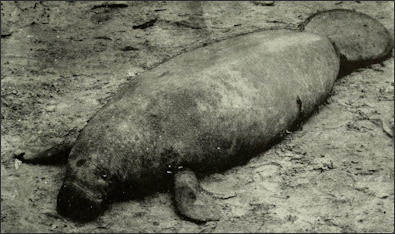
West African manatee Dugongs and manatees were among the first mammals to take to the water. Fossils of dugong-like creatures with hind legs have been dated to 50 million years ago, a time when mammals were beginning to spread out after the age of the dinosaurs. Dugongs and manatees are believed to be distant relatives of elephants. Some species have useless toenails at the ends of their flippers and elephant-like molars. Fossil manatees show gradual reduction of their hind limbs.
Manatees are found primarily in freshwater. They are found in the Amazon, rivers and swamps in Florida, and some African rivers. In the West Indies and Central America they can be found in estuaries, swamps and coastal areas. Dugongs live in marine environments in coastal areas in the southwest Pacific and Indian Ocean in an area that stretches from Red Sea and Persian Gulf in the west through Sri Lanka, Thailand and Indonesia to Japan, Australia and the Solomon Islands in the east.
There are three species of manatees and one species of dugong. 1) the West Indian manatee (residing in the Caribbean and Atlantic and coastal waters between Florida and Brazil); 2) the Amazonian manatee (residing in the Amazon basin); 3) the West African Manatee; and 4) the dugong. Manatees are found in the Atlantic and Caribbean area. Dugongs are found in the Pacific and Indian oceans. The manatees found in Florida are a subspecies of the West Indian manatees. Once one showed up near the Statue of Liberty in East River of New York.
Manatee Characteristics
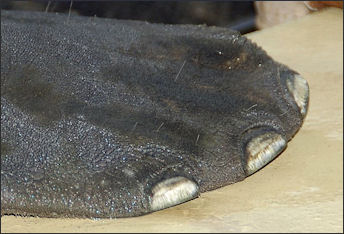
Manatee foot Manatee adults average around three meters (10 feet) in length and weigh 360 to 544 kilograms (800 to 1200 pounds). The largest on record were almost four meters (13.3 feet) and weighed more than 1,360 kilograms (3,000 pounds). Females are usually larger than males. Florida manatees can live to be 50 years old, weigh 454 kilograms to 907 kilograms and reach a lengths of three meters.
Manatees have a fat, sausage-like, mostly hairless body with a broad with a spade-shaped tail and short paddle-like front flippers. They have no hind flippers but do have vestigial pelvic bones. Two species of manatee have three or four nails on each flipper, vestiges of their four-legged past. Submerged, manatees swim around somewhat like seals in slow motion, moving along with downward sweeps from their massive tails.. In shallow water use their front flippers for balance and to walk on the bottom.
Manatees range from gray to brown in color and have streamlined bodies that are larger in the middle but taper at the ends. They have a large paddle-shaped tail with a pair of front flippers with three to four nails on each flipper. Their faces are wrinkly and contain whiskers. Hair is located all over the body in a sparse pattern. Their skin is wrinkly and the surface layer is constantly replaced by new skin to reduce the build-up of algae growth. Under the skin, is a layer of fat. [Source: An-Ping Yu, Animal Diversity Web (ADW) /=]
According to Animal Diversity Web: Manatees have small eyes that can be protected by a nictitating membrane when moved across the eyeballs. The nostrils are located at the top of the snout with valves that close when underwater. They have small ear openings behind the eyes. Despite having lobeless ears and small eyes, manatees have acute hearing and sight abilities. The prehensile lip allows manatees to draw in their food. They rely on grinding cheek teeth with cusps to eat high fiber plants. Manatees have adapted to replace their teeth when they are worn down. Female manatees have a teat against their bodies under each flipper as well as a urinary reproductive opening just in front of the anus. In male manatees, the opening is below the navel. Young manatees can be as small as three to 4 feet in length and weight around 60 to 70 pounds. At birth, manatee calves are usually darker in color than the adults. (Save the Manatee Club, 1994; Van Meter, 1989; World Animal Foundation, 2021) /=\
Manatees have only six vertebrae in their neck, fewer than other mammals. They have peg-like molar teeth which they use to grind the grasses they feed on. As these teeth wear down they slowly migrate along the jaw and are replaced by new ones which emerge at the back of the mouth and slowly move forward.
Manatee Behavior
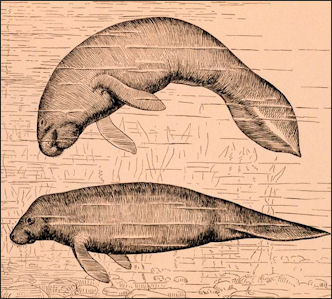
Manatees are motile (move around as opposed to being stationary), nomadic (move from place to place, generally within a well-defined range), migratory (make seasonal movements between regions, such as between breeding and wintering grounds) and solitary. [Source: An-Ping Yu, Animal Diversity Web (ADW) /=]
According to Animal Diversity Web: Commonly characterized as gentle and slow-moving, manatees spend much of their time eating, resting, and traveling. On average, six to eight hours a day are spent feeding and two to 12 hours are spent resting. They rest underwater at the bottom or right below the surface. While resting, they surface to breathe about every three to five minutes. Manatees are able to hold their breath for up to 20 minutes before needing to surface and breathe. Manatees normally cruise around at a speed of two and five miles per hour and can reach speeds of 20mph with quick up and down thrashes of their tail for short periods of time. . They tend to stick to certain areas but migrate to warmer waters when water temperature drops.
Manatees have not been observed to be territorial (defend an area within the home range), and they do not rely on a herd for survival. Their lack of requirement for a social structure results in their semi-solitary behavior. Small groups of manatees occur, but these groups are informal and have no dominating leader. Manatees engage in play by body-surfing and barrel rolling with other manatees.
Manatees are generally very docile and slow moving. They can also be very playful and curious. The often nibble on, kiss, nuzzle, nudge, butt, embrace and groom each other and occasionally pull on the fins and chew on the diving suits of snorkelers. Some manatees are loners. Other hang out in small herds that play, graze and doze together.
It was once thought that manatees and dugongs were dim-witted brutes. They have the smallest brain to body ratio of any mammal and are of one of the few large mammals that has virtually no ridges or wrinkles on their brains — often viewed as a sign of intelligence. But many experiments it turns out they performs just as well as dolphins. For example they can distinguish between different colors and geometric shapes. It is believed that the reason their body is so proportionally large to their brain is because they need a large body to control their body temperature and they have few predators to fear.
Manatee Senses
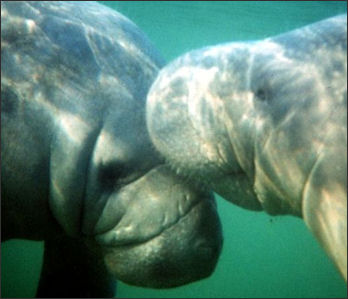 Manatees communicate with vision, touch, sound and chemicals usually detected by smelling and sense using vision, touch, sound and chemicals usually detected with smell. They
have the ability to communicate with a wide range of sounds. According to Animal Diversity Web: Communication is mostly between mothers and their calves. Mothers have been observed to respond to their calves from almost 200 feet away. Communicating sounds are described as chirps, whistles, and squeaks. Fear, stress, or excitement can be expressed in squeals. Adult manatees communicate during copulation and when playing. It is possible that pitch, volume, and duration of calls convey information. Touch, taste, and smell, may be other forms of communication within manatees. Manatees can also perceive their environment visually. In clear water, visual cues can be noticed from up to 115 feet away. It is understood that manatees can see in color due to the presence of two types of cone cells in their retina. [Source: An-Ping Yu, Animal Diversity Web (ADW) /=]
Manatees communicate with vision, touch, sound and chemicals usually detected by smelling and sense using vision, touch, sound and chemicals usually detected with smell. They
have the ability to communicate with a wide range of sounds. According to Animal Diversity Web: Communication is mostly between mothers and their calves. Mothers have been observed to respond to their calves from almost 200 feet away. Communicating sounds are described as chirps, whistles, and squeaks. Fear, stress, or excitement can be expressed in squeals. Adult manatees communicate during copulation and when playing. It is possible that pitch, volume, and duration of calls convey information. Touch, taste, and smell, may be other forms of communication within manatees. Manatees can also perceive their environment visually. In clear water, visual cues can be noticed from up to 115 feet away. It is understood that manatees can see in color due to the presence of two types of cone cells in their retina. [Source: An-Ping Yu, Animal Diversity Web (ADW) /=]
Manatees have bristle-covered snouts, two circular disks on their forehead that act as nostrils, tiny, deep-set eyes, and no external ears. The thick hairs on their face — called vibrissa — are very sensitive to touch. About 600 vibrissa are situated on a manatee’s mouth. They relay information to the brain about what the manatee touches and senses in the water. About 3,000 vibrissa are located on the bodies of manatees. Researchers speculate they may help the animal navigate and even hear. Each vibrissa sits in a blood-filled pocket. Movement affects the amount of fluid in the pockets and changes and other information from the pockets is passed on to receptors which relay the information to the brain.
Manatees spend much of their time in murky water and don't have very good eyesight. Their hearing is better than humans in some ranges. They have a permanent smile on their face like dolphins and probably have a poor sense of smell. They keep their nostrils closed with valves when they are underwater and only open them a few seconds after they surface. Individual manatees are recognizable by a combination for size, shape and scars.
Manatee Feeding Behavior
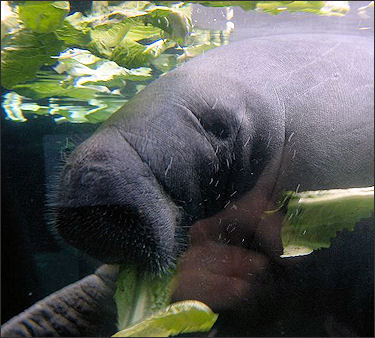 Manatees live mostly in warm, shallow water and spend most of their time grazing on water plants. Their life is slow and easy. They nap a lot between meals. The plants they feed on need sunlight and live near the ocean surface so the animals tend to stay close to the surface and do not need to dive to any great depths. They are so big and strong that predators do not attack them and the shallow waters they hang out in are generally not places that sharks go.
Manatees consume 5 to 10 percent of their body weight every day, which can work out to about 200 pounds of food. Florida manatees eat water hyacinths, freshwater grass, wild celery, milfoil, and bottom-growing vegetation. They consume huge quantities of aquatic plants and are regarded as invaluable cleaners of clogged waterways. Captive dugongs and manatees are often fed lettuce and cabbage supplemented with vitamins and minerals.
Dugongs and manatees have large lip pads. They suck in plants and tuck them into their mouths with their bristles. They also use their front flippers to push food into their mouths. Their upper lips are disk-shaped well muscled and so dexterous that can use them to grasp leaves, rip them up and put them in their mouths and to grasp the rhizomes of sea grass from the sandy sea bottom. Browsing takes up about a forth of their time.
Describing manatee eating habits, the explorer O.W. Barret wrote, “The body is held nearly vertical while grazing. The head is well out of the water, while the armlike flippers poke the grass towards the mouth. The noise made by the flapping of the huge upper lip and the crunching of the large teeth can be heard distinctly 200 yards or more away. The sound is much like that of horses grazing in a pasture.
According to Animal Diversity Web: Young calves drink their mother’s milk, but adult manatees spend much time grazing. Manatees are herbivorous and feed on water grasses, weeds, and algae. In 24 hours, a manatee can eat a tenth of its weight. On average, this is about 100 to 200 pounds of vegetation a day. Manatees are known to eat over 60 species of plants. Some common marine vegetations include manatee grass (Syringodium filiforme), turtle grass (Thalassia testudina), widgeon grass (Ruppia maritima), and shoal grass (Halodule beaudettei). Common freshwater vegetation include Florida elodea (Hydrilla verticillata), Southern naid (Najas guadalupensis), Eurasian watermilfoil (Myriophyllum spicatum), tapegrass (Vallisneria neotropicalis), coontail (Ceratophyllum demersum), water hyacinth (Eichornia crassipes), and water lettuce (Pistia stratiotes). [Source: An-Ping Yu, Animal Diversity Web (ADW) /=]
For a mammal of its size, manatees have very low metabolic rates. This low metabolic rate may explain their sensitivity to cold and slow healing rate. This adaptation most likely allows manatees to stay cool in their warm environments and to live off of their nutrient-poor diets. Unlike their relatives the dugongs, manatees have developed root hypsodonty which is characterized by tall-crowned teeth and enamel that extends below the gum line. This type of dentition is present in mammals that feed on abrasive material. Modern manatees have more teeth that are more resistant to wear than their ancestors. As teeth are worn, new molars move forward from the back of the jaw and push out the older teeth. The rate that this happens is dependent on how abrasive the diet is. The Amazonian manatee has specialized its diet and has thus developed even smaller and more wear-resistant teeth for eating aquatic grasses when compared to the other species. Prehensile lips are adapted to tear and grab plants into a manatee’s mouth. They also utilize their front flippers to guide plants towards their lips or to dig up an entire plant.
Manatee Mating and Reproduction
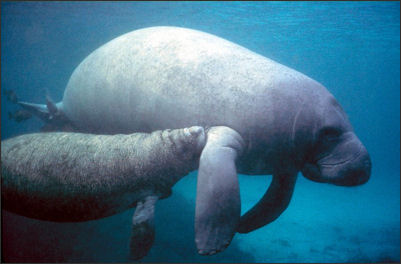
Manatee with calf Manatees are viviparous, meaning they give birth to live young that developed in the body of the mother, and engage in sexual reproduction. Usually one calf is born one at a time, but there have been recorded instances of twins. The range for time between births range from 2-5 years, with the average gestation period being around 13 months. The birth rate is slow. It is estimated that female manatees do not become sexually mature until they are between five to nine years old. Males are estimated to begin producing sperm at around two years old[Source: An-Ping Yu, Animal Diversity Web (ADW) /=]
Manatees are polygynandrous (promiscuous), with both males and females having multiple partners. Females have a long estrus period. During breeding events, female manatees are followed by a dozen or more males for a week up to a month. Males can establish an order for mating rights. Multiple males will compete against each other by pushing and shoving. Manatees display promiscuous mating behavior, therefore they do not form monogamous bonds. Breeding and birth can happen anytime of the year, but there is a peak in calves born during the spring. /=\
Manatee mating sometimes resemble a gang rape. Females in estrus often accept the advances of several males. A single female has been observed being followed by 17 males although usually the large bulls and able to scare off the younger males. Copulation is short and involves the male below the female in an abdomen-to-abdomen position. Variations in reproductive behaviors between manatee species have not been identified.
Manatee Young
Infants weigh about 27 kilograms (60 pounds) and reach a length of about 1.2 meters (4 feet) at birth. They suckle from the thumb-size teat on their mother’s armpit for three minutes at a time underwater while their mother lays at the surface so she and her baby can breath. The mother often holds her baby in her flippers in a human-like way. It is this position, some say, that gave birth to mermaid legend.
Describing the birth of a manatee, Jesse White wrote in National Geographic, "In a single explosive contraction an elastic, grayish thing, about 12 inches in diameter appeared. During each successive contraction it grew bigger and more oblong. [About two hours later]...the amniotic sac burst. Minutes later, in a frenzy of movement and an extreme, flexed contraction, the baby was born tail first. With his mother beneath him, the infant swam to the surface, making loud, high-pitched cries.” [Source: Jesse R. Whaute, National Geographic, September 1984]
Parental care is provided by females. The post-independence period is characterized by the association of offspring with their parents. Manatee young stay with their mothers about one or two years after birth before heading off on their own. It is not uncommon for mothers to nurse a yearling and an older calf but rarely at the same time.
Manatees have a high adult survival rate. The female manatee has complete responsibility of their calf without the help of the male manatee. Manatee milk does not contain lactose, but is rich in fats, proteins, and sodium. After a few weeks of nursing, calves begin to include plants in their diet. Mother manatees and young manatees can recognize each other even after weaning. Some younger manatees may spend their young adulthood living within the range of their mothers. This behavior can be beneficial as young manatees can learn migration routes to winter refuges in this way. /=\
Endangered Manatees
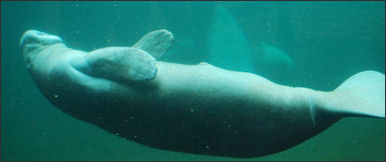 All three manatee species are listed as vulnerable for extinction on the International Union for Conservation of Nature (IUCN) Red List. As of 2021, population estimates for each species are: 13,000 for the West Indian manatees, 11,000 for the African manatees and 8,000 to 30,000 for the Amazonian manatees (Trichechus inunguis).
Threats include watercraft injuries, obstruction of migration routes by flood-control structures, entanglement in fishing gear, poaching, loss of habitat, and pollution. Poaching of manatees is rare, but pollution of estuaries, rivers, and oceans have led to debris ingestion and entanglement. As manatees live near coasts, they are prone to interactions with humans. Watercraft collisions are the most common causes of death among human activities. Blunt trauma from impact is enough to kill manatees. Motors and propellers may not always be deadly to manatees, but these wounds from collisions can be serious after reproduction and long-term survival.
In Florida manatees show be thriving as they have no natural predators and they have a plentiful food supply. Up to 80 manatees are killed by boats in Florida every year. Manatees are hurt so often by boats partly they have trouble hearing the low frequency noised made by the engines. They are also killed cold stress, red tides, flood gates and accidents
Manatees gave been successfully raised in captivity and released in the wild Born-Free-style. In 2006 a manatee was spotted in the Hudson River in New York. It was the northernmost sighting of a manatee ever. No one could explain what had happened. Some scientists suspected that U.S. Navy sonar was maybe to blame.
Image Sources: Wikimedia Commons, NOAA
Text Sources: Animal Diversity Web (ADW) animaldiversity.org; National Oceanic and Atmospheric Administration (NOAA) noaa.gov; Wikipedia, National Geographic, Live Science, BBC, Smithsonian, New York Times, Washington Post, Los Angeles Times, The New Yorker, Reuters, Associated Press, Lonely Planet Guides and various books and other publications.
Last Updated June 2023