
Home | Category: Ocean Environmental Issues
DAMAGE CAUSED BY RISING SEA LEVELS
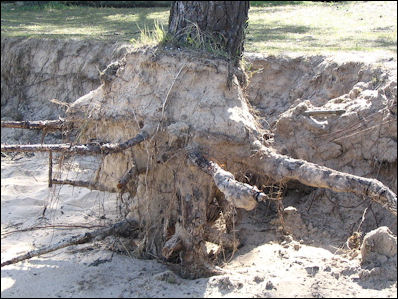
rising sea level erosion The 3000-page “Third Assessment Report” “a United Nations document released in 2001 estimated that the sea level could rise by one meter by 2100. A rise of half that could cause great hardship for coastal areas, low-lying islands and ports.
The areas are particularly vulnerable during storms when big waves can wash inland and stirs are expected to get bigger rand string as global warming intensifies. More than a 100 million people worldwide live within three feet of mean sea level. Every inch of sea level rise could translate to eight feet of retreat on a sandy beach. Damage can be particularly nasty where the coastline is subsiding. George Maul, an oceanographer at the Florida Institute of Technology told AP, "People are worried and they are justified in their worry. But even a few kilometers in a the equatorial seas you'll fin f one island experiencing a sea-level rise and once experiencing a fall."
Tim Folger wrote in National Geographic: “Even in the absence of something very nasty, coastal cities face a twofold threat: Inexorably rising oceans will gradually inundate low-lying areas, and higher seas will extend the ruinous reach of storm surges. The threat will never go away; it will only worsen. By the end of the century a hundred-year storm surge like Sandy’s might occur every decade or less. Using a conservative prediction of a half meter (20 inches) of sea-level rise, the Organisation for Economic Co-operation and Development estimates that by 2070, 150 million people in the world’s large port cities will be at risk from coastal flooding, along with $35 trillion worth of property—an amount that will equal 9 percent of the global GDP. How will they cope? [Source: Tim Folger, National Geographic, September 2013]
In March 2016, James Hansen, an influential NASA scientist, estimated that seas could rise by seven meters in the coming century, a figure that would decimate coastal communities and submerge many islands if true. Losing Ground, a report issued by the nonprofit news organization ProPublica in 2014, said large sections of the Louisiana coastline are being lost to rising sea levels; a 2011 study by the U.S. Geological Survey determined that the state's wetlands were being lost at a rate of "a football field per hour." South Florida, the Carolinas, and the Jersey Shore are also in danger of losing land due to sea level rise, according to an interactive map created by Climate Central, an organization of scientists. [Source: Michael Edison Hayden, ABC News, May 10, 2016]
See Separate Article: GLOBAL WARMING AND RISING SEA LEVELS factsanddetails.com
RECOMMENDED BOOKS:
“Climate and the Oceans” (Princeton Primers in Climate) by Geoffrey K. Vallis Amazon.com
“The Encyclopedia of Weather and Climate Change: A Complete Visual Guide”
by Juliane L. Fry, Hans-F Graf, et al. Amazon.com
“Atmosphere, Ocean and Climate Dynamics: An Introductory Text” (International Geophysics by John Marshall, R. Alan Plumb Amazon.com
“Great Ocean Conveyor: Discovering the Trigger for Abrupt Climate Change”
by Wally Broecker Amazon.com
“Beyond Extinction: The Eternal Ocean―Climate Change & the Continuity of Life”
by Wolfgang Grulke Amazon.com
“The Unnatural History of the Sea” by Callum Roberts (Island Press (2009) Amazon.com
“The Ocean of Life: The Fate of Man and the Sea” by Callum Roberts Amazon.com
“Plastic Soup: An Atlas of Ocean Pollution” by Michiel Roscam Abbing Amazon.com
“Blue Hope: Exploring and Caring for Earth's Magnificent Ocean” by Sylvia Earle (2014) Amazon.com
“The Empty Ocean” by Richard Ellis (2003) Amazon.com
“Oceans: The Threats to Our Seas and What You Can Do to Turn the Tide” by , Jon Bowermaster (2010) Amazon.com
“Dark Side of The Ocean: The Destruction of Our Seas, Why It Maters, and What We Can Do About It” by Albert Bates Amazon.com
“Ocean's End: Travels Through Endangered Seas” (2001)
by Colin Woodard Amazon.com
“The Blue Machine: How the Ocean Works” by Helen Czerski, explains how the ocean influences our world and how it functions. Amazon.com
“The Science of the Ocean: The Secrets of the Seas Revealed” by DK (2020) Amazon.com
“Atmospheric and Oceanic Fluid Dynamics: Fundamentals and Large-Scale Circulation” by Geoffrey K. Vallis (2006) Amazon.com
“Essentials of Oceanography” by Alam Trujillo and Harold Thurman Amazon.com
“Ocean: The World's Last Wilderness Revealed” by Robert Dinwiddie , Philip Eales, et al. (2008) Amazon.com
Hurricanes, Typhoons and Global Warming
The jury is still out on what kind of impact global warming will have on big storms like typhoons. In 2005, there was record-breaking 28 named storms around North America, of which 15 were hurricanes. Some said this caused by global warming. There were predictions that 2006 would be a nasty hurricane season but that did not happen.
A study by Kerry Emanuel, an MIT climatologist, released in August 2005 just before Hurricane Katrina, said there had been an marked increase in the intensity and duration of tropical storms since the 1970s. It is said the number of Category 4 and 5 storms worldwide had doubled and the wind speed and duration if all hurricanes gad jumped 50 percent.
Some climatologists believe that the surge in the number of typhoons and hurricanes in recent years may be linked to global warming which warms up the seas and provides more energy for weather phenomena that develop into severe storms. In 1995, there were unusually high number of hurricanes. Coincidentally or not, 1995 also had the highest global surface temperatures on record. and ocean temperatures in the Atlantic were the highest ever recorded. In one of the 11 years between 1995 and 2005 there were unusually high numbers of hurricanes. A January 2010 study from the National Oceanic and Atmospheric Administration suggests that a warmer planet will generate fewer storms overall, but those that do form will be stronger.
See Separate Article HURRICANES, TYPHOONS, GLOBAL WARMING AND STORM MODIFICATION factsanddetails.com
Rising Sea Levels and Coastal Areas
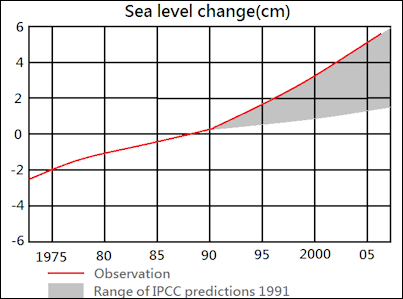
Rising sea levels could cause flooding, beach erosion, submerged beaches, lose of farmland, displaced populations, disturbances to ecosystems and wildlife, and inundate houses, and allow and salt water to intrude into drinking water supplies. Low-lying islands and coastal areas will become increasingly vulnerable to storms, storm surges, and salt water intrusions. Already some beaches have become noticeably eroded by increases in severe storms and flood during tidal swells.
Major wetlands are losing hectares and hectares to erosion as a result of rising seas levels. Without natural shoreline barriers storms cause more damage and eat up more land than before. Palms, mangroves and salt marshes are drowning.
According to some local reports, shorelines have receded half a foot per year for 90 years. In some places people are already being displaced from the coastline and there is a fear that some atolls may have to abandoned in the not to distant future.
Rising Sea Levels and Saltwater Inundation
Saltwater inundation in coastal areas caused by rising sea levels, storm surges and other causes is damaging coastal mangrove forests and reducing shorelines. Infiltration of salt water kills trees and plants. That is bad in itself. The trees and plants also hold the land together and keep the land from being washed or blown away.
Rising seas levels also cause salt water to inundate water tables, which can contaminate drinking water with salt water. In places where freshwater reserves have been infiltrated by sea water the drinking water has a brackish taste. In some places the water is so salty people have been forced to rely on collected rain water and water purified in desalinization plants imported from Japan at a cost of $200,000. Under these conditions people have to relatively pay a lot of money for water and supplies are limited.
The Mekong Delta in Vietnam is home to more than 17 million people and a source of food for millions more. Rising sea water caused by global warming is now increasing the salt content of the river water and threatening the livelihoods of millions of poor farmers and fishermen. Water with 4 percent salinity has encroached by 40-50 kilometers far into the Mekong Delta. [Source: Kit Gillet, The Guardian, August 21, 2011 :::]
According to The Guardian: A one-meter rise in sea levels could leave a third of the Mekong Delta underwater and lead to mass internal migration and devastation in a region that produces nearly half of Vietnam's rice. "If there was a one-meter rise, we estimate 40 percent of the delta will be submerged," says Tran Thuc, director general of the Vietnam Institute of Meteorology, Hydrology and Environment. "There is also the threat of cyclones and storms linked to climate change. The people in this area are not prepared for any of this."
“Already affected by regular flooding, those who live in the low-lying delta are focusing on the rising salt content of water in land that has for thousands of years been used for rice paddies, coconut groves and other crops which locals rely on for their livelihood. Government officials and international observers are predicting significant lifestyle changes for the delta's population, which will be forced to adapt to survive. :::
See Separate Article MEKONG DELTA, AGRICULTURE, GLOBAL WARMING AND ENVIRONMENTAL PROBLEMS factsanddetails.com
Low Islands and Raising Sea Levels
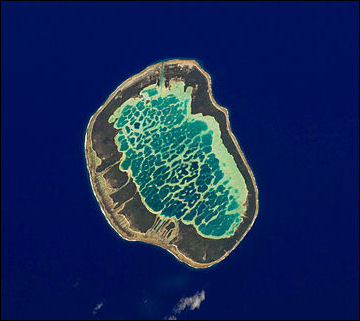
Mataiva Atoll, Tuamotu Archipelago
South Pacific Ocean Low ocean islands are particularly vulnerable to unusually high tides and sea surges. On some islands global warming and rising sea levels are causing the seas to wash over roads on the coast and flood houses. A rise of as little as four inches can cause serious flooding problems on some islands. Extreme El Niño and El Nina-related weather can produce serious damage.
Forty-two small island nations are threatened by the severe weather and rising ocean levels caused by global warming. Low-laying coral islands in places like the Maldives, Micronesia, Kiribati and Tuvalu are particularly vulnerable to sea level rises. No island there rises more than six feet above sea level.
Sea levels rose between 10 and 20 centimeters during in the entire 20th century, ten 10 times faster than rates observed in the previous 3,000 years. Sea levels are currently rising at a rate of around two millimeters a year. The rate could easily accelerate. Studies show that glaciers in Greenland and Antarctica are melting faster than previously thought. If sea levels rise more than a meter 80 percent of the land on the Maldives would be lost. If that were to happen people left would either have crowd together on the land that is left or leave.
The 42 small island nations threatened by the severe weather and rising ocean levels caused by global warming and other problems have united to form the Alliance of Small Island States. In January 2005, leaders of 37 small island states met in Mauritius to discuss early warning systems for tsunamis and the impact of global-warming-induced rising sea levels. Some of them accused large developed green-house-gas producing countries of “eco-terrorism.” Some islands are building sea walls but they are vulnerable to the kind of breaching that swamped New Orleans during Hurricane Katrina.
Countries such as Saudi Arabia and Australia have suggested the residents of the islands simply move to some new islands.
Five Solomon Islands Disappear as a Result of Climate Change
Five Solomon Islands have submerged underwater and six more have experienced a dramatic reduction in shoreline due to climate change, according to a paper published in the journal Environmental Research Letters. Michael Edison Hayden of ABC News wrote: “The Solomon Islands, a sovereign country consisting of a network of picturesque, tropical islands located in the Pacific Ocean, has a population of a little more than 500,000 people, according to census data published in 2009, many of whom have been adversely affected by rising sea levels in recent years. [Source: Michael Edison Hayden, ABC News, May 10, 2016]
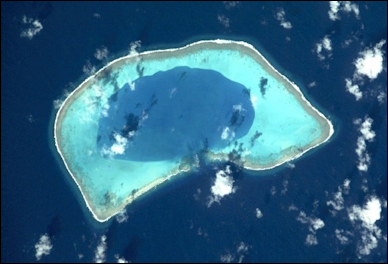
“Ten houses from one island were washed away at sea between 2011 and 2014, according to the study, which asserts that the rising sea levels affecting the Solomon Islands are caused by the warming of the planet. The research, which was conducted by Australian scientists, bears implications that are likely to reverberate far beyond the turquoise shores of Oceania.
“The Solomon Islands provides a preview of how sea-level rise could affect other coastal communities in the coming years, according to the study, largely because the speed with which erosion is taking place there has been accelerated by a "synergistic interaction" with the waves that surround it. "In addition to village relocations, Taro, the capital of Choiseul Province is set to become the first provincial capital globally to relocate residents and services due to the threat of sea-level rise," the study said.
Island in Panama Evacuated Due to Rising Sea Levels
In 2024, about 300 Guna families on the tiny Panamanian island of Gardi Sugdub, prepared to relocate to the mainland, becoming the first of 63 coastal communities in Panama expected to move because of rising sea levels. The low-lying island, only half a meter above sea level, faces frequent flooding and worsening heat as climate change drives both sea-level rise and stronger storms. Though some residents will stay until conditions become unsafe, most are moving to a new $12 million government-built settlement about a mile inland. [Source: Matías Delacroix and Juan Zamorano, Associated Press, June 2, 2024]
The move is emotionally difficult: the Guna have lived on the sea for more than 200 years, relying on fishing and tourism, and fear losing aspects of their maritime culture. Earlier discussions about relocating were driven by overcrowding, but climate impacts accelerated the timeline. Scientists warn that all 50 populated islands in the Guna Yala archipelago will likely be abandoned by century’s end.
Panama expects to lose over 2 percent of its coastal territory to sea-level rise by 2050 and estimates a cost of $1.2 billion to relocate roughly 38,000 vulnerable coastal residents. Similar climate-driven relocations are already underway globally, from Mexico to New Zealand and Venice.
Living with Rising Sea Levels
Some argue that mankind should be able to adapt to rising sea levels. If the money is available, people can relocate their houses, fortify shorelines and replenish beach sand. In some places mangrove trees are being planted to create coastal wetlands that will act as a barrier against storms and the effects of sea level rises. Barriers built against the ocean have proved ineffective. They don't work so well and the small island nations that need them can't afford them.
Byorn Lomborg wrote in the Christian Science Monitor, Since 1930, excessive groundwater withdrawal has caused Tokyo to subside by as much as 15 feet, with some of the lowest parts of the downtown area dropping almost a foot per year in some years. Similar subsidence has occurred over the past century in a wide range of cities, including Tianjin, Shanghai, Osaka, Bangkok, and Jakarta. In each case, the city has managed to protect itself from such large sea-level rises and thrive. [Source: Byorn Lomborg, Christian Science Monitor, August 11, 2010]
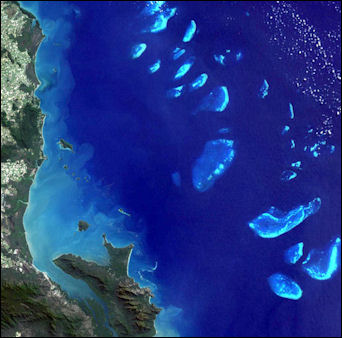
Great Barrier ReefConsider, for example, the findings of climate scientists Robert J. Nicholls, Richard S.J. Tol, and Athanasios T. Vafeidis. In research funded by the European Union, they studied what the global economic impact would be if global warming were to result in a collapse of the entire West Antarctic Ice Sheet. An event of this magnitude would likely cause the oceans to rise by perhaps 20 feet over the next hundred years — precisely the sort of thing that environmental activists have in mind when they warn about potential end-of-the-world calamities. But would it really be all that calamitous?
Not according to Nicholls, Tol, and Vafeidis. Here are the facts. A 20-foot rise in sea levels (which, not incidentally, is about ten times more than the United Nations climate panel’s worst-case expectations) would inundate about 16,000 square miles of coastline, where more than 400 million people currently live. That’s a lot of people, to be sure, but hardly all of mankind. In fact, it amounts to less than 6 percent of the world’s population — which is to say that 94 percent of the population would not be inundated. And most of those who do live in the flood areas would never even get their feet wet.
That’s because the vast majority of those 400 million people reside within cities, where they could be protected relatively easily, as in Tokyo. As a result, only about 15 million people would have to be relocated. And that is over the course of a century. In all, according to Nicholls, Tol, and Vafeidis, the total cost of managing this “catastrophe” — if politicians do not dither and pursue smart, coordinated policies — would be about $600 billion a year, or less than 1 percent of global GDP.
Image Sources: World Meteorological Organization; National Oceanic and Atmospheric Administration (NOAA), Wikimedia Commons
Text Sources: World Meteorological Organization; National Oceanic and Atmospheric Administration (NOAA), New York Times, Washington Post, Los Angeles Times, Times of London, Yomiuri Shimbun, The Guardian, National Geographic, The New Yorker, Time, Newsweek, Reuters, AP, Lonely Planet Guides, Compton’s Encyclopedia and various books and other publications.
Last updated December 2025