
Home | Category: Coastal Areas
BENEFITS OF MANGROVES
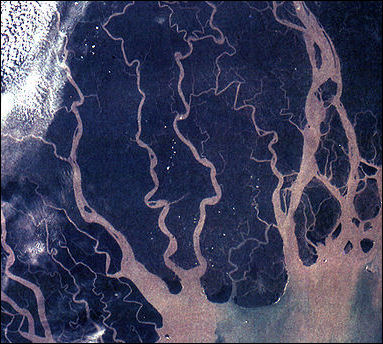
Ganges River Delta, Bangladesh India
Mangrove forests stabilize the coastline, reducing erosion from storm surges, currents, waves, and tides. The intricate root system of mangroves also makes these forests attractive to fish and other organisms seeking food and shelter from predators.
Mangrove forests provide vital habitat for endangered species from tigers and crocodiles to rare humming birds the size of a bee. Kennedy Ware wrote in National Geographic, “Forest mangroves form some of the most productive and biologically complex ecosystems on Earth. Birds roost in the canopy, shellfish attach themselves to the roots, and snakes and crocodiles come to hunt. Mangroves provide nurseries for fish; a food sources for monkeys, deer, tree-climbing crabs... and a nectar source for bats and honeybees.”
Achin Steiner, United Nations Under-Secretary General told the Times of London. “We already know that marine ecosystems are multitrillion-dollar assets linked to sectors such as tourism, coastal defense, fisheries and water purification services. Now it is emerging that are natural allies against climate change.”
Mangroves are excellent carbon sinks, or absorbers of carbon dioxide. Research by Jin Eong On, a retired professor of marine and coastal studied in Penang, Malaysia, believes that mangroves may have the highest net productivity of carbon of any natural ecosystem. (About a 100 kilograms per hectare per day) and that as much as a third of this may be exported in the form of organic compounds to mudflats. On’s research has show that much of the carbon ends up in sediments, locked away for thousands of years and that transforming mangroves into shrimp farms can release this carbon dioxide back into the atmosphere 50 times faster than if the mangrove was left undisturbed.
RECOMMENDED BOOKS:
“The Biology of Mangroves and Seagrasses” by Peter J. Hogarth Amazon.com
“The Botany of Mangroves” by P. Barry Tomlinson Amazon.com
“Coastal And Estuarine Processes” by Peter Nielsen Amazon.com
“The World of the Salt Marsh: Appreciating and Protecting the Tidal Marshes of the Southeastern Atlantic Coast” by Charles Seabrook (2013) Amazon.com
“Waves, Tides and Shallow-Water Processes” Open University(1989) Amazon.com
“Tides: The Science and Spirit of the Ocean” by Jonathan White Amazon.com
“Ecology of Coastal Waters: With Implications For Management” by K. H. Mann Amazon.com
“Introduction to Coastal Engineering and Management” by J William Kamphuis Amazon.com
“Introduction to Coastal Processes and Geomorphology” by Robin Davidson-Arnott, Bernard Bauer, et al. Amazon.com
“Physical Oceanography of Coastal and Shelf Seas” by B. Johns Amazon.com
“Descriptive Physical Oceanography” by Lynne Talley (2017) Amazon.com
“Essentials of Oceanography” by Alam Trujillo and Harold Thurman Amazon.com
“The Blue Machine: How the Ocean Works” by Helen Czerski, explains how the ocean influences our world and how it functions. Amazon.com
“How the Ocean Works: An Introduction to Oceanography” by Mark Denny (2008) Amazon.com
Benefits of Mangroves to Coastal Areas and Humans
Preserving mangroves is vital to people that live in coastal areas, providing them with fish and other seafood and offers protection from storms and tsunamis. Natural coastal environments and mangroves also play a vital role in absorbing carbon dioxide and combating climate change.
Mangroves are useful in many ways. Many commercial important fish and crustaceans spend part or all of their lives in mangroves, which also provide a home of many terrestrial animals. Some 250-acre sections of mangrove produce four tons of shrimp a year.
Mangroves also produce three tons of organic matter per acre a year; protect shorelines from winds, waves and erosion and provide lumber, firewood, charcoal, tannins, medicines, food and alcoholic beverages. Local people do things like harvest wild honey and collect reeds for roof thatching and baskets.
All types of coastal wetlands help to prevent millions of dollars in damage from flooding and save hundreds of hours of labor to repair storm damage. Mangrove forests are vital for protesting farmland from salt water intrusion and buffeting the effects of tropical storms. The great tsunami of 2004 demonstrated how they can save thousands of lives by blunting the force of tsunami waves.
Threats to Mangroves and Coastal Areas
Mangroves are regarded by some as the world’s most endangered habitat, with more than third being lost between 1980 and 2000. Parts of Asia have lost 90 percent of their mangrove forests., robbing fish of a place to spawn and people protection from storms. One estimate in the mid 2010s suggested that mangrove deforestation rates in recent decades had been three to five times faster than other forests around the globe. [Source: Samantha Chapman, Associate Professor of Biology, Villanova University, The Conversation, February 9, 2018]
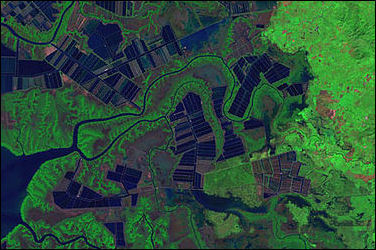
Before shrimp farming, Honduras 1987 Coastal habitats have been lost to development, shrimp farms, fish farms and land reclamation. Run off, agriculture, overfishing, dumping of garbage, surface mining and construction all degrade the coastal environment. Untreated raw sewage, industrial chemical and other pollutants are released directly into the sea. Even in the United States this is still occurring on a grand scale.
Houses and hotels are built too close to the water. Dredging and filling have destroyed near shore habitats. Oil spills equal in size to the Exxon Valdez spill occur on average around the world every eight months. In some places the accumulation of pollutants is so bad that dead zones — areas where there is so much algae that all the oxygen is sucked out of the water making it impossible for most life forms to exist — have sprung up. There are nearly 150 of these worldwide. Even when progress is made improving water quality the improvements can not keep up with the waste produced by the increasing number of people that are migrating to coastal areas all the time.
Mangrove forests are being destroyed to make way for coastal development, salt pans, port facilities, farms, golf courses and roads. The mangroves themselves are chopped up to provide chips for the production of rayon or processed into charcoal in rudimentary ovens. They die as a result of pollution, oil spills, sediments overlaid and disruption to their sensitive water and salinity balance.
Perhaps the biggest threat comes from shrimp farms, which are easy to set up in mangrove areas and provide much need jobs in poor countries, When there a choice between leaving a mangrove undeveloped for the sake of the fish and crabs and carbon-consuming tree or developing the site for money and jobs you know who is going to win out. To make matters worse, shrimp farmers typically abandon their ponds after a few years to avoid disease outbreaks and declining productivity and move to new sites, leaving behind degraded areas and plowing up new ones.
Mangroves and Climate Change
Samantha Chapman wrote in The Conversation:Mangroves line the world’s coastlines and prefer warm temperatures, so they have traditionally been restricted to subtropical and tropical environments. But they have many features that have enabled them to survive major climate shifts in the past. Now, in a harbinger of climate change, mangroves are expanding from tropical zones into temperate areas. Scientists are finding them at higher and higher latitudes in North America, South America, Asia, Africa, Australia and Latin America. [Source: Samantha Chapman, Associate Professor of Biology, Villanova University, The Conversation, February 9, 2018]
Working with other ecologists in the shadow of the huge launch complex at Florida’s Kennedy Space Center, we have found that mangroves have increased in abundance by 70 percent in just seven years over an area of 220 square miles (567 square kilometers). This is a dramatic change in the plant community along this stretch of the Atlantic coast. Unlike many other impacts of climate change, we expect these shifting ranges to produce some benefits, including increased carbon storage and storm surge protection.
As mangrove propagules drift north along the Atlantic coast, they are reaching areas where winter freeze events that could kill them are becoming less common due to climate change. Similar movements are occurring in other locations around the world.
In the Gulf of Mexico and Florida, mangroves are increasingly found in areas recently dominated by salt marshes, which typically occur in cooler zones. Using satellite images and land-based field studies in our ongoing study of mangroves, we can see this spread of mangroves occurring faster than we could have expected based on climate data alone.
Though these shifts also likely happened in the past due to hurricanes and freeze events, the recent changes in mangrove range are still dramatic. One study from Florida shows that mangroves from northern populations may be reproducing earlier than normal and producing bigger propagules, which could help them take over salt marshes.
In a recent modeling effort, we examined how mangroves protect NASA facilities at the Kennedy Space Center. We found that a 2-meter-wide strip of mangroves along the shore can reduce wave height by 90 percent. In contrast, it takes 20 meters of salt marsh habitat to reduce waves by the same amount. Other studies have found that mangrove forests helped reduce shoreline damage during the catastrophic 2004 Indian Ocean tsunami and Tropical Storm Wilma in Belize in 2005.
Mangrove Conservation
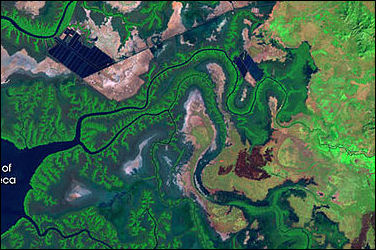
After shrimp farming, Honduras 1999 A United Nations task force on mangroves and the environment recommending: 1) setting up a blue carbon fund to help developing countries to protect mangroves as well as rain forests; 2) place a value on mangroves that takes into consideration their value as carbon sinks; and 3) allow coastal and ocean carbon sinks to be traded in same fashion as those for terrestrial forests. Christian Nellemann, an author a United Nations report on the issue, told the Times of London, “There is an urgency to act now to maintain and enhance these carbon sinks. We are losing these crucial ecosystem much faster than rainforests and at the very time we need them. If current trends continue they [mangrove and coastal ecosystems] may be largely lost within a couple of decades.”
Countries need to set aside protected areas where nature is allowed to run its course without human interference. Managing these habitats is often far less expensive than repairing degraded habitats. In Asia, for example, careful management of mangroves has proved far more effective in protecting coastal areas from storms, surges and waves than man-made coastal defenses. In some places mangrove trees are being planted to create coastal wetlands that will act as a barrier against storms and the effects of sea level rises.
Samantha Chapman wrote in The Conversation: Mangrove restoration efforts are ongoing in many parts of the world, including the Tampa Bay estuary and southern China, but some projects have been major failures. To succeed, these initiatives need to consider mangrove habitat needs, particularly hydrology. Though mangroves may protect coastlines even more effectively than salt marshes, it is important to note that marsh plants provide important habitats for numerous species of birds and fish. We don’t yet know how these animals will fare as mangroves replace marshes, nor do we yet understand other downsides of plant range shifts due to climate change. [Source: Samantha Chapman, Associate Professor of Biology, Villanova University, The Conversation, February 9, 2018]
Mangrove loss has dropped world-wide from one to two percent a year to less than 0.2 per cent, , But that doesn’t mean we should let down our guard. “Even if we are losing fewer mangroves than in the past, we are still talking about roughly 20,000 hectares a year,” says Professor Martin Zimmer, who heads the Mangrove Ecology Working Group at the Leibniz Centre for Tropical Marine Research (ZMT) in Bremen, Germany, “Over the last 50 years, in total, more than a third of the world-wide mangrove stocks has either been logged or destroyed.”
See Creating Desert Wetlands Under DESERT AGRICULTURE AND IRRIGATION factsanddetails.com
Benefits of Mangroves in the Fight Against Global Warming
Samantha Chapman wrote in The Conversation: Continued mangrove expansion could increase carbon storage along coastlines. Mangroves have an enormous capacity for sucking up carbon dioxide and other greenhouse gases and trapping them in flooded soils for millennia. They are among the most carbon-rich tropical forests and can store twice as much carbon on a per-area basis as salt marshes. During normal growth, mangroves rapidly convert carbon dioxide into biomass. The saturated soils in which they grow contain low levels of oxygen, which bacteria and fungi need as fuel to break down dead plant matter. Instead, this dead material is stored in the soil. [Source: Samantha Chapman, Associate Professor of Biology, Villanova University, The Conversation, February 9, 2018]
We estimated in one study that mangrove carbon storage at the Kennedy Space Center increased by 25 percent in only seven years as mangrove forests spread. We concluded that if mangrove expansion continued unchecked by freezes into other southeastern U.S. wetlands, wetland carbon storage could result in the uptake of 26 million metric tons of carbon by 2080. This is equivalent to just over 95 million metric tons of carbon dioxide, which is about 28 percent of Florida’s total greenhouse gas emissions from human activities in 2010.
Preserving coastal mangroves improves climate resilience in several ways. First, if the carbon stored in these soils were released as carbon dioxide and methane, this would likely cause an increase in climatic warming. Second, the same processes that store carbon in wetland soils also allow these wetlands to accrete sediment and keep pace with rising sea levels.
In Rio de Janeiro, 30,000 mangrove trees have been planted in Guanabara Bay, transforming a deforested area into a thriving ecosystem. This reforestation project, led by Instituto Mar Urbano, showcases a natural solution for climate resilience, particularly against floods. Mangroves are crucial for absorbing seawater, stabilizing soil, and acting as carbon sinks. The project has also improved water quality and brought back marine life, benefiting local crab pickers. This initiative serves as a model for other cities, especially in light of increasing flood disasters globally and the recent devastating floods in Brazil's Rio Grande do Sul, where deforestation has exacerbated the problem. Experts emphasize the importance of natural vegetation in mitigating floods and building resilient communities, and reforestation efforts are expected to be key in the recovery of flood-affected areas. [Source: Diarlei Rodrigues and Mauricios, Associated Press, May 25, 2024]
Scientists Warn Against Mass Planting of Mangroves
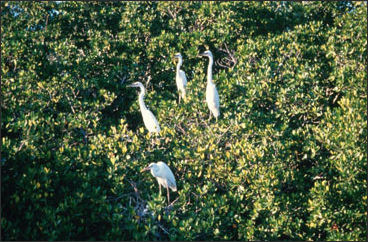 In the spring 2021, mangrove experts of the International Union for Conservation of Nature (IUCN) warned against mass planting because important ecological prerequisites are not considered. Presented their concerns in their Position Paper “Pause before you plant”, they said that although global mangrove conservation and reforestation efforts have been partly successful IUCN researchers are wary of mass plantings of mangrove seedlings. [Source: Rural 21, May 1, 2021]
Rural 21 reported: The IUCN group comprises mangrove experts from across the world. IUCN scientist Professor Martin Zimmer said: “For some time, we in the IUCN Mangrove Specialist Group have been observing with concern a sort of doing things for the sake of doing things which often goes hand in hand with planting mangroves. Of course it should be welcomed that people are taking action to save the mangrove forests, but unfortunately, in the long run, many of these projects will not meet with success.”
The scientists believe that there are several reasons for setbacks. Often, projects aimed at restoring mangrove forests fail because, especially in the case of mass planting, important ecological prerequisites are not taken into account. For example, mangroves are planted on sites exposed to strong currents, so that the young seedlings which have not yet taken root are simply washed away. “Mass planting campaigns may have a good media impact, but often, they focus on only one or two species which are easy to plant,” Zimmer explains. “Frequently, this results in stocks which do not render the desired ecosystem processes and services. Often, little stress-resistant monocultures or species are established which are not indigenous, become invasive and may result in ecological problems.”
The experts argued that in many cases greater emphasis should be places on preserving the mangroves we already have rather than producing new ones. Countries such as Sri Lanka and Indonesia have made efforts to protect the remaining mangrove forests along their coasts. The said: “We first of all recommend relying on the natural regeneration potential of the mangroves. If we can restore the original environmental conditions, the mangrove will be strong enough to spread again. Wherever this is not possible, or where particular ecosystem services are to be achieved, reforestation can represent a solution, but only under suitable ecological conditions.”
Image Sources: Wikimedia Commons; YouTube, Animal Diversity Web, NOAA
Text Sources: Animal Diversity Web (ADW) animaldiversity.org; National Oceanic and Atmospheric Administration (NOAA) noaa.gov; “Introduction to Physical Oceanography” by Robert Stewart , Texas A&M University, 2008 uv.es/hegigui/Kasper ; Wikipedia, National Geographic, Live Science, BBC, Smithsonian, New York Times, Washington Post, Los Angeles Times, The New Yorker, Reuters, Associated Press, Lonely Planet Guides and various books and other publications.
Last Updated December 2025