
Home | Category: Oceans and Sea Life
HISTORY OF THE OCEANS
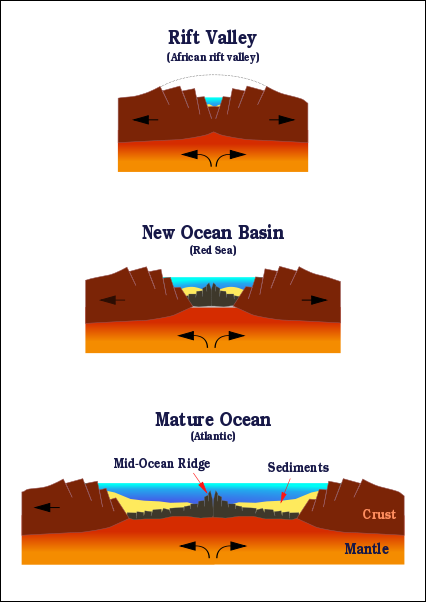
Ocean births The first oceans formed billions of years ago when the earth began to cool and water condensed on the earth's surface. These early oceans were full of chemical like iodine, chlorine and nitrogen. Water came from volcanic vents. Over time the oceans have been getting saltier. The salt has come mostly from weathered rock on land
Water remained a gas until the Earth cooled below 212 degrees Fahrenheit. At this time, about 3.8 billion years ago, the water condensed into rain which filled the basins that we now know as our world ocean. Most scientists agree that the atmosphere and the ocean accumulated gradually over millions and millions of years with the continual 'degassing' of the Earth's interior.
According to this theory, the ocean formed from the escape of water vapor and other gases from the molten rocks of the Earth to the atmosphere surrounding the cooling planet. After the Earth's surface had cooled to a temperature below the boiling point of water, rain began to fall—and continued to fall for centuries. As the water drained into the great hollows in the Earth's surface, the primeval ocean came into existence. The forces of gravity prevented the water from leaving the planet.
Life first appeared in the oceans 3.5 billion years ago in the form of simple bacteria and algae almost exactly types of bacteria and algae that still exist today.
Creation of Water
Water is everywhere on Earth and a prerequisite for life, but nobody has ever been able to determine conclusively how it got here. The Earth formed about 4.5 billion years ago. At that time it was too close to the sun to hold much water or water vapor. But around 4.1 billion years ago began a period of “heavy bombardment,” when Earth was pummeled by comets and cold meteorites — both of which carry water — from the outer reaches of its disk. In relatively short time, geologically, the oceans appeared. [Source: Marc Kaufman, Washington Post October 20, 2011]
Planetary scientists have determined that huge amounts of graphite and silicon dust surround stars as they form. That material over time binds together to form larger bodies such as comets and asteroids and — around many stars — ultimately planets.
The bombardment ended about 3.8 billion years ago, and at that point much of the Earth’s water was in place. The earliest forms of microbial life detected lived some 3.6 billion years ago, a relatively short geological period after the oceans had filled.
While there is growing evidence for the explanation that comets and wet asteroids delivered our oceans, some researchers hold that the water came primarily from other sources. For instance, water is believed to have been released from early volcanos that belched up molten material from deep within the planet, including H2O. Water could also leak out of certain minerals in rocks as the planet cooled. Hogerheijde said that while this early “outgassing” most likely played a role in making early Earth wet, the evidence is now persuasive that much of the water for our oceans was later delivered from afar.
RECOMMENDED BOOKS:
“The Unnatural History of the Sea” by Callum Roberts (Island Press (2009). Roberts is a professor of marine conservation at the University of York in England Amazon.com
“Ocean: The World's Last Wilderness Revealed” by Robert Dinwiddie , Philip Eales, et al. (2008) Amazon.com
“Into the Great Wide Ocean: Life in the Least Known Habitat on Earth” by Sönke Johnsen (2024) Amazon.com
“An Introduction to the World's Oceans” by Keith A. Sverdrup (1984) Amazon.com
“The Sea Around Us” by Rachel Carson, an influential work that highlights the importance of ocean conservation (1950) Amazon.com
“The Life & Love of the Sea” by Lewis Blackwell Amazon.com
“Song for the Blue Ocean” by Carl Safina (1998) Amazon.com
“Blue Hope: Exploring and Caring for Earth's Magnificent Ocean” by Sylvia Earle (2014) Amazon.com
“National Geographic Ocean: A Global Odyssey” by Sylvia Earle (2021) Amazon.com
“Deep: Freediving, Renegade Science, and What the Ocean Tells Us About Ourselves” by James Nestor, investigates the ocean and human physiology through freediving. Amazon.com
“The Log from the Sea of Cortez” by John Steinbeck (Penguin Classics) (1951) Amazon.com
“The Ocean Book: The Stories, Science, and History of Oceans” by DK (2025) Amazon.com
“Ocean Art: From the Shore to the Deep” by Helen Scales (2025) Amazon.com
Earth May Have Been a 'Water World' 3.2 Billion Years Ago
Scientists have uncovered evidence that more than 3 billion years ago, Earth may have been a global “water world” with almost no continents. The clue comes from a 3.2-billion-year-old slab of ocean crust in Western Australia, whose oxygen-isotope ratios show seawater once contained unusually high levels of oxygen-18. This composition fits a planet lacking large landmasses, because continental clays normally absorb heavy oxygen isotopes. [Source: Ian Sample, The Guardian, March 2, 2020]
Researchers suggest early Earth may have featured only small volcanic islands rather than true continents, creating vast uninterrupted oceans that shaped early environmental conditions for life. Although alternative explanations exist—such as slower continental formation or clay formation underwater—the findings add new insight into how Earth’s surface evolved. Future work comparing isotope ratios in younger oceanic crust may help pinpoint when major continents finally emerged.
Evidence of Water from Comets
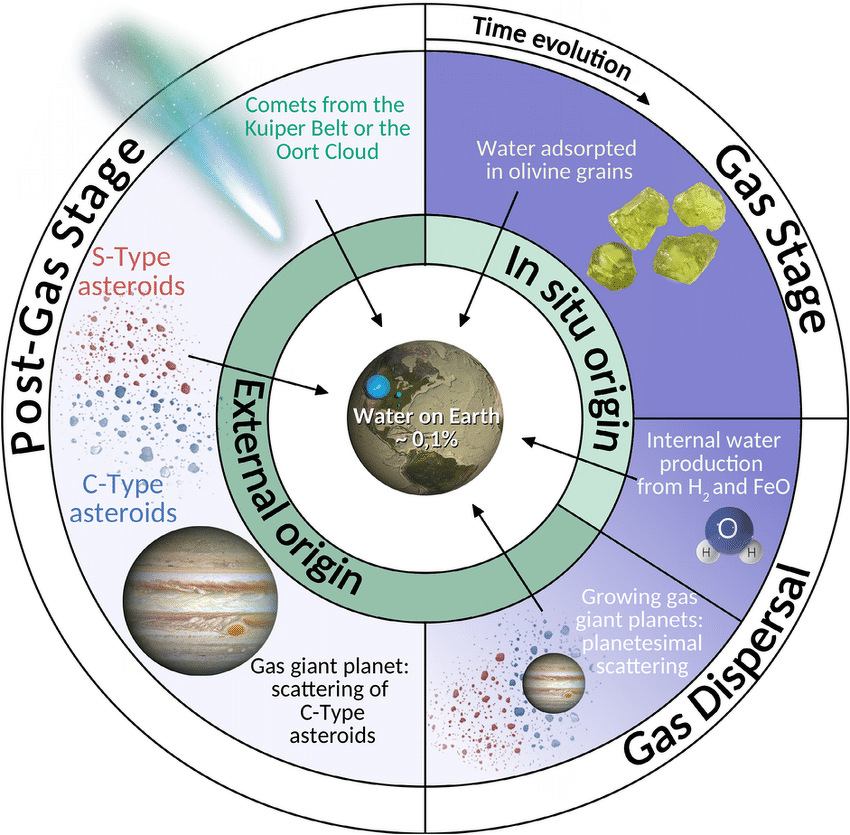
main processes that could contribute to the origin of water on Earth, illustration by Jack Cook (Woods Hole Oceanographic Institution) researchgate
In 2011, a European team reported that it had found a very cold reservoir of water vapor in space that could explain where the water came from. The region they discovered is at the outer reaches of a dusty disk surrounding a star 175 light-years away. The star and disk are in the early stages of forming planets, much as Earth was formed some 4.5 billion years ago. [Source:Marc Kaufman, Washington Post, October 20, 2011]
The scientists’ concluded, Marc Kaufman wrote in the Washington Post, that “life-giving H2O was almost certainly delivered to Earth via comets and asteroids known to originate in these cold but water-filled zones, which were assumed to also be present when our solar system was forming. “Our observations of this cold vapor indicates enough water exists in the disk to fill thousands of Earth oceans,” said astronomer Michiel Hogerheijde of Leiden Observatory in the Netherlands. Hogerheijde is the lead author of a paper describing these findings in the Oct. 21 issue of the journal Science.
Hogerheijde said the 10 million-year-old star his team examined, TW Hydrae, is the closest planet-forming star yet identified. Signs of the cold water vapor were detected by the Herschel Space Observatory, a European Space Agency satellite that looks for infrared light in the galaxy using the Heterodyne Instrument for the Far-Infrared, or HIFI. Efforts to find the cold water vapor in the past all failed because the instruments were not powerful enough to pick up the faint spectroscopic signals.
According to Hogerheijde, the cold water vapor detected is a small portion of the “ice reservoir” existing in the region. The ice crystals, which cover the widespread dust particles, form in conditions reaching 400 degrees below zero. But ultraviolet light from the star warms the ice enough to briefly release the vapor that was detected, Hogerheijde said.
The announcement comes weeks after a related finding that the water in some comets has the same chemical composition of Earth’s oceans. Previous detections had found water with a different isotopic make-up, suggesting that no more than 10 percent of the Earth’s water was delivered by comet. But data from the comet Hartley 2 found the ratio of heavy hydrogen (deuterium) to ordinary hydrogen to be almost exactly what it is in Earth’s oceans. “Now, in principle, all the water [in Earth’s oceans] could have come from comets,” said principal investigator Paul Hartogh of Germany’s Max Planck Institute.
Oceans Used to Be Green — and Could One Day Become Purple
The Earth ocean’s look blue when viewed from space or the window of an airplane. But according to an a study published in Nature in April 2025 by Japanese researchers the Earth’s early oceans may have been green, a result of ancient ocean chemistry and the emergence of early photosynthesis. [Source: Cédric M. John, The Conversation, Live Science, April 14, 2025]
A key clue comes from banded iron formations, deposited 3.8–1.8 billion years ago, when life consisted only of single-celled organisms in the sea and the continents were barren. Rain and hydrothermal vents supplied large amounts of iron to the oceans, which reacted with the first oxygen produced by early photosynthesizing microbes. Only after this iron was fully oxidized did oxygen begin accumulating in the atmosphere, triggering the Great Oxidation Event.
The new study draws on modern analogues: waters around the volcanic island of Iwo Jima appear green because of oxidized iron (Fe(III)), and blue-green algae thrive there. These bacteria contain both chlorophyll and a second pigment, phycoerythrobilin (PEB). Experiments show algae with PEB grow better under green light. Computer simulations indicate that early oxygen production could have created enough oxidized iron particles in surface waters to give Archean oceans a green tint. Once the iron was consumed, oxygen finally built up in the oceans and air. If so, pale-green oceans on distant planets might signal early photosynthetic life.
Ocean color likely shifted gradually over the 1.5-billion-year Archean eon, helping explain why early microbes evolved multiple light-harvesting pigments. The study also shows how closely ocean color follows chemistry and biology. Under different conditions, other hues are possible: purple oceans under sulfur-rich, low-oxygen environments dominated by purple sulfur bacteria; red oceans during intense weathering or blooms of red-pigmented algae. As the Sun brightens with age, coastal and stratified waters may turn purple, brown, or green before Earth’s oceans eventually evaporate.
Oceans Become Salty
In the beginning, the primeval seas were probably only slightly salty. But over time, as rain fell to the Earth and ran over the land, breaking up rocks and transporting their minerals to the ocean, the ocean has become saltier. Rain replenishes freshwater in rivers and streams, so they don’t taste salty. However, the water in the ocean collects all of the salt and minerals from all of the rivers that flow into it.
It is estimated that the rivers and streams flowing from the United States alone discharge 225 million tons of dissolved solids and 513 million tons of suspended sediment annually to the ocean. Throughout the world, rivers carry an estimated four billion tons of dissolved salts to the ocean annually. About the same tonnage of salt from ocean water probably is deposited as sediment on the ocean bottom and thus, yearly gains may offset yearly losses. In other words, the ocean today probably has a balanced salt input and output (and so the ocean is no longer getting saltier).
Not all bodies of water are salty like the ocean. Rivers and streams are replenished with freshwater from rain. Oceans, on the other hand, collect salt and minerals from every river that flows into them. According to NOAA, rivers carry approximately 4 billion tons of dissolved salts to the ocean each year. Of the world’s five ocean basins — the Pacific, Atlantic, Indian, Southern, and Arctic — the National Weather Service says the Atlantic has the highest salinity. This is because salinity decreases near the equator and at both poles.
The salinity of an ocean varies in different areas. Heavy rainfall in the tropics near the equator decreases salinity when fresh water falls into salty ocean water. According to the National Weather Service, the Red Sea has the saltiest ocean water, with a salinity level of about 40%, due to the region’s high evaporation rate.
Creation of the Pacific, Atlantic and Indian Oceans
The three major oceans (Pacific, Atlantic, and Indian) were not created simultaneously. The Pacific is the oldest, and the Atlantic and Indian oceans were formed later as the supercontinent Pangaea broke apart and tectonic plates shifted, a process that continues today. The first oceans formed on Earth approximately 4 billion years ago when the planet cooled enough for water vapor to condense into liquid water, which rained down to form a global ocean. [Source: Google AI]
The world's oceans as we know them today began to form with the breakup of the supercontinent Pangaea, which started around 200 million years ago.The Atlantic Ocean began to form as Pangaea rifted apart between North America and Africa in the Late Triassic and Early Jurassic periods. The South Atlantic opened later, when South America and Africa separated in the Early Cretaceous.
The Pacific Ocean is the remnants of the vast Panthalassic Ocean that surrounded Pangaea. As the continents moved, new oceans like the Indian Ocean formed in the gaps that opened up. The formation and shape of the oceans are still changing today due to ongoing plate tectonics.
Image Sources: Wikimedia Commons; YouTube, NOAA
Text Sources: National Oceanic and Atmospheric Administration (NOAA) noaa.gov; “Introduction to Physical Oceanography” by Robert Stewart , Texas A&M University, 2008 uv.es/hegigui/Kasper ; Wikipedia, National Geographic, Live Science, BBC, Smithsonian, New York Times, Washington Post, Los Angeles Times, The New Yorker, Reuters, Associated Press, Lonely Planet Guides and various books and other publications.
Last Updated November 2025