
Home | Category: Oceans and Sea Life
SURVIVING MONTHS ADRIFT IN THE PACIFIC
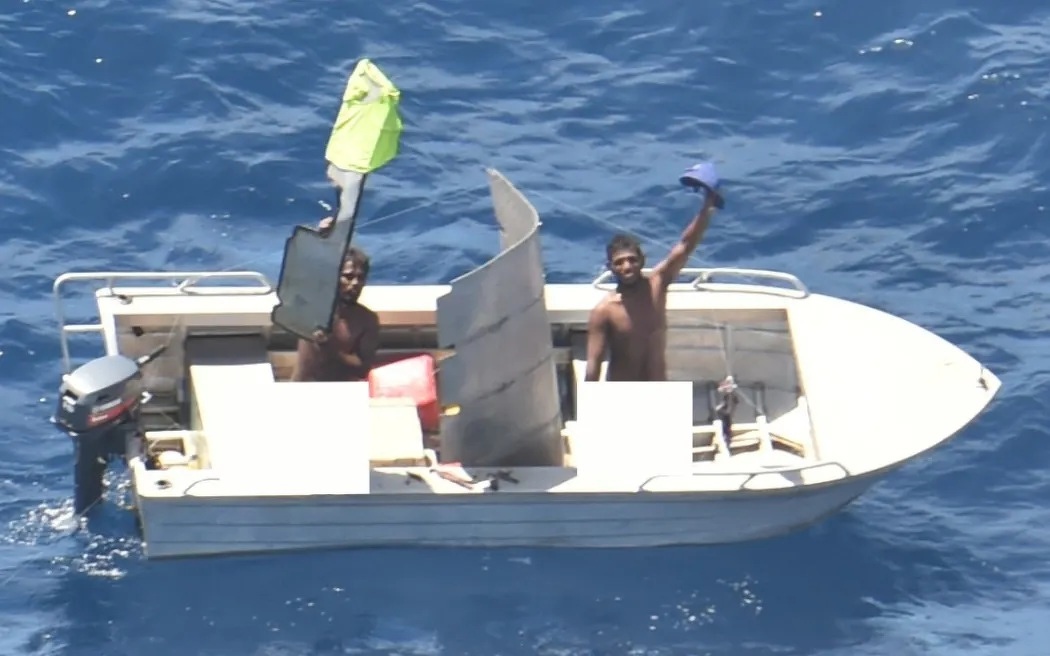
Two Kiribati fishermen rescued by New Zealand defence forces
In 2025, Peruvian fisherman Maximo Napa, 61, was rescued after drifting 94 days at sea in a small boat that had been pushed off course by bad weather and currents. Spotted by an Ecuadoran vessel off northern Peru, Napa told reporters he survived by eating cockroaches, birds, and a turtle, and stayed alive by thinking of his mother and newborn granddaughter. After being brought to shore, doctors reported he was shocked but in good physical condition, able to walk and care for himself. His daughter called the rescue a miracle, saying the family never gave up hope since his boat had no radio beacon and had drifted into the open ocean. [Source: AFP, March 16, 2025]
In 2023 Australian sailor Tim Shaddock survived two months adrift in the Pacific Ocean after a storm disabled the electronics on his catamaran during a voyage from Mexico to French Polynesia. Alone except for his dog, Bella, Shaddock lived on raw fish, rainwater, and shade from the sun while drifting thousands of miles from land. Shaddock, a retired IT worker who once overcame bowel cancer through fasting and a raw-food diet, said that experience may have helped him cope with the austere conditions at sea. [Source: Nick Squires, The Telegraph, July 17, 2023]
Shaddock was eventually spotted by a helicopter working with a tuna trawler — an event experts compared to finding a “needle in a haystack.” When rescued, the 51-year-old resembled Tom Hanks in Castaway but was in surprisingly good health. Survival experts credit a mix of luck, skill, careful rationing, and protection from heat. The companionship of his dog likely helped him maintain the mental resilience needed to endure isolation.
Related Articles:
SURVIVORS AT SEA: SELKIRK, ALONE IN A RAFT, 480 METERS UNDERWATER ioa.factsanddetails.com
LARGE WAVES: ROUGE WAVES, METEOTSUNAMIS AND THE BIGGEST WAVES EVER ioa.factsanddetails.com ;
OCEAN CURRENTS ioa.factsanddetails.com
RECOMMENDED BOOKS:
“438 Days: An Extraordinary True Story of Survival at Sea” by Jonathan Franklin Amazon.com
“Adrift: Seventy-Six Days Lost at Sea” by Steven Callahan Amazon.com
“José Salvador Alvarenga: 438 Days Lost at Sea — The Extraordinary True Story of Survival, Hope, and the Will to Live” by Brenda R. Thompson Amazon.com
“Life of Pi: A Novel” by Yann Martel Amazon.com
“Ditched: A Survivor's Story of a B-24 Lost at Sea during World War II”
by Mr. Curtis Grant Parker Amazon.com
“Robinson Crusoe” by Daniel Defoe Amazon.com
“Marooned: The Strange but True Adventures of Alexander Selkirk, the Real Robinson Crusoe” by Robert Kraske and Robert Andrew Parker (2005) Amazon.com
“The Unnatural History of the Sea” by Callum Roberts (Island Press (2009) Amazon.com
“Ocean: The World's Last Wilderness Revealed” by Robert Dinwiddie , Philip Eales, et al. (2008) Amazon.com
“Blue Hope: Exploring and Caring for Earth's Magnificent Ocean” by Sylvia Earle (2014) Amazon.com
“National Geographic Ocean: A Global Odyssey” by Sylvia Earle (2021) Amazon.com
Two Men Survive Five Months Adrift in the Pacific
In 2001, two Samoan fishermen survived almost five months adrift on the Pacific Ocean in a small metal boat by catching fish and birds and drinking rainwater, one of the survivors said after being rescued. Associated Press reported: Two other men died during the torrid journey, which saw them drift nearly 2,480 miles west from Western Samoa to Papua New Guinea. Lafaili Tofi, 36, and Telea Pa'a, 27, were extremely lucky to be alive, said Dr. Barry Kirby from Alotau Hospital in eastern Papua New Guinea. "Basically they survived on the rainwater they got while they were drifting, some small fish which they caught and also some birds which landed on the . . . vessel," Kirby said in a telephone interview. [Source: Associated Press, November 14, 2001]
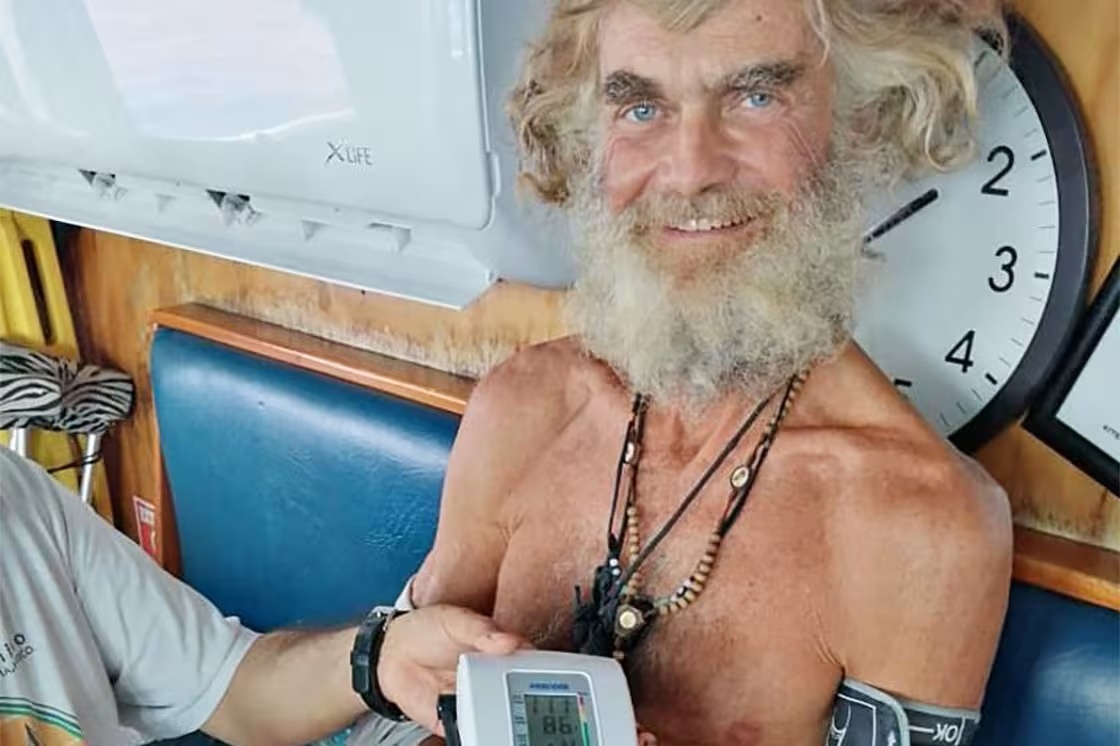
Tom Shaddock after his rescue
The men were fishing off their native Western Samoa on June 20, 2001 when a huge load of fish dragged their 20-foot aluminum boat under water. The men righted the well-built boat by cutting away the fishing lines and two outboard motors but were left powerless as currents pushed them out into open ocean, missing many islands on the journey, Kirby said. Several ships passed by, but none came to their rescue.
The survivors were finally rescued in November by a villager on Normanby Island in Milne Bay, Papua New Guinea, who paddled out to them after they fired off their last flare. "They suffered from exposure and were basically on a starvation diet," he said. "One man is unable to walk, he's a stretcher case. He's very, very wasted and he was probably about a week away from death. The other man was quite strong considering his ordeal." Kirby said both men were stable and recovering well.
Two Others Rescued after Floating in Pacific Ocean for Five Months
In 2014 two Papua New Guinea men drifted in an open boat in the Pacific Ocean for five months before they were rescued in Micronesia in December, over 1,600 kilometers (1000 miles) from where they set after setting out in early July. Both men were badly sunburned and suffering from hunger. A third man in the boat died just two weeks before the rescue. [Source: Richard Shears, Daily Mail, December 5, 2014]
The Daily Mail reported: The Papua New Guinea fishermen told officials in the town of Pohnpei in the Caroline Islands that they had survived by eating raw fish and drinking rainwater. Their ordeal finally ended when they were picked up by a fishing boat called Yap Seagull, about 120 miles south of remote Kapingamarangi Island. Badly sunburned and suffering from hunger, they were described by hospital officials as being in 'reasonable' condition considering the many weeks they had spent drifting across the ocean.
“Officials named the rescued men as Michael Bolong, 54, and Ambros Wavut, 28. A third man who had been on the tiny open boat had died, said the men. They claim that the man, Francis Dimansol, 48, died from 'severe health conditions' while they were adrift in the Pacific. No details have emerged about what happened to his body, but it is known that in similar dramas on the high seas survivors have lowered those who have succumbed to the elements over the side of the boat as their bodies started to decompose.
“It was also emerged that Mr Bolong is the uncle of Mr Wavut — and their survival story was made even more remarkable because they were not fishermen but construction workers who were sailing from one small island to another. But somehow they managed to catch fish and eat them raw, while scooping up rainwater that had gathered in the bottom of their boat. ‘We were convinced that everyone had given up looking for us,’ Mr Bolong told the crew of the Yap Seagull fishing boat which picked them up. ‘We know from other instances of boats being lost that after a while searchers give up, convinced that no-one can survive after many weeks in an open boat,’ he said in broken English. ‘We managed to sit out storms without being overturned, but that might also have led to people thinking we had no chance of surviving. There is no doubt that after weeks, which turned into months, we were forgotten, except by our families.’
Mr Bill Janes, editor of the Kaselehlie Press in Pohnpei said that when he saw the men step ashore from the Yap Seagull he noticed how thin they were, but thought that they were otherwise in 'great shape'. What might have helped their recovery, he noted, was the fact that they had been on the Yap fishing boat for four days after being picked up and brought into port.
While the rescued men have still to tell their story in detail, it is believed they drifted helplessly for at least 1000 miles after setting out on a fishing trip in early July from their village in the province of New Ireland, which comes under Papua New Guinea administration. All was going well until the engine on their boat broke down and they became victims of the ocean currents. 'They saw passing ships but could not get the message across that they were in trouble,' said an official on Pohnpei.
According to a report from the Federated States of Micronesia government information service on the island of Yap, the men's boat had been carried out to sea by a strong current. The report said they had managed to survive a number of severe storms.
José Salvador Alvarenga — Lost at Sea for 14 Months
In 2012-2014, 36-37-year-old El Salvadorian fisherman Jose Alvarenga drifted across the Pacific for 14 months before his boat was washed ashore in the Marshall Islands, He disappeared on November 17, 2012 off the coast of Costa Azul, Pijijiapan, Chiapas, Mexico, and was found on January 30, 2014, on the Ebon Atoll on the Marshall Islands. He was accompanied by another man, Ezequiel Córdoba, who died during the voyage, [Source: Wikipedia]
Alvarenga's story was widely reported in the international media. There was a lot of criticism from skeptics but his story held up and now he is recognized as the first person in recorded history to have survived in a small boat lost at sea for more than a year. Alvarenga survived mainly on a diet of raw fish, turtles, small birds, sharks and rainwater. He swam to shore at Tile Islet, a small island that is part of Ebon Atoll, on January 30. Two locals, Emi Libo kilometerseto and Russel Laikidrik, found him naked, clutching a knife and shouting in Spanish. He was treated in a hospital in Majuro before flying to his family home in El Salvador on February 10.
Alvarenga was born in Garita Palmera, Ahuachapán, El Salvador. He left El Salvador in 2002 for Mexico, where he worked as a fisherman for four years. At the time of his rescue, he had not been in touch with his family in eight years. On November 17, 2012, Alvarenga set out from the coast of Chiapas, Mexico. An experienced sailor and fisherman, he planned to deep-sea fish for sharks, marlins, and sailfish for 30 hours. His usual fishing mate was unable to join him, so he was accompanied by the relatively inexperienced 23-year-old Ezequiel Córdoba, with whom he hadn't previously spoken, and whose surname he didn't know.
Shortly after embarking, their boat, a seven-meter (23-foot) topless fiberglass skiff equipped with a single outboard motor and a refrigerator-sized icebox for storing fish, was blown off course by a storm that lasted five days, during which the motor and most of the portable electronics were damaged. Though they had caught nearly 500 kilograms (1,100 lb) of fresh fish, the pair were forced to dump it overboard to make the boat maneuverable in the bad weather. Alvarenga managed to call his boss on a two-way radio and request help before the radio's battery died. Having neither sails nor oars, no anchor, no running lights, and no other way to contact shore, the boat began to drift across the open ocean. Much of the fishing gear was also lost or damaged in the storm, leaving them with only a handful of basic supplies and little food.
The search party organized by Alvarenga's employer failed to find any trace of the missing men and gave up after two days because visibility was poor. As days turned to weeks, they learned to scavenge their food from whatever sources presented themselves. Alvarenga managed to catch fish, turtles, jellyfish, and seabirds with his bare hands, and the pair occasionally salvaged bits of food and plastic refuse floating in the water. They collected drinking water from rainfall when possible, but more frequently were forced to drink turtle blood or their own urine. Alvarenga frequently dreamed about his favorite foods, as well as his parents.
According to Alvarenga, Córdoba lost all hope around four months into the voyage after becoming sick from the raw food, and eventually died from starvation by refusing to eat. Alvarenga has said that he contemplated suicide for four days after Córdoba died, but his Christian faith prevented him from doing so. He related that Córdoba made him promise not to eat his corpse after he died, so he kept it on the boat. He sometimes spoke to the corpse, and after six days, feared he was becoming insane, so he threw it overboard.
Alvarenga reported that he saw numerous transoceanic container ships but was unable to solicit help. He kept track of time by counting the phases of the moon. After counting his 15th lunar cycle, he spotted land: a tiny, desolate islet, which turned out to be a remote corner of the Marshall Islands. On January 30, 2014, he abandoned his boat and swam to shore, where he stumbled upon a beach house owned by a local couple. Alvarenga's journey had lasted 438 days.
The length of his voyage has been variously calculated as 5,500 to 6,700 miles (8,900 to 10,800 kilometers). According to Gee Bing, Marshall Islands' acting secretary of foreign affairs, Alvarenga's vital signs were all "good", with the exception of blood pressure, which was unusually low. Bing also said that Alvarenga had swollen ankles and struggled with walking. On February 6 the doctor treating him reported that his health had "gone downhill" since the day before and that he was on an IV drip to treat his dehydration.
After 11 days in a hospital, Alvarenga was deemed healthy enough to return to El Salvador. However, he was diagnosed with anemia, had trouble sleeping and developed a fear of water. Alvarenga's parents, who had not been in contact with him for years, had feared he was dead long before he went missing, and they were overjoyed to discover he was still alive. His father said that he had prayed for his son while he was missing. His daughter, upon hearing that her father had been found, said that after he returned home, the "first thing I'll do is hug him and kiss him." In 2015, Alvarenga gave a series of interviews about his ordeal to the journalist Jonathan Franklin, who published his story as the book “438 Days: An Extraordinary True Story of Survival at Sea”. Shortly after the release of Alvarenga's book, the family of Ezequiel Córdoba sued Alvarenga for $1,000,000, accusing him of cannibalizing their relative in order to survive, despite their pact that Córdoba would not be eaten after death. Alvarenga's lawyer has denied this accusation.
Corroborating José Salvador Alvarenga’s Story
The implausibility of someone surviving so long at sea on a small craft led a number of commentators to doubt Alvarenga's story, though investigators were able to confirm some of the basic details. The owner of the boat he used, César Castillo, said that "it's incredible to survive that long. It's hard to think how anybody could go more than six or seven months without getting scurvy at least." However, in an interview, Claude Piantadosi of Duke University said that fresh meat from birds and turtles contains vitamin C and that eating a lot of it, as Alvarenga claims to have done, "would provide sufficient vitamin C to prevent scurvy." [Source: Wikipedia]
The Guardian found the Chiapas rescue services official, Jaime Marroquín, who was informed that a fishing boat had gone missing in the area on November 17, 2012. The official report identified the two fishermen as Cirilo Vargas and Ezequiel Córdova, and stated that both were in their 30s. Marroquín also indicated that according to the boat's owner, Vargas was born in El Salvador. The local authorities originally searched for Vargas and Córdova, but called off the search after two days, citing heavy fog and bad weather. In regard to the discrepancy between the names of the fishermen in the 2012 report and those of Alvarenga and Córdoba, CBS News reported that "records in Mexico are often filed with such mistakes". Another explanation was provided by Alvarenga's parents, as reported by National Post, when they confirmed that in Mexico their son was known as "Cirilo".
Tom Armbruster, the United States ambassador to the Marshall Islands, acknowledged that it seems implausible for someone to survive at sea for 13 months, but that "it's also hard to imagine how someone might arrive on Ebon out of the blue. Certainly this guy has had an ordeal, and has been at sea for some time." Norman Barth, also of the American Embassy in the Marshall Islands, did the initial questioning of Alvarenga upon his arrival in Majuro and found him to be truthful. The Guardian's Jo Tuckman argued that the fact that a fishing boat had been reported missing on November 17, 2012 "lin[es] up" with Alvarenga's claim that he went to sea the following month and that this supports the view that "at least some of his story holds up". In addition, Erik van Sebille, an oceanographer at the University of New South Wales, said that it was entirely possible that sea currents could carry a boat from Mexico to the Marshall Islands. He also estimated that such a trip would take about 18 months, but said that 13 months was still plausible. Further support for his account came from a study by researchers from the University of Hawaii that modeled the path a boat might have taken after departing from the Pacific Coast in Mexico based on wind and current conditions, and concluded that it would end up "within 120 miles of Ebon", where Alvarenga actually landed. In April 2014, Alvarenga's lawyer told a press conference that he had passed a polygraph test while being asked about his voyage.
Three Mexican Fishermen Lost at Sea for Nine Months
In 2005-2006, three Mexican fishermen — Lucio Rendón, Jesús Vidaña, and Salvador Ordóñez — survived nine months adrift in the Pacific Ocean in a 27-foot skiff that set sail from the Mexican port of San Blas.in October 2005 and drifted 8,000 (5,000 miles) across the central Pacific halfway between North America and Australia before being rescued by a tuna vessel north of Baker Island, an atoll just north of the Equator in the about 3,090 kilometers southwest of Honolulu. [Source: Hector Tobar, Los Angeles Times, August 26, 2006]
Hector Tobar wrote in the Los Angeles Times: Family members say the three are typical fishermen from a stretch of coast dotted with hardscrabble fishing hamlets. When they left San Blas with two other men on Oct. 28, they didn’t notify port authorities, or even many members of their family — not an unusual practice in an area where many fish illegally. Local authorities say the federal government has declined to issue licenses to most of the small-time fishermen in the San Blas area, citing the threat of overfishing. “That’s why no one tells the port authorities when they set out, because they could be prevented from leaving, or they could even go to jail for being pirate fishermen,” David Lara Plasencia, a municipal official in San Blas, told the newspaper El Universal this week.
“The survivors have said in interviews that they set off in search of shark, but have not said whether they were licensed. Their first night out, they lost a fishing line. While they tried to find it the next morning, their onboard engines ran out of gas. They began to drift. One of the men, known to the others only by the nickname “El Farsero,” died in January. Fifteen days later, a second man, known to the others as “Juan,” died. The men either wouldn’t eat or couldn’t hold down the raw fish the others were eating to survive.
“In a television interview Ordonez, 37, said that after months adrift the men had no idea where they were. “One day I saw a plane pass and I said, ‘Where is that plane coming from?’ ” Ordonez recalled. “ ‘I think it’s coming from China. And that’s where we’re headed.’ ” The men read a Bible they had on board. When a storm ripped out the Apocalypse chapters, they said, they took it as a good sign. They collected rainwater to drink. Ordonez remembered advice from a government-sponsored survival course: Eat as little as possible and drink fish blood to stay hydrated. (Officials in San Blas confirmed that Ordonez completed the course in 2004.)
Back ashore, some relatives had already recited a series of Catholic prayers for the dead. Upon hearing of his presumed death, Ordonez’s 15-year-old daughter, Gladiola, gave up her dream of being a teacher, dropped out of school and set out for the United States, the newspaper La Cronica de Hoy reported. “My father is dead,” Gladiola told her brother Angel. “What will I do here? I don’t even have money for a notebook.” Gladiola crossed the border illegally and reportedly is working in a Los Angeles factory, the newspaper reported.
The three drifters were asleep when they were spotted August 9. The Taiwanese crew of the Koo’s 102, based in the Marshall Islands, found the men. For 12 days, until the boat pulled into port, the skinny and sunburned survivors recuperated, sharing meals of rice and noodles with the crew. On the Marshall Islands, a doctor found the men were suffering from various minor ailments, including swollen limbs and ear infections. But otherwise, they were healthy.
For a long article on this read “The Castaways: A Pacific Odyssey” by Mark Singer in The New Yorker, February 11, 2007 newyorker.com
How Two Mexican Fishermen Died
Mark Singer wrote in The New Yorker: Most fishermen routinely eat raw seafood without giving it a thought. Señor Juan simply couldn’t. Starting in mid-December, he vomited blood and bile several times. (These symptoms are common with severe digestive disturbances.) Meanwhile, Lucio had developed an ear infection that left him weak and unable to keep his balance. Bleeding from both ears, he stuffed them with cotton ticking from the lining of a jacket. Wrapped in blankets, both men huddled under the bow, turning it into a sick bay. After eight days, Lucio began to get better, but Señor Juan did not. [Source: Mark Singer, The New Yorker, February 11, 2007]
Once the unforeseen odyssey began, El Farsero spent much of every day crouched in a corner, weeping. “We wanted to talk to him, and he wouldn’t talk,” Jesús said. “We wanted him to move, and he wouldn’t move.” Salvador and Lucio never cried, but Jesús often did, usually at night. Thinking of his family back in Las Arenitas — Jumey, his wife, and Juan José, their son — invariably induced longing and remorse.
One December day when Salvador, Lucio, and Jesús were urging the captain to eat, Señor Juan stood in the front of the boat, flexed his biceps, and declared, “I’m strong!” At that point he’d gone six weeks without food. “He was very fat, and he thought he was full of life,” Lucio recalled. Within days, Señor Juan began bleeding internally. By mid-January, he had lapsed into a semi-consciousness punctuated by bursts of delirium. The others did what they could — rinsed his mouth, brushed his teeth, washed his face and hands — but knew that they weren’t much help. He’d become incontinent. One night, when Salvador was fishing and the others were sleeping, Señor Juan started groaning and called Sal-vador’s name. Salvador went to his side and said, “What’s wrong, Juanito, brother?” But Señor Juan was already dead, his eyes still open. It was January 20th, almost three months since he’d left Mazatlán for San Blas. The fishermen cleaned Señor Juan’s body and kept it in the boat for three days, in case they were rescued and could arrange a proper burial. Before finally placing the body in the sea, Salvador, who read from his Bible and prayed every morning and evening, gave a final benediction.
With Señor Juan gone, El Farsero confronted an awkward social dilemma. “At the beginning, because El Farsero was friends with the captain, he thought he was better than the rest of us,” Lucio observed. “It was like, if you’ll ignore me, I’ll ignore you. But after the captain died who else was he going to talk to?” When the fishermen shared their visions of what they would do if they ever made it back to the inhabited world, El Farsero spoke of helping his sister establish a bakery. He also began helping the others catch fish.
On the coldest nights, they all slept in the bow side by side, in the fetal position, an intimate arrangement that would have made them self-conscious on land. It was crowded, but they succeeded in staying warm. Then it became less crowded: one morning in February, El Farsero didn’t wake up.
Lucio: “He died at my side, asleep. We all lay down, and when the sun rose he had already died. That’s the prettiest death, I think. To go to bed and die in your dream.”
How the Three Mexican Fishermen Survived
Mark Singer wrote in The New Yorker:Lucio wore a Casio digital watch with a calendar, and it preserved some demarcation of time’s otherwise blurred contours. Occasionally, planes passed overhead, prompting discussions about whether anyone in San Blas had realized that they were lost and instigated a search. (In fact, family members of Lucio’s had started looking for him and the others, and fishermen in the community undertook an eight-day search after the Port Authority of San Blas failed to act. The search was called off when they could no longer afford the fuel.) For ten days, Lucio heard Salvador and Jesús repeat that they would soon be rescued. As he no longer believed this himself, their hollow reassurances irritated him, and he told them so. Yet he never accused Señor Juan of being the agent of their distress; even if they were lost at sea, Señor Juan was still the ship’s captain. [Source: Mark Singer, The New Yorker, February 11, 2007]
When they had consumed no food, only water, for thirteen days, a sea turtle weighing about thirty pounds showed up, swimming just off the bow. Salvador jumped on its back and gripped its shell, which he’d learned to do in Oaxaca in his teens. The turtle suddenly dove deep, and he went along for the ride, wrestling until he had turned it toward the surface. Lucio and Jesús helped him hoist the turtle into the panga. They severed a flipper; Salvador sucked its blood and passed it around. Lucio took the knife, cut off the head, and drained a dense stream of blood into a bucket for drinking. After he had removed the meat from the shell, Jesús rinsed it, and Salvador filleted it.
Lucio: “I remember we said, ‘How are we going to eat that meat?’ It’s not like a normal meal. All you can see is the meat. Pure red. I was thinking, How is it possible that I’m going to eat that? In November, we ate only two times. I’d never been hungry like that, with a desperateness that can’t be expressed. I don’t know how to explain that this is something that one feels. It’s desperateness, hunger, thirst, cold.” Did he want to die? “No, that was not a thought that passed through my head. Even though I knew I was headed that way.”
Their other November meal presented itself a few days later, when a white seabird — most likely a tern, which can fly for long distances over the ocean — alighted on a corner of the boat. Salvador slowly removed his shirt, crept toward the rear, netted the bird, grabbed its feet, and dashed it against the inside of the boat. He decapitated it, drank some blood (“because I felt it gave me energy”), offered it to his companions, then plucked and quartered it: seabird sashimi. Lucio and Jesús ate their portions, but Señor Juan and El Farsero could only gag. The same thing had happened when they’d tried the raw turtle.
Schools of small fish often surrounded the boat, attracted by the barnacles that studded its hull. The flesh inside a barnacle shell was potential bait, but most of the hooks and hand lines had either been lost or damaged. With the cowlings removed, the men scrutinized the innards of the outboard engines. The carburetors had thin rods that could be sharpened and bent into hooks. There were screws with wires wrapped around the threads, and those wires could also become hooks. Each motor had six in-sulated cables about three feet long which, spliced together, made lines. A hook baited with a barnacle could catch a small fish, and that fish, cut up, could become bait for bigger fish. With this approach, they caught dogfish, sharks, sawfish, and dorado. Though the men didn’t realize it, this diet probably protected them from developing scurvy — uncooked seafood has a small amount of Vitamin C.
Fishermen Lost at Sea Badgered by the Mexican Media
Reporting from Mexico City, Hector Tobar wrote in the Los Angeles Times: When three fishermen returned home after a miraculous ordeal at sea, the questions from this city’s boisterous press corps didn’t focus on the Hemingway-like details of their nine months adrift...Instead the 100 or so journalists who greeted the survivors at Mexico City’s international airport, who are more used to reporting crime and scandal than heroism, grilled the three men at an often chaotic news conference that ended in a melee between producers and cameramen from rival television networks. [Source: Hector Tobar, Los Angeles Times, August 26, 2006]
“Is it true that you guys are really drug dealers on a failed smuggling mission, the reporters asked. What happened to the two other men who you say were on board with you? Did you eat them? If you were at sea for nine months, why aren’t your fingernails longer? “To those who don’t believe us, all I can say is that I hope that what happened to us never happens to you,” Lucio Rendon, 27, said after denying that he and his comrades were either “narcos” or cannibals. “I just thank God for being here.”
“Like many of the tragedies that befall the poor in Mexico, the full story of the three lost fishermen has turned out to be a complicated and hazy affair. The saga of Rendon, Salvador Ordonez and Jesus Vidana involves illegal immigration, suspicions of unlicensed fishing, petty theft and two “ghosts.” Mexico’s attorney general said this week there was no evidence that the men were drug smugglers — though smuggling is common along the stretch of coastline where they set out.
As the men began the long journey home via Honolulu and Los Angeles, the news media went to work investigating their past. Rendon, it turned out, was on probation on charges of stealing shrimp from a fishing company. A mortgage company was about to foreclose on the family home of Vidana, 27. Vidana’s wife had given birth to their baby, a girl — Juliana is now 4 months old. And while talking with Ordonez in a phone call broadcast live by the Televisa network, his family in Oaxaca learned that he had moved in with a woman in San Blas. But little has emerged about the two men said to have died at sea. “Up to now they are only ghosts,” the newspaper El Universal wrote Tuesday. “No one knows their full names or where they’re from. It’s as if they never existed.”
At the airport news conference, a radio reporter asked the three men whether they would take lie detector tests to prove that their story was true. Yes, the fishermen answered. After the news conference, producers from the rival Televisa and Azteca television networks engaged in a shoving match over who would get the first “exclusive” interview with the three men: Televisa ended up with two of the survivors, Azteca with one.
Image Sources: Wikimedia Commons; YouTube, NOAA
Text Sources: National Oceanic and Atmospheric Administration (NOAA) noaa.gov; “Introduction to Physical Oceanography” by Robert Stewart , Texas A&M University, 2008 uv.es/hegigui/Kasper ; Wikipedia, National Geographic, Live Science, BBC, Smithsonian, New York Times, Washington Post, Los Angeles Times, The New Yorker, Reuters, Associated Press, Lonely Planet Guides and various books and other publications.
Last Updated November 2025