
Home | Category: Ocean Fish
OPAH
Opah
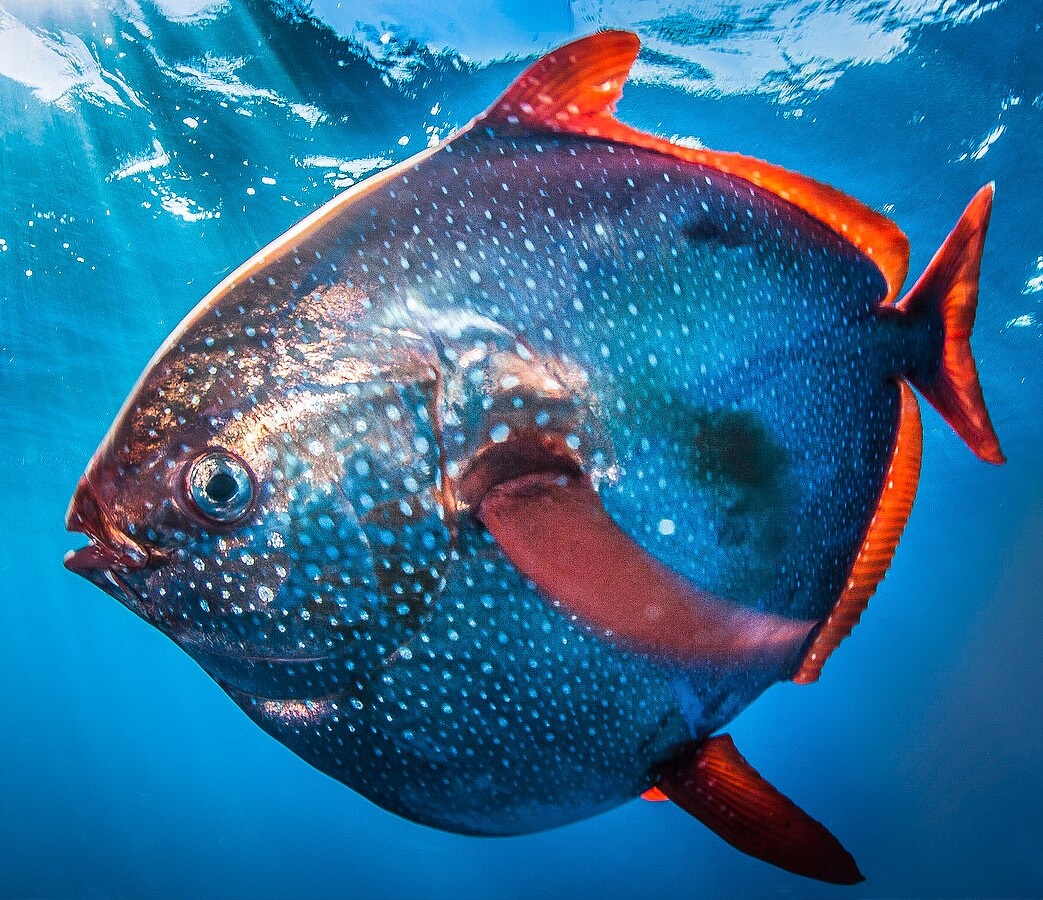
The opah ( Scientific name: Lampris guttatus, Lampris spp.) is one of the most colorful of the commercial fish species, and is particularly popular in Hawaii. It is overall red with white spots and turns a silvery-grey when it dies. Its fins are crimson, and its large eyes are with gold. The fish’s large, round profile is thought to be the origin of its “moonfish” nickname. These combined characteristics certainly make this “warm-blooded fish” unique among the many wondrous creatures of the ocean.
Opah are an unusual looking fish. They have a round, flat body that’s silvery gray in color. Toward the belly, the silver shades to a rose red, dotted with white spots. Their fins and mouth are red, and their large eyes are encircled with gold. [Source: NOAA]
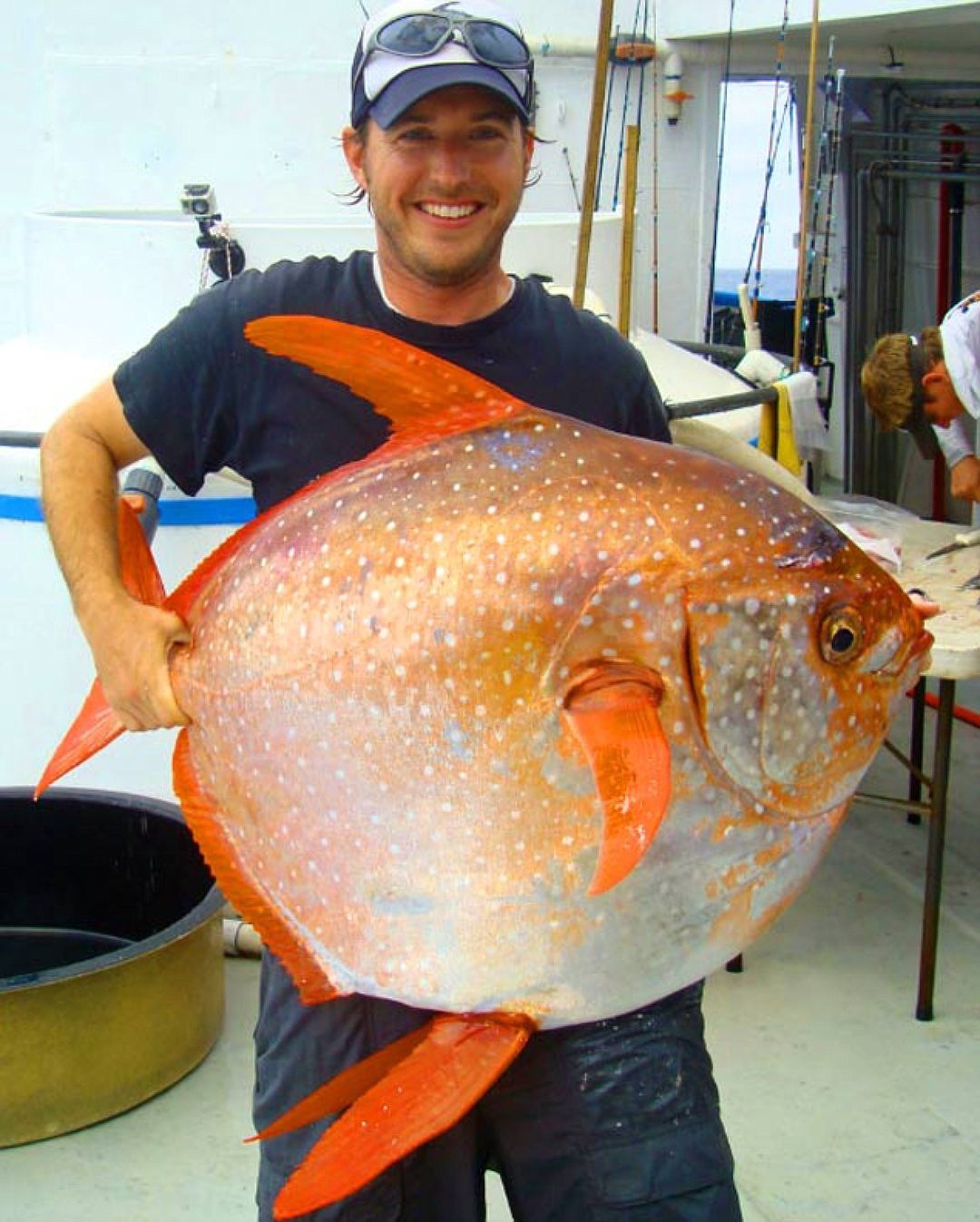
Because opah are not a major commercial seafood species and they live in the deep ocean, scientists know very little about their biology and ecology. Scientists assume opah share general characteristics with other Pacific Ocean pelagic fish. Scientists estimate that opah grow quickly. Although they’re not sure of opah’s exact life span, scientists age opah by their fin rays, assuming fin ray marks are formed annually. Most opah caught in longline fisheries are estimated to be between 1 and 6 years old. They average about 45 kilograms (100 pounds) with a diameter of one meter (3 feet). It
Opah spawn in warm surface waters throughout the year in the tropics and more seasonally in cooler waters. They seem to be very productive, potentially spawning many times throughout the spawning season. Opah are capable of traveling long distances, often in response to changing oceanic conditions such as temperature..
Opah Warmbloodedness
Abigail Tucker wrote in Smithsonian magazine: “Scientists have long known that some fish, including select species of billfish, shark and tuna, are partially warmblooded. In 1835, British physician John Davy noted that a tuna’s blood temperature was “much the same, or little less than the blood of a pig.” That was a bit of an overstatement. Most partially warmblooded fish stay just a few degrees above the surrounding water temperature. But that’s enough to give them a predatory edge, relative to their “thermoconformist” peers. [Source: Abigail Tucker, Smithsonian magazine, September 2015]
“Warmer fish can expand their range, in latitude and depth, and cruise faster because of increased red muscle output, benefits brought to an extreme in birds and mammals, whose stable body temperatures might have led to the development of complex central nervous systems. While mammals make meta-bolic heat even at rest, fish mostly keep warm through active movement. Thus the opah’s juiced-up pecs.
opah range
Not all fish are cold-blooded. In 2015, researchers with the NOAA Southwest Fisheries Science Center revealed the opah, or moonfish, as the first fully warm-blooded fish. Although not as warm as mammals and birds, the opah circulates heated blood throughout its body, giving it a competitive advantage in the cold ocean depths from 47 to 400 meters (150 to 1,300 feet) below the surface. [Source: NOAA]
Its body temperature isn’t the only thing that makes this fish stand out from the rest in its environment. Most fish living in the dark and chilly depths rely on ambush to catch their prey, but the agile opah is fast and efficient, flapping its bright red pectoral fins to race through the water. The constant flapping of its fins heats the opah’s body, speeding its metabolism, movement, and reaction times.
Abigail Tucker wrote in Smithsonian magazine:“The rotund, silvery opah looks less like a deep-sea predator than a Mylar balloon, with curved pectoral fins that flap like wings. Its chest muscles account for almost a fifth of its body mass and, cleverly marinated, can pass for beef. “The coolest part — well, not cool in terms of temperature, but the neatest part — is that the opah has a warm heart,” says Kenneth Goldman, an Alaska shark biologist. [Source: Abigail Tucker, Smithsonian magazine, September 2015]
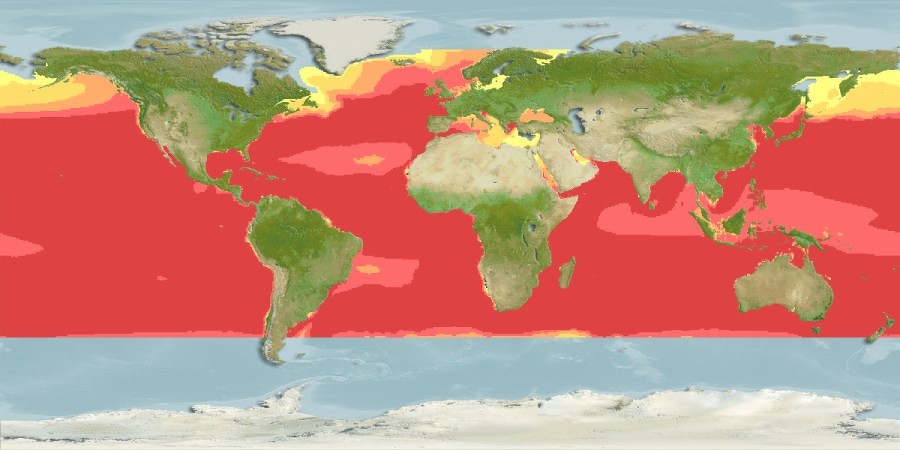
Opah are found in tropical and temperate waters around the world. Also known as moonfish, they live in deep open ocean waters but sometimes swims up near the surface of ocean water where sunlight penetrates. In the U.S. they can be found off New England and Mid-Atlantic, Hawaii, other Pacific Islands, the Southeast and the West Coast.
The opah is a valuable species for commercial and recreational fishermen. However, researchers do not have a full understanding of the basic biology and ecology of this species. NOAA's Southwest Fisheries Science Center began collecting biological samples from opah in 2009 and initiated an electronic tagging program in 2011. Scientists hope to continue tagging opah to learn about their movements and range. This research will provide the basic life history information necessary for future population assessments and management. NOAA Fisheries is also working with the seafood industry to help reduce waste during the processing of opah.
Opah Characteristics
About the same size as a large automobile tire, the opah is equipped with specialized blood vessels that carry warm blood to its gills to rewarm the blood that cools as the fish breathes and absorbs oxygen from the water. These heat-exchanging blood vessels minimize the loss of body heat to the opah’s cold environment, ensuring a warm core body temperature, increasing muscle output and swimming capacity, and boosting eye and brain function. The opah is also able to stay in deep water longer without risking reduced function to its heart and other organs because the fatty tissue surrounding its gills, heart, and muscle tissue acts as insulation against icy waters.
“Partial warmbloodedness has evolved several times in fish, and yet it’s rare, found in less than 0.1 percent of fish species. It’s tough to retain warmth in water, which is far denser than air and sucks body heat, particularly where it meets blood for oxygen exchange. (One critique of the movie Waterworld is that a gilled Kevin Costner would have died of hypothermia.) Specialized blood vessel systems called retia mirabilia — “wonderful nets” — work like radiators to heat isolated organs. Some stomachs are warm for better digestion. And the opah is known to have warm eyes. But typically only a few organs benefit.
“Not so in the opah. Nicholas Wegner, who has been tagging live opah and dissecting dead ones with his NMFS team, found the retia mirabilia embedded right in the opah’s gill arches, meaning that heat circulates throughout the whole body. When a colleague, Owyn Snodgrass, checked core opah temperatures in living fish, they were uniformly warm. Yet warmth does not equal invincibility. Sometimes a tagged opah’s light sensor will go dark and its heat sensor will mysteriously warm, suggesting that a study animal has ended up inside the warm belly of a cold-hearted shark.
Opah Fishing
In 2021, the commercial landings in the U.S. of opah in Hawaii totaled 210,000 kilograms (460,000 pounds) and were valued at $1.8 million, according to the NOAA Fisheries commercial fishing landings database. While there is no directed fishery for opah, they are harvested in small but significant quantities. U.S. fishermen catch them incidentally in tuna and swordfish fisheries around the U.S. Pacific Islands and off southern California. In Hawaii, opah are caught using longlines set deep below the surface to target bigeye tuna. Off California, they're taken incidentally in the California drift gillnet fishery targeting swordfish. Although not commonly caught, opah are prized by deepwater recreational anglers for their unique colors and light flavor. [Source: NOAA]
U.S. wild-caught opah is a smart seafood choice because it is sustainably managed and responsibly harvested under U.S. regulations. The population level is unknown but presumed stable. The fishing rate is at recommended level. Fishing gear used to catch opah rarely contacts the ocean floor so habitat impacts are minimal. There is no directed fishery. Regulations are in place to minimize bycatch in the tuna and swordfish fisheries, which incidentally catch opah. Population Status: Opah has never been assessed, but there is no evidence that populations are in decline or that fishing rates are too high.
NOAA Fisheries and the Western Pacific Fishery Management Council manage this fishery in the Pacific Islands. The species are managed under the Fishery Ecosystem Plan for the Pelagic Fisheries of the Western Pacific: No management measures specifically apply to opah. However, general management measures apply to the fisheries that harvest opah. Fishermen are required to have permits and record their catch. Gear restrictions and operational requirements to minimize bycatch and potential gear conflicts among different fisheries. A limit on the number of permits for Hawaii and American Samoa longline fisheries controls participation in the fishery.
Longline fishing is prohibited in some areas to protect endangered Hawaiian monk seals, reduce conflicts between fishermen, and prevent localized stock depletion (when a large quantity of fish are removed from an area). These zones are enforced through the NOAA Fisheries vessel monitoring system program (longline boats must be equipped with a satellite transponder that provides real-time position updates and tracks vessel movements). Hawaii- and American Samoa–based longline vessels must carry onboard observers when requested by NOAA Fisheries, in part to record interactions with sea turtles, seabirds, and marine mammals.Annual training in safe handling and release techniques for protected species is required, and all vessels must carry and use specific equipment for handling and releasing these animals.
Image Sources: Wikimedia Commons; YouTube, Animal Diversity Web, NOAA
Text Sources: Animal Diversity Web (ADW) animaldiversity.org; National Oceanic and Atmospheric Administration (NOAA) noaa.gov; Wikipedia, National Geographic, Live Science, BBC, Smithsonian, New York Times, Washington Post, Los Angeles Times, The New Yorker, Reuters, Associated Press, Lonely Planet Guides and various books and other publications.
Last Updated November 2025